Blog Archives
Mortal Revenge
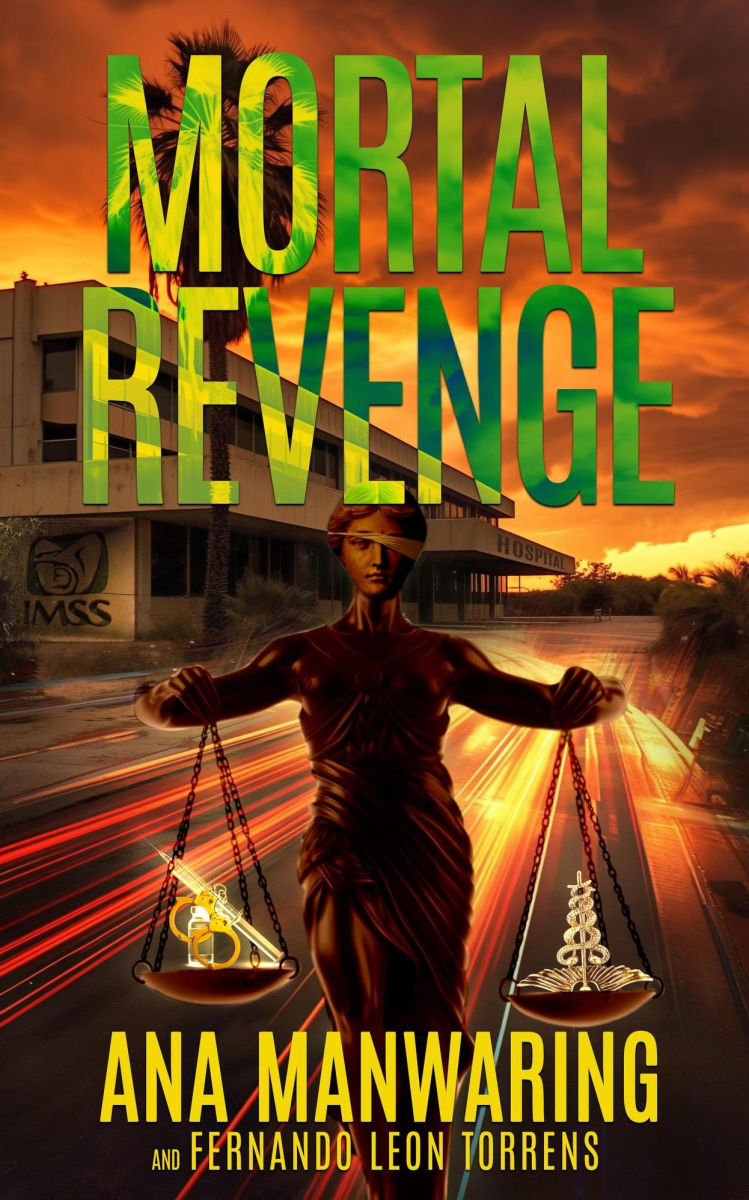

At its core, this is a crime thriller that blends family betrayal, corruption, and moral reckoning into a story driven by personal stakes. The book follows Alex Deltoro, a successful pharmaceutical executive in Mexico City, whose professional triumphs collide with a dark family crisis involving his mother, his brother, and a web of neglect, greed, and possible murder. Set against the early days of the COVID-19 pandemic, the novel moves between domestic abuse, corporate intrigue, and the broader rot of institutional corruption, all building toward a question that lingers throughout. How far can a decent person be pushed before justice turns into revenge?
What stayed with me most was how grounded the writing feels, even when the plot leans into high-stakes territory. The authors do not rush Alex’s inner life. We sit with his guilt, his exhaustion, and his instinct to care for others even when it costs him. The pacing reflects that choice. Some scenes stretch out, especially in hospitals or family spaces, and that patience pays off. It gives the story weight. The prose is clear and unflashy, which works well for a thriller rooted in realism rather than spectacle. Those details never feel decorative. They serve the story.
I also appreciated how the book handles power and corruption. No one twirls a mustache here. Harm happens through neglect, selfishness, and systems that reward the wrong behavior. The pandemic backdrop is especially effective. It adds urgency without feeling opportunistic, and it mirrors the novel’s larger concerns about who gets protected and who gets sacrificed. There were moments where I wished certain confrontations had been sharper or arrived sooner, but in hindsight, the slower burn fits the emotional logic of the story. Revenge, in this novel, is not impulsive. It is something that grows quietly, fed by love and frustration in equal measure.
Mortal Revenge felt less like a simple thriller and more like a meditation on responsibility. It sits comfortably in the crime thriller genre, but it also borrows from social realism and psychological drama. I would recommend this book to readers who like suspense grounded in character, especially those interested in morally complex stories set in real-world crises. If you enjoy thrillers that make you think about systems, family, and the cost of doing the right thing, this one is worth your time.
ISBN: 978-1-64456-875-0

The Goldilocks Effect in Prescription Drugs

The Goldilocks Genome follows an epidemiologist investigating the death of her best friend, who uncovers more suspicious deaths that can be linked to the Goldilocks effect in prescription drugs. What was the inspiration for the setup of your story?
I heard an NPR interview with Irv Weissman, a leader in stem cell biology, was asked, “How does the lay public learn about science?” His answer: “Fiction.” Weissman’s insight inspired me to use my knowledge and background in pharmaceuticals, genetics, and epidemiology to craft a medical thriller to introduce the lay public to the importance of personalized medicine.
What were some themes that were important for you to explore in this book?
One of the most important themes I wanted to explore in The Goldilocks Genome was the concept of the Goldilocks effect in prescription drugs. Meaning the prescribed dose of a medication can be “too little”, “too much”, or “just right” depending on a person’s individual genetics. Today we have the tools to discover how our genes process prescription drugs and initiate a discussion with their healthcare provider or physician to get a prescription or dose that is right for them.
What is your background and experience, and how did it help you write the medical thriller, The Goldilocks Genome?
My doctoral research was in biomedical anthropology where I used epidemiology to study the natural history of infection with hepatitis B virus. My post-doctoral studies focused on human genetics. I then went on to build a career in pharmaceuticals where I was learned the basics of pharmacology. The Goldilocks Genome combines all of these skills and passions while using antidepressants as the drug of choice to showcase why personalized medicine is important and necessary.
What is the next book that you’re working on, and when can your fans expect it out?
My next book is a memoir, Mud, Microbes, and Medicine that goes into depths of solving the problem of how infants in a remote Melanesian culture become chronic carriers of hepatitis B virus. Beyond the science it is also my coming of age story set in the 1970s across Melanesia, Philadelphia, the Silicon Valley, and Basel, Switzerland. Mud, Microbes, and Medicine will be published April 21, 2026 and is available for pre-order on Amazon and other booksellers.
Author Links: GoodReads | X | Facebook | Website | LinkedIn | Instagram | TikTok
To unravel the puzzle, Carrie assembles a team: some talented post-doctoral fellows, a quirky pharmacologist, an unctuous chemist, and a skeptical FBI agent that she can’t help her attraction for. Together, they follow the data through the twists and turns, eventually uncovering that the Goldilocks effect in prescription drugs—the premise that people are inclined to seek “just the right amount” of something—is central to understanding these mysterious deaths. Through the twists and turns, Carrie and her team enter a race to uncover the truth . . . and catch a killer.
Grounded in real data analysis techniques, real science and pharmacology, and actual current psychiatric practices, The Goldilocks Genome is simultaneously a taut, race-against-time thriller and a condemnation of the psychiatric industry’s failure to implement genetic-based “personalized medicine”—a problem that persists to this day.
Carnage in D minor

Carnage in D Minor follows Leeza Allen’s rise from a prodigious Southern piano talent to a battle-hardened military veteran who is struggling to hold herself together while trauma keeps dragging her back into the dark. The novel blends psychological suspense with a deeply personal story about survival, family, fear, and the brutal tug of the past. From childhood recitals in Beaufort to the nightmares she carries home from deployment, the book moves between tenderness and terror with an intensity that caught me off guard. The story paints a heroine who is gifted and broken and stubbornly alive. It builds a world where beauty and violence keep brushing up against each other in quiet but devastating ways.
I found myself pulled in by the voice of the book. The writing swings sharply between raw emotion and calm precision. I liked that. It made me feel as if I was inside Leeza’s head even when I wanted to reach out and steady her. The scenes around her childhood are vibrant and warm. Then the tone shifts when the story lands in adulthood where PTSD, addiction, and grief turn everything jagged. That contrast shook me a little, and honestly, that is what made the book memorable. The author seems to understand trauma from the inside out. The panic attacks. The sudden triggers. The numbing habits that pretend to help but only make the ground softer under your feet. Those moments felt painfully real. The writing has a rhythm that matches Leeza’s state of mind. Sometimes measured. Sometimes chaotic. Sometimes barely holding onto structure at all. I felt myself riding those waves with her.
I also found myself reacting strongly to the ideas the book brings up about responsibility and the human mind. The novel keeps circling back to the question of why people break the way they do. It shows trauma not just as an event but as a rewiring of a person’s internal world. I appreciated that the story never treats addiction or homelessness or depression as simple problems with simple solutions. There is frustration in Leeza’s voice. Anger too. And a fierce compassion that pushes her to believe she can fix the unfixable even while her own life is slipping through her fingers. At times, her determination feels reckless. At other times, it feels heroic. I found myself rooting for her even when she made choices that scared me.
The novel is gripping and emotional and often uncomfortable in ways that feel purposeful. I would recommend Carnage in D Minor to readers who enjoy psychological fiction that digs into trauma without sugarcoating it. It is also a strong pick for anyone drawn to stories about gifted women trying to rebuild themselves after the world has already taken too much. If you want a book that feels honest and relatable and a little bruising in all the right ways, this one is worth your time.
Pages: 265 | ASIN : B0G1CN78FG

Life is Messy and Chaotic

The Unassuming Vector follows a gifted ten-year-old child who, after the death of his parents, is taken in by a mysterious organization that fosters exceptional children to further their clandestine agenda. What was the inspiration for the setup of your story?
The inspiration for The Unassuming Vector really came from my frustration with how many stories feel too linear and predictable. Life isn’t neat or perfectly structured—it’s messy, chaotic, and often full of contradictions. I wanted to write something that reflected that truth. For me, the story is less about extraordinary events and more about the human experience within them. I wanted my characters to feel real—to be humans first, defined by their vulnerabilities and emotions before anything else. Through this lens, The Unassuming Vector became a way to explore how people, especially a child with exceptional gifts, navigate a world that tries to shape them in ways that don’t always align with who they truly are.
Gaston and Alex are at opposite ends of the spectrum in terms of their moral compass. What were some of the emotional and moral guidelines you followed when developing your characters?
I wouldn’t necessarily say Gaston and Alex are opposites in terms of their moral compass. To me, Alex is more of a victim of unchecked ambition—a reflection of what can happen when drive and potential aren’t grounded by self-awareness or compassion. Her choices took a drastic turn, but they stem from very human desires: to be seen, to achieve, and to matter. It’s also important to remember that The Unassuming Vector is part of a six-part franchise. What readers see now is only a moment in a much larger journey. While Alex’s path might seem to be at a low point, things may evolve for her later, just as Gaston’s story might take an unexpected detour. My goal was to show that morality isn’t static—it’s fluid, shaped by circumstance, emotion, and perspective.
What were some themes that were important for you to explore in this book?
One of the most important things for me in writing The Unassuming Vector was to create an evolving story—one that takes readers on a genuine emotional journey. I wanted them to experience a full spectrum of feelings as they turn the pages: compassion, pity, anger, love, and even indignation. Life isn’t static, and neither are our emotions, so I wanted the story to reflect that natural ebb and flow. Another key theme was exploring the vicissitudes of life—its constant changes and unpredictability—through the lens of a child growing into adulthood. Seeing the world evolve alongside the character allowed me to examine how experiences shape identity, morality, and resilience over time. Ultimately, I wanted readers to not just follow a story, but to feel it deeply, as though they were living it themselves.
What is the next book that you’re working on, and when can your fans expect it out?
I’m currently taking a short pause from the Vector series to work on a sports thriller that’s packed with twists and unexpected turns. Beyond the thrill and tension of the story itself, it also takes a satirical look at some of the societal issues we often overlook in competitive environments. It’s been exciting to explore a different kind of narrative energy while still staying true to my love for complex, emotionally charged storytelling. Fans of the Vector series won’t have to wait too long, though—Gaston’s story is set to make a comeback in Mid 2027. In the meantime, the sports thriller is scheduled to debut in mid-2026.
Gaston, meanwhile, leads a major Tretfax initiative to create precision-enhancing weaponry, a project that the Pentagon successfully adopts. But when the same technology is distributed to a violent faction in an African nation, resulting in widespread loss of life, Gaston becomes disillusioned. Alienated within Tretfax and wracked with guilt, he leaves the organization and joins Biomer Energy, where he spearheads a revolutionary project that reduces carbon emissions by attracting bees to carbon dioxide. Just as he begins to find purpose again, Alex—having murdered the Tretfax CEO and seized control—sets her sights on acquiring Biomer to exploit Gaston’s discovery.
The Unassuming Vector

Xavier Ndukwe’s The Unassuming Vector follows the extraordinary journey of Gaston, a gifted child whose brilliance thrusts him into a world far larger and darker than his young mind can comprehend. The novel begins with a stunningly vivid scene of a ten-year-old prodigy lecturing professors on Egyptian hieroglyphics, then spirals into tragedy as a mysterious organization called Treftax shadows his life, culminating in the loss of his parents and his reluctant induction into its secretive ranks. What starts as a story about genius quickly evolves into a layered exploration of power, corruption, and destiny. The plot bends science, philosophy, and conspiracy into a narrative that feels both intimate and global. It’s a coming-of-age story wearing the clothes of a thriller.
I admired how the author wrote Gaston not as a flawless genius but as a lonely, grieving boy who thinks faster than he can feel. The writing hit me hardest when it slowed down, when Gaston stared at his father’s books, or when the chaos of Treftax’s marble halls clashed with the silence inside him. There’s a sharp intelligence in the prose, but it never turns cold. Some scenes lingered long on exposition while others, especially the moments of emotional breakthrough, ended abruptly. Even so, the story kept me curious, always nudging me to think about how ambition can twist into manipulation and how brilliance can become a burden.
What surprised me most was how the book’s ideas snuck up on me. Beneath the polished science-fiction surface lies a meditation on grief and control. Treftax isn’t just a villainous institution, it’s a mirror of society’s hunger to shape talent for its own ends. I caught myself wondering how much of Gaston’s journey was about survival and how much was surrender. The dialogue felt natural, and the moral tension felt real, especially when Gaston started questioning the motives of those who claimed to protect him. Ndukwe’s tone is calm, almost cinematic, and that made the darker turns hit harder. The ending, though abrupt, left a lingering ache that I couldn’t shake.
I’d recommend The Unassuming Vector to readers who love smart, character-driven stories that question power and destiny. It’s perfect for anyone who enjoys mysteries with a philosophical twist, something between The Da Vinci Code and Ender’s Game. The book left me thinking about how genius can isolate, how institutions consume the individuals they praise, and how some stories don’t end, they just change direction.
Pages: 377 | ASIN : B0DL2CGFWT

Deadly Vision
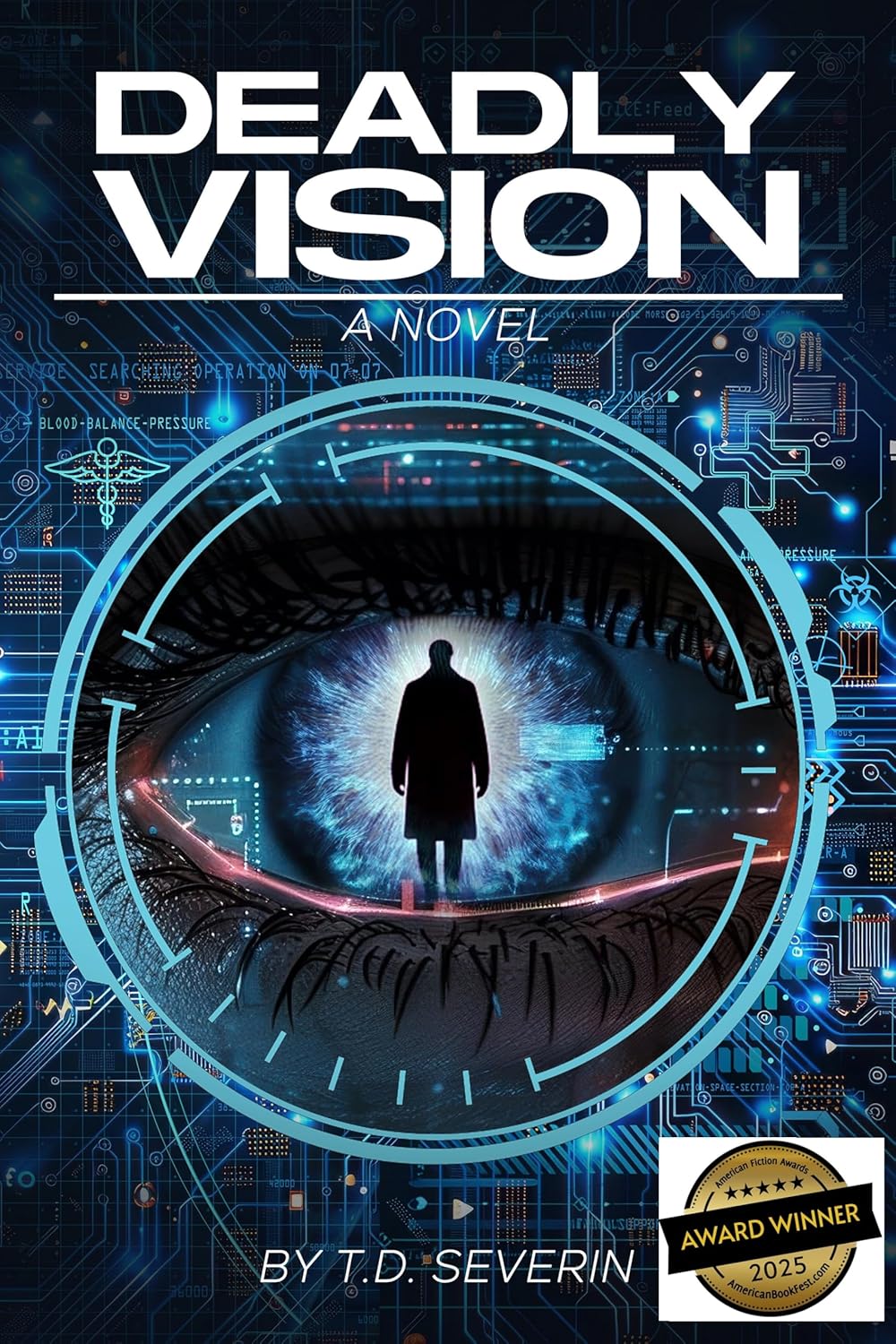
Deadly Vision starts like a high-tech thriller but unravels into something much deeper and darker. It follows Dr. Taylor Abrahms, a driven ER doctor whose research into virtual reality medicine collides with political greed, corporate secrets, and moral decay. From a Silicon Valley conspiracy to a presidential campaign in chaos, author T. D. Severin stitches together the worlds of science, power, and human frailty with an eerie sense of realism. The story opens with a murder and keeps up a relentless pace, jumping between operating rooms, campaign dinners, and backroom plots. At its heart, it asks one big question: how far would we go in the name of progress?
Severin’s writing has a cinematic quality. Scenes move like quick cuts in a film, filled with blood, urgency, and political swagger. The dialogue feels authentic, sometimes clinical, other times sharp enough to draw blood. The medical details are vivid and intense, almost uncomfortably real, and the moral tension keeps you off balance. Abrahms is compelling, but he’s also hard to love, too focused, too numb from exhaustion. And that’s the point, I think. Severin doesn’t romanticize science or heroism. He shows their cost.
What struck me most wasn’t the tech or the politics but the fear under it all. The fear of losing control, of letting machines replace human touch, of progress turning against its maker. The book hums with that dread. It’s ambitious and messy and alive. The villains feel terrifyingly real because they believe they’re doing the right thing. And Severin has a knack for making every ethical question feel personal. There’s a sadness that lingers after the last page, the kind that stays with you longer than the plot itself.
I’d recommend Deadly Vision to readers who like their thrillers with brains and bite, people who enjoy Michael Crichton’s scientific tension or Robin Cook’s medical intrigue but want something a bit grittier. It’s not a light read, and it doesn’t hand you easy answers. But if you like stories that make you squirm, think, and wonder what’s really possible when science meets ambition, this book will grip you from start to finish.
Pages: 468 | ASIN : B0DZ3JWVYX
Vaccine: A Terrorism Thriller


Robin C. Rickards’ Vaccine: A Terrorism Thriller is a tightly wound medical and geopolitical thriller that spans decades, tracing the roots and reach of a mysterious virus with chilling implications. The novel kicks off with a covert extraction in post-war Vietnam, spirals into secretive military research at Fort Detrick, and stretches to the 1990s with echoes of biological danger and buried secrets. At its core, the book follows Major Darien Rhodes, a gifted but stubborn infectious disease expert, as he battles bureaucracy, hidden agendas, and his own conscience in an effort to uncover the truth behind a terrifying disease with no name, no cause, and no cure.
What struck me most was the writing’s visceral intensity. The first few chapters grabbed me, drenched in sweat, blood, and the low thrum of helicopters and paranoia. Rickards writes like someone who’s lived in a lab coat and knows what’s at stake when science goes silent. The pacing is confident, with bursts of claustrophobic tension that feel like watching a fuse burn. But it’s not just action; the book spends thoughtful time inside the minds of its characters. Rhodes is a complex, sympathetic lead — brilliant, dogged, haunted. His frustration with the military’s politics and their cold, calculated response to a mystery illness felt raw and real, especially in an era where public trust in institutions is fragile.
The plot sometimes leans on exposition. There are moments, particularly during scientific breakdowns or historical recounts, where the narrative slows and the tension thins out. At times, the dialogue leans more toward explanation than emotion, shifting the focus from character feeling to background detail. Still, I didn’t mind being taught, because Rickards clearly knows his stuff. The background in infectious disease, military protocol, and covert research added weight and believability. And when the story snaps back into motion — as it often does — it hits hard. The final act, in particular, left me uneasy in the best way, with ethical questions echoing after the last page.
I’d recommend Vaccine to readers who enjoy thrillers with brains and backbone. It’s ideal for fans of Michael Crichton, Richard Preston, or anyone who likes their fiction layered with fact. If you’ve ever wondered what kind of nightmares lie behind closed lab doors, or how far people will go to hide the truth, this book’s for you. It’s gritty, smart, and at times deeply unsettling.
Pages: 421 | ASIN : B009596W5O



 LITERARY TITAN