Blog Archives
Gangsters and Demons


Gangsters and Demons is a dark, pulpy, and strangely heartfelt novel set in 1920s Chicago. The story follows Jimmy Maloney, a dockworker trying to survive amid the city’s industrial grime, systemic poverty, and rising organized crime. What starts as a classic gangster tale gradually transforms into something much more unexpected, something deeply strange, even supernatural. As Jimmy gets drawn deeper into a criminal underworld, he confronts not just mobsters but literal demons, both personal and paranormal. The lines blur between addiction and possession, loyalty and survival, faith and fear. O’Neill stitches together Prohibition-era crime drama with elements of horror and religious myth in a way that feels both ambitious and unhinged.
I felt like I was being pulled into an old noir film that slowly melted into a fever dream. O’Neill’s writing is rich with mood and texture. The way he builds atmosphere, from fog-drenched alleys to crowded tenement kitchens, is immersive and unflinching. But it’s not just about setting. The dialogue is sharp and believable, especially when tensions rise between dockworkers and mob bosses. At times, the narrative veers into melodrama, especially when introducing the more fantastical elements, but somehow, it works. The raw emotion in the scenes with Jimmy’s mother or his deteriorating friendship with Nathan hits hard. You feel the weight of hopelessness, the creeping dread of losing control. It’s messy, and that’s what makes it feel real.
What surprised me most were the ideas buried beneath the genre trappings. Addiction, exploitation, poverty, faith, these aren’t just backdrops, they’re the bones of the story. There’s something gutsy about blending demonic possession with union strikes and rent hikes. It’s as if O’Neill is saying the real horror isn’t the supernatural, it’s the everyday grind that breaks people down. There were a few moments where the themes came through a little strongly, as if the story had something meaningful to share and leaned into it with intention. A couple of plot threads faded into the background, and a few characters seemed to serve more symbolic roles. Even so, the story gripped. I kept turning the pages, eager to see where it would go next.
I’d recommend Gangsters and Demons to anyone who enjoys stories that punch you in the gut and don’t apologize. If you’re into gritty historical fiction with a twist of horror, think Peaky Blinders meets The Exorcist, you’ll find something to love here. It’s bold, honest, and haunted.
Pages: 255 | ASIN : B0F48TS4R5

Spider Seeds
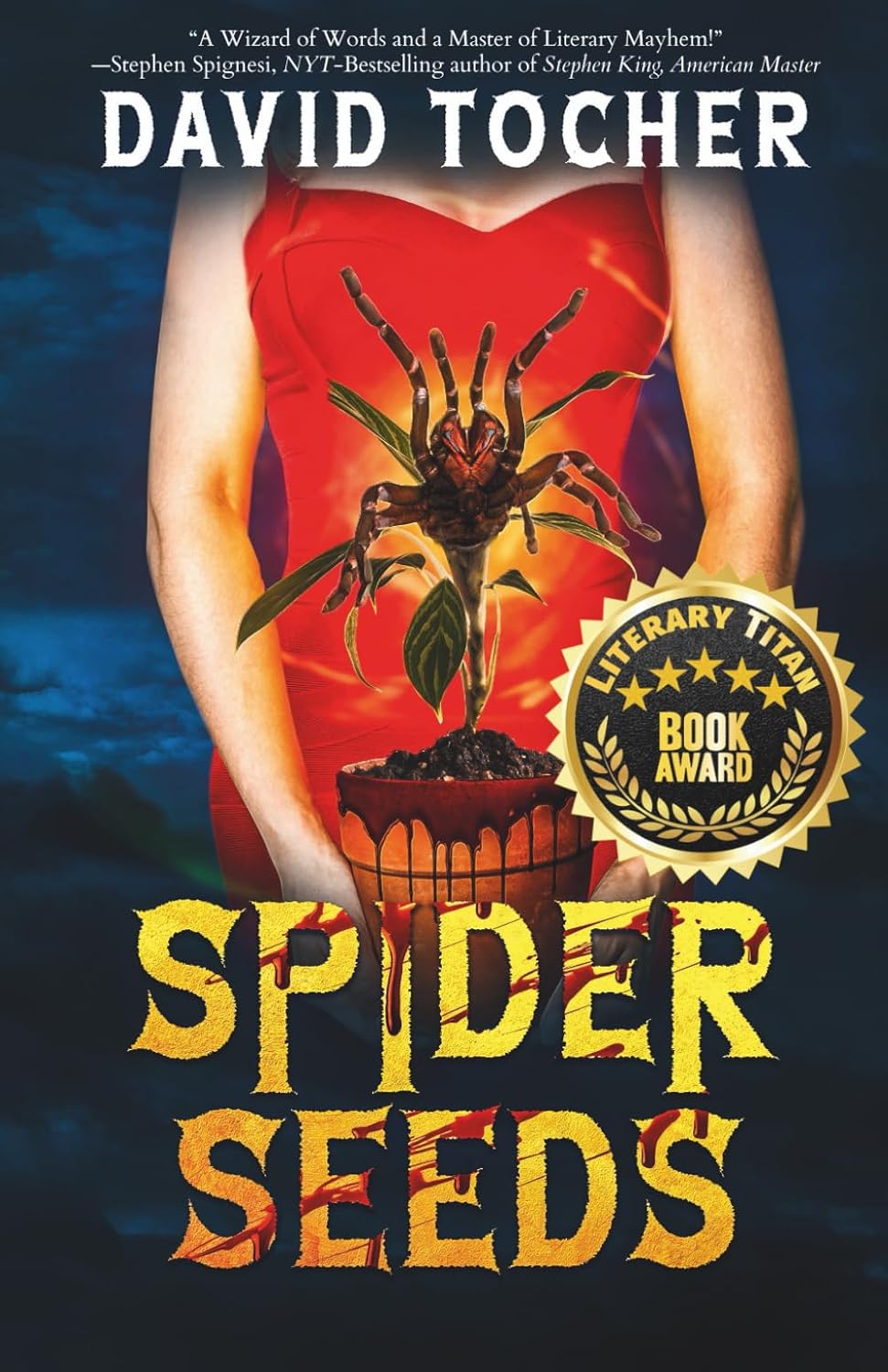

David Tocher’s Spider Seeds is a genre-bending literary tale that blends horror, folklore, and psychological drama into a haunting and poignant coming-of-age story. The novel follows Madison Perth, a successful author haunted by a brutal act of teenage bullying and the creeping darkness that event plants within her. As an adult, she crosses paths with a strange plant shop and unwittingly reignites the sinister forces tied to her past. From the ghostly forests of British Columbia to the cozy neighborhoods of Victoria, the novel peels back layers of trauma, resilience, and transformation, both emotional and otherworldly.
Tocher’s writing hits hard and fast, then lingers like the sticky web it describes. What impressed me most was how vividly he brings scenes to life—one minute, you’re on a nostalgic walk through a peaceful, cherry-blossomed city; the next, you’re choking on dread in a shadowy gully. His prose carries the rhythm of folklore but is sharp with modern sensibility. The characters—especially Maddy—feel incredibly real. She’s prickly, vulnerable, brilliant, and deeply scarred, and that’s what makes her so compelling. Her inner monologue, particularly when battling the internal venom of her past, left me shaken and nodding in recognition.
But what stuck with me even more than the plot was the slow, chilling realization that Spider Seeds is really about infection, not just by something supernatural, but by hate, memory, guilt, and self-protection. The horror isn’t loud or gory; it’s soft, parasitic, and psychological. That said, I felt that a few narrative beats, like the mythos surrounding the plant and the shop’s family legacy, felt rushed. I wanted just a little more from the ending. Still, the way Tocher plays with tension and emotional stakes more than made up for it.
Spider Seeds is a novel for readers who enjoy their horror quiet but unforgettable—less jump scare, more creeping dread. It’s perfect for fans of Stephen King’s more psychological work, or even Neil Gaiman with a darker twist. Anyone who’s ever been bullied, or who still carries the weight of being “the outsider,” will see pieces of themselves in Maddy.
Pages: 124 | ISBN : 1068965495
Explore Indigenous History

Diablo Canyon follows a burnt-out writer searching for inspiration in Diablo Canyon, who instead uncovers a dark history and an evil, ancient entity that is out for blood. What was the inspiration for the setup of your story?
The spark actually came from a dream—kind of a wild one. I go into the full story in the afterword of the book, but that dream stuck with me. I used to live in Elizabeth Lake, and it’s just one of those places that feels… different. Beautiful, but mysterious. Over time, I started hearing these strange, fascinating stories from locals. Then I found out the lake’s original name was La Laguna del Diablo, which translates to The Devil’s Lake. That was it—I started researching, and everything started clicking into place. With that foundation, the story practically wrote itself. Honestly, about 60% of it is rooted in real events and local legends.
All your characters felt real, giving the story an emotional pull that connects readers to them. What character did you enjoy writing for? Was there one that was more challenging to write for?
It was honestly a blast to write them all, but it was also a balancing act. I really wanted a diverse set of characters, each with their own voice and purpose. Writing for the Tataviam Tribe members meant doing a lot of thoughtful rewrites—I wanted to treat their story and culture with the respect it deserves, so that took time and care. As for the hardest character? Probably Jack. Capturing his inner conflict—the grief, the guilt, the tension with his daughter—that was tough, but also really fulfilling. He’s the emotional anchor of the book in a lot of ways.
What were some themes that were important for you to explore in this book?
A few things really drove this story. First, I wanted to shine a light on the beauty and history of the Elizabeth Lake area—especially the stories that often go untold. Through Tibu’s storyline, I was able to explore Indigenous history and voices that history tends to erase. I wanted to honor that.
There’s also a strong theme of grief and how it shapes us. Jack’s journey is wrapped in loss, and that grief fuels a lot of his choices—some good, some not so good. Trauma, if we don’t face it, can lead us down dangerous paths.
And of course, the danger of unchecked curiosity plays a big role. Whether it’s digging into the past or awakening something ancient, Diablo Canyon reminds us that some doors are closed for a reason. Once you open them, there’s no going back.
What is the next book that you are working on, and when can your fans expect it to be out?
Right now, I’ve got a few irons in the fire. I’m working on a four-book series called The Elementals, which dives into a supernatural mythology that I’m really excited about. I’m also building a paranormal detective series centered on a character named Smoke Ravenstein—the first book’s called The Demon on the Hill, and it’s halfway done.
And then there’s The Body Farm, which is a dark horror comedy we’re actually filming this summer. That one’s a wild ride with a twisted sense of humor. I’m not sure exactly when the next book will hit the shelves, but hopefully soon. Stay tuned! Stay Spooky!
Author Links: GoodReads | TikTok | X (Twitter) | Instagram | Website | Amazon
More than a century later, Jack Morrison, a burned-out novelist, arrives in the canyon looking for inspiration—but what he finds is far worse than writer’s block. As he digs into the dark history of the land, he uncovers chilling stories of vanished settlers, vengeful spirits, and men who disappeared only to return… changed. The deeper Jack goes, the more the lines blur between past and present, until the horrors that haunted Tibu’s time come clawing their way into his own.
This is not just a story about outlaws and gold—this is a story about the things that lurk beneath the earth, waiting. The kind of nightmares that do not just haunt the past, but infect the present, whispering promises of power in exchange for blood. Diablo Canyon is a tale of monstrous men, vengeful spirits, and the unrelenting grip of an ancient evil that does not forgive… and never forgets.
If you think evil stays buried, you’ve never been to Diablo Canyon.
Mysterious Stranger

Inescapable follows a 17-year-old boy dreaming of escaping his small-town life, whose life takes a strange turn when a vampire and a witch move into town, and bodies start mysteriously piling up. What was the inspiration for the setup of your story?
I find small towns intriguing because everyone knows everyone – and everyone talks about everyone. It’s like a soap opera. It can be great because there usually is a sense of community, but if you don’t fit in it can also be very lonely. When I was Dylan’s age – and I think it’s the same for most teenagers – I always felt like an outsider in my small town and I desperately wanted to leave. I loved stories about teenagers befriending the mysterious stranger who had just moved to town and turns out to be a vampire or a witch. But it got me thinking… What if – unlike in most YA vampire stories – the newcomer isn’t the good guy?
In many contemporary coming-of-age fiction novels, authors often add their own life experiences to the story. Are there any bits of you in this story?
As I said I’m from a small town. It is not as remote as Berlin, New Hampshire in Inescapable but everyone knows everyone there as well. I’m also really lucky to have an amazing mom – just like Dylan. We don’t have the same dynamic as Susan and Dylan, but I drew from my relationship with my mom to paint a convincing picture of Dylan’s.
What were some themes that were important for you to explore in this book?
I wanted to explore the concept of the vampire as an outsider – someone on the fringes of society who lives by their own rules – and what happens when they meet a human outsider. The concept of “monster” in general is something that I dive into in the book as well. What makes a monster? Who is the good guy, who’s the bad guy?
Friendship and family are an important topic, too. Who are we without the people who love us? And can we choose our own family?
Where does the story go in the next book, and where do you see it going in the future?
The next book will dive deeper into the vampire lore of the Immortal-Blood-Gift-universe. You’ll meet new characters and Dylan will face new challenges. I can’t really say much more without spoiling Inescapable. So go ahead and read it!
Author Links: GoodReads | Instagram | Website | Amazon
As bodies start piling up, each one more gruesome than the last, the town suspects a wild animal is to blame. But Dylan’s world is turned upside down when he learns that Marie is a vampire and Molly, the daughter of his mother’s new boyfriend, is a witch who believes Marie is responsible for the murders.
As Dylan finds himself drawn deeper into the supernatural world, he must make a choice: embrace the darkness within or fight for his humanity. But with a bloodthirsty monster on the loose and no way to return to his old life, Dylan’s decision may already be made for him.
\
Set against the backdrop of 1980s horror, “Inescapable” is a chilling coming-of-age tale that will keep you on the edge of your seat until the very end. If you enjoyed “Stranger Things,” you’ll love this thrilling tale of magic, monsters, and self-discovery.
Don’t miss out on this gripping read.
I Don’t Create the Path—I Follow It

Divine In Essence is a collection of imaginative short stories that immerse readers in the supernatural world. What was the idea, or spark, that first set off the need to write this collection?
I write to dream. Whenever I compose a story, I keep Beauty on one side, Truth on the other. As long as I’m between the two, I know I’m on the Path. I don’t create the Path—I follow it.
Each of these stories was composed in this manner, for its own sake, not toward this collection in particular…and yet, once the pieces were gathered, Divine In Essence emerged vividly as a totality—not simply an assortment of stories—just as a human body is a totality of organs performing distinctive, necessary tasks aligned to support the function of the whole. For Divine In Essence, that function is to imagine a dream of the world that replaces the world: for the time that you read the words, you live in the dream. The words you imbibe from the page become your own words, and the dreams they describe become your own dreams.
What dreams? Sometimes, a fanciful surrealism emerges, as in the pan-telluric ontological upheavals of “The Great Event” or the fantastic voyage through the id of “Icarus in Bardot.” At other times, a heavy-lidded hypnagogia prevails, as in “I in the Eye,” which relates the observations of a boy imprisoned in his stepmother’s glass eye, or “Your Mother Loves You,” a survivor’s memoir in four dimensions. Occasionally, we float into some pleasant reverie tinged with sorrow, as in the perambulations of the gently damned in “Nancy & Her Man,” or the sweet, meek fortitude of “Mary Alice in the Mirror.”
I should say, many of these stories were written toward the purpose of publication in journals and anthologies. My previous work had been more in the experimental vein, and I had seen it published in various lit journals, online and in print, but I developed an interest in Horror and the Weird (so hospitable as they are to the dream sensation), along with a desire to publish stories in the journals and anthologies of those genres, which tend to be very classy and well-produced. I’m happy to report I managed to appear in several of those publications over the years, including some gorgeous hardcover anthologies from the UK, which hosts a thriving book culture.
What were some themes that were important for you to explore within your stories?
I am an intuitive writer, so I don’t necessarily impose themes on my work, but isn’t it funny how they emerge anyway? Especially in this collection!
Divine In Essence is STEEPED in the dichotomy of human existence between the Real and the Symbolic. The Real is your animal body; the Symbolic is your human spirit. The body (Real) is a medium for suffering and isolation; the spirit (Symbolic) is a medium for ecstasy and connection. Your struggle as a human being is to unify these divergent aspects of your nature, to inhabit both realms at once—to be kind in spite of cruelty, to identify your own pain in the pain of others (and theirs in yours), to understand your suffering within the greater context of your relationships to your family and your species, to be more than a survivor of the world-at-hand but a striver toward another world always out-of-reach.
You don’t create the reality you inhabit—it creates you—but you do create continually the ILLUSION that you’ve created that reality…which is all that makes it bearable. When the illusion is revealed for what it is and stripped away, hope flees, despair triumphs, and the human spirit sinks into perdition. Thus, the illusion MUST be maintained, with Dream as the only viable working method.
Many of my stories concern children. A child must come to terms with the arbitrary, senseless cruelty of existence and develop a sense of ownership over it: “This suffering is MY suffering, a very special sort of suffering indeed…if only I could share it with someone else!”
A child, being innocent, is the perfect victim. People tend to blame adults for their own misfortune: if something bad happened to you, you must have done something to deserve it! You simply can’t think that about a child, however: no child deserves punishment or abuse. That’s probably why I’m attracted to the theme of childhood suffering and how a child in the wake of trauma that is by definition unjust must reimagine the world itself in order to justify and endure it…again, with Dream as the working method.
Do you have a favorite story in your collection? One that was especially enjoyable to craft?
My favorite story is the finale, “The Life of Cherry.” This story represents the summa of all that came before. Each story in Divine In Essence exudes a spiritual dew that flows down into the next, and “The Life of Cherry,” situated at the bottom, collects all that spectral moisture into one supremely potent libation.
On the level of craft, it was incredibly rewarding to write this story. When I began it, I only eked out a few pages before abandoning it to the Purgatory of False Starts, but then I picked it up again six or seven years later, and it flowered on its own into a piece of art so precious and prescient that I can hardly believe it came from me. Whenever I read it, I learn something more about myself. Within my life, it serves as a practical demonstration of Literature’s power as a path to self-knowing. If I should ever doubt my calling to this practice of Writing, I need only to reread “The Life of Cherry” to refresh my conviction.
Can we look forward to more work from you soon? What are you currently working on?
I’m duking it out with the Muse as we speak. No telling at this point how it will go, but I’m rooting for Her!
Author Links: GoodReads | Website
You will encounter:
a young boy captive in his stepmother’s glass eye,
the engrossing diary of a sassy and intrepid girl-ghost,
an “impudent” woman consigned to a passive life in a mirror,
a mutilated Fury ransacking the dream world,
Icarus mired in Brigitte Bardot,
ten tales of the Strange to unchain you from the Real.
The stories of Divine In Essence exemplify a sui generis slipstream style that deftly weaves a psychedelic literary fabric from elements of Irrealism, Occult Horror, Oneiric Fiction, and the Weird. Attune your mind and be transformed. Escape!
“Yarrow Paisley dictates dreams onto paper. His work is like nothing else I’ve read—enchanting, touching, terrifying, absurd.” —E. Catherine Tobler, author of The Necessity of Stars
“With his trademark sly humor, Paisley has created a world in a glass eye, a tour de force guaranteed to give readers delightful nightmares.” —Mickey J. Corrigan, author of What I Did for Love
Divine In Essence

Divine in Essence, by Yarrow Paisley, is a surreal and endlessly imaginative collection of short stories. The book is a wild ride, blending the bizarre with the artistic in a way that’s both entertaining and unsettling. It’s a mix of the otherworldly and the unnerving, constantly pushing boundaries and keeping the reader off-balance with its strange, dreamlike narratives.
Paisley’s writing is so unconventional that condensing these incredible short stories into a brief description feels almost impossible. Take The Great Event, a fresh twist on a ghost story involving a young girl, Helen, and some haunted pipes. Or I in The Eye, where a boy finds himself trapped inside his stepmother’s glass eye while a homunculus takes his place. Then there’s Rocking Horse Traffic, a fever dream about a boy undergoing surgery, blending reality and a strange world filled with rocking horses. Each tale feels like it’s pulled from a feverish imagination, and they demand to be experienced firsthand.
What stands out in this collection is the way each story mixes the supernatural with ordinary horrors. The familiar becomes strange, as Paisley twists traditional horror elements into something more abstract and mind-bending. His writing style is rich, poetic, and sometimes so abstract that you’re left wondering what’s real and what’s imagined. The stories have a dreamlike quality that keeps readers guessing, making the experience immersive and often disorienting in the best way. Paisley’s prose is dense and lyrical, with themes revolving around identity, mortality, and the essence of existence. His characters are often trapped, whether physically or psychologically, and the way he plays with language blurs the line between fantasy and reality. It’s an unsettling but engrossing experience, pulling you deeper into his strange worlds.
This collection is unlike anything I’ve read before. While I thoroughly enjoyed the ride, it’s not for everyone. Paisley’s writing works best in small doses—I feel that some might find it somewhat difficult to follow. This isn’t an easy read, and the stories are definitely not for those who prefer straightforward narratives. However, for fans of surreal horror, it’s a rewarding challenge. Each story stands out in its own right, and there’s not a weak one in the bunch. It’s best enjoyed story by story, allowing time to digest each one’s unique oddities. Divine in Essence is perfect for readers who crave something deeply strange and entirely original.
Pages: 216 | ISBN : 978-1952600555
The Broken Dollhouse

In The Broken Dollhouse by Sofia Ekebom, readers are drawn into a haunting psychological thriller with elements of horror, weaving together themes of trauma, mental illness, and suspense. The protagonist, Micayla, has been haunted since childhood by a devastating event, the brutal murder of her aunt, which she witnessed at the age of five. The trauma left deep psychological scars, affecting her well into adulthood. Now living in a villa by a lake steeped in dark folklore with her husband, she finds herself ensnared in an eerie mystery. The legends surrounding a mystical creature lurking in the lake are mere whispers—until her husband dies under suspicious circumstances, and her 17-month-old son vanishes. As Micayla seeks answers, she uncovers unsettling connections between these events, the lake, and its cryptic secrets.
Ekebom’s novel intricately explores mental health, beginning with the abandonment of Micayla and her brother due to their mother’s postpartum psychosis. As the story progresses, Micayla’s struggles with anxiety, depression, and suicidal thoughts create a vivid portrait of a woman teetering on the edge. Her character becomes increasingly layered, shaped by a toxic marriage and long-standing abandonment issues, leading her to distrust those around her. When her son disappears, the narrative takes a sharp turn, propelling her into a desperate search filled with suspense and uncertainty. She encounters various characters along the way, some trustworthy, others far from it, heightening the tension and adding depth to her journey. While the novel’s title is captivating and the premise promising, it falters in execution. The lack of descriptive detail, particularly surrounding the mythical lake creature, leaves readers craving more. Key elements, such as the creature’s motivations and the ritual mentioned in passing, remain frustratingly vague. This underdevelopment of the horror aspect detracts from the novel’s potential to fully immerse its audience in fear and suspense.
The Broken Dollhouse by Sofia Ekebom presents a compelling blend of psychological thriller and horror centered around trauma, mental illness, and a chilling mystery. The novel offers a strong premise and intriguing character development. Readers of psychological thrillers and dark fiction will find the story engaging.
Pages: 328 | ISBN : 9526502035
Dreamlike Nature of Reality

The Monarchs follows a teenage boy with unique psychic abilities living in a laboratory who escapes and goes on the run with an ordinary orphan girl. What was the inspiration for the setup of your story?
This is a good question, as it is often difficult to discern the source of the inspiration. The original idea for The Monarchs came to me all the way back in 2014 during a senior year of college spring break beach trip. At the time I was questioning what I wanted to do with my life (having chosen philosophy as one of my majors) and was searching inward for answers. My own process of spiritual awakening, questioning the nature of reality, and exploring the potentials of consciousness through modalities such as lucid dreaming were obvious inspirations for this novel and are reflected in Samuel’s journey.
Moreover, I’ve always been fascinated with psi phenomena and the possibility of supernormal abilities. Even as a kid, I was obsessed with the movie Matilda—about a young girl who could move objects with her mind—and the X-Men series. Eventually, I came across the concept of indigo children which reignited my interest in supernatural abilities—as well as a possible shift in human evolution—and inspired the idea for “new youth” children. Music was another big inspiration, particularly M83’s “Midnight City” music video, which shows psychic kids being tested at a facility. Only later when I researched the Montauk Project, which the show Stranger Things is based on, did I understand that this might be more of a reality than most people realize.
One point I’d like to add is that although the novel may be taken literally (a teenage boy with psychic powers escaping a facility), from another perspective, it may be interpreted as an allegory for spiritual awakening and enlightenment. The opening scene, which is very dreamlike in nature, shows Samuel attempting to escape the laboratory complex with no end in sight. This represents the endless maze of the thinking mind, the dream of the egoic personality which many teachers and mystics insist that we must awaken from. Luna hints to this later in the novel when teaching Samuel how to meditate: “Beyond the thinking mind, escaping its never-ending labyrinth of illusion, there exists a force infinitely more intelligent.”
From there ensues a hero’s journey which forces Samuel out of his comfort zone, leading him to confront his shadow, learn through challenges, and awaken to his essential oneness with God (or, using an analogy of a book, oneness with the author and all other characters). This culminates with him breaking out of character and transcending the strings of time—symbolizing cutting the cords to his past and dying to his time-based egoic self. The evolution and awakening of Evelyn from her coma also represent that of the earth and humanity as a whole. This novel is loaded with symbolism and synchronicity, and although I left several things up to interpretation, there are many Easter eggs and hidden surprises that readers may not immediately pick up on.
The writing in your story is very artful and creative. Was it a conscious effort to create a story in this fashion or is this style of writing reflective of your writing style in general?
Thank you for the kind words. Because music is a central theme (and I often used lyrics from popular songs in the dialogue), in general, I did try to make the writing more lyrical and poetic, allowing the sentences to flow in a smooth manner. I wanted my writing to be affecting to the reader, instilled at points with uplifting wisdom, while being careful not to sound verbose or pretentious. Truthfully, because this is my first novel, it took me a while to find my writing style, and it is still a learning process. It took a leap of faith, and years of trial and error, to trust the ideas that came to me and discover how to put them together into a coherently written story. My editors were also a big help. I am grateful for the journey.
What were some themes that were important for you to explore in this book?
Beginning with Samuel’s conversations with his wise tutor, Walter, and expounded on thereafter, this novel explores several philosophical and metaphysical themes, including the existence of God, free will versus predeterminism, human evolution, planetary ascension, and the dreamlike nature of reality. Before embarking on his hero’s journey, Samuel tells Walter that he feels he has no control over his own destiny—that he is trapped like a puppet on a prewritten path. Here and at points throughout the book, we see Samuel developing a sort of metacognition of being a character in a novel—one who indeed is on a path that is already written, yet strives for free will.
Samuel must reconcile this paradox with the ultimate realization of his essential oneness with God (again, oneness with myself as the author). There is no separation between me, him, and all other characters; it is simply an illusion, a game of “one consciousness interacting with itself.” From this highest level, beyond the conditioned limitations of the egoic personality and into God or “author” consciousness, Samuel comprehends that he does have free will, as in a sense he has “written all of it.” His identity as the small, helpless, separate character dissipates as he attunes to the power to write his own destiny. He dies to his old self and is reborn as a Monarch, a symbol of personal sovereignty and spiritual transformation.
As previously mentioned, music is a central theme, as is the idea that we are living in a musical universe, or the view that “all things could be expressed through vibration, sound, and geometry.” To compliment this theme, many song lyrics are quoted in the book, some explicitly referenced, and others hidden in the dialogue. Samuel gradually picks up on the fact that there is music all around him—that his consciousness is but one note in a cosmic symphony. I had to receive print license permissions for 24 different songs to be included in the novel, from artists ranging from The Beatles to Fleetwood Mac to Jimi Hendrix to The Flaming Lips. This was a journey in itself, but it was worth it to preserve the musical element. Some song references may contain hidden clues pertaining to the story when interpreted correctly.
The book is not without darker themes, including the perpetual cycles of human war and division, government corruption, and secret experimentation (some researchers have spoken of “Monarch” mind control programming, which is the lesser-known negative connotation to the symbol). Although another human division is introduced in the book, between the larger-eyed “new youth” and the “ordinary” people and children, the ultimate theme I strove to emphasize is that only through unconditional love, acceptance, empathy, and forgiveness can we truly heal our planet and transcend the influences that have long kept us divided.
As the sagacious Leon puts it, “We are but dream characters in the mind of God, striving for Self-realization, though only a select few may consciously remember this. Most identify entirely with their egos, and this generates great inner conflict.” We all have a choice to stay stuck in our characters, our narrow ego identities trapped in the game of duality and separation, or strive toward something higher—a deeper connection with ourselves, with nature, and with all other beings. Taking this path requires a leap of faith into the unknown, opening our hearts and allowing a greater intelligence to guide us through life, which is one of Samuel’s main lessons.
I find a problem in well-written stories in that I always want there to be another book to keep the story going. Is there a second book planned?
Another great question. During most of my time writing The Monarchs, I didn’t plan for there to be a second book. Yet as my first editor told me, this story is almost too big to contain in just one book. I now realize that it is meant to be a trilogy, and I have already (albeit very loosely) outlined the story for books 2 and 3. I’m not going to give it away, but it will be done in a way that plays with time, lending a chance to fill in more of Samuel’s backstory, his time at the Facility, and the world in general, while also pointing toward an incredible future destiny.
Books 2 and 3 will further explore mind-bending themes such as the multidimensional nature of self, extraterrestrial life, other incarnational existences, and even other timelines. I’m excited to expand on this story, and I will continue to trust what comes to me. Stay tuned and thank you for the support.
Author Links: GoodReads | Website | Amazon
Born into a world ravaged by war, Samuel Helen is among the first in a wave of “new youth” children who possess abnormally large eyes and breathtaking psychic abilities. But Samuel’s powerful telekinesis cannot be managed by the team of scientists at General George Mabus’s military facility. He finds his only solace in his sessions with his wise tutor, Walter, who introduces him to music and philosophy, and his cherished weekly visits with an ordinary orphan girl, Evelyn, in the neighboring village.
When a twist of fate sends Samuel and Evelyn into uncharted territory, Samuel is forced to confront dark shadows from his past in order to unlock the deepest wells of his psyche, even the universe itself, and discover deep spiritual truths while harnessing his abilities-and facing off with vengeful enemies.
He soon realizes that he is part of something much greater than he could have ever imagined . . .


