Blog Archives
Write Fully and Freely
Purple Summer, Gray Fall is an eclectic blend of poems ranging from themes of warmth, youth, and desire to introspection, loss, and renewal. What inspired you to write this particular collection of poems?
Thank you! This book began as 1-2 poems and random thoughts I wrote during and after a particularly impactful romance. I didn’t plan for Purple Summer, Gray Fall to become a book, let alone a book that I would publish. Not long after this romance, I went through a huge emotional journey, including and most notably, the start of my writing career. I began writing and unpacking things, which led to more writing. Then, synchronistically, the title Purple Summer, Gray Fall came to me one day. That’s when I knew I had to create a book. This book allowed me to understand and process that time period, learn more about myself, and explore and expand creatively. I realized I had to publish this book because, as an artist, there is nothing more urgent than to share what moves you.
Were there any poets or other writers who influenced your work on this collection?
Absolutely. The late Nikki Giovanni is my favorite poet of all time. The late Toni Morrison is my favorite author, and I’m also a huge fan of poet Marie Howe. Collectively, they have inspired this book as their work is frank and sharp, full of imagery, emotion, connection, and courage. They are a source of strength and commitment for me to write fully and freely. I honestly can’t do justice to describe how influential these three women are to my work as a writer, but I’m glad I can pay homage to them here.
How do you approach writing about deeply personal or emotional topics?
It wasn’t easy initially, but it was much harder for me not to go deep with this book. Purple Summer, Gray Fall could have had a vastly different tone. I scrapped almost half of the original poems because they were ok and fit, but they didn’t feel authentic, and they didn’t make me proud. I made a choice and decided to write free of external pressure, and once I did, the rest of the book came together pretty quickly. It was very exciting. I knew the excitement and pride I felt from writing from a place of authenticity was and is the reason why I am a writer. I’m not aiming to be controversial or deeply personal, but I’m sticking to my decision to write for me and no one else, letting whatever needs to come out be free to do so.
Can we look forward to more work from you soon? What are you currently working on?
Absolutely. Poetry is my favorite genre, and I’m working on my 2nd book now, no title available! I’ll share that the collection will explore my past relationships. But I also plan to write fiction, plays, and screenplays as I have started drafting quite a few projects. Stay tuned for updates by following me on Instagram @writeaway_selena.
Author Links: GoodReads | Instagram | Amazon
Poetry Thrives on a Mystery

What We Hold No Longer is a collection of poems that circle around memory, aging, identity, and the haunting void that lies beneath it all. What inspired you to write this particular collection of poems?
I’ve recently become an avid reader of psychoanalyst Adam Phillips. Last year, one of his books introduced me to Jacques Lacan. Specifically, how our subconscious impacts language, and in turn, how we use language shapes desire. For a poet, what could be more delicious to explore? Ineluctably, even mentioning Lacan brings up his theories on the Void (The Thing) and religion. This, in turn, led me to Lacanian scholar Richard Boothby (Embracing the Void). Along the way, I also read a book by Phillips on our ambivalence towards transforming our lives (On Wanting to Change). Transformation is a particularly important topic at this stage of my life. What I did not anticipate in reading this book was the evocation of so many memories. As a pediatric psychoanalyst, Phillip’s description of childhood, particularly the excruciating years of adolescence, flooded me with things I’d long forgotten (eg, seeing my grandfather’s corpse at age 9, the inchoate sense of frustration, and seeking revenge on my parents’ reputation with a can of red spray paint, etc.).
Can you share a bit about your writing process? Do you have any rituals or routines when writing poetry?
I’m trying to understand my writing behavior. I appear to have a natural rhythm, whereby I’ll write a dozen poems over a month or two and then go silent for just as long. During the quiet months, I read more and pay attention to what I see and listen to: all the things popping up as thoughts and feelings. The poems “The False God’s Lullaby” and “New Year’s Day” were brief glimpses of people, just a few moments of an image that resonated deeply, and unexpectedly.
What moves me from outside triggers something poignant nesting deep inside: “The I of my other who moves silently with me” (The False God’s Lullaby). Also, I love editing. Paul Valéry once said: “A poem is never finished, only abandoned.” I think he meant you can always refine and improve a poem. I try to limit my revision window to six months. Once a poem reaches structural stability (ie, I know what I want to say and the confines to say it in), I put it away for several days or weeks at a time. It’s important to understand that during initial composition, the poem’s neural map is being built using high stores of neurotransmitters. This is how we learn. However, it also prevents us from seeing inherent weaknesses when we’re still trying to get our thoughts written down. Taking a break for days or weeks reduces neurotransmitter stores. This removes the blinders to our writing, so we can see problems more readily and find better ways to say what we’re trying to convey.
How do you approach writing about deeply personal or emotional topics?
I think it is important during initial composition to just let things rip, because that is likely to be the most truthful. However, there is a balance to be struck. I’m reminded of a phrase from the Upanishads: “The path to salvation is narrow. It is as difficult to tread as the razor’s edge.” I view confessional poetry as an attempt to achieve psychic salvation. To shy away from powerful emotions creates a sense of falsity impossible to ignore. Yet, in the passion of writing, we can also say too much. Poetry thrives on a mystery, on what is left unsaid. That’s part of the art form I’m still working on improving.
How has this poetry book changed you as a writer, or what did you learn about yourself through writing it?
I have the sense in writing What We Hold No Longer that I’m beginning to mature as a poet. I’m not sure anyone else would agree. But there was something about the Lacanian cycle of poems that shifted my writing in a way I haven’t fully grasped. At this moment, I can’t imagine writing anything more profound or better composed than those poems. Time will tell. Every book I’ve written so far has enriched my sense of self and given me a sense of being more at peace with myself. Something that had eluded me before I’d written The False God’s Lullaby.
Author Links: GoodReads | Amazon
Such topics have been the foundation of his poetry explored in his previous works and have been expanded upon in “What We Hold No Longer.” As in his other works, poems are grouped together in themes. These themes approached from a deeply psychic perspective and include: personal transformations throughout life, existential encounters with “Nothingness,” the rise of fascism, loss, and the realm of an interior life (both our conscious narratives and our river of unconsciousness). What Gedaliah refers to as “the I of my other, who moves silently with me” (The False God’s Lullaby).
The poems in this current collection maintain characteristics that reviewers of his previous works have consistently noted. That “Gedaliah seamlessly blends philosophical depth with artistic expression, offering a deeply reflective journey through identity and human complexity, striking a perfect balance intellectual exploration and emotional resonance.”
A Wave Without a Shore


Verde Mar’s A Wave Without a Shore is a collection of cosmic, romantic, and deeply introspective poetry that travels across galaxies of emotion. It’s the second in the Entangled Universes Trilogy and feels like an odyssey of the human heart stretched over light-years. Each poem blends science and soul, love and starlight, until the line between them vanishes. Through Sol, Andromeda, and beyond, Verde Mar crafts a journey that explores love as both gravitational and spiritual, binding beings across time and space. The book is full of tenderness and ache, and its language, though celestial, often lands close to home.
Verde Mar writes in a way that’s both fragile and fierce. The imagery burns with suns and oceans, yet it’s anchored by something deeply human: loss, longing, wonder. I caught myself rereading lines just to feel them again. Sometimes the poems seem to talk to each other, echoing themes of light, rain, and rebirth. It’s a bit like jazz; it improvises, loops back, and finds new notes in familiar chords. I liked how the poems moved between intimacy and infinity, how they made small moments, like a look or a kiss, feel as vast as galaxies.
At times, I felt a kind of dizzy awe, like I was reading the diary of a star in love with the universe. There’s a hypnotic rhythm here, but also melancholy, an awareness that love, no matter how eternal it feels, still has to live inside the temporary. Some pieces are so intimate they almost blush on the page. Others zoom out, showing humanity as one brief flash of light in a cosmic sea. Verde Mar’s voice is warm and unguarded, yet his language carries a quiet precision that feels earned. The blend of scientific metaphor with emotional truth works beautifully most of the time, though in a few spots it drifts into the abstract. Still, the overall effect is spellbinding.
I’d recommend A Wave Without a Shore to readers who love poetry that makes them both think and feel, especially those drawn to the stars and the soul at once. It’s for dreamers, musicians, lovers, and anyone who has ever looked up at the night sky and felt something stir inside. The book doesn’t just ask to be read, it asks to be experienced.
Pages: 206 | ISBN : 978-1837945597

Fight For What Matters
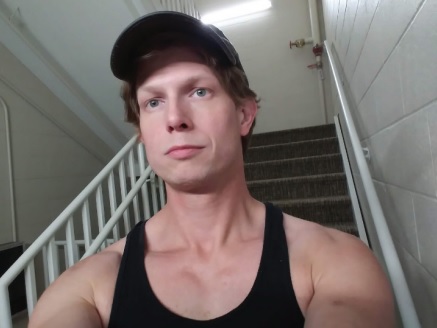
American Entropy is a collection of poetry that swings from political outcry to spiritual yearning, from queer love to existential doubt, and ignites readers’ desire to fight for what matters. What inspired you to write this particular collection of poems?
It was largely just paying attention to the news and seeing how every day, Trump is violating the Constitution, trying to force universities and museums to adopt right-wing propaganda and treat it as fact. Like all fascist authoritarians, Trump hates it when truths that contradict his lies proliferate, so I felt it important to do my part to tell those truths.
Doing it in a way that makes readers want to fight for what matters, rather than just dwelling on the darkness of modern American life, was important to me too, because if you don’t focus on what we still have, it becomes all too easy for people to give up.
The poems about love, metaphysical, spiritual topics, and queer love are all just examples of me writing what I know.
Your poetry tackles deeply emotional and politically volatile topics while also touching on hope for the future. How do you approach writing about deeply personal or emotional topics?
“Power through and write what’s true,” like it says in the poem “It’s Not Too Late.” I just get it out onto the page as accurately as I can before giving myself a chance to question how honest is too honest. I feel like if I’m too reserved in writing my poetry it won’t be as relatable, and the reader will be able to tell I’m holding something back, and it won’t foster empathy as much as I hope my work does by being unflinchingly honest.
How has this poetry book changed you as a writer, or what did you learn about yourself through writing it?
This book really crystalized for me that poetry is an important type of resistance, which is something I think my work has always been when it comes to fighting heteronormativity and homophobia and other bigotries, but this is the first time I’ve dedicated so much of any one poetry collection to raging against one corrupt administration and detailing all the ways it’s trampling our rights and waging war against the American people.
I’ve learned about myself that I really just don’t give up no matter what, and I can help others not give up either.
What is one thing that you hope readers take away from American Entropy?
That this isn’t normal, the way Trump is shredding the Constitution and speaking to our worst natures, and the way Republicans in Congress and conservative Supreme Court justices are complicit in enabling it. That it’s bigoted Nazi fascism, and we don’t have to just roll over and take it.
Author Links: GoodReads | Facebook | Website | Amazon
Through explorations of the metaphysical, religion, and relationships, the poems delve into both darkness and the light born of efforts to expand human consciousness. Despair is given unflinching witness, making the discovery of hope all the more profound. And love—raw, imperfect, and essential—is celebrated as a balm for our plugged-in yet detached modern lives.
If you’re disillusioned with an America sliding toward fascism and the strain it places on relationships, American Entropy may reignite your fire to keep fighting for what matters, keep loving, and hold faith in something greater than ourselves.
Purple Summer, Gray Fall
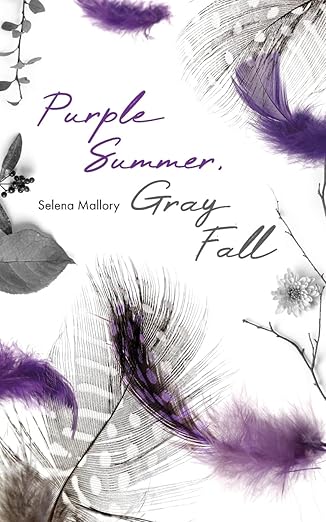
Selena Mallory’s Purple Summer, Gray Fall is a tender, raw, and often startling collection of poems that drifts between sunlight and shadow. The book is divided into two sections: “Purple Summer,” which hums with warmth, youth, and desire, and “Gray Fall,” which cools into introspection, loss, and renewal. Across both halves, Mallory writes with a confessional edge that feels both intimate and unguarded. Her voice slips easily between humor and ache, sensuality and solitude, all while painting vivid slices of womanhood, memory, and self-discovery. The poems read like diary entries whispered aloud on quiet evenings, revealing a life lived in color and reflection.
What I liked most about Mallory’s writing is its honesty. She doesn’t shy away from the awkward, the lustful, or the mundane. In one breath, she’s talking about shaving her legs for a Tinder date, and in the next, she’s describing grief, faith, or mental fatigue. That range feels human in a way poetry often forgets to be. Her language is unpretentious, even conversational at times, and that makes the emotional moments hit harder. The transitions from lighthearted pieces like “Shiny Hiney” to weightier ones such as “Sweat(H)er” are seamless, showing how closely joy and despair live beside each other. The humor never undercuts the pain; it just reminds you that both belong.
The collection’s imagery also carries a quiet rhythm. I loved how the “Purple Summer” poems glow with heat and motion, fields, sun, and laughter, while “Gray Fall” settles into stillness and introspection. There’s an arc of growing up here, or maybe just growing deeper into oneself. Mallory has a knack for turning everyday details into metaphors that linger, like the simple act of baking brownies or watching a storm. Her poems invite you to slow down and notice small, beautiful things, even when they hurt. Sometimes the structure feels loose, even meandering, but that looseness matches the emotional truth of the work. It’s messy, alive, and personal.
I’d recommend Purple Summer, Gray Fall to readers who love poetry that feels like conversation rather than performance. It’s perfect for anyone who’s ever laughed through heartbreak or found comfort in small, domestic rituals.
Pages: 56 | ISBN: 978-16629604444
American Entropy


Travis Hupp’s American Entropy is a gut-punch of a poetry collection that straddles rage, revelation, and redemption. The book unfolds across sections named for emotions, Anger, Politics, Metaphysical, Despair, Hope, and Love, each one a pulse of raw feeling. Hupp writes from the jagged edge of personal struggle and cultural collapse, his voice cracking with both fury and faith. The poems swing from political outcry to spiritual yearning, from queer love to existential doubt. It feels like watching someone fight off demons with words, sometimes literally, sometimes metaphorically, until the language itself starts to shimmer like something divine.
Reading Hupp’s work shook me up in the best way. His writing doesn’t just tell you what he’s feeling, it makes you feel it too. The anger is real, the despair palpable, and the hope stubbornly alive. His author’s note alone hit me hard. It’s this mix of confession and confrontation that sets the tone for the entire collection. There’s no pretense here. He talks about hearing voices, about spiritual warfare, about the cruelty of politics, and yet there’s a strange humor threaded through it all. The poems rage against Trumpism, systemic hate, and hypocrisy, but they also reach for angels and grace. His faith isn’t clean or easy, it’s a messy, miraculous survival instinct. That duality is what makes it powerful.
What I enjoyed most was how relatable it all felt. The writing doesn’t hide behind polish or perfect meter. It’s rough and raw and full of bite. Sometimes the rhythm stumbles, but that only makes it more alive. You can hear the exhaustion in his lines, the defiance, the flashes of tenderness. His metaphysical poems, especially, have this haunting, electric pulse that made me stop and reread. It’s poetry that talks back to God and politics in the same breath. I could feel his mind running hot, reaching for meaning in a country and a body both cracking under pressure.
I’d recommend American Entropy to anyone who’s ever felt overwhelmed by the noise of modern life and still wanted to believe in something good. It’s for readers who crave honesty over polish, for those who don’t mind poetry that bleeds on the page. Hupp’s voice is that rare mix of furious and forgiving, and by the end, I felt like I’d witnessed someone claw their way toward the light.
Pages: 231 | ASIN : B0FCD51KZG

The Right Inspiration

Whisk of Dust is a collection of poems that weave together themes of love, faith, struggle, and beauty. What inspired you to write this particular collection of poems?
I’m often inspired by simple things that others might take for granted. I found inspiration from different aspects of my life in writing this collection.
Were there any poems that were particularly difficult to write? If so, why?
None were difficult to write. With the right inspiration and motivation, the words were not difficult.
Did you write these poems with a specific audience in mind, or was it a more personal endeavor?
I like to think of this collection as universal. They are for anyone who can relate and or just enjoys poetry.
How has this poetry book changed you as a writer, or what did you learn about yourself through writing it?
There has been no change, my desire has always been and still is to inspire and uplift with my writing.
Author Links: GoodReads | X (Twitter) | YouTube | Amazon
Fairy Lights: Bed Time Poems & Gallery of Fairytale Art from Yesteryear

Fairy Lights is a wonderful collection of bedtime poems interwoven with fairy lore, myth, and timeless art. Moving through the seasons of the year, the book gathers stories of spirits, shape-shifters, ocean dwellers, elven royalty, and everyday enchantments. It draws from Irish, Nordic, Greek, and New World traditions, blending them into verses that feel both ancient and freshly spoken. Each section carries its own mood, from the playful revels of spring to the melancholy mysteries of autumn and the haunting stillness of winter. Alongside the words, the author curates a gallery of fairytale art from past centuries, which adds a lovely echo of history to the poetry.
What struck me most was the way the poems refused to be pinned down. They could be lyrical and delicate in one breath, then strange, even eerie, in the next. A piece like A Piece of Amber felt tender and tragic, like a whispered legend by firelight, while something like The Baallad of Blaackie Coal made me grin with its folkloric humor and Scots cadence. I loved how the writing carried me away from reason into a place where fairies still dance, seashells sing, and even the smallest bird is mourned with reverence. The language is musical and sometimes unpredictable. At times, I found myself rereading lines not because I needed to but because I wanted to savor the rhythm.
The author clearly delights in layering metaphor upon metaphor, which creates a rich tapestry. This very quality also gives the book its dreamlike atmosphere. It reminded me of wandering through a forest at dusk, you don’t always know what you’re seeing, but the mystery is the point. I also appreciated how personal some of the poems felt. Knowing that pieces like To Wee Russet Tuft came from real experiences gave the collection an intimacy that balanced out the more mythic material.
Fairy Lights feels like a gift for anyone who still listens for magic in the quiet hours. I would recommend it to readers who love fairytales, folklore, or poetry that doesn’t mind breaking free from neat structure. It’s especially suited for those who want to share stories aloud, whether with children at bedtime or with the inner child who still believes in hidden worlds.
Pages: 181 | ISBN : 0473742454



 LITERARY TITAN