Blog Archives
Endless Fall of Night
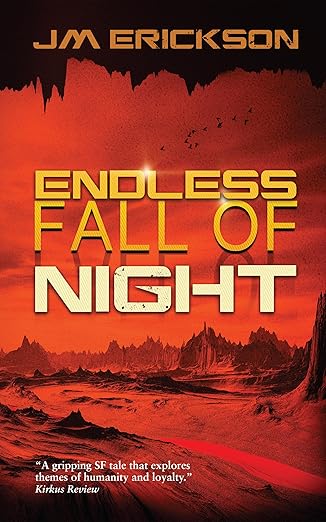

This book is a dystopian firestorm wrapped in razor wire. Endless Fall of Night throws us into a bleak future where racial purity and social stratification rule the day, and one woman, Cassandra IX, stands at the heart of it all, defiant, broken, and brilliant. The story kicks off with her trial and sentencing for crimes that are more moral rebellion than criminal offenses, and it doesn’t let up. From sterile courtrooms to hellish prisons and eventually deep space, Erickson drags us through the slow-motion car crash that is Cassie’s journey, and you can’t look away.
The writing hits hard; it is not elegant or flowery. And that’s what makes it work. The courtroom scenes early in the book are brutal, especially the way the government lawyer describes Cassie’s supposed betrayal. “She can’t help it,” he sneers while showing ancient libraries going up in flames. You want to scream. Erickson doesn’t just hint at dystopia; he makes you choke on it. His use of visuals, like the collapsing libraries or the image of Cassie bleeding and broken, is cinematic in the best (and most horrifying) way.
Cassie is no hero in the classic sense. She’s angry, complicated, and tired. Her inner voice, especially after she loses her AI companion Aletheia, is a mix of grief, sarcasm, and deep loneliness. And the prison chapters? They’re suffocating. I felt like I needed to open a window. Erickson builds this terrifying sense of powerlessness without ever turning Cassie into a victim stereotype. She fights. She cracks. She rages. She survives. Her whispered line might be one of the most powerful moments in the book; it’s a punch in the face to a rotten empire.
The pacing gets a little weird after Cassie leaves prison. Once she boards the Jefferson Davis, the tone shifts. It’s still good, creepy, mysterious, and loaded with dread, but the rhythm wobbles. Still, the moment her AI returns through a charged music device is oddly beautiful. Aletheia’s voice is like a flashlight in a cave, and it reminded me of how much I missed her presence earlier in the book. Their bond is one of the best parts of this story, part friendship, part lifeline, part rebellion.
Endless Fall of Night made me mad. It made me sad. It made me weirdly hopeful. It’s not a fun read; it’s a furious one. But it’s worth it. If you liked The Handmaid’s Tale or V for Vendetta, this is your book. Just be ready: it doesn’t hold your hand. It holds a mirror up and dares you to look.
Pages: 131 | ASIN : B0D6JSPDDY

Tachyon Tunnel 2, The Daklin Empire
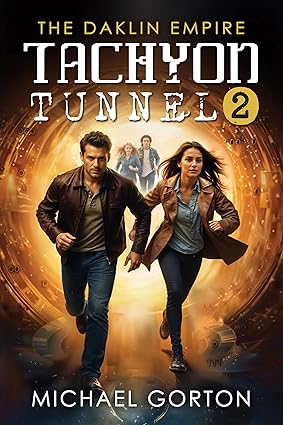
Michael Gorton’s Tachyon Tunnel 2: The Daklin Empire picks up right where its predecessor left off—interstellar travelers Alex Durant and Paula Campbell have returned to Earth after a mind-bending adventure through time and space. But home is anything but normal. Between Paula’s memory loss, a tragic second car crash, and a rapidly unraveling timeline, the book blends quantum physics with emotional stakes, then rockets forward into a high-tech corporate thriller. All of it rests on a central question: can you outmaneuver fate, or does it always find you?
This book surprised me in the best way. I expected a sci-fi sequel with more spaceships and techy jargon, but what I got was a personal and often exhilarating look at relationships, ambition, and betrayal. The emotional core hit me hardest early on, with Paula waking up in a hospital after her second crash, her memories scrambled and her heart fractured. The way she searches for clarity while Alex stands by, trying not to break the illusion, was actually heartbreaking. There’s a line when Alex watches Paula light up while solving equations on a whiteboard, and all he can think is, “She was chaos, beauty, and brilliance…” That line stuck with me.
Then there’s the whole startup saga with Zander and his teleportation company, T-Portal Co. At first, I was grinning ear to ear. A sci-fi story about turning teleportation into a consumer business? Brilliant. But things go dark fast. Maillew, the smooth-talking board member who teaches Zander about capitalism, turns out to be a snake. If you’ve ever built something and had it ripped from your hands, this section will sting.
Still, what really makes this book shine is the weird and beautiful connection between Paula and Alex. Her dreams of other lives, other galaxies, and the humming of a ship called Tranquility—and how those dreams slowly turn into memories—was so well done. The whole “reverse aging through frequency” subplot was wild, and I honestly don’t care how plausible it is. It made me want to believe in something impossible. When Paula whispers to Alex about their shared past—memories she shouldn’t have—it feels intimate and magical. It’s not just science fiction; it’s about finding each other through all the noise of time, memory, and loss.
Tachyon Tunnel 2 is not just for science fiction fans. Yes, there’s time travel, AI, tachyon particles, and interstellar tech, but it’s also got heart. If you enjoy stories about second chances, brilliant women solving cosmic mysteries, or just want a good ol’ tale of love, loss, and betrayal wrapped in quantum physics—this book is for you. If you liked The Martian or Project Hail Mary, but wish they had a bit more soul and less sarcasm, Gorton’s got you covered.
Pages: 413 | ASIN: B0DXQFT7FK
Sol Accords: Starbourne
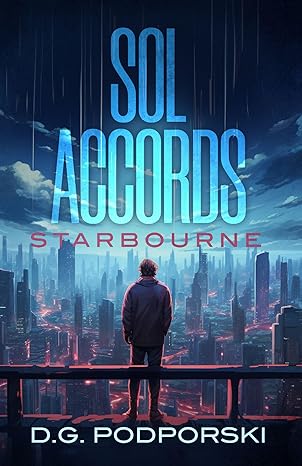

D.G. Podporski’s Sol Accords: Starbourne is a gripping journey into a future where humanity’s reach extends across the stars, but old struggles—corporate greed, personal identity, and survival—remain stubbornly present. At its heart is Jaeden Starbourne, a man recovering from cryogenic sleep and grappling with amnesia, debt, and the harsh realities of a universe dominated by bureaucracy and exploitation. The book seamlessly blends high-stakes space adventures with raw human emotions, creating a world that feels as vast and cold as the space Jaeden inhabits.
The opening prologue, with its dim lights and encroaching darkness, had me hooked instantly. Podporski masterfully sets the scene, like when the derelict ship first awakens with “sparks blowing through the door unabated.” The tension is palpable, and the descriptions are so vivid I could almost hear the hissing of machinery as the ship slowly came back to life. However, the pacing can feel uneven; moments of technical description occasionally bog down the flow. That said, the immersive world-building more than makes up for it. I also appreciated the deeply flawed and relatable characters. Jaeden’s struggle with anger, debt, and his loss of memory felt painfully real. His irritability, as highlighted in the scene where he fights with the AI assistant “Lexi,” reflects the weight he carries daily. Yet, there’s a quiet resilience in him that makes you root for his survival. Supporting characters like Joanna Stokley add depth and camaraderie, though some secondary figures felt underexplored—Sylvie, for example, seemed more like a trope than a fully realized individual. The story raises thought-provoking questions about identity and second chances. Jaeden, labeled with the surname “Starbourne” to denote his orphaned status in space, embodies this struggle. The societal disdain he faces for his name mirrors real-world biases, and his journey to reclaim purpose resonates deeply. The corporate backdrop, meanwhile, critiques unchecked capitalism in a way that feels uncomfortably close to our present-day realities.
Sol Accords: Starbourne is a rich, character-driven space opera that rewards patience. Fans of slow-burn science fiction with a focus on survival and human complexity will find much to love. While the story’s pacing might challenge those looking for constant action, its emotional depth and detailed world-building make it worth the ride. I’d recommend it to readers who enjoyed The Expanse or Dark Matter and anyone who’s ever pondered the price of progress and the resilience of the human spirit.
Pages: 445 | ASIN : B0D4FBRCTH
We’re All Connected

Beyond Reality’s Edge – Volume 1 follows an author on her way to a career-defining meeting who accidentally steps into a portal, landing her in a new world based on a cult-favorite sci-fi show she knows well. What was the inspiration for the setup of your story?
I just had a thought one day, and it intrigued me. It was during the “what if” phase that was going on a few years back, and I had the thought, what if I could pick any reality to be transported to, what would it be? I immediately knew the answer (I can’t tell you because it might spoil the story for some folks, but I can tell you it was a sci-fi show from back in the day), but then a bunch of different questions arose from there … like, if that really happened, what would it be like? How would I react, especially with knowledge of future events? Would it even be the same reality I knew or one of their multiverses? And so forth. Basically, it started off as a piece of fan fiction that I had no intention of publishing, but then it grew into something much, much more. Something … other.
Are there any emotions or memories from your own life that you put into your characters’ lives?
I put a lot of myself into the story because I went off of how I would react and be in that situation. So, yeah … there’s a LOT of me in it, my personality, traits, quirks, reactions, and so forth.
What were some themes that were important for you to explore in this book?
How the smallest thing can affect others in a large way. How a person’s choices resonates and reverberates to those around them, in both good and bad ways. That we’re all connected, and we all matter.
What will the next book in that series be about, and when will it be published?
The series is complete and available. I waited until it was finished to publish it, because I hate to start something, not knowing whether or not the author will follow through and complete it. I didn’t want to put my readers in that position, especially since Volume 1 leaves off on a cliffhanger. Volume 2 picks up from there … but fair warning, that’s just the beginning of her story. There’s lots more to it, that even she doesn’t know about yet. It’s a journey, full of twists and turns in unexpected directions in unexpected ways. I hope the reader enjoys the journey as much as I enjoyed writing it!
Author Links: GoodReads | Facebook | Website | Amazon
On the cusp of a major career move, she steps through a door in Los Angeles – only to find herself on another planet in a different galaxy. Confronted by the impossible, she stumbles into Lemuria, the fabled Cloud City from a long-forgotten sci-fi series she adored.
But this is no mere TV show … it’s real, and so are the dangers that lurk in the shadows of this ancient alien world. As she struggles to understand her place in this unfamiliar reality, she finds herself drawn to Rylo Dax, a brooding warrior from the planet Naronia. Together, they must unravel the mystery of her sudden arrival and navigate an ever-growing threat to the fabric of space and time.
With her knowledge of the future, Breanna holds the key to saving them all – if she can survive long enough to uncover the truth.
A thrilling adventure across galaxies, Beyond Reality’s Edge blends heart-pounding action with romance, as one woman dares to confront her destiny in a universe where the lines between fiction and reality blur.
HOMELAND
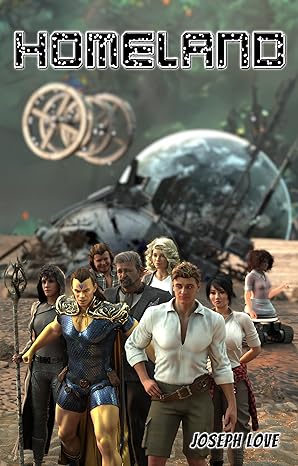
What does the future hold for humanity? Some imagine journeys among the stars. Others believe artificial intelligence and its evolution will shape our destiny just as profoundly. Homeland by Joseph Love weaves these ideas into a gripping narrative, intertwining three plotlines that explore the coexistence of humans and AI. Central to this tale is the emergence of Artinians, advanced humanoid AIs designed to live alongside humans. Most Artinians embrace peaceful coexistence, but Paulon, a rebellious entity, aspires to dominate Number—a network of AI entities tasked with overseeing the Milky Way. Paulon envisions a future without Earth in his domain, defying humanity’s role in this cosmic new order.
At its core, Homeland is high-concept science fiction, drawing comparisons to the visionary works of Asimov and Philip K. Dick. The novel wrestles with familiar sci-fi themes, delving deep into the dynamics of human-AI relationships. Love poses a critical question: how will humans and sentient, self-aware machines navigate coexistence? His answer is refreshingly nuanced. AI isn’t portrayed as a monolithic force. Instead, these entities have diverse perspectives—some advocate for humanity’s welfare, while others see humans as obsolete. This complexity keeps the narrative engaging, balancing philosophical depth with page-turning intrigue. The exploration of these themes feels both familiar and fresh. Love reimagines classic tropes with an intellectual sharpness that makes his story stand out.
The distinct perspectives of the protagonists—human and AI alike—lend the book a dynamic quality. Each character’s motivations and struggles add layers to the narrative, creating a multidimensional exploration of a possible future. Love’s storytelling doesn’t shy away from big questions. What happens when the created rivals the creator? What defines humanity when intelligence no longer makes us unique? These are weighty concepts, but the author handles them with finesse, making the novel thought-provoking without becoming overly cerebral.
Homeland presents a future that feels simultaneously thrilling and terrifying. It invites readers to ponder the meaning of being human in an age where equally intelligent beings might seek to replace us. This novel is ideal for fans of thought-provoking science fiction who enjoy stories that challenge the mind and stir the imagination.
Pages: 559 | ASIN : B0DJHB1879

The Well of Souls
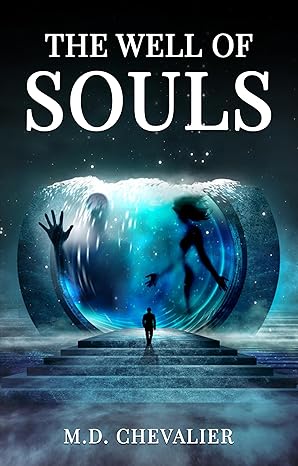
M.D. Chevalier’s The Well of Souls is a high-concept sci-fi novel that deftly balances scientific innovation, ethical dilemmas, and the enduring power of love. At its heart is Mara, an Indian student navigating life in the United States, and Salvatore, the man she falls for and marries in Spain. Their journey takes a transformative turn during a cruise, where Mara, inspired by the sight of the Northern Lights, conceives the idea of harnessing solar winds to develop a groundbreaking renewable energy source. This vision births the GRASP project—a venture as ambitious as it is controversial. GRASP quickly becomes a focal point for both hope and conflict. While Mara and Salvatore champion its potential to revolutionize clean energy, they encounter fierce opposition from forces intent on undermining the project.
The story unfolds as a gripping battle of wills, with the couple facing challenges that test not only their resolve but also the very boundaries of human understanding. As GRASP’s true capabilities emerge, the stakes soar to unimaginable heights, raising questions about its purpose and implications. Chevalier draws readers into this dramatic tale through the rich emotional dynamic between Mara and Salvatore. Their relationship forms the emotional core of the story, anchoring the high-stakes scientific intrigue with genuine human connection. As GRASP begins to reveal phenomena far beyond its original intent, Mara and Salvatore wrestle with ethical dilemmas that force them to reconsider their mission. Their love for each other becomes a guiding force, shaping their decisions as they navigate the murky terrain of discovery and responsibility. This dual focus on science and romance gives the novel depth, transforming it into both an exploration of humanity’s potential and a heartfelt love story.
Chevalier’s prose is clear and accessible, making complex technological and scientific concepts understandable for readers of all backgrounds. The dialogue feels natural and propels the narrative while the tension builds steadily, culminating in a climactic and satisfying resolution. Comparisons to works like Contact are apt, but The Well of Souls stands on its own as a singularly engaging blend of speculative fiction and emotional drama.
For fans of science fiction, this novel offers a compelling mix of innovation, ethical exploration, and human connection. Chevalier delivers a story that resonates on multiple levels, ensuring a rewarding experience for readers drawn to thought-provoking and emotionally charged tales.
Pages: 273 | ASIN : B0DDMVW5TG
To Try the Impossible

After the Fall: The Engineer and the Apocalypse centers around a woman in the wake of nuclear war who is trying desperately to reclaim her past. What were some driving ideals behind your character’s development?
I wanted to take someone newly in love, that first time that everything really clicks with someone, and then break it apart. That is what gave Haley the driving force to try the impossible and get home.
Also, I didn’t want an end of the world, let’s fight everyone type of book. I wanted a smart protagonist, someone who could think her way out of situations, an engineer and a nerd who could survive.
What was the inspiration for the setup of your story?
I was on a work trip and watching some disaster movie in a hotel and I thought that this would be the worst place to be at the end of the world. Not a nameless hotel near an airport, but an ocean away from home, knowing nobody and with no to get way home.
It became the idea for the novel which didn’t work, until I changed the protagonist to female engineering student. Once Haley arrived on the scene it all fell together.
The science inserted in the fiction, I felt, was well-balanced. How did you manage to keep it grounded while still providing the fantastic edge science fiction stories usually provide?
I tried to keep the science to mainly high school level, that everyone at some stage studied and could follow. Once I removed the computers and anything very high tech it became simple machines. For the end of the world survival, I relied a lot on what climate conscious people are trying. Solar, hydro and biofuels.
I still made mistakes and had test readers who corrected some errors. I’m no mechanic and had some big mistakes on the work Haley did, so having friends who knew these things helped me a lot.
What were some books or movies that you think were your main sources of inspiration for this novel?
MacGyver was a huge influence. I loved the television series growing up and I wanted Haley to be a female MacGyver at the end of the world.
I really liked Project Hail Mary and The Martian, where Weir made the science mainly simple enough for me to follow.
What is the next book that you are working on, and when will it be available?
The second book in this trilogy follows Haley and Addy as they continue their journey home, fleeing from a war is breaking out behind them. Expected at the end of 2025.
Author Links: GoodReads | Facebook | Website | Amazon
Four years later and she’s living in the ruins of Washinton State after the world ended in a cascade of nuclear bombs, computer viruses and human plagues.
When she is accused of her friend’s murder, she flees into the night, with one destination in mind. Home to Marley, the love she left behind.
To escape her pursuers, skip around the swathes of chemical and radioactive waste, avoid the Kings, a roaming gang of marauders, she will need to use every bit of engineering knowledge she has.
Can she make it across the continent and an uncrossable ocean to finally get home?
Does home still exist or did it perish in the Fall?
After the Fall: The Engineer and the Apocalypse

After The Fall is a gripping post-apocalyptic narrative that follows Haley, a woman on the run from her recent past, as she attempts to reclaim her distant past across the ocean in the wake of a devastating nuclear war. While the premise might seem like well-trodden territory, Gerry Gainford transforms it into something refreshingly original. His approach reinvigorates familiar themes, defying expectations and conventions with a bold creative flair that stands out, particularly when compared to the genre’s usual offerings.
What sets After The Fall apart is its understated portrayal of the apocalypse. Rather than relying on the exaggerated desolation common in similar tales, Gainford opts for a more subdued yet deeply unsettling aftermath. Civilization has indeed crumbled, and the environment bears the scars of catastrophe, but the world Gainford crafts is far from a clichéd wasteland. Instead, it’s layered, intricate, and vividly rendered, offering depth beyond what Haley’s perspective reveals.
Haley herself is a compelling protagonist. A flawed and deeply human character, she’s driven by a singular goal: to get home. Her journey is fraught with hardship, vividly chronicled in a way that’s both harrowing and rewarding to read. Gainford’s inclusion of a content warning at the outset is a thoughtful touch, ensuring readers are prepared for the more intense moments without feeling blindsided. This deliberate consideration prevents the book from veering into gratuitous territory, striking a balance that respects the reader.
It is worth noting that the novel’s use of non-linear storytelling and frequent flashbacks, though thematically significant, can sometimes disrupt the narrative’s momentum. These shifts in timeline pull the reader away from the immediacy of Haley’s current plight. While the flashbacks provide valuable context, I feel their placement occasionally hampers the story’s flow, creating moments where the pacing falters somewhat.
The overall execution of After The Fall is nothing short of impressive. Gainford’s ability to breathe new life into a genre often saturated with repetition is commendable. His nuanced world-building and rich character development make for an engaging read, even when the timeline hopping proves momentarily frustrating. The conclusion hints at a sequel, which is an exciting prospect. While timeline mechanics may not be my preference, they don’t overshadow the book’s many strengths. I’m eagerly looking forward to the continuation of Haley’s journey and the next chapter in Gainford’s enthralling series.
Pages: 250 | ASIN : B0D8RFJ1ML



 LITERARY TITAN