Blog Archives
Arcanoforge: Midnight Metropolis


Arcanoforge: Midnight Metropolis is a feverish plunge into the neon-choked streets of Noctara City, a dystopian sprawl where humans and husks, ghosts and hemo magicians blur into a single, strange pulse. The story follows Tattie, a blood seer who’s fled her dying homeworld, and Brax, the man who tracks her across galaxies as their shared past claws its way back into the present. Around them spin a chorus of restless lives, skaterats, dealers, dreamers, all caught in the thrumming heart of a city that feels alive and dying at once. It’s part cyberpunk, part occult noir, and part heartbreak.
The writing is gritty, poetic, and weirdly tender. Author Caroline Barnard-Smith doesn’t just describe Noctara, she burns it into your head with words. Every street and shadow has its own personality, every conversation crackles like static. I loved how the world felt handmade, patched together with old wires and bad memories. The characters stumble through it broken and fierce, never really heroes, just people trying to stay one step ahead of decay. The prose leans heavily on texture, smells, lights, and sounds, and it builds a rhythm that makes the whole book feel like a song played through busted speakers. Sometimes it’s overwhelming, but in the best way.
There’s this deep ache about survival, about what we lose when the world stops caring. I kept thinking about the husks, these half-human enforcers who’ve traded pain for obedience, and how much that says about our own craving for numbness. And Tattie, she’s messy, angry, brilliant. I believed every choice she made, even when it hurt to watch. The story toys with power, guilt, and the ghosts that cling to love long after it’s gone.
Arcanoforge: Midnight Metropolis reads like Blade Runner crashed into The City & The City with a shot of Neuromancer’s grit and the bruised heart of a Becky Chambers story. I’d recommend it to anyone who loves science fiction that’s soaked in mood and grit. Fans of Gibson and VanderMeer will feel right at home. If you like your futures dark and your magic dirty, if you want to taste the metal in the air, this book’s for you.
Pages: 278 | ASIN : B0FFH6BS5L

Cold Blooded
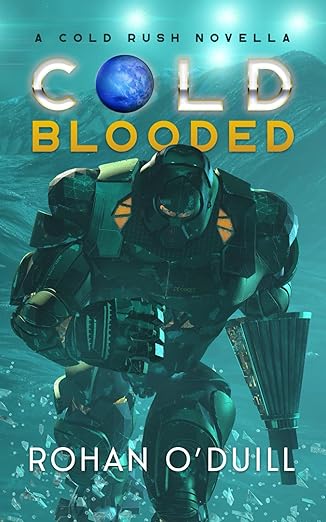
Cold Blooded by Rohan O’Duill transports readers to a vividly imagined future where corporate powers dominate the solar system, wielding unparalleled influence. At the heart of this dynamic setting is Mint, a skilled yet detached marine mech pilot. Once content as an instructor, she is thrust back into action, navigating the chaos of the “Cold Rushes.” Her journey takes an unexpected turn when she reunites with her former colleague, Bjorn—now a pirate—and his spirited daughter, Frida. Unexpectedly, Mint finds herself as Frida’s reluctant guardian, forcing her to balance survival, loyalty to her friend, and her obligations to her corporate overlords.
What sets Cold Blooded apart is its remarkable ability to function both as a prequel and as a self-contained narrative. Striking a delicate balance, the story seamlessly establishes a foundation for the larger series while delivering a complete and compelling tale in its own right. Far from feeling like a mere setup, the book captivates with dynamic characters, unpredictable plot twists, and gripping conflicts. O’Duill’s storytelling ensures that Cold Blooded stands firmly on its own, an achievement worthy of high praise. Equally impressive is the depth and intricacy of the book’s science fiction elements. The richly detailed futuristic worlds, advanced technologies, and innovative equipment are described with a precision that immerses the reader. Every aspect of this universe feels meticulously crafted, reflecting the author’s dedication to thoughtful world-building. The result is a setting that feels authentic and alive, adding a tangible sense of realism to the narrative.
Cold Blooded by Rohan O’Duill offers a thrilling blend of fast-paced action and intricate science fiction, making it an ideal pick for fans of the genre. Whether you’re new to O’Duill’s work or already familiar with his universe, this novel delivers an engaging and satisfying experience. Highly recommended for readers who crave immersive storytelling and high-stakes adventure.
Pages: 304 | ASIN : B0D9TY1V5N

Isn’t that why any of us write?

The Intrepid: Dawn of the Interstellar Age follows two space crews investigating a potential planet for colonization who discovers a mystery that could alter the course of the human race. What was the inspiration for your story?
It is a big challenge, sitting down to construct a story world and a plot that are not only compelling and fresh but that also have something meaningful to say. My initial inspiration was not for the story itself; it was to write a story that could express the ideas that I believe are the most important for us to be thinking and talking about, as Earthlings. Of course, I then had to find inspiration for the actual story.
I wanted to write hard sci-fi that was as scientifically accurate as possible because, as a scientist, it often bothers me how Han Solo and Captain Kirk manage to avoid the effects that Relativity should have on their relationships with everyone in their lives who is not traveling with them — or aging at the same rate.
I am also passionate about science and believe in promoting scientific literacy. While my background does include the entertainment and technology industries, I was also a science teacher for over a decade, teaching Chemistry and Environmental Science. I am also the co-founder of an international scientific think-tank called The Quantum Bicycle Society (Quicycle.com), where we are making interesting progress in understanding the electron and magnetism at the sub-quantum level. So I wanted my science fiction to reflect the most up-to-date scientific concepts, as well as to show how cool, interesting, and intuitive so many aspects of real science and engineering can be. In fact, I sometimes like to call this S.T.E.M. fiction rather than science fiction.
When it came to the story itself, I wanted one that was not only fun, surprising, and compelling, but that also spoke loudly to many of the central issues surrounding our humanity and the global socio-economic and geo-political interactions that shape our world — today and moving into the future. Human nature and the state of our race is something I have been contemplating for many years. It is the subject of a non-fiction book that I hope to release soon, called The Animal In The Mirror. In it, I seek to unmask our instinctive nature and the way that our fears and emotions govern our thoughts and actions. It is the precise cause of all of our individual and societal dysfunction, and creating a story world provides a wonderful opportunity to present such a message exactly the way I want to say it. In my estimation, the truth of our biological nature is the single most important message about humanity that humanity needs to hear. It is the reason I am writing The Animal In The Mirror, and it is also the reason I wrote this novel.
Although I had not intended to write novels at all, I very much do intend to put these ideas out into the world. A novel seemed like one more logical avenue to employ for the purpose. It also allows these ideas to be presented to those who might not pick up a non-fiction book about human behavior and its evolution as soon as they would an interesting sci-fi novel.
I wanted my story world to bring together some of my favorite sci-fi elements, to write the kind of sci-fi that I would enjoy to read (or watch). I’m a big fan of Asimov, of movies like Contact or Passengers, and shows like The Expanse. My main concern was that it is difficult to approach story elements like the existence of extra-terrestrial civilizations or space colonization without it becoming cliched, cheesy, or implausible, and I really wanted to avoid that if I could.
That is why I decided to write about what our world might be like in 50 years from now, what might be in store for us en route to that future, and how we might react as we reach towards the stars. In reality, how will we humans approach such an interstellar step? Will we manage to achieve and to maintain a stable and peaceful world order? Or will our biological nature get the better of us?
And what if, on our journey, we encountered something REALLY unexpected?
The science inserted in the fiction, I felt, was well-balanced. How did you manage to keep it grounded while still providing the fantastic edge science fiction stories usually provide?
Firstly, thank you. I appreciate you describing it like that. I think a gripping story can occur in the context of any level of science or technology. As a long-time fan of NASA, I wanted to explore what it might be like — what it might really be like — on the first manned mission of exploration to the closest star system — Proxima Centauri, and without employing any ‘fantastical’ science. (Except for one or two story details, like the propulsion speed, for example, but even that I attempted to base upon real physics concepts.)
As I mentioned before, one of the reasons for writing this book was not only to promote scientific literacy but also to bring more attention to the scientific breakthroughs made by members of our Quicycle group. In addition, as a science teacher, I always prided myself on being able to convey scientific concepts in an intuitive and compelling way, making them accessible even to those who don’t see themselves as the ‘science type.’ Science is, after all, a description of the universe around us, and the cosmos is nothing if not super interesting. And science should be intuitive; our own experiences of the world should enable us to relate to the concepts. The fact that many people don’t know the parametric equations that describe a sphere does not mean that they do not have a clear understanding of exactly what a sphere is.
So I don’t think sci-fi needs to dumb down the science in order to be compelling. I think, science is so cool that, if it is incorporated correctly, it can make the story even more compelling. That was my hope. The fact that you asked how I managed to keep it grounded and well-balanced makes me very happy that, at least in your estimation, I succeeded.
What were some themes that were important for you to explore in this book?
The most important theme was how we humans must evolve our behavior and consciousness in spite of our biology — in spite of the fear-based emotional imperatives that hold us back and slow our (psychological) progress, no matter our technological advances. If we choose to, we can evolve our society far more quickly and far less painfully than our instinctive nature would otherwise cause us to endure. But in order to choose it, we must first recognize and accept it.
There are also many misconceptions and unscientific ideas that pervade popular culture regarding important scientific ideas. One example is the Big Bang. It is an idea that violates many basic laws of physics, yet has become a fixed idea — dare I say, a dogma — in the minds of many scientists, and as a result, in the minds of the layman. Fortunately, observations of the James Webb Space Telescope are helping to change that. I also believe it is important that we all understand that our instinctive nature affects our science as much as it affects any other arena of human thought and interaction. It affects our biases and perspectives, and when money or influence are at stake, they corrupt the efficacy of our science. It would be naive to pretend otherwise.
To me, one of the most important things to be concerned with in this life is our deeper purpose. In this book, I try to explore that question on a larger scale. Is it about biological evolution, the evolution of consciousness, or even the idea of galactic community?
It is my deepest hope that, after finishing this book, the reader will continue thinking about it for a long time to come.
Isn’t that why any of us write?
Will this novel be the start of a series or are you working on a different story?
I am very pleased with the way this story world came out. It presents many possible opportunities for sequels and prequels. I have started putting some ideas together for a sequel, and I find the prequel idea also quite compelling. As I mentioned above, I am also working on the non-fiction book about human behavior, The Animal In The Mirror, and I hope to have that finished soon. (I have never found it easy to focus on only one thing. There are just far too many fascinating things out there!)
Author Links: Website | GoodReads | Facebook | Twitter
3rd place Winner, 2023 London Book Festival Awards (Science Fiction)
When crews on the first two interstellar missions confront the same confounding mystery, their dispute over what it means could alter the trajectory of the entire human race.
Thirty years after the last war, in a world of plentiful energy, Lunar and Mars bases, and a global federation of nations, an international crew of exceptional men and women sets out to explore the closest potentially habitable planet in the Alpha Centauri star system.
The stakes become elevated by the unexplained presence of another ship from the solar system, a ship with weapons. When the two crews interpret a perplexing find on the surface quite differently, it brings them into a conflict that threatens to lead to a nuclear showdown — with consequences more far-reaching than they could have imagined.
They may be over 4 light years from Earth, but the implications could not hit closer to home.
And they are too far away for two-way communication.
More than just another space saga, this wild, hard sci-fi ensemble drama (with a touch of romance) digs deep into human nature and the animal instinct that keeps us from elevating our existence. The only question left — is humanity doomed to repeat its mistakes, or are we ready to take the next crucial step?
Forcing Him To Make Hard Choices

Cargo 3120: Ties that Bind follows a retired mercenary on one last mission, which ends up in the middle of a galactic power struggle to control the new energy source. What was the inspiration for the setup of your story?
The efforts to find viable alternative energy sources for fossil fuels in our world today was a major part of that inspiration. For our story, the creative team, Daymond C. Roman, Lloyd Walker Jr., and I wanted to raise the stakes. In our universe, the powers that be left the energy crisis unaddressed for far too long. Now, the need for a new energy source is critical, as countless terraformed planets and moons across the galaxy are in jeopardy. Specifically, the technology that these planets rely upon to maintain their modified atmospheres are on the verge of failing due to the growing scarcity of the existing energy source: Krillium Ore. In Cargo 3120, Marcus finds himself caught in the middle of that power struggle, forcing him to make hard choices that will forever change his life, and the life of his family.
Captain Marcus La’Dek endures a great deal in this novel and has to make difficult choices at times. What were some driving ideals behind your character’s development?
Our goal for character development for Marcus, as well as the rest of the characters, was very simple. We wanted to make characters that feel real, even though they exist in the distant future. The reason for this was so the readers would hopefully make a real connection with them, and would want to follow them throughout the series. We didn’t want an action hero that existed for the sake of just being an action hero. Likewise, we didn’t want villains that existed for the sake of being “the bad guy”. In the case of Marcus, while he does have skills from his former occupation, he also has many things in his life that drive him to do the things that he does. He’s not perfect. I believe that Marcus having these flaws is something to which we all can relate, thereby making him feel more “real” in the process.
What were some themes that were important for you to explore in this book?
As I started writing the book, I wasn’t shooting for any specific theme. I just wanted to tell the story the way I saw and heard it in my head. However, there were a number of themes that did emerge during the course of telling the story. Themes such as the power of family bonds, love, redemption, and even forgiveness. But there were also other themes that emerged, such as revenge, betrayal, and the fact that our actions have consequences. And that in the end, you have to step up and take responsibility for your actions.
Where does the next book in the series take the characters?
Because cargo 3120 is intended to be an ongoing series, the second book will pick up where the first book ended. It’s difficult to tell you exactly what happens without giving anything away, but what I can say is that the next book largely takes place on the war torn planet of Bion IV, the home world of one of the characters. I intended to release book two last year, but due to health and other personal reasons, I was unable to meet that goal. The good news is that I’m back on track, with plans to release the book this year. And I want everyone to know that I’m working hard to make sure that the second book (subtitled: “Severed Ties”), will be worth the wait.
Author Links: GoodReads | Twitter | Facebook | Website
Fans of Star Wars, Dune, and Star Trek buckle up…
…because there’s another intergalactic franchise that’s about to suck you into a futuristic adventure like you’ve never experienced before!
The year is 3120 and the Milky Way is in turmoil. Each alien race, including humans, is fighting over the scraps of what’s left of Krillium, the current energy source.
But there’s a new source of energy on the horizon: Ladium Crystals…
…And that’s about to change everything as the powers of the universe jockey for control, knowing whoever gets control of this precious resource will reign supreme within the galaxy.
It all starts when Captain Marcus La’Dek, a retired mercenary fulfilling one last mission to help his old buddies, unknowingly finds himself right smack in the middle of this galactic power struggle when he transports mysterious CARGO to the outer reaches of the stars.
If you’ve been searching for the next big book, this is it!
This action-packed science fiction novel is a high-octane, fast-moving adventure that will literally reach out and grab your attention from chapter one and not let you catch your breath until you’ve reached the last page!
Cargo 3120: Ties that Bind has received multiple honorable mentions:
Honorable Mention – 2022 Beach Book Festival
Honorable Mention – 2022 San Francisco Book Festival
Did I Accomplish Everything I Set Out To Do?
Waltzing Matilda follows Captain Delahaye and her crew as they race against time to save their missing crew member from becoming a source of destruction while navigating the dangerous and revolutionary-filled asteroid Scrapheap. Were you able to accomplish everything you set out to with this series?
The Matilda Series was as much an adventure for me as it was for the characters! Its universe grew much larger than I had initially expected, and far stranger things were afoot than I could have dreamed at the beginning. Writing these characters and their story exceeded everything I thought I was capable of as a writer. Did I accomplish everything I set out to do? I didn’t even know how much there was to tell until it was all said and done!
If you could have dinner with any character from the Matilda series, who would it be and why?
Oh my, what a fun question! Just for the sheer food journey alone, it would have to be Anton Roane! His knowledge of foods is astounding and his excitement in sharing what he knows would be worth the price of admission. After that, it would have to be Luli Qing as she is a food lover, bar none! And any time spent with Luli will always be a blast.
What was the most challenging aspect of writing the final book in the Matilda series, and how did you overcome it?
Waltzing Matilda was easily the toughest book in the series for me to write. I think I restarted it from zero at least five times. Never mind that the middle was ‘Frankensteined’ together at one point before being entirely replaced. But each time there was always something missing or that didn’t flow the way I wanted it to.
How did I get through it? Perseverance, blood, sweat, and tears. And a whole lot of editing! To be honest, it finally came together through the first set of editing as I could finally see those bits that were missing or didn’t fit or were just plain wrong.
The funniest part (to me) is I knew the ending before I even really knew the beginning of the whole series! And the ending I wrote doesn’t even really resemble what I started with. By the way, this ending is hundreds of times better and I am way more pleased with the how characters and the story progressed from that initial kernel.
Do you have any plans to write more sci-fi novels in the future, and if so, can you give us a sneak peek into what we can expect?
After the long journey on the Matilda, I plan to step back from sci-fi for a bit. I have this crazy old wizard that loves grits and beer who desperately wants to go on an adventure, and I’ve put him off long enough.
But even before I hop into that fantastical world, I’ll be saddling up for another Western novella or two with the Nun with a Gun!
But I will come back to sci-fi. There are more stories to tell in Consortium space. I can already hear Mr. Leon and the genorgs knocking at my door with something to say.
Author Links: GoodReads | Twitter | Facebook | Website
Smuggler. Fugitive. Cyborg. Bounty Hunter. Ex-Freedom Fighter. Butcher.
Far off into the future in a distant part of the galaxy, the Consortium controls the human colonies held together by the jump gates. Where the Consortium doesn’t hold sway, crime flourishes. Through the use of a hellish engine that goes where no one should, the crew of the Matilda slips its way between the two. But now they’re stuck on a backwater asteroid and time is running out.
Rumors drift of jump gates falling to rebel forces while other systems succumb to the alien invasion. The crew knows where Galena is being held but have no way to get there. Making dark deals in the folds may get them a way out.
Will the terrors from outside space lay claim to more systems? Can the insurrection prevail? With the universe against them, can Jacquotte Delahaye rescue Galena from this war-torn galaxy?
Loosen that pistol in your holster and prepare for the fifth and final book of the series, Waltzing Matilda.
Waltzing Matilda

Captain Delahaye and the rest of the crew of the Matilda are back for more adventures across space. Waltzing Matilda by Jon Gray Lang is the fifth and final book of the Matilda series, an exhilirating science fiction story that holds intrigue and entertainment from beginning to end. The crew of the Matilda doesn’t seem to have much time to rest, always ending up in the most unexpected and dangerous places. This time, they find themselves on an asteroid named the Scrapheap, a place filled with pirates, smugglers and many others that have the primary intent of avoiding the eye of the Consortium. Their mission is to find their missing crew member, Galena Chadov, a genorg who has been trapped and might become, against her own will, a source of complete destruction. A revolutionary sentiment keeps growing, ignited by the unjust treatment given to genorgs. Galena’s strange tendencies flourish again in this book, and the plot thickens as we see her fight with unknown entities deep inside her mind. War is approaching and unsure who to trust, the Matilda crew remains strong, relying on each other to protect who they care the most for.
Author Jon Gray Lang is a consistently entertaining writer. The book was fantastic and maintained the theme of the other books in the series. It all reads as a set of numerous adventures that the Matilda crew must partake in to fight for what they believe in and save one another. As the conflict between the humans and the genorg populations becomes more troublesome, the members of the Matilda are there to showcase the complex and profound bonds that can be made between humans and those that were built to serve them. Each character has its own strengths, and through each chapter, each of them is able to showcase an interesting and exciting part of their journey. With lots of new dangers and complications hiding on each corner, there’s simply no time to get bored. The resilience of the crew remains the key reason why there are always new intriguing and exciting events to experience and follow along.
The narration style and plot made for a riveting and gripping science fiction adventure book that was hard to put down. Join the final journey and get to know the answer to the many questions that have been planted along the series. Against all odds, the crew is set to save their friend and traverse an approaching revolution and alien invasion, doing their best to stay away from dangerous criminals and the threatening hands of the Consortium.
Pages: 379 | ASIN: B0BSGBYTWX
Teamwork, Determination, and a Strong Moral Compass

Crucible: Records of the Argos follows a young captain who embarks on his first mission and finds an enemy threatening his ship and the inhabitants of the system he was sent to investigate. What was the inspiration for the setup to your story?
The previous series, The Host Saga, had come to an end. I wanted to try something new with new, young characters. I picked the son of the previous lead character from The Host Saga to be the lead in this series. His assignments and adventures, however, would be completely different. His crew would be a diverse mix of characters that he meets along the way or is assigned. I had in mind that this new young crew and ship would develop as a team in their own rights and that they would find themselves in new places and in circumstances that would challenge them and see them grow. Finally, I wanted something different to separate this crew and ship from those of the previous series. That comes in the form of an onboard AI that undergoes a dramatic change when the ship, the Argos, strikes something odd when exiting hyperspace. The changes in the AI become, to be nice, quirky with an odd sense of humor.
Nick Hall is an intriguing and well-developed character. What were some driving ideals behind your character’s development?
First, there is a link to the previous books in that Nick is the son that Van Childs did not know he had until the end of the Host Saga. Therefore, he has some of his father’s characteristics but has his own style. He has a mix of military experience as an intelligence officer for the U.S. Navy and experience in Iraq. Second, He wants to be his own man and chart his own future with a team and a ship he can trust. Third, he will make mistakes and learn from them. Fourth, the team operates an old, tired cargo ship which has been extensively upgraded internally to support an intelligence mission. It also has some unique but limited combat capability. Finally, even though women have thrown themselves at Nick in the past, he has still not figured them out.
What were some themes that were important for you to explore in this book?
Teamwork, determination, and a strong moral compass. Nick will normally choose what he thinks is morally correct even if it conflicts with his orders. His attitude is that if his superiors don’t like it, he will quit and move on. Both Nick and his crew never give up despite the odds or the difficulties they face. The crew count on each other, are proud to be the team they are and have no plans to separate.
What is the next book that you are working on, and when will it be available?
Unfortunately, the prime antagonists from Crucible escaped capture. Nick’s next set of orders is to find them and bring them to justice. The follow-on book, Retribution, follows the crew of the Argos as they seek out the Arkon Red, Gurko, and the Arkon Blue, Berzalius. As in life, nothing is easy. In a new planetary system from their previous adventure, the team is exposed to a more complex and diverse group of countries than in Crucible. The countries in this book are less advanced than in Crucible, making the team’s job more of a challenge. They are also hampered because of tighter restrictions on their actions from higher authorities. Finding the bad guys might be the easy part. Capturing them, not so easy.
Author Links: Amazon | Website | Facebook
Dark Enemy


In Dark Enemy, we see the struggles and victories of Van Childs of the Galactic Force against the Arkon force as well as against the new force that betrayed them. The Allies have been promised more than six hundred Naskapi ships, making the force of Van Childs the largest group of Allies. Earth is not happy with this new development, and the dissatisfaction is fueled by a politician named McDuff for his gains. While all the politics from earth prevented the expansion of Allied forces, the Arkon forces were collecting in their space. This caused Van Childs to act fast and thus began the battle in space and politics.
Author Michael J. Farlow opens the book by giving readers some explanation regarding the background of the fight that has been occurring between several space forces. This leads to the political drama that is happening back on Earth, which is directly impacting the space forces. The ongoing political battles in this novel are not so unlike what politics look like currently. Each politician has their own agenda and wants to make sure their plan is executed.
This intriguing science fiction story is told in a third-person narrative. The author gives readers in-depth details regarding the mission background; which is fantastic for readers who love strategy. Farlow knows how to capture the excitement and anticipation that comes with battles. The descriptions are brilliant, and readers will get to see the battle plan as it is developing before the actual fight starts.
The author gives a captivating description of the battle, fully immersing the reader in the story. I found the euphemistic description of the deaths of those who die in the fight to be an interesting take, and I was able to empathize with the officers. In addition, I enjoyed reading about all of the technological advances of this Galactic Force world. The author made the creation of the technology feel achievable.
Dark Enemy is a fast-paced space opera. Readers that look for detailed action sequences and fascinating technological advances will find a lot to enjoy in this science fiction novel. A post-apocalyptic world with alien forces as friends and foes creates a drama that will have readers on edge as they continue the Host Saga series.
Pages: 269 | ASIN : B083S1X8QZ



 LITERARY TITAN