Blog Archives
A Touch of Quirkiness

In The Meeting Place, a community fights for survival following an environmental disaster and a devastating public health crisis that tears three friends apart. What was the inspiration for the setup of your story?
The context of the story – an environmental crisis and a pandemic -are what we already live with a slight increase in factors that could possibly happen over the next few years or decade. I have always had a fear of mass round-ups and I wanted to explore the hypothetical situation of adding in a round-up of community members in the Northern Rivers, within the backdrop of devastating drought.
I chose to look at this scenario from the point of view of 3 different characters each landing in different places and with their unique strengths and weaknesses that would come to play in their survival. The three characters could be said to represent different parts of myself but also different parts of our community.
Did you plan the tone and direction of the novel before writing, or did it come out organically as you were writing?
I was compelled to write this story. It would nag and nag at me to be written until I committed to it and even then it took several years. I had no ideas beyond the initial hypothetical and the three characters. The rest of the story only emerged as I put pen to paper, with my left hand. That said the dark tone with a touch of quirkiness was somewhat intentional, as well as a slight exaggeration to characters and the context as well. Stretching truths a bit, I saw it in my mind as a film and that is how it revealed itself to me, frame by frame. To tell you the truth it was quite a gruelling, challenging writing process. I would become so frustrated about the lack of knowing where the story was going. I had to learn to be patient and to trust that when I picked up the pen the words would appear, voila!, just like that.
The style of the book is quite choppy, the way our thoughts and flashes of memories of disaster times can be. Some people would probably like more backstory about the baddies but that part of the story was not available to me, or perhaps that just does not interest me that much. Who does it and why… not as interesting as how the community survives and stands up eventually and overcomes.
What is the next book that you are working on, and when will it be available?
I am working on the sequel now.
Author Links: GoodReads | X (Twitter) | Facebook | Amazon
With the pulse of a thriller, The Meeting Place is a dystopian place-based novel about ordinary people confronted by extreme circumstances.
Enigma Forced
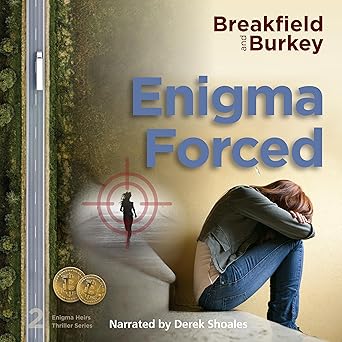

In an era where crimes grow increasingly heinous, the fight against human trafficking, drug trafficking, and the relentless opioid crisis demands a specialized group of extraordinary individuals. The Enigma Heirs face their most formidable challenge yet, navigating a high-stakes mission with global repercussions. As they confront the complexities of morality and strategy, the teams of the R-Group and CATS grapple with impossible decisions. How many lives can be risked or lost in the pursuit of stopping a monster?
Enigma Forced, the second installment in the Enigma Heirs series by Charles Breakfield and Rox Burkey, picks up where the first book left off, plunging readers into a world of escalating tension. The story begins with the grim discovery of human “cargo” at the site of an unrelated crime. From there, the narrative deepens, unflinchingly exploring themes of exploitation and justice. Breakfield and Burkey deliver a chilling antagonist in Mateo, a villain defined by his manipulation and deceit. He preys on vulnerable hopes, turning human lives into commodities—whether as drug mules or merchandise. The Enigma Heirs race to dismantle his sinister empire, setting the stage for a gripping battle where good and evil cannot coexist.
The authors weave an intense and fast-paced plot, skillfully balancing action with emotionally charged themes. The story does not shy away from its darker elements, instead presenting them as essential to the narrative’s authenticity. As the tension rises, the stakes feel both personal and universal, amplifying the reader’s engagement.
This review is based on the audiobook version of Enigma Forced. While the narration displayed appropriate emotion and inflection, I feel it fell somewhat short of creating an immersive experience. Issues with pacing occasionally hindered the story’s momentum, leaving the impression that this book might shine even brighter as a traditional read. Despite this, the strength of the writing and the compelling plot combine to offer a riveting tale. The depiction of violence, while frequent, never felt gratuitous, serving instead as a stark reminder of the harsh realities the narrative mirrors.
Though a work of fiction, Enigma Forced, by Breakfield and Burkey, resonates with the harsh truths of modern headlines, offering a story that lingers long after the final chapter. The emotional weight of its themes, combined with a well-crafted plot and characters, ensures it remains both thought-provoking and memorable.
Pages: 296 | ASIN : B0D134Z98S

Far-Reaching Impacts

The Pattern Maker follows a former astronaut now working at NASA’s Johnson Space Center whose colleagues claim they were passengers in a driverless SUV accident leading him to investigate more unsettling occurrences. What was the inspiration for the setup of your story?
I have had a fascination with simulation theory for a long time, especially the work of philosophers, such as Rene Descartes and Nick Bostrom, and from watching shows like Ghost in the Shell and The Matrix. I knew I wanted to base a series of novels on this possibility but I needed another story element to cause a high-stakes thriller plot. This introduced the Pattern Maker because of course, there would be someone who would want to take advantage of changing the world to suit their plans. This book opens with how those changes may look to us as they are happening. I also needed some events that were going to make the fact that we live in a simulation believable to the characters.
I found the science in the novel to be well-developed. What kind of research did you do to make sure you got it all right?
I follow a lot of sites and feeds that cover the latest scientific discoveries and thinking, and this information triggers ideas about how I could bring them together in a plausible way. I then build in extra layers to develop the thriller aspect of the book. To ensure that the science I’m using, and the way I’m twisting it, could work, I refer to the work that researchers have kindly shared in formal papers and scientific journals.
What were some themes that were important for you to explore in this book?
The premise of the whole series is that nature will repair itself, with a strong leaning toward Gaia theory, which suggests that the planet is self-regulating to sustain life. And, the more humans attempt to “fix” things, the worse they get. I also wanted to explore the idea of how rapidly we can now make changes to systems, at massive speeds, that can have such far-reaching impacts to all lifeforms.
Where does the story go in the next book and where do you see it going in the future?
The main plotline of the series is that by accessing and changing the simulation code, the Pattern Maker has introduced the Year 2038 problem. In a simplified nutshell, the year 2038 problem is a bug that may impact the way some computer systems store and represent time values from January 19, 2038, as they will run out of space to store dates. This could cause the computer to malfunction or stop working, or the calculation could overflow causing the system to think the date has looped and is back at the original start date of 1 January 1970, or the system could go into underflow and make the time value negative, and the system would think it was 13 December 1901. When we’re talking about computer systems, this is something that can (and is currently being) addressed. But when it happens to the simulation that we live in and are an integral part of there’s a range of extinction-level outcomes that could occur. To stop any of these disasters, the team attempts to make changes to the code but they need to somehow test their work. Using a new method of quantum time travel, Sam undertakes missions to throw his consciousness forward to the year 2040 to see if they have been successful. But a lot can happen in 18 years – not just to the world but to Sam’s life. And the Pattern Maker didn’t bow out gracefully, leaving a series of cipher blossoms, which bloom within the simulation code at the worst moments.
Author Links: GoodReads | Amazon
Its code has been breached.
Will a cyber zealot destroy our world?
The Pattern Maker is erasing their enemies by deleting their code. But this increase in data is moving the simulation toward a gravitational singularity when it will crush itself.
The only clues discovered by NASA and Homeland Security lead to the Sámi people of the Arctic. Their ancient understanding of physics may help stop the simulation overloading, while a realistic environment is developed to test reversing the changes.
Can they use an existing test model for this purpose?
Or will the Pattern Maker stop them in a deadly code battle?
The ancient role of Weaver introduces another person who can change the simulation but she can do it with her mind. Can the government task force build an alliance with her or do they have another enemy to defeat?
If you dig science fiction where reality is made surreal as it intersects with theoretical physics, this book is for you.
Author’s note:
Some readers have found this book to be quite a dense read due to its complexity. This is from hard science fiction themes, a non-linear narrative, and multiple points of view that deliver various pieces of the puzzle at different times.
If you don’t enjoy these elements of story-telling, you might want to give this book a miss.
Whatever you decide, happy reading to you!
The Senescence Sentence: A Short Novel
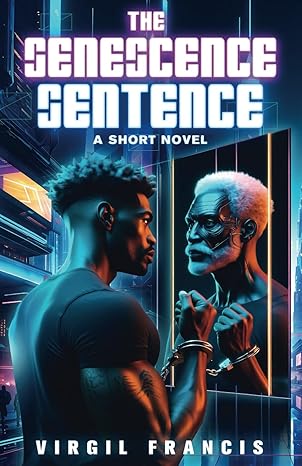

The Senescence Sentence, by Virgil Francis, is a compelling blend of futuristic science and philosophical tension, centered on Frances, a nanotechnology scientist navigating an increasingly dystopian world where technology and corporate ambition blur moral boundaries. Frances grapples with the allure and danger of technological advancements, especially as his work places him at odds with powerful organizations and impacts his family life intensely. His struggle with ethical limits, corporate pressure, and personal responsibility create a narrative that feels at once suspenseful and introspective.
The writing strikes a unique balance between technical immersion and emotional depth, though at times, the level of detail around futuristic technology can feel overwhelming. The detailed descriptions, like the “holographic 4D model” and Frances’ advanced “NanoShots,” allow readers to visualize this futuristic world. Francis does a fantastic job using relationships to ground the story’s intensity. Frances’ bond with his daughter, Gege, and wife, Naomi, brings warmth and stakes to his otherwise clinical, tech-driven world. These relationships are crucial to understanding Frances’ internal conflict, making him feel real and vulnerable. The complexity of his friendship with Fray, a business partner driven by ambition, further enhances the story’s themes, showing Frances’ struggle between corporate allure and ethical boundaries.
One of my favorite aspects of the book is how it raises philosophical questions about technological advancement. The story poses the question: How far should science go before it encroaches on our humanity? When Frances resists unethical partnerships, the narrative invites readers to consider their own moral lines. The moral dilemma Frances faces, especially against the backdrop of companies like NanoDawn, keeps the reader wondering if anyone can stay principled in a world dominated by corporate giants. The novel encourages self-reflection, making it more than just a futuristic thriller.
The Senescence Sentence is a great fit for readers interested in science fiction that explores the ethical dimensions of tech advancements. Fans of Black Mirror-esque tales who enjoy introspective, morally complex narratives will find this book thought-provoking. It’s a bold, reflective story that pulls readers into a world of intense moral and technological exploration.
Pages: 268 | ASIN : B0DDTTFS3F
The Pattern Maker

The Pattern Maker is a science fiction thriller set in 2024, primarily revolving around Commander Sam Perry, a former astronaut now working at NASA’s Johnson Space Center. The novel kicks off with a mysterious car accident involving Perry’s colleagues, who claim they were passengers in a driverless SUV. This puzzling event triggers a series of increasingly bizarre and unsettling occurrences. As Perry investigates, he uncovers a deeper conspiracy suggesting reality itself is a simulation manipulated by a shadowy figure known as the “Pattern Maker.” The book weaves science, technology, and philosophical speculation into a gripping story about the nature of existence and free will.
I found the writing to be sharp and engaging, with a lot of emotional intensity coming from Sam Perry’s inner monologues. The story’s pacing is fast, and the mix of technical NASA details with the eerie supernatural elements creates a unique blend of realism and sci-fi. Perry’s frustration as he navigates this convoluted reality felt authentic, especially when the surreal events started pushing him to the brink. In particular, the scene where he watches footage of a driver’s skeletal hand gripping a steering wheel is haunting, sticking in my mind long after I read it. I appreciated how the book didn’t rush through its central mystery but let the tension build as Perry pieced everything together.
Perry is the reluctant hero, drawn into a conspiracy beyond his control, and Kate Martin, one of his colleagues, serves to mostly introduce the central mystery. However, the mystery surrounding the “Pattern Maker” kept me hooked, especially as it became clear that this entity was erasing people from existence. The scene where Perry learns about his role in this cosmic manipulation sent chills down my spine. There’s something genuinely terrifying about the idea that reality can be undone like lines of code.
The Pattern Maker is a thought-provoking and eerie thriller that will appeal to fans of speculative fiction and those interested in the intersection of science and philosophy. While the book’s dense plot and technical details might not be for everyone, its suspense and exploration of reality’s fragility make it a compelling read. I’d recommend this to anyone who enjoys shows like Black Mirror or books like Philip K. Dick’s Do Androids Dream of Electric Sheep? If you love to question the nature of existence while being entertained by a gripping mystery, this one’s for you.
Pages: 293 | ASIN : B0DFTKJS7Q
Ambition vs Integrity

Whistleblower: Integrity in AI follows a dedicated AI engineer who faces a dilemma that threatens his career and global security and must find a path forward. What was the inspiration for the setup of your story?
My inspiration was my life experience as a high-tech entrepreneur. Like in all my books, real-life events are the foundation of the story. I have changed names and identities and augmented the story to make it more engaging.
Alexander is a talented AI engineer whose morals wind up in conflict with his employer. What were the morals you were trying to capture while creating your characters?
The main moral value I was trying to capture is the struggle between ambition and integrity. In the corporate world, this struggle is omnipresent and often a fine line to walk.
What were some themes that were important for you to explore in this book?
I love to explore how the corporate environment shapes businesspeople and push the boundaries of traditional mystery. The themes that were important for exploring were ambition, betrayal, loyalty, and integrity.
What is the next book that you are working on, and when will it be available?
Since WhistleBlower, I have published the first two books of the medical thriller series The AI Singularity Experiments: The First Patient and The Second Patient. I am now working on the third book of the series.
Author Links: Facebook | X | Website
Alexander was always willing to help, and many people he had helped became influential figures in technology and business, and they all owed him favors.
Dr Ethan Harris was a partner with Singulon Capital. Ethan’s approach had always been to prioritize transparency and ethics in the operations; for him, it was not just about the returns but how they were achieved. Ethan had a nagging feeling that there was more to Singulon Capital than met the eye. Ethan stirred up a hornet’s nest with his findings but remained steadfast and continued his pursuit of the truth, even if it meant standing alone.
Whistleblower: Integrity in AI by Noah Tuya is filled with drama, betrayal, lies, and espionage. The story was fast-paced and full of action. It was a page-turner, and I had difficulty putting it down. The suspense kept me on the edge of my seat, not knowing what would happen next. The characters were authentic and relatable.
They were introduced one at a time with a backstory. It helped a lot to get to know them and understand where they came from. The story was well-written, and with all the twists and turns, I was guessing until the end. Just as I was sure of what was going to happen, there was a twist that changed the course of the story again. I was hooked until the end.
Whistleblower: Integrity in AI

Whistleblower by Noah Tuya is a compelling dive into the high-stakes world of corporate ethics and espionage. At the heart of this gripping narrative is Ethan Harris, a newly appointed AI engineer at Singulon Capital. Ethan’s dedication to AI development soon places him at a crossroads, facing a dilemma that threatens not only his career but global security. The question looms: can Ethan bring the situation to light, or will he remain ensnared in a perilous path?
Noah Tuya masterfully explores the difficult decisions that define the corporate landscape. Through themes of espionage and illicit international trade, Tuya guides readers through a journey where uncovering the truth comes with severe consequences. The novel underscores the fine line between ethics and success in the business world, delving deep into Ethan’s internal struggles with the implications of Alexander’s past, providing rich insights into his layered thinking and emotional turmoil. Tuya’s portrayal of the corporate environment is both vivid and intricate. He examines how integrity, boundaries, and ethical dilemmas influence decision-making, painting a realistic picture of the pressures and complexities within a powerful enterprise. As readers follow Ethan’s journey, they gain a perspective on the psyche of the corporate world, understanding the intensity and potential fallout of decisions made in such high-stakes scenarios. Ethan’s cautious navigation through these challenges is a testament to the delicate balance between virtue and survival.
Whistleblower by Noah Tuya is highly recommended for anyone interested in the intricate dynamics of corporate politics and power. With its unexpected twists and deep dive into the murky waters of the tech world, Whistleblower is a thrilling technothriller that keeps you on the edge of your seat.
Pages: 122 | ASIN : B0D27RDRRS
Prolific Dependency on the Internet

In WORDS, an activist fights to clear her name after she is suspected of launching a devastating hack that spreads ominous text messages setting the world on edge. What was the inspiration for the setup of your story?
The inspiration for the setup of WORDS was the prolific dependency on the internet by the general public. What would be the impact on society and individuals if we had no internet now since it has become such an integral part of our lives? And “Could that happen? If so, how?”
Those two main questions persisted–“What if…?” and “How?” After going over numerous complex options and solutions, the answer boiled down to a simple idea inspired by a proverb from the Dutch philosopher, Desiderius Erasmus–“In the kingdom of the blind, the one-eyed man is king.” This proverb has other meanings but it prompted me to think of something different.
The primary use of the internet is visual. The ‘internet” didn’t have to be eliminated, it just needed to be made unusable. That could be done by blocking a person’s computer monitor, phone, or any other video screen. The story evolved from there.
It began as lines of text that would block all video screens, then the idea changed to a gradual build-up of lines of text, then it narrowed down to just a ‘single line of text’. That would be enough to disrupt use and lines of text would be ‘added’ as the story evolved. This would also create suspense and a mystery as to who or what caused the texts to appear.
Was there anything from your own life that you put into the characters in your novel?
The fact that I am a single father was useful in developing the ‘father/daughter’ relationship in the novel. Although very different there was an emotional pull between the relationship in the book and my own life. However, like all ‘real life’ inspirations or connections it just provided some ‘seasoning’ to the story. The main idea in all the characters was to have them be relatable. Put them in a ‘real life’ situation that could happen to anyone. Regardless of their background, or nationality.
I found the science in the novel to be well-developed. What kind of research did you do to make sure you got it all right?
The research was a priority in writing this book. There are stories of authors traveling to other lands or working in a unique profession to gain knowledge. While that is valid and would be nice to be able to do, I believe it really isn’t that necessary today. What is necessary is the ‘search’ in ‘re-search.’ There are many journals, books, papers, and other outlets that provide accurate and verifiable facts on various topics. The trick is to dive deep. Find the details. Then make the research understandable to the reader. That requires the ‘writer’ to weave information into the story not present a dissertation. A good story will allow the reader to ‘learn’ about something they didn’t know about. If a story is based in ‘reality’ then factual research is a must. I did seek out some medical professionals and computer professionals to help me understand or explain certain issues. Information and research on Artificial Intelligence over the last few years has surged.
The great historical/thriller writer Ken Follett said-to paraphrase–‘He thanked historians for all their work…he simply takes what they have found and looks for the story.’ He has a point. The facts are out there, we must find them and translate them in an interesting way for the reader.
Can fans expect to see more work from you soon? What are you currently working on?
Yes, I think it will be this year but I am currently working on two possibilities. A sequel to WORDS and a romantic type thriller. We’ll see which gets finished first! TBD.
Author Links: GoodReads | X (Twitter) | Website | Amazon
Student and activist GENEVIEVE PHILLIPS might have been too smart. She can’t stand LUX Corporation, the company her scientist father works for, and its involvement with Artificial Intelligence. So Gen downloads her anti-AI science project into the company’s server as a protest.
When a cryptic text appears during the launch of LUX Corporation’s worldwide AI system, Gen is suspected of a malicious ‘hack.’ Then, an internet pandemic erupts as the text message spreads around the world.
Gen is hurtled onto a journey to find the real hackers and clear her name. When the virus expands and cripples even the most secure networks. Multi-national corporations point fingers, and superpower governments prepare for all-out war.
Gen finds herself involved with an AI plan that goes against everything she believes in and is thrust into a non-stop race to prevent the end of civilization as we know it.



 LITERARY TITAN