Fragments of Light follows a young Archivist named Keela as she uncovers relics of a forgotten civilization while ancient machines awaken beneath the ice. What was the inspiration for the setup of your story?
Winter. It all started with that. I live where winter is a VERY present concept, and as much of an avid reader as I am, rarely did I ever find a compelling SciFi story that took place in winter or somewhere where winter was the norm. So I figured that starting everything there would be something that could generate a different type of texture to the narrative. And one of those threads is the impact – or I should probably say “impacts” – of climate change. As harsh an environment as the Arctic is, climate change has a disproportionate effect on it; everything seems magnified. So to me, that area would likely be a natural refuge for human civilization should the World go to Hell in a handbasket…
Keela’s emotional journey feels incredibly intimate. Was her character shaped by any personal experiences or themes you wanted to explore?
No personal experience per se. However, being a parent, I see that many young people – and having been one myself – are unsure of the potential in them; of the strength that inhabits them. Sometimes it’s easier to wait for someone else to do what needs to be done, but most of the time, YOU could do it, and you could probably do it better. As for the archivist part, that’s purely projection: I’m a big history nerd! I just find it fascinating – good and bad – how technology throughout the ages shaped humans; how it creates a virtuous (or perverted, depending on where you stand) cycle where humans create technology that changes them and allows them to create more “advanced” or different technology that in turn changes them again, and so on and so forth.
What were some themes that were important for you to explore in this book?
Resilience. Ambiguity. Adventure. Friendship. And as corny as it sounds, humor. Because I really do not want to live in a world where even during the worst of the worst we are not able to smile or laugh. Maybe not at what’s happening, but surely at how we deal with ourselves and others.
The machines beneath the ice feel both mythical and scientific. What was your process for designing their nature and purpose?
Well, in Fragments of Light, machines are not generally “under the ice.” Some are, but it’s more because of their purpose, really. In the subsequent books, we see that Keela and Anina need to go outside the safety of their known world – the Arctic – and cross entire continents to continue their quest and get to interact with many different societies, machines, and people. . Without spoiling too much, let’s just say that machines are left over from a technologically advanced world that existed pre-Fracture. One where geo-engineering was seen as the way to stop/reverse/curb global environmental collapse. Think huge sun reflecting mirrors, carbon catchers, water purifiers, methane gas processors, etc. These would need to be massive, on a scale that would blow your mind, in order to affect the climate of a system as big and complex as the Earth. And you are right, as with anything that is old, eventually they did drift into mythology or quasi-myth.
BENEATH THE ICE, THE WORLD STILL SINGS. Keela was meant to guard the past, not be claimed by it. In the frozen city of Lumik, she touches a relic that hums with memory, and nothing stays buried. Her quiet life shatters, pulling her into a truth no one else will face.
With Anina, a gifted technician who reads machines like language, Keela follows its call across a fractured Earth. Engines stir beneath snow. Salvage-built cities whisper of healing long abandoned. Wonder ignites, but so does danger, as rivals twist awe into power.
This is not destiny. It is choice. And when no one else steps forward, Keela must.
For fans of Skyward, Scythe, The 100, and Ship Breaker. Discovery-driven sci-fi with brave heroines, hidden tech, and the courage to do what must be done. Scroll up to begin.
Caroline’s Purpose follows a once-promising athlete and equestrian who, after an accident, struggles to navigate college, broken relationships, and haunting memories, while trying to find purpose in a life that feels hollow. What was the inspiration for the setup of your story?
My inspiration for the setup of my story was my own journey. I tried to be the best at different things, only to come out on the other side hollow and disappointed. I wanted to encourage readers that God always has the best purpose for our lives. We don’t have to rely on ourselves. We don’t have to strive to be the best at something for fulfillment or to find our identity or value. Our identity and value are found in who God made us to be. Caroline needed to discover that by losing the identities she had worked endlessly for. Her pain is relatable for anyone who has lost dreams or the identities they created for themselves. God uses our pain to bring us back to Him and the value He created us with
In many contemporary coming-of-age fiction novels, authors often add their own life experiences to the story. Are there any bits of you in this story?
There’s a whole lot of me in this story. I played softball in high school and was a pitcher. I chose not to play in college because I didn’t think I was good enough. I was offered an academic scholarship to the University of Arizona. I lived out my dreams of pitching for the U of A through Caroline. At U of A, I majored in Equine Science. A riding accident in middle school led me to playing softball. The Equine Program at the U of A was my return to the horse world, like it is for Caroline in the book. Luna, the weanling, is based on the weanling I was assigned in the weanling class. Her name is Goldee, and she is now my horse. Edison is based off of the real-life Edison I leased and then owned until he had to be put down two years ago. Edison is the horse who gave me my confidence back. He wasn’t abused, like the Edison in the novel, but he was a huge part of my healing and moving forward.
What were some themes that were important for you to explore in this book?
The themes that were important for me to explore in this book were God’s purpose for each life and healing from the pain of the past. It is easy to get stuck in the pain, especially when multiple dreams have fallen apart. It is easy to feel like God has forgotten about us or doesn’t care about us. I wanted to create a story to show readers that God always loves and always cares and always has a purpose for us. I wanted to create characters that would show that healing is possible.
Will this novel be the start of a series, or are you working on a different story?
Caroline Davis, a sophomore in college, finds herself at a crossroads, suffocated by fear and anxiety. Everything she claimed to be or dreamed of becoming has been lost to her, including her faith in God.
When she meets Connor Taylor, Caroline finds that he is able to relate to her pain more than she would have thought possible.
With the help of Edison, an abused horse, Connor seeks to help Caroline learn to use her past as a stepping stone towards the future.
As her relationship with Connor grows, Caroline must make a choice to conquer her fear or to stay where she feels safe. Their relationship and her future hang in the balance.
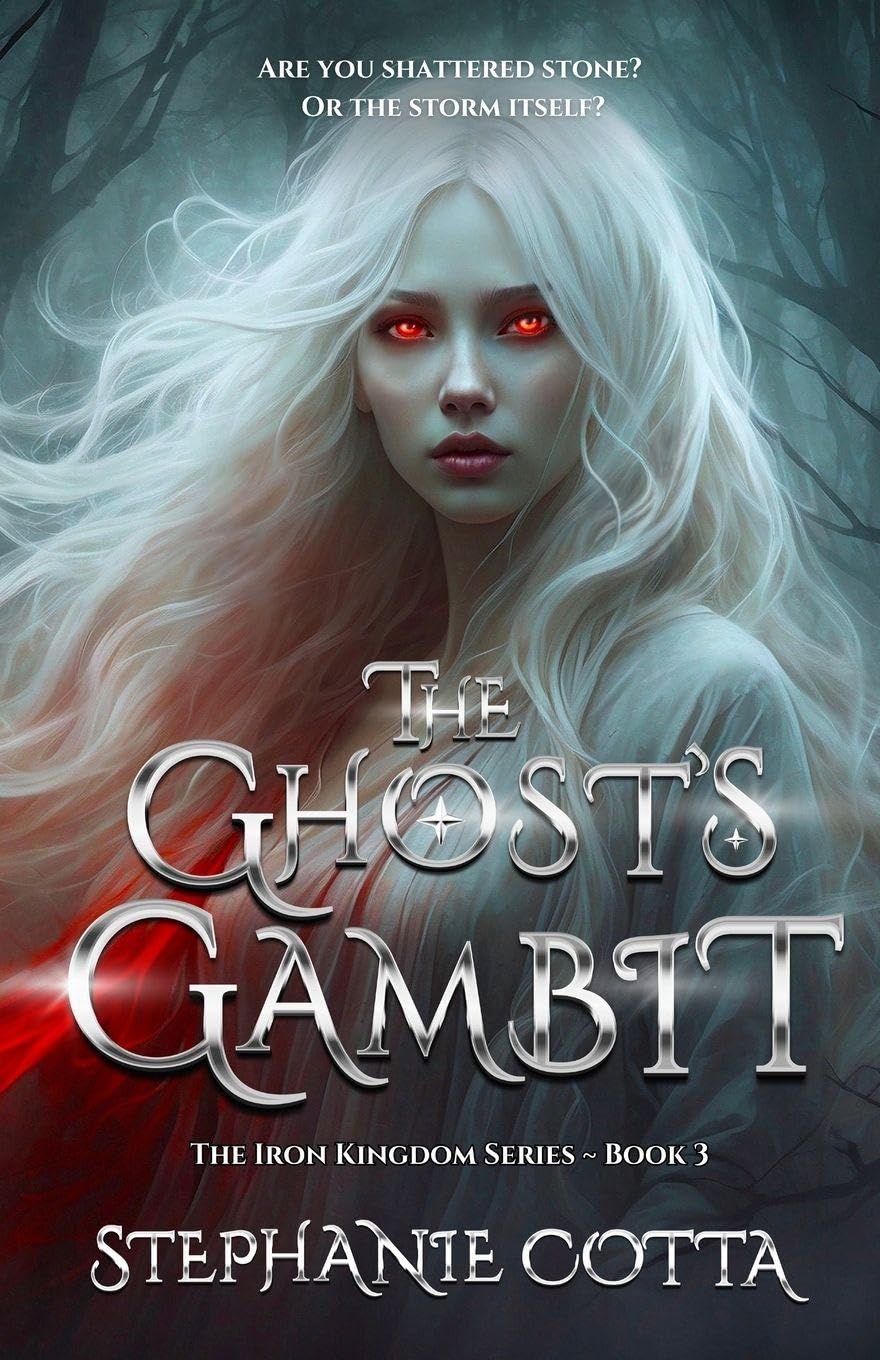
The Ghost’s Gambit, the third installment in Stephanie Cotta’s Iron Kingdom series, sweeps readers back into the dark, perilous world of the Iron Kingdom, where rebellion burns quietly under the thumb of a brutal empire. The story picks up in the midst of chaos, rebels fleeing through snow, soldiers in pursuit, loyalties torn to pieces. Author Stephanie Cotta crafts a world that is both cruel and tender, filled with haunted warriors, hidden magic, and fragile hope. The narrative follows a cast of complex characters, Wraiths, Conjurers, and outlaws, each wrestling with their own ghosts as they defy a king who seeks to crush them. It’s a tale of defiance, sacrifice, and the flickering light that refuses to die in the shadow of tyranny.
Cotta’s writing moves with fierce rhythm, sometimes sharp as steel, other times soft as snowfall. Her descriptions pull you straight into the fight, the clang of metal, the sting of regret, the ache of loss. What struck me most wasn’t just the action, though it’s thrilling, but the intimacy of the quiet moments in between. When Rowan bleeds for his brother, or Tahira whispers spells through tears, or Akaran faces the cost of vengeance, it hits hard. The book isn’t afraid to show how grief shapes courage, or how love can bloom even when surrounded by blood and ruin. I found myself caring deeply for these characters, even when they stumbled, even when they broke.
The pace shifts swiftly, cutting one moment and lingering the next. There are scenes where the prose leans into drama, yet I couldn’t fault it because it felt honest to the pain the story carries. The dialogue has a rawness that fits the world’s brutality, and while the lore is dense, it rewards you for paying attention. What really lingered with me was the emotional weight beneath the battles. This isn’t just a fantasy about swords and sorcery; it’s about forgiveness, loyalty, and the ghosts we carry when the fight is done.
The Ghost’s Gambit is a story that grips you and doesn’t let go, yet somehow leaves a quiet warmth behind. I’d recommend it to readers who crave epic fantasy with heart, especially those who love stories like Throne of Glass or Mistborn but want something cleaner in tone and more focused on the ties between family and faith. It’s dark, yes, but not hopeless. If you like your fantasy with both grit and grace, this book is worth every page.
The Dragon Moonstone follows a young man who discovers he’s inherited wizard blood and must learn to control his unstable magic before it consumes him. What was the inspiration for the setup of your story?
I write primarily to inspire my grandsons to discover the joy of reading. We’re all flawed—that’s what makes us human—and I wanted them to see Noah, a young man who discovers his inherited wizard blood, grappling with unstable magic just like any beginner. Even the greatest wizards start somewhere, and I hope Noah’s journey shows them that mastering your gifts is a process worth celebrating.
I find the world you created in this novel brimming with possibilities. Where did the inspiration for the setting come from, and how did it change as you were writing?
My stories tend to unfold organically as I write—I never start with a rigid plan, and it often feels like Noah himself is in the driver’s seat, steering the adventure. The inspiration for the brimming world of The Dragon Moonstone came from my love of classic fantasy realms, blended with everyday wonders I share with my grandsons.
Courage, perseverance, and the drive to make things right were essential themes I wanted to weave throughout The Dragon Moonstone. These aren’t just plot devices—they’re the story’s true heartbeat, lessons I hope to impart to my young readers. Noah embodies this when life hurls challenges his way: unstable magic, self-doubt, and unexpected losses. Through it all, he learns to step up, push through, and emerge stronger, reminding us that true power comes from facing our flaws head-on.
Can you tell us more about what’s in store for Noah and the direction of the next book?
Grief has threaded through Noah’s journey so far, and the next book dives deeper into it as he learns to process his sadness and confront his challenges head-on. Along the way, he’ll discover that kindness isn’t a weakness—it’s a quiet strength—and that being the underdog comes with its own fierce advantages. Above all, Noah will embrace the power of paying it forward, turning his losses into legacies that inspire those around him. Expect more magic, more heart, and even higher stakes when you dive into The Griffin Moonstone.
The Dragon Moonstone: Book Two of The Moonstone Legacy Series
Noah never asked to be a wizard—too bad magic doesn’t take requests. Patience? Not exactly his strong suit. With messy, unpredictable powers that have a mind of their own, Noah puts his friends at risk. So, his great-aunt Shirley pulls some strings and sends him and his friends to Castle Dragon, where they’re in for a bumpy ride convincing the legendary sorcerer to come out of retirement and train them.
As Noah’s emotions tangle with his chaotic magic, a seemingly harmless shortcut spirals into disaster. To fix his blunder, he must find rare dragonroot, the only cure for his magical mishap. But fate throws him another curveball: the Dragon Moonstone has gone missing, and the realm’s balance hangs by a thread. Without it, chaos could reign, endangering everyone he cares about.
With a vengeful witch, a devious bounty hunter, and nearly every Fae in the Otherlands pursuing their own agendas, Noah knows he can’t do this alone. His quirky and brave friends offer their support, but in a world rife with deception and treachery, trust is a dangerous gamble.
When tragedy strikes, Noah confronts a haunting question: does the reluctant hero have what it takes to save the realm, or is he destined to be the guy who always ruins everything?
Join Noah and his friends on a fast-paced fantasy adventure filled with magic, humor, and action. Tailored for teens and adults who enjoy action-packed contemporary fantasy with a mystery to solve.
Wing Haven follows a fairy who finds herself queen after being betrayed by her sister, and along with some unlikely allies, enters into a dangerous adventure. Where did the idea for this novel come from?
I looked on Submittable for short story and flash fiction writing contests because I think it’s a good way to flex your writing muscles, and saw one which must have had a fairy or forest theme. I hit the word count limit and had so much more to say about Almond’s journey that I just kept going.
There was a lot of time spent crafting the character traits in this novel. What was the most important factor for you to get right in your characters?
I think archetypes are powerful tools for storytelling, and each character has a role: the hero, the sidekick, the love interest, the comic relief, the villain, the muscle, etc. In Wing Haven, the hero is a fairy, the sidekick is a chipmunk, the comic relief is insects—and they have motivations and quirks corresponding with their roles in the story that I hope draw the reader into a suspension of disbelief that allows them to go along for the ride.
What were some themes that were important for you to explore in this book?
Some of Wing Haven’s most important themes are self-reliance, chosen family, and acceptance. Almond must learn to live outside of the regimented Fairy Nook, where there are no rules or safety nets, but also learns to trust the creatures she befriends. They’re a ragtag group of very different creatures who accept each other as they are and appreciate each other’s strengths.
Can fans of Wing Haven look forward to more work from you soon? What are you currently working on?
I am excited to share that I’m working on my first closed circle murder mystery, but I also have ideas for more adventures for the Wing Haven crew, so sign up on my website for updates.
When Almond Nettlesworth is taken from the Fairy Nook, she is desperate to find her way home. Alone in the dark forest, Almond collects a ragtag gang of characters and together, they transform an abandoned dollhouse into a haven for tiny creatures. But when the Fairy Queen sends the Knight of the Nook to bring her back, Almond must decide between the home she knows and the home she’s built.
The Queen’s Dark Ambition follows a fourteen-year-old girl whose struggle to belong in a new town plunges her into a sinister fairy world where trust is perilous and survival demands courage. What was the inspiration for the setup of your novel?
What prompted me to write the first few chapters was when I dreamt of standing in a local wood, jumping over a stream, and finding a whole strange world of hostile fairies on the other side. Those first few chapters were written over ten years ago, when I was still at University, and the story itself developed slowly since then. I guess that shows the power of an idea or story, that it can stay with you.
I intentionally wanted the main character’s curiosity towards a stranger she meets to be what draws her back, as equally, if not stronger than, the dangerous pull of the wood and the fairy abode. A core part of the story explores the development of their relationship. The stranger, Bower, who is a wizard, helps Stacy, the main character, to question life and explore the bigger issues, whilst untangling the true and unexpected nature of the fairy domain.
A pivotal part of the story is about her finding not only her courage, but her voice as well, as fighting for what’s right. I initially thought of her as an introvert, like myself.
It wasn’t until much later in the revision and editing process that she really started to surprise me with just how strong a character she is and what she’s capable of.
Stacy’s voice feels raw and unfiltered, especially in her messy emotions. What inspired you to write her with such honesty rather than softening her flaws?
I’m an emotionally driven writer and love exploring characters’ thoughts and emotions. The protagonist, Stacy, is a teenager, and I craved leaning into that emotional space for the sake of the reader, for them to be taken along for the ride and feel those messy emotions along with Stacy.
The story shifts from domestic drama to eerie fantasy, almost like stepping from one world into another. How did you balance the real-life struggles with the supernatural elements?
I don’t think it’s much of a balancing act, but a question of putting Stacy’s domestic drama into perspective. She’s still obsessed with her phone and is wrestling with teenage worries. She realises the importance of her friends, from whom she is estranged, as well as her parents, whose love she’s been doubting recently, what with a family move and arguing with her Mum. Her friends have also shunned her due to the move. Despite this, she would do anything to protect them all and to get back to them, even in a perilous and unfamiliar world.
Throughout the story, I’ve sprinkled in some real-life grit, which hopefully makes it more believable and resonates widely with readers. I think that’s the glue between the two worlds, as well as seeing both through Stacy’s eyes. I hope I’ve created moments of unexpected surrealism and joy from Stacy’s perspective, too, though.
The fairies in your book are both beautiful and menacing. What drew you to portray them in such a dangerous, unsettling way?
I really wanted the main villain to be alluring to Stacy and to readers, hence why Elantra, the Queen, is beautiful too, to create jarring and unexpected undertones. Honestly, I think the most dangerous thing about the Queen could be that she’s relatable, and, at times, Stacy has sympathy for her. She gets under Stacy’s skin, and Stacy wants to understand how she got like that.
A forbidden forest. A corrupted fairy queen. And children who vanish in the night. Some boundaries were never meant to be crossed.
Life for fourteen-year-old Stacy takes a terrifying turn when she discovers a parallel world hidden within the mysterious woods near her new home. After witnessing a child’s sacrifice, she becomes trapped in a realm where fairies aren’t the gentle creatures of bedtime stories. Under the watchful eye of Bower, a centuries-old wizard bearing the weight of his own tragic past, Stacy uncovers a sinister plot involving imprisoned children and a pure malevolence that will stop at nothing to claim the power of the stars.
Can Stacy find the strength to challenge a Queen who once turned her back on love itself? And if she fails, what fate awaits not only the imprisoned children, but the entire human world?
Are you drawn to magical realms, powerful adversaries, and tales of courage in the face of darkness? Then you’ll be spellbound by this captivating story.
If you like authors Laini Taylor, Melissa Albert or Holly Black, you may like The Queen’s Dark Ambition.
At the core of this low spice, character driven fantasy, Stacy’s journey explores themes of found families, fitting in and finding her voice, which will resonate with many YA readers.
If you enjoy these themes and fillings, The Queen’s Dark Ambition, may appeal to you: belonging/identity, glow up/ fish out of water, chosen girl, hidden heritage, confidence/self-love, power and agency, coming of age, angst & grit, plot-twists, mean girl, tear-jerkers, end of the world, clean Christian mystery.
Successful Life Skills for Teens is a positive, practical guide for young readers who want to build confidence, manage emotions, and get their lives on track. Why was this an essential book for you to write?
I wrote Successful Life Skills for Teens to bridge the gap between what schools teach and what teenagers need to thrive in today’s world. Many young people leave the classroom with a wealth of knowledge, yet they often lack confidence, resilience, and emotional awareness. This book gives them practical tools to navigate real-life challenges with courage and clarity. It guides teens to manage stress, build strong relationships, make wise decisions, and believe in their own potential. Each chapter was carefully crafted to support teens in becoming confident, capable young adults who are prepared to approach life with strength and purpose.
What were some ideas that were important for you to share in this book?
I wanted teens to understand that success lies in growth, not perfection. Each step forward, no matter how small, builds the strength and wisdom needed to face life with confidence. The ability to manage emotions, balance responsibilities, and nurture friendships is a quiet but powerful skill that shapes character and leadership. Also, I want to remind teens and young adults that understanding mental health and resilience are signs of courage, not weakness. Developing self-awareness helps teens better understand who they are and how they respond to challenges. This understanding enables self-discipline to guide them through life’s ups and downs with confidence, grace, and purpose.
What is one thing that people point out after reading your book that surprises you?
It’s encouraging to see so many parents enthusiastically recommending this book to others. The support they provide emphasizes its importance and the positive effect it can create. They’ve told me it not only helps them understand and reinforce the principles I share but also inspires them to apply the lessons in their own lives. Many expected Successful Life Skills for Teens to benefit their teenagers, but they found the strategies on confidence, focus, and stress management just as meaningful for themselves. Hearing that the book sparks honest conversations about mindset and personal growth within families has been one of the most rewarding surprises.
What is one thing that you hope readers take away from Successful Life Skills for Teens?
I hope readers, both teens and parents, see this book as more than a bridge that brings together an understandable connection between generations. My greatest wish is for it to spark genuine conversations about confidence, stress, and self-belief, allowing these topics to be discussed at the dinner table before the struggles become too deep. I want parents to feel empowered to guide their teens with compassion and genuine connection, and for teens to recognize their parents as their most incredible supporters to cheer them on as they discover their place in the world. If this book inspires families to listen more intently, support one another, and grow stronger together, then it has achieved my hopes. True success shines brightest when understanding fuels our strength, love guides our actions, and unity becomes the bond that helps us grow together.
You Want to Feel Confident, Lead with Purpose, and Build a Life You Love—This Is Where It Begins.
Every parent dreams of seeing their teen confident, capable, and ready for life but most teens are never taught the real-world skills to make that happen.
Successful Life Skills for Teens bridges that gap with practical lessons in confidence, emotional intelligence, communication, time management, and goal setting.
Packed with relatable examples and proven strategies that empower teens to overcome stress, build stronger relationships, and take control of their future.
Give your teen the tools to succeed in school, work, and life with confidence that lasts a lifetime. Trusted by parents, loved by teachers, and life-changing for teens.
The Inside Benefits: Powerful practical strategies for building your self-confidence and developing your courage Why it’s so important for you to recognize your emotions… and how you can use this intel to reduce your stress and anxiety and boost your friendships What a healthy friendship looks like—plus the social skills you need to take your relationships to the next level Clear guidance for navigating conflict and expressing yourself clearly in every context How to become the master of your own time—with practical strategies that really work (even if you’re a chronic procrastinator!) A practical and user-friendly guide to managing your finances… so that you understand how money works and keep more of it in your bank account! The critical thinking techniques you need to make smart decisions and solve problems quickly, easily, and effectively Why making a mistake is no bad thing—and what you can do to make the most of it every time The digital literacy skills that will keep you safe and secure in an increasingly online world Why you need “LION goals” in your life: Discover what they are and how you can use them to achieve your dreams How to ace a job interview and get a firm foot on the career ladder (in any field) The reason a growth mindset is going to be your superpower… and exactly how you can develop one
And much more.
You might think these are skills you can pick up as you go along, and to a certain extent, you’re right… But wouldn’t it be better to perfect them now?
You can avoid a whole lot of stress and unnecessary mistakes if you build up these skills now, and the difference you’ll feel in your confidence and certainty will be striking.
There isn’t a person in the world who doesn’t need these skills… and this is your chance to get ahead of the game.
Wing Haven, by Naomi Shibles, is a beautifully imagined fairy tale that feels both timeless and new. It tells the story of Almond Nettlesworth, a reluctant fairy who doesn’t quite fit into her messy, mossy world. After being outshone and betrayed by her younger sister, who suddenly becomes queen, Almond is thrust into an adventure that forces her to confront danger, friendship, and her own sense of belonging. Alongside unlikely allies like a chipmunk named Nutsie, she journeys through the wild forest in search of purpose and freedom, discovering a forgotten dollhouse that becomes a kind of refuge. Beneath the fantasy, the story hums with ideas about independence, family, and what it means to find beauty in imperfection.
What I liked most was how the book blended the charm of childhood imagination with the weight of adult emotion. The writing is lush and cinematic, full of textures like glittering wings, sticky sap, and the smell of damp moss. Shibles has a gift for description that makes even tiny moments feel alive. Still, it’s the heart of the story that got to me. Almond’s frustration with her world, her yearning for cleanliness and order in a place ruled by chaos, hit closer to home than I expected. I found myself rooting for her even when she stumbled, even when her pride made her prickly. The relationship between Almond and Pepper, sisters bound by rivalry and love, felt raw and real. Their clash mirrors the kind of quiet wars siblings fight when one grows up too fast and the other gets left behind.
I felt the pacing sometimes slows under the weight of its detail. The world-building is rich, like a garden that needs a little pruning. Yet, I didn’t mind walking through that garden. The story invites you to pause and notice the small wonders that are hiding. I also admired how the author used the natural world not just as a setting, but as a character. The forest breathes and sighs, both nurturing and cruel. It reminded me of how nature holds contradictions, beauty and decay, danger and shelter, and how those same tensions live inside us.
Wing Haven left me with a quiet ache and a deep sense of wonder. It’s a story for readers who still believe that magic exists just out of sight, for dreamers who feel out of place in the noise of the world. I’d recommend it to anyone who loved The Secret Garden as a child and now wants something more grown, more tangled, and more tender.