Blog Archives
Circling Home: What I Learned by Living Elsewhere


Circling Home: What I Learned by Living Elsewhere, by Terry A. Repak, offers an insightful and captivating account of her family’s life during their time overseas. Repak’s narrative style is engaging and eloquent, drawing parallels between their international experiences and the challenges akin to scaling a mountain – demanding yet extraordinarily rewarding. The memoir skillfully intertwines her personal journey with her husband Stefan’s professional endeavors in addressing the AIDS crisis. It presents a rich tapestry of experiences, evolving from her initial days as a new mother in Ivory Coast to becoming a seasoned traveler settling in Seattle.
Repak’s memoir stands out for its honesty and emotional depth, particularly in depicting family and friendship dynamics. Her interactions are not limited to fellow expatriates; she equally values her relationships with locals like Gladys, Adama, and Ousmane, showcasing the enduring connections formed despite geographical relocations. The narrative poignantly covers challenging times, such as her father’s illness, with a rawness that deeply resonates with readers.
Repak’s portrayal of her relationship with her daughter, Elena, is an especially compelling aspect of the book. Parents who have adopted will find comfort and understanding in Repak’s reflections on parenthood and the unique experiences of expatriate children. The portrayal of Elena’s growth is handled with nuance, acknowledging the complexities of her experiences thoughtfully and respectfully.
Circling Home is a commendable memoir, particularly for those intrigued by travel and life in foreign lands. Repak’s narrative is a reassuring guide for anyone navigating the intricacies of living in unfamiliar territories, providing a sense of kinship and understanding for those who have ever felt like outsiders. Her story is a testament to the transformative power of travel and the enduring strength of human connections, regardless of physical distance.
Pages: 308 | ASIN : B0BQDTBVSJ

Entertaining Fact-Filled Journey

Delaware from Railways to Freeways explores the little-known history of this small state from the period of 1800-1907 and the emergence of freeways. Why was this an important time period to cover?
This was the birth of the Industrial Revolution, and it impacted both Delaware and the nation enormously. Several ‘firsts’ originated in the state during this period. Early in the 19th century, the Delaware Breakwater, completed in 1835, was the Western Hemisphere’s first such structure. The bay’s barrier protection has been pivotal in facilitating safe maritime passage and trade, bolstering Delaware’s economy as well as Pennsylvania’s and New Jersey’s. Its strategic location also rendered the Delaware Bay more secure for naval operations, particularly during times of conflict like World War II. By mid-19th century there’s the ‘first’ from Betts, Pusey, and Harlan of Wilmington, who stand as pioneers in American industrial history for their role as the first iron shipbuilders in the country. Their groundbreaking work laid the basis for the broader American shipbuilding industry, contributing to the nation’s economic growth and naval capabilities. And finally, heralding the freeways era, Delaware’s DuPont Highway introduced the concept of separated lanes, enhancing road safety and efficiency. Funded by T. Coleman du Pont, this seminal model set a precedent for the U.S. highway system.
With so many interesting facts included in this book about Delaware, like Return Day, how did you narrow down what information to include and what to save or discard?
That’s a challenge for all three of the books I’ve worked on or am working on in this series. On the one hand, I look to academic history book models to get an idea of broad topics that should be tackled: Historical Context, Key Figures and Personalities, Major Events and Turning Points, and so on. On the other hand, I personally love to include quirky anecdotes and folklore items that add local color. One of my favorites from this particular book is about an innkeeper who trained a goose to keep an eye on his bar while he was out back plowing the field. If a customer entered the bar, the goose knew to go out to signal the innkeeper in the field with a honk! It’s a delicate balance to maintain gravitas without getting dull and to entertain the reader without being trivial. Writing a nonfiction book takes a lot of time and research, as well as talent, to take it from the level of a textbook to an entertaining fact-filled journey.
What would you say is your strength as a writer?
I was trained as a journalist. Reporters are drilled with a who-what-when-where approach to writing that always keeps an eye on the word count. And so, I’m always crosschecking my writing to make sure that the pace is brisk, that I’m getting to the point, not losing my reader through mountains of dull verbiage. I was fortunate to have writing professors who in addition to instilling bullshit monitors into me, also insisted that good journalism is about good storytelling. I think I spin an ok yarn.
What can readers expect in the third installment of this series about Delaware? What time period will it cover? When will it be available?
The third book is tentatively titled Delaware from Freeways to e-Ways, covering the 20th century. I’d like to have it in the public’s hands by Christmas 2024. The term “e-Ways” is a made-up word that refers to digital avenues of transportation, drawing from the 1990s trend of using “e-” as a prefix for things related to the nascent e-commerce industry. Digital technology has modernized traditional transportation methods, enabling, for example, self-driving cars, and rendering unnecessary outdated tools like sextants for ships and cabooses for trains. And while Delaware may not be a tech hub like Silicon Valley, the University of Delaware has offered up pure research and patents that have aided in the development and commercialization of the Internet’s physical infrastructure. In between freeways and e-ways, of course, there’s lots more to talk about. Stay tuned!
Author Links: Goodreads | Twitter | Facebook | Website | Amazon
Complex Issues Of Other Countries

Where Are You This Time? is an amazing account of your experiences traveling far and wide and the positive impact you left behind in each country. Why was this an important book for you to write?
Working in places like Kosovo and Afghanistan was a life-changing experience. It was exciting and eye-opening to find out what life was like there. I felt it was important to share the excitement and the challenges with other people so that they understand some of the complex issues other countries need to deal with.
What experience in your life has had the biggest impact on your writing?
I suppose it would be the first time I travelled to a foreign country when I was young. I landed in Kuala Lumpur in Malaysia and suddenly realised that absolutely everything was different from what I was used to – the weather, the smells, the trees, the food, the people. Photographs don’t really communicate the experience, only writing it down can do that, so I started keeping diaries to try to capture everything I experienced.
What was your writing process to ensure you captured the essence of the characters?
The book is based on the diaries I kept while I was travelling. I often had plenty of spare time after work to write about what had happened during the day and what I thought about it so it stayed fresh in my mind. Later, I used this material to build a story about the most important things that happened.
Can you tell us more about what’s in store for you as a writer, and can we expect more books about your experiences?
The first draft of this book was very long, so I had to leave out many stories and even whole countries to get it to a publishable length. So there is a lot more material. But I am not currently planning another book like this. The basic messages about the work of international aid projects and the problems facing people in developing countries that I wanted to communicate are already covered in the book. However, I still write blog posts about things like what has happened in Afghanistan and the problems of international aid on my Where Are You This Time? Facebook page and website.
Author Links: Facebook | GoodReads | Website | Amazon
Where Are You This Time? Making a Difference in Places from Kabul to Kyiv, Kosovo to Kazakhstan and Kismayo to Qatar
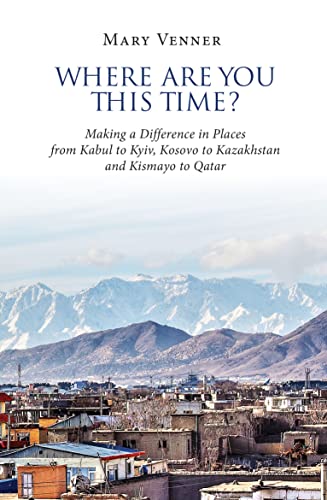
Mary Venner’s memoir, Where Are You This Time?, provides a riveting account of her nomadic life as a financial consultant in far-flung locales such as Kabul and Kyiv, among others. With remarkable precision and lucid prose, Venner’s stories spring to life, captivating readers from the opening lines to the closing punctuation. The narrative unfolds with a mysterious email offering Venner a consultancy role in post-crisis Kosovo, a beginning that quickly gives way to the challenges and triumphs of rebuilding a nation torn by civil unrest, energy deficits, and social constraints.
Venner’s journey as a consultant is not confined to Kosovo. Her zeal to make a difference leads her to traverse a multitude of countries, each facing distinct economic and political challenges. By deftly weaving personal experiences with expert insights into historical contexts, she crafts a literary tapestry that is both rich and engaging.
What sets this memoir apart is its accessibility, particularly concerning the technicalities of consulting and accounting. Rather than overwhelming readers with details, Venner’s explanations are concise and pertinent, allowing for a greater exploration of the cultures and relationships that inform her work. Her introspective reflection on Western-focused ideology initially tinged with a rose-colored optimism, evolves and deepens as she gains experience and understanding.
Where Are You This Time? also excels in character development. Every individual Venner encounters is vividly portrayed, fostering a connection between the reader and the subject. Whether introducing characters that offer comedic relief in a dense narrative or sharing her emotional response to leaving friends behind, Venner’s writing resonates with sincerity.
This memoir stands as a valuable contribution to contemporary nonfiction. It sheds light on a unique career path that might otherwise remain obscured, infusing it with human warmth and intellectual insight. Where Are You This Time? is an exemplary read that I wholeheartedly recommend to anyone interested in a combination of personal narrative, global issues, and an insider’s view of a specialized profession. It not only entertains but also educates and inspires.
Pages: 308 | ASIN : B0C3LM4MY2

Wash Ashore: A Tale of Cape Cod
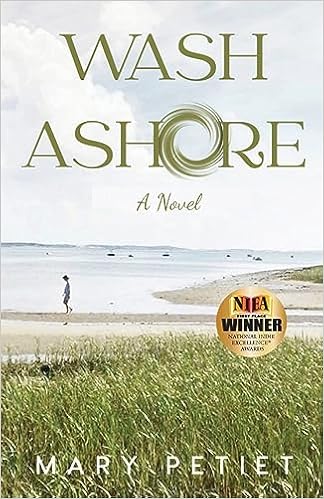
Olive remembered, fondly, childhood summers spent on Cape Cod with her aunt. The sense of community, the palpable history, and the slower way of life seemed like another world from what she was used to in Boston. With her aunt’s passing, Olive now found herself in possession of that same house she used to visit, and quickly realized a permanent life there was more than possible- it seemed almost inevitable. In the midst of making new friends, introducing old friends to the Cape, and delving into a centuries old family mystery, Olive realizes that there are many pieces that connect to make a place feel like home.
Wash Ashore: A Tale of Cape Cod is a novel by Mary Petiet that follows Olive as she inherits her aunt’s family home and becomes immersed in all the history and traditions of the sleepy little village. Bringing along a couple of friends from Boston, Johnny, and Ann, the three of them quickly find the charm of Cape Cod irresistible.
Petiet has created an excellent blend of characters and immerses them with a vibrancy that creates a sense of realism regarding their tight-knit group. Never once does it seem odd that a magazine director, a hot shot designer, and a chef would be spending their days with an octogenarian gardener, a land preservationist, and various other people who had always lived right there and never do any of their roles feel forced or unnecessary.
Wash Ashore has a lot going on within its pages and truly offers a little bit of everything- history, mystery, romance, a suitably sleazy villain, ghosts (yes, really!), and even a somewhat strange secondary storyline about trying to create the most perfect clam chowder recipe. All of it combines to make a wonderfully entertaining and charming story that sees all of its parts well balanced. (Much like the decided-upon chowder recipe, which is included at the end!)
The premise of this book is fairly straightforward, and I half expected a very dry narrative that droned on with history and preservation laws, but I was so pleasantly surprised to find so much more! Each new angle that was introduced was better than the last, and while the ending was no shock by any means, it was nonetheless satisfying when you arrived.
Pages: 186 | ASIN : B0B11R14H5
Let’s Go to Gabon, Cameroon, and Namibia

Terry Lister, an avid writer, and explorer, vivaciously brings to life the enchantment and allure of Africa in his captivating travelogue, Let’s Go to Gabon, Cameroon, and Namibia. Through an in-depth examination of each location he visits, Lister offers an immersive and intimate perspective of remarkable villages, exotic fauna, and notable tourist attractions, providing an armchair travel experience par excellence.
In addition to recounting specific details about each location, Lister further enriches the narrative by showcasing his personal photography collection. He paints a vivid picture with his words and imagery, drawing the reader into the heart of each experience. In a thoughtful and comprehensive approach, he details his routes, accommodations, and modes of transportation, creating an engaging travel blueprint that seems almost within reach.
Lister’s journey is punctuated by the inevitable trials and tribulations that accompany travel, but his unwavering positive outlook and resilient spirit give the narrative an enchanting charm. The reader is apt to be swept away in the exhilaration of travel, the comfort of home notwithstanding.
Let’s Go to Gabon, Cameroon, and Namibia is a treasure trove of remarkable experiences, from breathtaking sunsets to awe-inspiring landscapes and intriguing museums. Lister’s visit to the spiral tower adjacent to the Monument of Reunification is particularly memorable for its uniqueness. He provides an unusual perspective with his visit to uranium mines, offering insightful commentary that attests to his seasoned travel expertise.
Lister extends his narrative beyond mere descriptions of locations, sharing personal travel experiences and illuminating each journey’s uniqueness. From the idiosyncrasies of public transport to the varied character of hotels, Lister offers a holistic view of the travel experience.
In Lister’s narrative, a relaxed and entertaining tone prevails. However, a deeper exploration of his interpersonal interactions would have added an additional layer of life and color to the narrative. Yet, Lister’s dedication to portraying the distinct characteristics of each region with authenticity and objectivity is commendable and adds significant value to the narrative.
Let’s Go to Gabon, Cameroon, and Namibia is a captivating travelogue, ideal for travel enthusiasts and anyone eager to discover new locations. It’s a testament to Lister’s passion and commitment to capturing and conveying the essence of his travels in an engaging and informative manner.
Pages: 207 | ASIN : B0C8F3X5WS
Other Conservationists Like Me

Volcanic Adventures in Tonga- Species Conservation on Tin Can Island follows your journey to Tonga and your experiences trying to save an endangered bird while experiencing a new culture. Why was it important for you to share your experiences in this book?
I had three important reasons for writing this book. First, I was hoping to familiarize my readers more with Tonga, its people and fascinating culture. This island kingdom is not as well known as other South Pacific destinations and has also received depressive coverage in the news lately following the devastating eruption of the Hunga Ha’apai-Hunga Tonga volcano in 2022. There is much more to these islands and they are worth visiting, either in real or at least from your armchair, while reading my book. They also need help with issues such as drinking water supply, sanitation, and education, and I hope that my book may encourage various government and non-government organisations to invest in providing such assistance.
Second, I aim to bring the reality of conservation work in remote locations closer to readers who may not be aware of either the struggles or the joy such work can bring with it. Many other conservationists like me show remarkable resilience when confronted with different cultures to live in, adverse climates, paucity of fresh food, deteriorating equipment, stinging bugs, illness and the threat of being stuck in a remote place for longer than expected. At the same time, they, too, are often driven by relentless enthusiasm and dedication to their work. Hence, my second aim was not only to rally support for the endangered bird I studied in Tonga but also for the work of all conservationists working under similar conditions worldwide.
My third aim was to stop the nagging of my friends and family. They had told me repeatedly that my stories from Tonga, conveyed in snippets during conversations, must be written down and would make a gripping tale. They also knew that I had my letters from Tonga with detailed accounts that I could base my book on. The final nagging kick came from my PhD supervisor, Prof. Darryl Jones, who declared that my stories had all the adventure, intrigue, romance, discovery and danger you would expect from one of those breathless traveller’s tales from the past, and that a book with all these features, but based on my real escapade to Tonga rather than a tale, would be a compelling read for many. I thank all these people for their prodding and encouragement.
What is your favorite memory of your time in the South Pacific? Also, what is one experience you would have avoided at all costs if you could?
May I pick two favorite memories, please, as I can’t decide? The first one is from a day about three months into our stay on remote Tin Can Island. It relates to the feeling of finally being accepted by the locals, after months of preparations to get to that isolated place and trying to learn the language and local customs. My partner and I had hitched a lift on the trailer of the only working tractor on the island. Every inch of it was filled with firewood, banana leaves, and coconuts as well as baskets full of fish, cooking bananas or root vegetables. The coconuts served as rather uneven seats for the locals, while space was made for us to sit on our backpack barrels. I felt rather jammed in-between so many men and their supplies, but it also felt good. The men were courteous, passed me young coconuts to drink and kept away branches that threatened to hit us in the face. My attempts to hold short dialogues in Tongan language, about the local treat Ofato (a beetle larvae eaten alive) and other delicacies, were received with a big warm smile. One local even commented on how my appearance had changed from ‘small fat’ to more ‘big fat’, which is a nice thing to say in Tonga. I felt like I was just one of them, not just a palangi – a white person – standing outside their culture all the time.
My second favorite memory is that of finally being able to observe the mysterious volcano bird that was the focus of our conservation efforts. This bird is unique in that it uses a volcano as an incubator instead of sitting on its eggs, and it also completely abandons its chicks. I had spent hours sitting in a bird hide, covered in sweat from the high humidity. Finally, a pair of these Tongan megapodes arrived and the female dug a metre or so deep hole into the ground to lay her egg while the male watched from nearby. After they had refilled the burrow and left, the head of a little chick that had hatched from an egg laid 60 days ago, emerged from the burrow. The little guy had dug itself out of its underground volcanic nest and was about to start life all on its own, without any help from its parents. I was so fascinated!
An experience I would have avoided? Becoming sick with a parasite that nobody knew existed in that part of the world. It had become established through a bizarre combination of events, all of which described in my book, and I was so sick towards the end of my stay that the already limited choice of foods was even more limited by what I could digest.
With so many experiences to recount from your 17-month adventure, what were some ideas that were important for you to share in this book?
In our Western society, we talk about mindfulness and living in the moment. Tongans have mastered this skill for a long time and their version is simply “Tongan Time”: don’t worry about the future, enjoy the now, and don’t care too much about punctuality and getting things done in time. But it also means they often don’t pay too much attention to planning ahead. If a cyclone that is known to arrive in Tonga happens to hit on a Sunday, when the shops are closed, that is bad luck. Many locals may not have any supplies left because they did not plan that far ahead. If you, as a white person, are trying to establish when a ferry may leave that you can catch to a remote island, you may, like us, be given three possible answers in apparently random order: In a while, in a little while, or in a long while. Tongan Time!
The second idea encompasses the importance that Tongans place on families, oral traditions, storytelling and respect for elders. In my book, I have tried to bring alive the high value Tongans place on positive social interactions and it may leave my readers pondering about how much this aspect of living is lacking in our lives.
And third, I was hoping to demonstrate that a book can transport you to a world far removed from your own, and that reading such adventure stories will make you feel more grateful again for home comforts of electricity, showers, the internet and books to read.
What is one thing you hope readers take away from your story?
That all of us can achieve far more than we ever imagine!
Author Links: GoodReads | Twitter | Facebook | Website
Are you a traveller with a wanderlust for faraway islands, an enthusiast for Tongan culture, an explorer wanting to learn about a mysterious part of the world, or a lover of exotic birds? This thrilling adventure takes you to far-away places – volcanoes overdue to erupt and coral cays rarely visited by most people.
Have you ever wondered what it’s like to live a simple existence on a remote Pacific Island? To leave the world behind and live in ‘Tongan Time’? Are you intrigued to learn about the mysterious ‘volcano bird’ that buries its eggs and abandons its chicks completely?
Join Ann and her boyfriend on a 17-month escapade on the isolated Tongan islands, where they try to save an endangered bird from extinction while living in a very different culture to their own. Guided by a youthful passion for conservation and authentic cultures, Ann tests her physical and mental stamina when confronted with cyclones, stifling humidity, stinging bugs, little fresh food, illness, and the imminent danger of volcanic eruptions.
This book is likely to leave you grateful for home comforts of electricity, showers, the internet and books to read, or perhaps it will entice you to consider a life changing adventure of your own. You can achieve far more than you ever imagine!
Volcanic Adventures in Tonga – Species Conservation on Tin Can Island
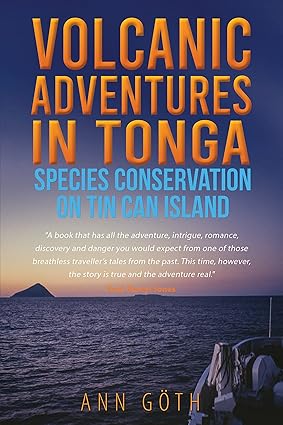
Volcanic Adventures in Tonga is an enthralling travel memoir that blurs the lines between fact and fiction, taking readers on a captivating journey to the remote Kingdom of Tonga alongside scientist Ann Göth. Departing from the picturesque Austrian Alps in the early 90s, a spirited 21-year-old Ann, accompanied by her German boyfriend and fellow scientist, Ivo, embarks on a daring 17-month expedition to save the endangered “Malau” bird, whose existence is exclusive to the volcanic island of Niuafo’ou. These enigmatic chicken-like creatures emerge from subterranean nests, buried deep beneath the ground.
In this vividly portrayed memoir, Ann and Ivo’s modest abode, a humble hut constructed from wood and leaves, becomes their sanctuary amidst the untamed beauty of Tonga. Here, they immerse themselves in the unhurried rhythm of life, embracing the “Anga faka Tonga,” the laid-back lifestyle unique to the region. The enchanting melodies of kava-drinkers echo through their hearts, while they marvel at the intricate craftsmanship of handwoven mats and traditional church dresses. Adventurous palates relish the indigenous cuisine, savoring dishes like breadfruit, succulent meats bathed in coconut water, and the delectable “Tongan ice cream.”
Despite grappling with concerns over animal welfare and the local consumption of Malau eggs, Ann and Ivo cultivate meaningful relationships with the Tongan community, earning the privilege of bestowing a name upon a newborn baby. However, the stark contrasts in Tonga leave an indelible impression on their minds: the regal Tongan king, stepping onto a ceremonial mat at the airport adorned with elegant German eyewear, juxtaposed with impoverished children, their innocent faces marked by bug bites, indulging in beetle larvae. Months of arduous camping and tireless excavation culminate in the relocation of Malau eggs to Late Island, thereby accomplishing their mission. Yet, as Ann succumbs to the allure of “island fever,” bidding farewell to Tin Can Island becomes inevitable. Within the pages of this captivating memoir, readers are transported to a world far removed from their own—a paradise juxtaposed with an inferno. Stunning coral islands surrounded by turquoise waters and pristine white sands stand in stark contrast to the pervasive poverty, environmental degradation, and the discomforts of fleas, bed bugs, and poor sanitation. Yet, it is impossible not to be awed by Ann and Ivo’s unwavering determination, profound passion, and extraordinary resilience. Through sleepless tropical nights, debilitating illnesses, relentless insect bites, and clothes stiffened by dirt and sweat, the tenacity of these “beautiful small fat palangi” shines through. Their unwavering spirit persists, even in the face of constant volcanic threats.
In Volcanic Adventures in Tonga, Ann Göth faithfully fulfills a promise she made to herself three decades ago. Her exceptional tales of volcanic exploration have been meticulously preserved within the pages of this remarkable book, which undoubtedly deserves a five-star rating. Seamlessly blending captivating storytelling with enlightening information, Ann’s contagious passion resonates from the first page to the last, creating an immersive experience that will captivate readers seeking an escape to a world both mesmerizing and unforgiving.
Pages: 277 | ASIN : B0BZSJT5TT



 LITERARY TITAN