Blog Archives
Inherited Courage

Beneath the Swamp’s Shadow is a historical fiction novel inspired by the Lumbee and Tuscarora resistance against the Ku Klux Klan during the 1958 Battle of Hayes Pond. Why did you choose historical fiction, rather than nonfiction, to tell this story?
I chose historical fiction because I really wanted readers to feel the story, not just learn the facts. Nonfiction can tell you what happened, but historical fiction gave me a platform to allow readers to step into the fear, the tension, the pride, and the generational memory that surrounded the moments leading up to the Battle of Hayes Pond.
The Battle of Hayes Pond is often described as the night the Lumbee people ran the Klan out of Robeson County, but the deeper story is much larger than that. It is about family, identity, inherited courage, and a people who had already endured generations of hardship. Historical fiction gave me room to honor the documented history while also exploring the emotional truth behind it.
I wanted the reader to understand that Hayes Pond did not happen in isolation. It came from a long legacy of resistance, including the memory of my 5th great-grandfather, Henry Berry Lowry, and the revolution of the Lowry War. Fiction allowed me to connect those threads in a way that felt personal and human.
How much research went into recreating Robeson County as it would have felt in 1958?
A great deal of research went into recreating Robeson County as it would have felt in 1958. I began writing this book in 2015, so this was not a quick project. For more than a decade, I researched the events surrounding Hayes Pond, the people involved, and their genealogies, newspaper articles, oral history interviews, family histories, local geography, businesses of the 1950s, and the social climate of the time.
I wanted this book to feel like home.
Like sitting in your grandma’s living room on a Sunday afternoon, the smell of home-cooked Lumbee meal drifting from the kitchen, the sweet warmth of cedar logs crackling in the wood heater and the sound of your elder’s voice carrying stories that remind you exactly who you are, and whose blood runs in your veins.
That’s the spirit I poured into this book. I wanted Robeson County to feel alive on the page, not just as a setting, but almost as a character itself. That meant paying close attention to the details: the roads, the communities, the way people spoke, the foods our people ate, the fear surrounding Klan activity, and the pride and closeness within Lumbee and Tuscarora families. I also wanted the environment to feel accurate—the cold January night, the broomstraw grass, the swamps, and the atmosphere of rural Robeson County during that era.
Because this history is personal to me, accuracy mattered. I did not want to simply recreate a historical event. I wanted to honor the people who lived it, the families connected to it, and the descendants who still carry that memory today. This is not just history. It is my people’s story. A Sunday story. The kind passed down while shucking corn on the porch, shelling peas at the table, or sitting close enough to an elder to understand that memory is one of the ways we survive.
The novel explores courage as something inherited as much as chosen. What does courage mean to you?
To me, courage is not the absence of fear. Courage is knowing fear is present and still choosing to stand for something greater than yourself.
In Beneath the Swamp’s Shadow, courage is inherited through blood memory, family, and community. It is passed down through the stories of ancestors who endured, resisted, and survived. The people at Hayes Pond did not suddenly become brave that night. They came from generations of people who had already learned how to survive intimidation, injustice, and violence.
Courage is also responsibility. It is understanding that your actions may protect not only yourself, but your family, your community, and the generations that come after you. That kind of courage is deeply rooted in Lumbee history.
Do you see yourself continuing to explore Indigenous history and Lumbee heritage in future books?
Absolutely. Preserving and sharing Lumbee history is a major part of why I write. Our stories deserve to be remembered, studied, and passed forward, not only within our own community, but beyond it.
There are so many parts of Indigenous history, especially Lumbee history, that have been overlooked, misunderstood, or left out of larger conversations. I feel a responsibility to help bring those stories forward in a way that is honest, respectful, and meaningful.
Beneath the Swamp’s Shadow is part of a larger mission for me. I want my work to help preserve our history, honor our ancestors, and give future generations something they can look to with pride. Our people have always had powerful stories. I plan to keep telling them.
Author Links: GoodReads | X (Twitter) | Facebook | Website | Amazon
Creature of Secret Sorrows


Creature of Secret Sorrows, by Dianne L. Hagan, returns to Cadence, New York, a town where history is never inert and the dead have unfinished claims on the living. When Randy Nichols disappears during a rockhounding walk, the search leads Marian Greene and her neighbors to a brutally lynched body in the woods. What begins as a murder investigation widens into a confrontation with ancestral violence, hidden family lines, supernatural guardians, and the damage passed down through the Hayward legacy. The mystery coils around Randy’s grief for his newly found mother, Madison’s fractured family, and the apparition of the asanbosam, a creature that seems less interested in terror than in justice.
I was struck by how Hagan refuses to separate the procedural from the spiritual. Cadence is full of police work, interviews, evidence, and old documents, but it is also a place where lake drums, bears, legends, and restless souls press against ordinary life. That mixture could have felt ungainly in a lesser book, but here it gives the story its pulse. The supernatural elements are not decorative fog; they are moral weather. They make visible what polite history tries to bury.
My strongest reaction was to the novel’s emotional density. Hagan writes community with breadth: meals, jokes, old resentments, marriages, griefs, and arguments all crowd the page. At times, the large cast demands attention, especially for readers new to the series, but the reward is a world that feels inhabited rather than staged. Randy’s tenderness, Madison’s jagged survival, and Marian’s weary courage give the horror a human temperature. I appreciated that the book is not content with simply exposing evil; it asks what repair might look like after truth has done its bruising work.
I would recommend Creature of Secret Sorrows to readers who enjoy supernatural mystery, psychological thriller, Black horror, historical suspense, ancestral trauma fiction, and community-centered crime novels. Fans of Stephen King’s small-town supernatural stories may recognize the sense that an entire place can become a haunted witness, though Hagan’s focus is more intimate, more reparative, and more explicitly tied to racial history. This is a dark, sinewy mystery with a conscience.
Pages: 320 | ASIN : B0GZK9V7MX

Believable Dark Fantasy

The Siren’s Daughter follows a young, spirited girl, drawn irresistibly to the sea, who finds a mysterious conch shell that lures her away from her family. What inspired you to retell this story in this manner?
I was working on another project, making cultural heritage cards. When researching CHamoru legends, I found that the Marianas had their own sea siren lore. Because of my Latino heritage, I know that “sirena” is Spanish for “siren.” While “Sirena” is a beautiful name, I started wondering if maybe the legend wasn’t actually about a girl named Sirena, but was a warning based on what happened to a girl claimed by a siren. A Spanish word for a warning instantly placed the story in Spanish colonial times, and I imagined that it was a priest who wrote the warning and did not care to keep the girl’s name. The details of the rest of the story just fell into place as I imagined it more. I really liked the whole premise of a siren claiming the girl as her own, and the details being lost to time because of colonial control. I liked it more and more as I kept developing the story.
What were some themes that were important for you to explore in this book?
The legend of Sirena is a Guam legend, but I wanted to make it more of a general CHamoru legend by integrating it with siren lore in the other Mariana Islands.
As with my other works, I want to share CHamoru heritage with readers everywhere. In The Siren’s Daughter, I saw an opportunity to share with audiences another part of CHamoru history – Spanish colonization. I wanted to mention the wars against the Spanish. I also wanted to mention the loss of spiritual and traditional knowledge because the Spanish killed off traditional healers.
What were some goals you set for yourself as a writer in this book?
My main goal was to create a believable dark fantasy that shares CHamoru heritage with readers. I wanted to give a glimpse of life under Spanish rule. But to be honest, I really liked the story that I had imagined, and I was excited to write it.
What story are you currently in the middle of writing?
I am currently working on Books 2 and 3 of what I am calling The Yo’Åmte Trilogy. The Makana’s Legacy is Book 1. I like the outlines that I have, and I wish I had the time to devote to these stories. These next two books will actually bring up topics that even many CHamorus might not have thought about. Because these stories delve deeper into the role of Yo’Åmte (traditional healers) in CHamoru society, I will be consulting with an expert on the topic of Yo’Åmte to help me stay accurate and respectful in my portrayal of Yo’Åmte.
Author Links: GoodReads | Facebook | Instagram | Website | Amazon
After the wars, Hagåtña fell hushed. Tasi – restless and bright – slipped to the reef where a siren waited with a black opal conch. At home, her mother’s patience frayed; her grandmother warned that spirits were listening. One bitter outburst became a curse, and the sea answered.
Sailors spoke of a girl in the foam. Priests spread a warning about la sirena – the siren. The word traveled farther than the truth – until it swallowed the girl’s name.
The Siren’s Daughter is a haunting CHamoru retelling set just after the Spanish-Chamorro wars: a tale of mothers and daughters, desire and duty, and what the ocean keeps while history erases.
Includes a traditional telling of the Sirena legend and an Author’s Note.
The Siren’s Daughter


The Siren’s Daughter is a haunting retelling of the CHamoru legend of Sirena, set in the turbulent period of Spanish colonization in Guam. It follows young Tasi, a spirited girl drawn irresistibly to the sea, her mother Marisol, burdened by loss and duty, and her grandmother Benita, who clings to the old ways. The story blends folklore with history, showing how faith, colonization, and myth intertwine. As Tasi’s fascination with the ocean deepens, a mysterious conch shell and a spectral sea woman lure her away from her family and into the depths, transforming the familiar legend into something darker and more tragic. By the end, what was once a story of disobedience becomes one about possession, inheritance, and the ocean’s unrelenting claim on those who love it too much.
Author M K Aleja’s writing is steady and clear, then suddenly crashing with emotion. The rhythm is almost hypnotic, and I found myself swept along, just like Tasi. The dialogue feels natural, the imagery rich but never overdone. The story’s pacing has the quiet patience of an island tide, moving slow in places but always purposeful. What struck me most was how Aleja breathed life into the CHamoru world, its language, spirituality, and pain under Spanish rule. The historical setting isn’t just a backdrop; it’s a living force pressing on every choice the characters make. It reminded me that legends aren’t made in peace, they’re born from suffering, from people trying to make sense of what they’ve lost.
This is an emotionally stirring novel. There’s a deep sadness running through it, a mother’s guilt and a child’s longing wrapped in superstition and love. I kept thinking about how easily a wish, spoken in anger, can turn into a curse. The siren scenes are chilling yet beautiful, a strange blend of horror and tenderness that left me uneasy in the best way. I loved how the book questioned the version of history we inherit, how the colonizers’ telling of events erases the truth beneath them. By the time I reached the end, I didn’t just see Tasi as a victim; I saw her as a symbol of something older than the Church or the Empire, something that refuses to be forgotten.
I’d recommend The Siren’s Daughter to readers who love stories that feel ancient yet new, mythic yet human. It’s perfect for those who enjoy folklore with teeth and heart, fans of writers like Silvia Moreno-Garcia or Neil Gaiman will find much to love here. It’s a story that is equal parts sorrow and wonder.
Pages: 52 | ASIN : B0FSF9P6LD
Conflict Over the Centuries
Whispers Through Time follows a successful writer whose life is upended when a former lover reappears with a stack of photographs and a secret about her origins, leading her on a journey of cultural identity and into a decades-old mystery surrounding the American Indian Movement. What was the inspiration for the setup of your story?
The inspiration for Whispers Through Time came from a trip my husband, Kevin, and I made in 2000 to South Dakota, which is a truly magical state. While there, we visited, among other historical places, the Pine Ridge Indian Reservation, the Wounded Knee Memorial, and the American Indian Movement (AIM) Museum, which commemorated AIM’s 1973 Occupation of Wounded Knee. As I stood beside the Wounded Knee Creek, near where the original massacre had occurred, I had a strange, empathic experience that changed my life…and gave me the most important kernel of truth to build on in Whispers Through Time: Heroine Sierra Masters learns that through her newly-discovered Lakota maternal bloodline, she can receive visions that help her ‘see’ historical mysteries and solve them.
The supporting characters in this novel were intriguing and well-developed. Who was your favorite character to write for?
That’s a really hard question because I love them all, but I think – outside of Sierra Masters – my favorite character to write had to be Nathan Winterhawk. He was based on several Lakota elders I met while on our vacation, or have followed over the years. He came to life immediately. His humor and optimism were interspersed with his love of tradition, and his right-below-the-surface, always-simmering rage was almost eerie in its truth. His dialogue and unusual way of expressing his feelings wrote themselves, as did his compassion for Sierra’s situation. He was certainly the easiest character to write because I felt like I knew him intimately after 20 years of research.
What were some themes that were important for you to explore in this book?
These are really great questions – thank you so much! More than anything else, I wanted to tell a really great story.
But I also wanted to show both sides of the White/Indian conflict over the centuries and to explore the vantage point of both ethnicities, from a historical view as well as from the White, without making the novel a political commentary of left vs. right. I think we’ve had enough of that. I also wanted to illuminate to people of all races across the US and the rest of the world the truth about the 1973 Occupation of Wounded Knee, and what AIM was trying to illustrate by taking it over. Finally, I wanted to create a real, honest-to-God love story between a man and a woman that was long-lasting with real heartache that had occurred many years earlier, but still affected them now.
When will Book Two be available? Can you give us an idea of where that book will take readers?
I’m nearly finished with the first draft of Journey of the Heart, Book Two of the Whispers Through Time series, so I don’t know at this time when it will be out. It will take readers into Comanche Indian territory on the Llano Estacado of Texas, a centuries-old treasure hidden in a canyon located on a Panhandle ranch belonging to Sierra’s best friend’s grandfather, and the final truth about a young girl with red-gold hair captured by Comanches during the 1860s.
Author Links: GoodReads | X (Twitter) | Facebook | Ronni Hoessli | Website | Amazon
Hunter Davenport realizes the evidence he’s shared with Sierra could indeed destroy her—but it could free her as well. The decision is yanked from her hands when the past and present collide through a historical portal on sacred Native American land. Will she take the gift that is offered? And will Hunter do what he didn’t do twelve years earlier—stand by her? Only time will give them their answers.
Whispers Through Time
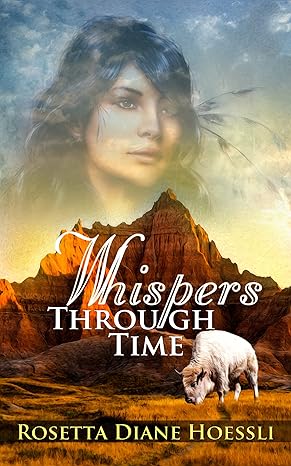
Whispers Through Time follows Sierra Masters, a successful historical fiction writer whose life is upended when a former lover, Hunter Davenport, reappears with a stack of photographs and a secret about her origins. What begins as a deeply personal reunion quickly spins into a tale of political resistance, cultural identity, and a decades-old mystery involving the American Indian Movement, the 1973 Occupation of Wounded Knee, and Sierra’s true parentage. As Sierra navigates her family’s past and her own shattered sense of self, the novel shifts seamlessly between romance, mystery, and historical fiction, creating a rich and emotionally charged story.
What struck me most was the emotional honesty in Hoessli’s writing. Her prose is straightforward and often stark, but that works in her favor. There’s just raw, heartfelt truth. Sierra’s breakdowns, her self-doubt, her fury, and her quiet moments of awe are painted vividly. I felt like I was sitting in that dusty adobe house in Big Bend, Texas. The pacing can feel slow at times, especially when the backstory expands into historical context, but the emotional payoff is worth every beat. The dream sequences and flashes of past trauma are especially affecting.
Sometimes characters drop into exposition mode and sound more like history teachers than people talking. But even then, the ideas they’re exploring, identity, betrayal, legacy, are weighty enough to hold my attention. The relationships, especially between Sierra and her mother, are what really gave the book its weight. Also, Hunter. He’s a classic storm-you-can’t-look-away-from kind of guy. I didn’t always like him, but I couldn’t stop watching him.
Whispers Through Time is a powerful blend of historical fiction, romantic suspense, and contemporary drama. A story about finding the truth, even when it hurts. It’s perfect for readers who crave novels full of long-buried family secrets, emotionally raw relationships, and a deep dive into forgotten corners of American history.
Pages: 276 | ASIN : B098278M38
Raven’s Legacy (A Jonah St. Clair Mystery)

Raven’s Legacy is an atmospheric mystery set in the remote Alaskan village of Koloshan in 1980. At the center is Jonah St. Clair, a war veteran and former LAPD officer turned village cop, who’s suddenly tasked with investigating the shocking theft of sacred Tlingit artifacts from the local Native Arts Center. The heart of the mystery is the missing Raven House screen—a symbol of cultural pride and community history—setting off a tense clash between tradition, greed, and the ghosts of the past. As Jonah digs deeper, he uncovers more than just clues; he finds tangled loyalties, unresolved grief, and a reckoning with cultural identity that makes this story far more than your average whodunit.
The opening prologue, where a young Jonah first lays eyes on the Raven House screen, is quietly haunting. That scene stayed with me, not because of flashy writing but because of the reverence and weight Stuart gives to culture and memory. There’s this moment where elders stand around naming each missing artifact in Tlingit—“Káa yooka.όot’ x’όow,” “Naaxein,”—like they’re reading names off a memorial. It’s a grief not just for stolen objects, but for a fading culture being ripped away in broad daylight.
Stuart’s writing is sharp but not showy. It flows easy, like a local telling a story over coffee—personal, thoughtful, no wasted words. I loved how she grounded everything in real place and texture. Koloshan doesn’t feel like a backdrop—it’s a character. The muddy roads, the rusting buildings, the church steeples clashing with old totems. It all feels lived-in and complicated. Stuart also gets small-town politics and family dynamics just right—the way gossip travels faster than police radios, and how history never stays buried. Especially when we get to the elder characters like Harold and Ray, each with their own ideas about what the artifacts “should” mean. It’s not just mystery—it’s a debate about identity, and who gets to decide what legacy survives.
The pacing drags a bit midway through Jonah’s hunt for leads, especially during the logistics-heavy stretch in Juneau. But even then, there’s always an emotional undercurrent. She writes with empathy. There’s tension, yeah, but also a real sense of stakes for these quiet, ordinary people caught in something bigger than them. Jonah himself is a standout. He’s tough, sure, but there’s a vulnerability there—he feels things deeply, and that gives the story its soul.
Raven’s Legacy is a thoughtful, rich, and emotional mystery with a lot of heart. If you’re looking for a mystery with real depth, layered characters, and a powerful sense of place, you’ll get a lot out of this one. I’d especially recommend it to fans of Dana Stabenow or those who love stories that blend culture, community, and quiet suspense.
Pages: 305 | ASIN : B0F3M8VPPP


