Category Archives: Five Stars
Between Flights: Reflections on the Unspoken Truths of Leadership and Life


Between Flights is a reflective leadership memoir in fragments, written out of airports, late-night flights, and the exhausted spaces in between a demanding career and a fully lived personal life. Author Wendy Walker builds the book less as a manual than as a series of honest landings, circling around ambition, empathy, confidence, burnout, identity, grief, patience, and the quiet recalibrations that keep a person from drifting too far from herself. What stayed with me most was the governing image of the book itself: that leadership is often shaped not in the loud moments of performance, but in the pauses, the delays, the window-seat silences where the truth finally catches up.
What I admired most is that Walker writes from inside the strain, not from some polished summit beyond it. When she describes opening her Notes app after a text from her son and typing, “This pace isn’t sustainable,” the book declares its emotional contract immediately: it’s going to tell the truth, even when the truth is tender or inconvenient. I found that candor appealing. The best sections have a lived grain to them, especially when she moves from abstraction into scene, like the quarterly review where empathy with a frightened sales leader changes the whole conversation, or the chapter on ambition where she refuses the noisy, conventional version of success in favor of something steadier and more interior. I also liked the book’s generosity. It doesn’t sneer at vulnerability or worship hardness. It keeps returning, with real conviction, to the idea that presence matters more than perfection, and that landed with me.
Walker trusts her images and lets them do the work, and I found that to be a strength. The aviation motif gives the reflections shape and lift. “The window seat perspective,” “holding pattern,” “landing gear,” “cabin pressure,” these metaphors create a quiet coherence across the book, and they suit its meditative temperament. I was especially moved by the chapters that widen leadership beyond performance into emotional weather: the heartbreak of a promotion that vanishes, the need to land a season well before taking off again, the insistence that emotion is not the enemy of judgment but one of its instruments.
Between Flights is less interested in teaching leadership than in humanizing it, and I think that’s exactly why it works. It’s warm without being soft, thoughtful without becoming abstract, and personal without collapsing into self-display. I’d recommend it to readers who are carrying a lot, especially leaders, working parents, women in senior roles, and anyone in a season of reassessment who wants a book that feels like calm company rather than instruction from a podium. It’s a graceful, intelligent reminder that sometimes the most important course correction begins in stillness.
Pages: 238 | ISBN : 978-1998528745

When the Forest Dreams

When the Forest Dreams, by Andrea Ezerins, follows Emma Jablonski, a dutiful Polish American bakery daughter living in a cramped Upper East Side apartment, who believes she may be on the brink of inheriting her mother’s illness and decides she has only a little time to begin living before life closes around her for good. What unfolds is a romance of awakening: Emma slips from obedience into appetite, from silence into speech, and from mere survival into a more enchanted attentiveness to birds, trees, food, friendship, and love. The novel braids immigrant family pressure, illness anxiety, Central Park birding, and a slow-blooming relationship with Jake into a story that is at once tender and self-consciously dreamy.
I was taken most by how emotional the book is. Emma’s voice has an inward intensity that could have grown claustrophobic, but instead it becomes the novel’s chief pleasure: she is funny, pious, exasperated, lonely, sensuous, and faintly feral all at once. Her private vocabulary of birds gives the story an animating pulse; the white-eyed vireo, the kingfisher, the wood duck, even the idea of the elusive ivory-bill make the natural world feel less decorative than salvific. I liked that the book understands how deprivation can make beauty feel almost violent. A plush quilt, a duck on a pond, a hand on the shoulder, fresh parmesan, a cup of tea these are not trimmings here. They arrive with the force of revelation.
This isn’t a book embarrassed by sincerity, and that gives it a certain old-fashioned glow. The prose is lush, and the emotional beats are worn close to the skin, but I found that part of its charm; the book is unabashed about wanting transformation, romance, and a reprieve from beige existence. Veronica also gives the story a welcome texture, preventing it from collapsing into a sealed two-person fantasy. Beneath the romance, I felt a persuasive argument that a life can narrow by increments, and that reclaiming it may begin in something as humble as cooking for someone, naming what you love, or admitting that duty alone is a meager gospel.
I’d recommend When the Forest Dreams to readers who gravitate toward contemporary romance, women’s fiction, coming-of-age fiction, immigrant family drama, and nature-inflected romantic fiction. Especially readers who like introspective heroines and stories where emotional thaw matters as much as plot. It will likely appeal to people who love L. M. Montgomery’s The Blue Castle or readers of Emily Henry who wouldn’t mind a more sheltered, more devotional, more bird-struck heroine; the author’s note makes that lineage explicit, and you can feel it in the book’s faith in reinvention.
Pages: 344 | ASIN : B0FWZXGTXC
Alphabet Albcell!

Alphabet Albcell!, by Gazmend Ceno, is a children’s activity book built around the Albcell system, a puzzle format that blends letter recognition, number patterns, and coloring into one routine. The opening section walks young readers through the rules with a large sample puzzle, showing how even numbers appear in circles, odd numbers appear in diamonds, and each zone follows a one-time-only number rule. That setup gives the book a clear identity right away: it’s not just a workbook page here and there, but a full method for solving and coloring alphabet-themed puzzles.
Once the instructions are over, the pages move into a steady rhythm of puzzle spreads that alternate between simpler even-number pages, odd-number pages, and fuller mixed-number designs. The shapes inside the squares shift from page to page to form large block letters and other bold paths, so the child is always working inside a strong visual structure. That repetition feels intentional. It gives children a pattern they can settle into while still keeping the pages visually fresh.
The book also has a nice classroom-to-kitchen-table feel. It explains the puzzle logic in a friendly voice that’s easy to follow. I liked that the coloring isn’t treated as an extra decoration tossed on top. It’s part of how the activity unfolds, first around the circles, then around the diamonds, then across the full finished shape.
Visually, the book is straightforward and easy to read. The pages are clean, the number placement is large enough for young children, and the black and white layouts leave plenty of room for coloring and marking with a pencil.
Alphabet Albcell! is a structured alphabet and number puzzle book with a specific game at its center. It’s made for children who like patterns, filling things in, and turning a page of shapes and numbers into something they’ve completed with both logic and color. If you want a book that gives readers a repeatable puzzle routine with an educational slant and plenty of room for coloring, this book is easily recommended.
Pages: 109 | ASIN : B0F281BZTD
Suzy & Roxy Go Camping
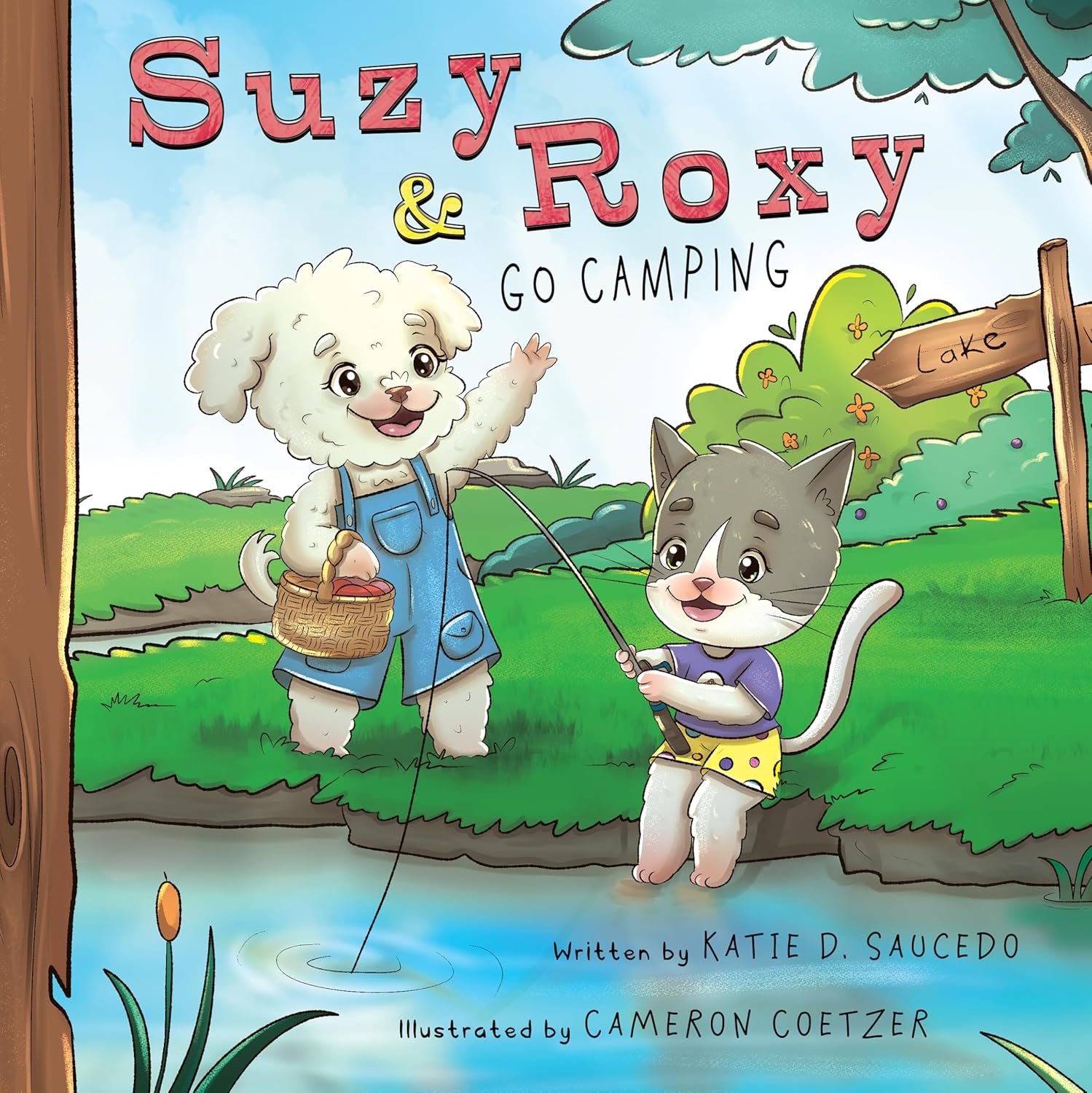
Suzy & Roxy Go Camping follows two best friends as they head out for a camping trip with a cheerful plan and very different personalities. Suzy is organized, practical, and eager to make the day special, while Roxy is more impulsive, overpacked, and charmingly scattered. When rain and lightning threaten to ruin their outing, the story turns into a gentle little celebration of flexibility, friendship, and the unexpected usefulness of all the extra things Roxy dragged along. It’s a simple arc that lands cleanly, and the book never loses sight of the warmth between its two leads.
What I liked most was how kindly the book understands the push and pull between planning and spontaneity. It doesn’t turn Suzy into the sensible hero and Roxy into the comic problem. Instead, it lets both of them be right in their own way, and that gives the story a sweetness that feels earned. The writing is straightforward, as you’d expect for a children’s book, but it has a nice emotional clarity to it. I especially liked that the conflict stays child-sized. A rainy camping trip is disappointing, but not devastating, and that scale makes the book feel reassuring. It says, in effect, that a spoiled plan doesn’t have to become a spoiled day.
I also found the artwork a huge part of the book’s appeal. The illustrations are bright, cute, and full of personality, with an almost storybook-cartoon softness that suits the tone beautifully. Roxy’s flair, Suzy’s earnestness, the rain gear, the umbrellas, the rubber duck boots, the bubble-filled indoor fun, all of it gives the book a buoyant visual rhythm. I was especially taken with how the stormy scenes never become overly gloomy. Even when the weather turns, the pages still feel playful and inviting, and that matters in a story built around disappointment giving way to delight. The visual world is cozy, colorful, and emotionally legible in exactly the way a good children’s picture book should be.
This is a genuinely tender little book about adaptability, companionship, and the way different personalities can balance each other out. I’d recommend this picture book to young children who enjoy animal characters, camping themes, and stories about friendship that feel comforting without becoming bland. This one would be a lovely read for kids who need a soft reminder that sometimes the day you planned isn’t the day you get, and that can still turn out beautifully.
Pages: 32 | ISBN : 978-1952199356
Adventures of a Looney Scot

Adventures of a Looney Scot is a memoir, but it doesn’t read like a careful march through dates and milestones. It reads like someone sitting across from you, pint in hand, telling you how a rough Glasgow childhood, a fierce family life, and an obsession with the outdoors slowly shaped him into a geologist with a taste for risk, argument, and reinvention. The book’s subtitle, From a Glasgow Urban Warrior to a Professional Geologist, turns out to be the clearest description of what it’s doing: tracing a life through class, landscape, work, and national identity, while keeping one foot in comedy the whole time.
What gives the book its real personality is the voice. McFeat-Smith writes in a way that’s unruly, funny, self-mocking, and deeply attached to Scottish speech and rhythm. A scene about midges lands because the punchline arrives with perfect local bluntness: “If the tourists knew about Scottish midges, they wouldnie come here tae enjoy themselves.” That line captures the book’s whole method. It doesn’t just describe Scotland. It performs Scotland as the author knows it: hard, absurd, affectionate, and never polished to the point of losing its bite.
The middle stretch is where the memoir really finds its shape. The childhood material has real grit, but the outdoor episodes turn that grit into momentum. Canoeing on Loch Lomond, hiking, cycling, close calls, family arguments, and reckless confidence all build the sense that this is a book about being formed by physical experience as much as by education. The book understands that a life story can be told through danger, embarrassment, and stubborn survival just as well as through achievement.
What I found most interesting is how the book gradually expands. It starts as a personal story, then grows into a broader portrait of Scottish culture, marriage, professional identity, food, ancestry, and politics. Jeanie isn’t treated as a side note but as part of the author’s development, and the later chapters move from memoir into a kind of argumentative cultural scrapbook, with sections on Scottish breakfast, self-determination, inventions, and odd laws. That shift makes the book feel true to its own ambitions. This isn’t just a record of one man’s youth. It’s a book that wants to place that youth inside a bigger Scottish story.
Adventures of a Looney Scot is a boisterous, big-hearted memoir about how a particular kind of Scottish boyhood becomes a professional life without ever quite losing its appetite for chaos. It’s at its best when memory, place, and voice are all firing at once, and even when it sprawls, the sprawl feels connected to the author’s personality. What stayed with me wasn’t just the sequence of events, but the sense of a mind trying to understand itself through weather, family, class, work, and country. That’s a rich mix, and the book leans into it with conviction.
Pages: 252 | ASIN : B0GVVPJ9KZ
Alpaca Ranch Fun!
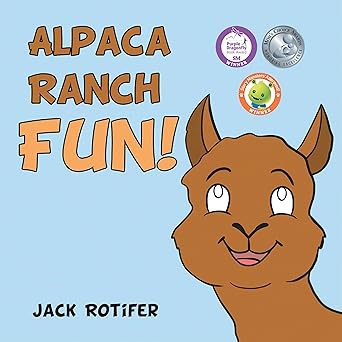
Alpaca Ranch Fun! is a children’s picture book with a gentle, educational animal-fiction feel. It follows three Yorkies, Jingle, Jaywok, and Joi Daisy, as they visit Aunt K’s ranch, meet baby alpacas June and Josie, and slowly learn about alpacas, alpaca fiber, shearing, and the other animals around them. What starts as a simple ranch visit turns into a series of small discoveries about friendship, difference, and how animals live in ways the Yorkies have never imagined.
What I liked most is how openhearted the writing is. The book doesn’t rush. Instead, it leans into a warm, earnest style that feels like someone sitting down and telling a story because they genuinely love these animals. The author keeps returning to curiosity as the engine of the book. The Yorkies ask direct questions, sometimes awkward ones, and the story treats that as part of learning rather than something to be ashamed of. I also liked that the book folds facts into the conversations so young readers pick things up along the way without the whole thing feeling like a lesson plan.
The book circles back to the thought that animals can be different and still become friends, and that difference is not something to fear. That is a familiar message, but here it works in a grounded way because it grows out of the Yorkies meeting alpacas, hearing about sled dogs, and seeing how each creature has its own place. The artwork helps a lot, too. The illustrations are bright, clean, and easy for a child to follow, with bold colors, smiling faces, and a playful look that matches the book’s friendly tone.
Alpaca Ranch Fun! would be best for young readers who like animals, especially kids who enjoy picture books that mix story time with bits of real-world learning. It would work well for reading aloud, and I think it would especially click with children who are curious and like asking why things are the way they are. I would recommend it most to families, early elementary readers, and classrooms looking for a gentle children’s picture book that blends animal friendship with basic nonfiction-style facts.
Pages: 47 | ASIN : B0BLG3JV1D
Mijo: We Bend, Not Break

Mijo: We Bend, Not Break opens as a multigenerational story about inherited silence, migration, and the long, uneven labor of becoming a different kind of man. Author Francisco Castillo begins in drought-stricken Michoacán with Joaquín, a boy starved for tenderness, then follows him across the border into California, through field work, fear, fatherhood, and the psychic aftershocks of survival. The book keeps widening from there, tracing how masculinity, trauma, family memory, and healing move from one generation to the next without ever feeling schematic. What stayed with me most was its belief that resilience is not hardness, but the stubborn decision to remain reachable.
What I admired first was the book’s emotional architecture. Castillo understands that generational damage rarely announces itself with grand speeches; it shows up in the hand that doesn’t quite reach back, the hug withheld, the child who learns to read distance as weather. Joaquín is drawn with real pity but not indulgence, and Antonia emerges as more than a counterweight to him: she is flint, witness, and moral pressure. I felt the novel’s strongest current in the scenes where love exists before the characters know how to perform it. That gives the book an ache that feels earned rather than manufactured.
I also liked that the prose aims higher than plain utility. At times it’s lush, but more often it lands on sharp, memorable images: labor as a language, silence as inheritance, tenderness as something nearly unbearable to touch. There are moments when the sentiment edges close to overflow, yet the book repeatedly recovers because its core insight is so recognizable: people can mistake emotional deprivation for strength, then spend a lifetime trying to unlearn the error. By the end, I felt I had read not just an immigrant family story, but a study in repair, crooked, incomplete, and therefore convincing.
I would recommend this to readers of family saga, immigrant fiction, literary fiction, historical fiction, and trauma-and-healing narratives. It will likely speak to readers who respond to the intergenerational emotional intelligence of Sandra Cisneros or the intimate family gravitas of The House on Mango Street, though Castillo is writing in a broader, more openly restorative register. This is a book for readers who can bear tenderness without mistaking it for softness. Its deepest argument is simple and durable: what we inherit may wound us, but it does not get the last word.
Pages: 216 | ASIN : B0FT6N57CG
The Making, the Rise, and the Future of the Speakingman-Seventh Edition

Dan M. Mrejeru’s The Making, the Rise, and the Future of the Speakingman is, in its seventh edition, an ambitious work that joins paleoanthropology, neuroscience, climatology, geomagnetism, and civilizational theory into a single interpretive design. Its architecture matters. The book moves from prelinguistic hominin development through migration, cognition, and symbolic culture, then turns toward the future, planetary thermal cooling, and finally the emergence of the Information Society. That breadth gives the volume its proper scale. This isn’t a monograph in the narrow academic sense. It’s a speculative system, a long argument about what kind of creature the human being became, what forces shaped that becoming, and what mental regime may be arriving next.
What gives the book its peculiar identity is the author’s insistence that human evolution can’t be understood by anatomy alone. Mrejeru treats the brain as a structure formed under planetary pressures, especially cooling cycles and geomagnetic disturbances, and he frames the human story around two decisive cerebral transformations: one that differentiates late hominins from apes, and another that produces the “modern brain.” Even the title term, “Speakingman,” is revealing. It presents humanity less as a biological species than as a being constituted by language, cognition, and collective adaptation. The result is a work that reads as both grand hypothesis and metaphysical anthropology, a theory of how matter, environment, and mind coevolve.
I think the book’s most interesting intellectual gesture lies in its contrast between nonlinear and linear modes of thought. Mrejeru isn’t content to narrate the emergence of Homo sapiens. He explains shifts in consciousness, the rise of quantification, the growth of individualism, and the possible need for a future “hybrid thinking approach.” That conceptual range lets the book travel unusually far, from cerebellar development to the political psychology of modernity. At one point, it distills its civilizational unease into the sentence, “This linear way of thinking produced many things,” and the line carries more weight than its plainness first suggests, because the entire book is wrestling with the achievements and costs of linearity as a cultural form.
Mrejeru writes like someone trying to assemble a total picture before the fragments drift apart. The book’s real subject is not only human origins. It’s the author’s attempt to think of origins and destiny within one continuum. That’s why a phrase from the dedication, “I am a nonlinear person,” feels more than autobiographical. It reads as a key to the entire enterprise: the book is shaped by a mind that values cross-domain association, recursive analogy, and large explanatory arcs over disciplinary restraint.
As a five-hundred-page intellectual construction, this seventh edition is best read for the pattern it proposes rather than for any single conclusion. Its scale is its argument. By the time it reaches the Information Society, the book has made clear that it sees humanity as an unfinished cognitive project, still being reorganized by environment, technology, and forms of thought. What remains most memorable to me is the seriousness of that wager. Mrejeru believes that the history of the human mind is inseparable from the history of the planet, and he writes as though both histories are entering another phase together. Whether one accepts every step of the argument or not, the book presents itself as a comprehensive anthropology of becoming, and that’s what makes it a singular, intellectually provocative work.
Pages: 542


