Blog Archives
Give the World a Consciousness

Wasp Oil follows a haunted cop as she navigates a web of corruption and faces off with an otherworldly presence that feeds on fury. Where did the idea for this novel come from?
I’m a big Stephen King fan. In which some of his early novels had a messy direction and at times absurd riffing on certain subject matter. In the best way possible, of course. During the process of writing the first draft, I listened to the audiobook of his novel, Tommyknockers. It was strange, gripping, zig-zagged in theme and direction, basically, you had no idea where the story was gonna go, and there were so many moments where I paused and audibly said: WHAT? WHY STEPHEN, WHY?
Knowing he wrote the story while under the influence of drugs for the most part, I asked myself: What would a sober version of this story look like? Would it be tamer or in your face in such a stomach- clenching and suffocating way that the reader becomes swallowed by the atmosphere of the world and the character’s blood-curdling anger and anxiety?
In addition, when I was watching TV one day, totally spaced out from the program, becoming background noise while I was staring at my TV, I remembered the grossest injury I had. I was working at a zoo. Repurposing old shipping containers with lead-based paint and thinning rusty steel. I was cutting sections of a metal wall my co-worker and I had fabricated as a divider for the three black bears that were going to use these containers as a hibernating den. I had all my safety gear on and started cutting one of the center pieces with a grinder. Silly me forgot the blade spun in my direction and locked it on. Thinking I was safe. Well, a bur I couldn’t see snagged the disk, the grinder locked on it, then flew at my face. In a fraction of a second, I could’ve had my brain severed or my skull cracked. I swung out of the way as this red-hot tool flew at me, then bam!
The disk cut through my arm. Deep into my skin, fatty, and muscle tissue. I screamed my head off until I got paper towel to put pressure on my wound, then called for help while I was in shock. First aid came, giving me the courage to look at my gaping wound, which was surprisingly not bleeding, and then the rest was history. That moment of my life was so eye-opening and biologically invigorating, etched into my brain, that it inspired the brutality and ick factor in Wasp Oil.
What is it that draws you to the fantasy genre?
Fantasy allows me to embrace the level of imminent danger for mortal characters. While also creating questions of what the right circumstances are, I can impart on my characters and give the world a consciousness that could dictate what level of power and effectiveness it has on who or what drives the story forward. Fantasy also increases the reader’s interest, especially if I create characters with mortal limits. Furthermore, any characters with fantastical capabilities could either be seen as all-powerful or blind by the reasoning behind their otherworldly and even mortal agenda.
What were some themes that were important for you to explore in this book?
Anger was the most important theme. I spent so many years hating myself due to my belief that I had to behave a certain way to keep those closest to me happy. Give them a sense of trust in the version of me that makes them feel good in terms of what role I play in their life. Once I saw that my truer self didn’t bother anyone, and especially myself, I recognized how much toxic anger and energy I was wasting on destroying and even hiding from who I truly am. Even questioning if I ever was my true self. In my 20s I was actively dating and had friends come and go in my life. But none of those relationships were ever genuine because I was never kind to myself. I gave everyone I loved what I believed made them happy and feel safe. Hoping I’d get the same in return. Which I did in most cases, but the love and trust never felt real or steady.
Goods and evils of anger are what truly summarized all my thoughts as I was writing this book. I knew anger as the main theme, especially as an umbrella term for other themes such as anxiety, regret, and maddening drive, would rub people either the wrong way or be overwhelmed by the rawness of the extremes I put my characters through. Nevertheless, I fought my nerves that wanted me to stop writing and do it anyway. Even if some readers might be put off by how intense the story is.
Can readers look forward to seeing more releases from you soon?
I will be writing one more book taking place in Halburton. Making it third to Black Rose Cocoon and Wasp Oil. The book will be called: Dead Mirrors Follow. The theme being: How do we deal with the ghosts of our past? Be they people, our mistakes, and the moments in which we wished we reacted differently. As for the storyline, all I’ll say is that it won’t be as wonderfully messy as Wasp Oil, but it will surprise you, scare, and hold you in ways you might not know how to feel. Storytelling is not about making you feel, then move on with your life. It’s about giving you pause in the rhythm and pattern you created to reorient yourself and appreciate the good in your life.
Author Links: GoodReads | X (Twitter) | Facebook | Amazon
Funhouse Mirror

DimWitts: The Big Stupid is a genre-crossing novel with elements of fantasy, dystopian, and satire as well. Did you start writing with this in mind, or did this happen organically as you were writing?
I wanted to write something funny in the speculative fiction category without committing entirely to one genre. Admittedly, a few subplots emerged organically along the way, but the core story and the character arc of the protagonist remained largely consistent with my original outline.
Some events in the book were chillingly similar to real-life events. Did you take any inspiration from real life when developing this book?
My inspiration came directly from the last American election. It occurred at the same time the Canadian Parliament was being prorogued, and the rest fell into place around it.
I found this novel to be a cutting piece of satire. What is one thing that you hope readers take away from your novel?
Fulfillment. Enlightenment. The best satire is a funhouse mirror; it exaggerates flaws to ridiculous proportions, allowing an audience to see what could happen if a bad idea is given too much credence. I hope to scratch that surface, at least a little, and maybe get some laughs along the way.
Will this novel be the start of a series, or are you working on a different story?
This is book one of three. I am currently working on the “dark middle child” of the series and hope to have it finished by the spring of 2026. Book three is stewing nicely on the back burner and will likely be in print shortly thereafter.
Author Links: GoodReads | Website | Amazon
Lancaster Dirk, the newly elected American president, is on a race to destroy his enemies and restore the glory of the republic. But to do it, he needs something extremely important. Something Canadian.
A dirty old smelter in a dirty old B.C. mountain town — with an even dirtier old secret.
Balanced between worlds, the past and future collide in a tale that spans the globe — and the very edges of reality itself.
Respect for Nature

Walk With Me follows a former park ranger and his grandson who bond through hikes and camping trips, and through their adventures learn valuable lessons about passing down knowledge, love, and courage. What was the inspiration for the setup of your story?
Walk With Me was inspired by my three grandsons, and I dedicated the book to them. As they’ve grown, I have tried to be their window to the outdoors, and it has rounded my life in amazing ways.
What were some themes that were important for you to explore in this book?
Important to me in my novella is the passing of valuable information – life skills – from one generation to the other. Respect for nature is a critical concept to pass on to all who will read my novel.
What experience in your life has had the most significant impact on your writing?
Influence from my parents, especially my mother, who encouraged my passion for written expression.
What story are you currently in the middle of writing?
I’ve written books in many genres, and Walk With Me is my latest. My favorite genre to write is historical fiction, and my thoughts are trending there again. Time will tell…
Author Links: GoodReads | Amazon
Terra Secundus: A Novel of Colonization of Titan


Terra Secundus is a richly imagined sci-fi novel that follows Paul Rexton, a soldier-turned-news-explorer sent to report on humanity’s colonization of Titan, Saturn’s largest moon. Through his journey, the book explores ambition, identity, and the dangers of unchecked progress. From Earth’s “Longevity Wars” to the discovery of Blue Ice, a mysterious energy source that could reshape civilization, the story blends political drama, personal reflection, and wonder at the unknown.
The author paints a future that feels both vast and believable, filled with new technologies, evolving religions, and the long shadow of human history. The glossary of terms felt like stepping into a fully realized civilization. Yet, at its core, the story stays personal. Paul isn’t a stereotypical space hero; he’s a curious, conflicted observer trying to make sense of a world that keeps expanding faster than its morality.
The writing often feels old-fashioned in a good way, dense, descriptive, and philosophical. When Paul’s editor, Lana Emerson, sends him on his Titan assignment, their exchange brims with tension and respect. It’s less “blast-off adventure” and more about duty, curiosity, and the cost of truth. I especially loved the sections describing Titan itself: the orange skies, the methane seas, and the eerie silence of an alien world. The conversation between Paul and Evelyn Best, a local officer, about Blue Ice and the fragile ecosystem beneath Titan’s crust perfectly captures the book’s sense of awe and unease.
What makes Terra Secundus stand out is its focus on people, not just technology. The Artborn androids, like Erika, Paul’s robotic companion, are more than machines. They’re reflections of humanity’s desire to create, control, and connect. The pacing is slow at times, but it suits the introspective tone. Each scene feels like it’s building toward something deeper, a question about what progress really means.
Terra Secundus isn’t flashy space opera; it’s thoughtful, emotional, and quietly haunting. It’s perfect for readers who enjoy rich, idea-driven science fiction like The Expanse or Solaris. If you like stories that make you think long after the last page, this one will stay with you like a distant echo from the edge of space.
Pages: 157 | ASIN: B0FPBN7GQ8

Time to Publish

The Long Red Hair and Other Short Stories is a collection of short stories, flash fiction, essays, and some true stories, shifting seamlessly between humor, nostalgia, and reflection. What was the inspiration for this collection of stories?
I felt it was time to publish a collection.
How did you decide on the themes that run throughout your book?
There were no particular themes. The author notes best describe what happens in the book.
Were there any stories that were particularly difficult to write? If so, why?
Writing about both childhood and adult sexual abuse, such as in my story, “Evie’s Shadows,” was challenging.
What is the next book that you are working on, and when can your fans expect it to be out?
I am in the process of writing a novel. Sorry, no spoiler on the topic. It is going slowly. I hope to complete it within a year.
Author Links: GoodReads | Facebook | Website | Amazon
I am indebted to the many good folks taking part in various writing groups who have included me over many years. We shared our work, listened to others’ writing, and offered writing prompt suggestions; some of the fiction stories here originate from these suggestions.
From Pain to Reflection to Action

No Filter: From Skateboard Kid to Entrepreneur shares your story about growing up in an abusive home, joining the Army at 19, and after living through combat, trauma, and broken relationships, before turning your pain into purpose. Why was this an important book for you to write?
No Filter was the book I couldn’t keep inside any longer. For decades I carried pain — from an abusive childhood, from what I saw and did in combat, from the way I failed as a husband and father — and it was eating me alive.
This wasn’t just a “next book project.” This was my line in the sand. When I came back from Phoenix, Arizona, after attending a book award event where I felt invisible and out of place, I had an awakening. I realized I could either keep playing nice and hiding behind polite words, or I could tear the mask off and tell the truth, even if it made people uncomfortable.
That’s why No Filter is written the way it is — blunt, messy, unpolished. Thomas Anderson said in his review that it feels “alive and immediate,” like I’m sitting across from the reader, telling it straight. That was intentional. I wanted people to feel like they’re in the room with me, hearing my story unfiltered, hearing the pain in my voice, and watching me fight my way through it.
I didn’t write No Filter to be liked — I wrote it to be heard. Because survival means nothing if you stay silent about what almost killed you.
What were some ideas that were important for you to share in this book?
This book was built on three core pillars: truth, accountability, and hope.
Truth was the foundation. The world is flooded with filters and fake perfection — I wanted the opposite. That’s why No Filter is unapologetically raw. As Thomas Anderson wrote in his review, the “short bursts of thought, the blunt admissions, the cursing when softer words won’t do” make the story feel alive and immediate. I wanted readers to feel like I was sitting across from them, looking them in the eye, telling them what really happened.
Accountability was the second pillar. I’m not just telling my story as a victim — I’m standing trial in front of every reader. I’ve hurt people I loved, including my daughter, and by letting her write the first entry, I opened this memoir by facing my own guilt and her forgiveness head-on.
And finally, hope is what carries the book through the darkness. The stories are painful, yes, but I wanted readers to see the redemption too. I wanted them to feel that even if they’ve been broken, they can still rebuild.
No Filter was never about telling a pretty story — it was about building a platform readers can stand on when life knocks them down. These three pillars hold that platform up.
What was the most challenging part of writing your memoir, and what was the most rewarding?
The most challenging part wasn’t the writing — it was tearing open wounds I’d tried to keep buried for decades. No Filter forced me to relive nights I tried to drink myself numb, the deployments that left ghosts in my head, the years I watched my daughter grow up from a distance because I was too broken to be there.
But it was also physically challenging. I live with severe tremors in my left hand, a lasting effect from years of medication prescribed through the VA. I can’t sit at a keyboard and type like most writers. I don’t use AI, and I don’t hire ghostwriters. Every single word of this memoir came from my own raw voice — recorded into my phone, turned into notes, and shaped into this book. That’s why, as Thomas Anderson wrote in his review, it feels “alive and immediate.” It literally is me, speaking directly to the reader.
The most rewarding part was turning that pain into something that could help someone else survive. When a reader tells me my words made them put the gun down, pour out the bottle, or call their kid after years of silence — that’s when I know No Filter has done its job.
I fought my past, my trauma, and even my own body to get these words out — and if they give just one person the strength to stay alive one more day, then every second of that fight was worth it.
What do you hope is one thing readers take away from your story?
I want readers to finish No Filter with one truth burning in their chest: you are not alone — but you can’t keep hiding from yourself.
That’s why the cover is black and white. It’s not an accident — it’s a statement. That cover is the darkness I was in. It shows me slouched, looking like the weight of the world is crushing me. Then you turn to the back and see the only color image in the entire book — a hint that there’s light on the other side if you’re willing to walk through the darkness.
When readers turn that last page, I don’t just want them to close the book. I want them to put it down, stand up, walk into their bathroom or bedroom, and stare into their own mirror. I want them to ask themselves: “Have I been living as the real me? Or have I been hiding this whole time?”
Because that’s what No Filter is — a confrontation. It’s not just my story. It’s an invitation for readers to strip away their own filters and face the person staring back at them.
And when they scan the QR code on the back cover, I want them to realize this book is just one piece of a bigger mission — The Mirror, The Broken Mirror, and now No Filter. It’s a trilogy designed to move readers from pain to reflection to action.
If just one reader closes No Filter, looks in the mirror, and says, “I’ve been hiding long enough — it’s time to face my life head-on,” then I’ve done what I came here to do. This book isn’t just a memoir — it’s a mirror, and it dares you to look.
What happens when the kid on the skateboard grows up, trades wheels for boots, and finds himself on the frontlines of war, fatherhood, and mental health?
William A. Stephens Jr. takes you on a no-holds-barred journey through the highs and lows of a life lived at full throttle.
This book doesn’t ask for sympathy — it demands honesty. No Filter is the third installment in William’s powerful trilogy that began with The Mirror and The Broken Mirror.
Here, he dives even deeper, peeling back the final layers to reveal a man who has been broken, rebuilt, and refuses to stay silent.
It’s about facing the demons that haunted him after the battlefield. It’s about the toll of PTSD, the pain of fractured relationships, and the unrelenting fight to keep going — not just for himself, but for the ones he loves and the community he serves.
If you’ve ever wondered what resilience really looks like, this book is your answer.
🔥 What You’ll Discover Inside:
• 🛹 Childhood on the Edge – From the streets to the skate park, where rebellion and resilience were born.
• 🎖 Life in Uniform – A front-row seat to deployments, leadership, and the toll that service takes on the soul.
• 💔 The Breaking Point – PTSD, loss, and family struggles laid bare with brutal honesty.
• 🧠 Mental Health Uncensored – No sugarcoating. Just real talk about trauma, therapy, and survival.
• 💼 Entrepreneurship with Purpose – How 1821 Productions became a platform to give “Voice to the Voiceless.”
• 🎃 The Final Chapter – Why No Filter is dropping on Halloween 2025, and what it means to confront your demons.
💡 Why This Book Matters:
• ✅ Perfect for readers who crave real, unfiltered storytelling.
• ✅ A lifeline for veterans, survivors, and anyone navigating their own mental health battle.
• ✅ Proof that you can lose it all, fight back, and still build something bigger than yourself.
⭐ Reader Takeaways:
• 🌌 Hope in the darkness.
• 💥 Courage to speak your truth.
• 🔑 Permission to build your own legacy.
🎯 Ideal For:
• 📚 Fans of military memoirs & survivor stories
• 🎙 Advocates of mental health & PTSD awareness
• 🚀 Dreamers & doers chasing purpose
What Might Be Possible

Dark Place centers around three students who stumble on an unsettling truth that society is being manipulated, and those labelled as “dispossessed” are being erased from existence. Where did the idea for this novelette come from?
I wanted to develop a near-future story in which a worldwide authority invokes extreme emergency powers to control a burgeoning population, resulting in the loss of freedom and rights.
The idea of a hidden penal colony came to mind, and a social scoring system would be the mechanism to segregate and banish the dispossessed.
My writing of the story started as a typical dystopian trope, but as it grew, I didn’t want it to be stark black and white: ‘good’ idealistic rebels versus ‘evil’ authority. So it becomes more nuanced when the three protagonists are stranded in the Dark Place and learn that it has a greater purpose with profound consequences. The protagonists must navigate not only external dangers but also their own internal struggles, confronting differences between themselves and moral dilemmas.
Dark Place has been described as subverting dystopian tropes and I hope readers find that rewarding.
What are some things that you find interesting about the human condition that you think make for great fiction?
There is a degree of anxiety in the world today about the future. Perhaps every generation in the past has had similar misgivings.
My intention is to write about what might be possible a few steps down the road. I don’t want to write far-future settings with fantastical technologies far removed from what we have now. Grounding the story in a familiar world, echoing some of today’s challenges, has more resonance.
The science inserted in the fiction, I felt, was well-balanced. How did you manage to keep it grounded while still providing the fantastic edge science fiction stories usually provide?
A lifelong interest in the societal implications of technology began in the 1980s when I taught the new technologies of microelectronics and microcomputers in colleges and universities. This early professional life directly influenced my creative pursuits, leading to my first story Larrs’ Ghost (published in a computing magazine) which explored a “computer-generated world” long before virtual reality was a common term. More recently Close To You is a cautionary tale about the imminent dominance of big corporations developing ever more powerful artificial intelligence and virtual reality.
Dark Place is set in a time just down the road from now, so the technology is a plausible extension of today: drones are becoming more advanced; flexible microelectronic circuits (I call them membranes) already exist in rudimentary form; AI is advancing at speed.
Can we look forward to more work from you soon? What are you currently working on?
I feel there’s a lot more to develop with the premise of Dark Place. Although the ending finished with a profound reveal, I deliberately left some aspects of the story open-ended that mirrors the uncertain future facing the characters and the broader society. The lack of a neat, conclusive resolution hopefully encourages readers to reflect on the story’s themes beyond the final page.
So now I’m working on parts two and three. Part two is how the people in the camps progress in the knowledge that the outside world is in total collapse and how they rise to the challenges they face. Part three is how they defend themselves from an external existential threat. How much will they fall back on technology to protect their new world? The three protagonists will have increasingly conflicting ideas on how they see their future world.
Author Links: Facebook | Website
In a near-future world ravaged by resource depletion, society is controlled by the Authority, which enforces a strict social credit system. Failure to maintain a high enough score means banishment to the mysterious “Dark Place.”
When three inquisitive students, Ros, Femke, and Domhnal, discover that parts of a hidden Earth have been concealed from the privileged population of the “Light Place,” they are determined to expose the Authority’s brutal culling system. To do so, they must intentionally lower their scores and enter the Dark Place, only to discover it holds secrets far more profound than they ever imagined.
Dark Place is a gripping novelette that transcends typical dystopian narratives. Praised for its compelling dialogue and nuanced characters, a testament to author Christopher Kell’s experience as an award-winning playwright, the story is a masterful exploration of moral ambiguity, technology’s ethical implications, and the enduring resilience of the human spirit. It is a thought-provoking journey that invites readers to reflect on the nature of freedom, the quest for truth, and what it truly means to survive. This powerful and multi-layered examination of contemporary issues through a dystopian lens is a key element of the novelette’s intellectual value and demonstrates the author’s ability to imbue a short work with significant philosophical weight.
Successful Life Skills for Teens
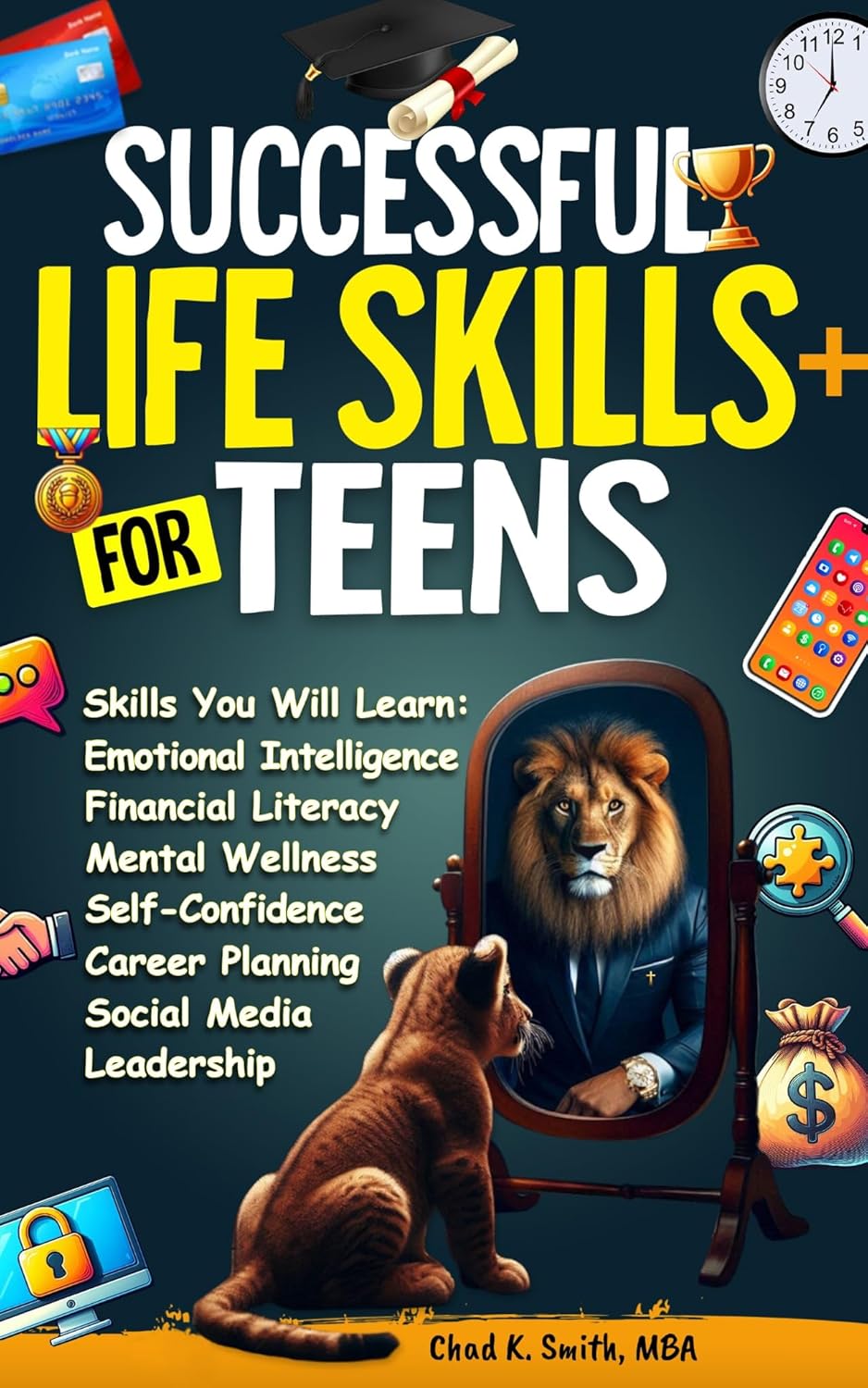
Successful Life Skills for Teens by Chad K. Smith is a positive, practical guide for young readers who want to build confidence, manage emotions, and get their lives on track. Smith mixes personal stories, simple psychology, and interactive exercises to teach lessons about self-worth, time management, and resilience. As a retired Marine, he writes with discipline but also with warmth and humor. The book feels more like a friendly conversation than a lecture, which makes it easy to connect with.
Right from the introduction, I was hooked by the story of James, a teen who went from terrified to fearless in public speaking. That small success captures what this book is about: steady growth through effort. I loved the first chapter on self-confidence. Smith compares it to building a house: you can’t stand tall until your foundation, self-worth, is strong. His advice about writing “self-acceptance letters” and practicing positive self-talk felt surprisingly doable.
The chapters on emotional intelligence stood out to me the most. Smith breaks down big ideas, like empathy and stress management, into everyday language. He suggests keeping an emotion journal, doing breathing exercises, and even rating stressors on a worksheet. It’s simple but smart advice, and he never makes it sound preachy. His focus on mindfulness felt refreshing, emphasizing awareness more than perfection.
Some parts, like the financial literacy and time-management chapters, read a bit like a school manual, but even those sections have solid takeaways. I liked his explanation of the Eisenhower Matrix for prioritizing tasks; it’s one of those “why didn’t anyone tell me this earlier?” tools. And his reminder to celebrate small wins might be the most underrated advice in the book.
By the end, I felt like I’d spent a few hours with a coach who genuinely believes in his students. Smith’s writing isn’t flashy, but it’s sincere, and that makes all the difference. Successful Life Skills for Teens is perfect for teenagers trying to figure out who they are and how to handle life’s chaos. I’d recommend it to anyone, teen or adult, who needs a reminder that progress is built one small, confident step at a time.
Pages: 156 | ASIN : B0FD5CY2WC




 LITERARY TITAN