Blog Archives
What Might Be Possible

Dark Place centers around three students who stumble on an unsettling truth that society is being manipulated, and those labelled as “dispossessed” are being erased from existence. Where did the idea for this novelette come from?
I wanted to develop a near-future story in which a worldwide authority invokes extreme emergency powers to control a burgeoning population, resulting in the loss of freedom and rights.
The idea of a hidden penal colony came to mind, and a social scoring system would be the mechanism to segregate and banish the dispossessed.
My writing of the story started as a typical dystopian trope, but as it grew, I didn’t want it to be stark black and white: ‘good’ idealistic rebels versus ‘evil’ authority. So it becomes more nuanced when the three protagonists are stranded in the Dark Place and learn that it has a greater purpose with profound consequences. The protagonists must navigate not only external dangers but also their own internal struggles, confronting differences between themselves and moral dilemmas.
Dark Place has been described as subverting dystopian tropes and I hope readers find that rewarding.
What are some things that you find interesting about the human condition that you think make for great fiction?
There is a degree of anxiety in the world today about the future. Perhaps every generation in the past has had similar misgivings.
My intention is to write about what might be possible a few steps down the road. I don’t want to write far-future settings with fantastical technologies far removed from what we have now. Grounding the story in a familiar world, echoing some of today’s challenges, has more resonance.
The science inserted in the fiction, I felt, was well-balanced. How did you manage to keep it grounded while still providing the fantastic edge science fiction stories usually provide?
A lifelong interest in the societal implications of technology began in the 1980s when I taught the new technologies of microelectronics and microcomputers in colleges and universities. This early professional life directly influenced my creative pursuits, leading to my first story Larrs’ Ghost (published in a computing magazine) which explored a “computer-generated world” long before virtual reality was a common term. More recently Close To You is a cautionary tale about the imminent dominance of big corporations developing ever more powerful artificial intelligence and virtual reality.
Dark Place is set in a time just down the road from now, so the technology is a plausible extension of today: drones are becoming more advanced; flexible microelectronic circuits (I call them membranes) already exist in rudimentary form; AI is advancing at speed.
Can we look forward to more work from you soon? What are you currently working on?
I feel there’s a lot more to develop with the premise of Dark Place. Although the ending finished with a profound reveal, I deliberately left some aspects of the story open-ended that mirrors the uncertain future facing the characters and the broader society. The lack of a neat, conclusive resolution hopefully encourages readers to reflect on the story’s themes beyond the final page.
So now I’m working on parts two and three. Part two is how the people in the camps progress in the knowledge that the outside world is in total collapse and how they rise to the challenges they face. Part three is how they defend themselves from an external existential threat. How much will they fall back on technology to protect their new world? The three protagonists will have increasingly conflicting ideas on how they see their future world.
Author Links: Facebook | Website
In a near-future world ravaged by resource depletion, society is controlled by the Authority, which enforces a strict social credit system. Failure to maintain a high enough score means banishment to the mysterious “Dark Place.”
When three inquisitive students, Ros, Femke, and Domhnal, discover that parts of a hidden Earth have been concealed from the privileged population of the “Light Place,” they are determined to expose the Authority’s brutal culling system. To do so, they must intentionally lower their scores and enter the Dark Place, only to discover it holds secrets far more profound than they ever imagined.
Dark Place is a gripping novelette that transcends typical dystopian narratives. Praised for its compelling dialogue and nuanced characters, a testament to author Christopher Kell’s experience as an award-winning playwright, the story is a masterful exploration of moral ambiguity, technology’s ethical implications, and the enduring resilience of the human spirit. It is a thought-provoking journey that invites readers to reflect on the nature of freedom, the quest for truth, and what it truly means to survive. This powerful and multi-layered examination of contemporary issues through a dystopian lens is a key element of the novelette’s intellectual value and demonstrates the author’s ability to imbue a short work with significant philosophical weight.
Successful Life Skills for Teens
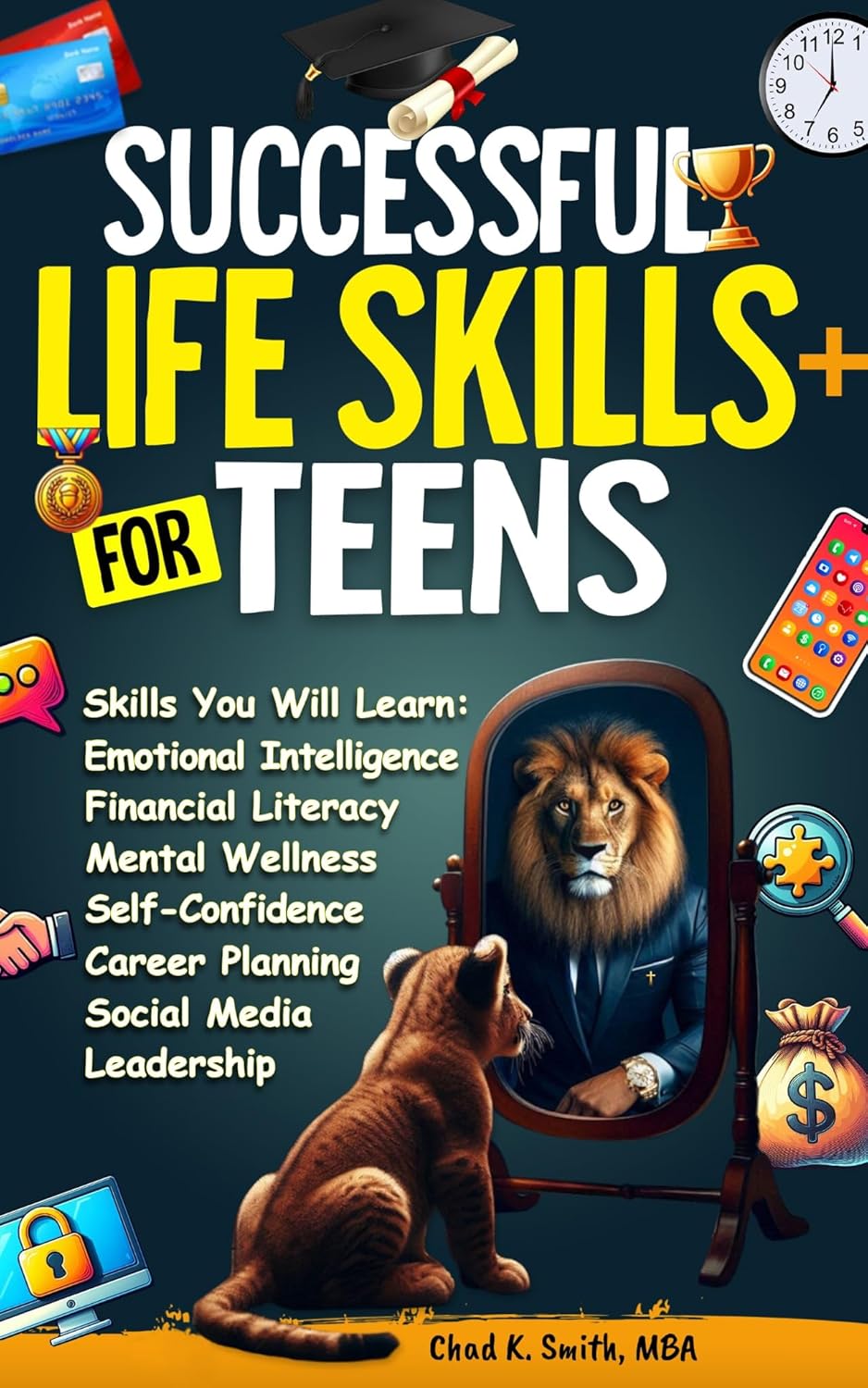

Successful Life Skills for Teens by Chad K. Smith is a positive, practical guide for young readers who want to build confidence, manage emotions, and get their lives on track. Smith mixes personal stories, simple psychology, and interactive exercises to teach lessons about self-worth, time management, and resilience. As a retired Marine, he writes with discipline but also with warmth and humor. The book feels more like a friendly conversation than a lecture, which makes it easy to connect with.
Right from the introduction, I was hooked by the story of James, a teen who went from terrified to fearless in public speaking. That small success captures what this book is about: steady growth through effort. I loved the first chapter on self-confidence. Smith compares it to building a house: you can’t stand tall until your foundation, self-worth, is strong. His advice about writing “self-acceptance letters” and practicing positive self-talk felt surprisingly doable.
The chapters on emotional intelligence stood out to me the most. Smith breaks down big ideas, like empathy and stress management, into everyday language. He suggests keeping an emotion journal, doing breathing exercises, and even rating stressors on a worksheet. It’s simple but smart advice, and he never makes it sound preachy. His focus on mindfulness felt refreshing, emphasizing awareness more than perfection.
Some parts, like the financial literacy and time-management chapters, read a bit like a school manual, but even those sections have solid takeaways. I liked his explanation of the Eisenhower Matrix for prioritizing tasks; it’s one of those “why didn’t anyone tell me this earlier?” tools. And his reminder to celebrate small wins might be the most underrated advice in the book.
By the end, I felt like I’d spent a few hours with a coach who genuinely believes in his students. Smith’s writing isn’t flashy, but it’s sincere, and that makes all the difference. Successful Life Skills for Teens is perfect for teenagers trying to figure out who they are and how to handle life’s chaos. I’d recommend it to anyone, teen or adult, who needs a reminder that progress is built one small, confident step at a time.
Pages: 156 | ASIN : B0FD5CY2WC

Our Uncle’s Promise


Our Uncle’s Promise is a deeply personal memoir that follows Ruta Levu’s childhood growing up in the 1970s and 1980s after the death of her mother. The story centers on four young sisters raised by their loving grandparents and two uncles, especially Uncle Rueben, who becomes a guiding light through their grief. Told through tender memories and raw emotion, the book captures the pain of loss, the power of chosen family, and the resilience born from unconditional love. Through vivid storytelling, Ruta takes readers into her world, a mix of laughter, sorrow, and the kind of warmth that lingers long after the final page.
Reading this book felt like sitting across from a friend sharing her life story. The writing is honest and full of heart. I loved how Ruta doesn’t polish the pain to make it pretty. She writes it as it is, messy, confusing, and relatable. The scenes of childhood are vivid, from fights with her sister Sina to those quiet, heartbreaking moments with her Uncle Rueben. I found myself smiling one moment and tearing up the next. Her humor sneaks in at just the right times, softening the heaviness without taking away from the emotion. The conversational tone makes the book feel intimate, like a late-night talk with someone who has lived through both joy and tragedy and learned to hold both in the same hand.
What really struck me was how the book balances grief with gratitude. Ruta never lets the sadness swallow the story. Instead, she shows how love, especially from her grandparents and uncles, filled the cracks left behind by loss. The descriptions of her family are so vivid that they feel alive on the page. There’s a rhythm to the storytelling that feels natural, almost musical. Her honesty about her father’s absence and her uncles’ sacrifices hit me hard. It reminded me how complicated love can be, and how family often shows up in unexpected ways.
Our Uncle’s Promise is a heartfelt read for anyone who has ever lost someone and wondered how to keep going. It’s not just about grief, it’s about healing, love, and the unbreakable bond of family. This book is for people who believe that pain and laughter can live side by side, and that even in loss, there’s room for light.
Pages: 442 | ASIN : B0FKNGVTBH
The Masterpiece of Nature

The Masterpiece of Nature is a reflective and relatable work about resilience, purpose, and the quiet courage that defines the human spirit. It moves through stories and essays that touch on belonging, doubt, hope, and growth. Wazzeh uses history, philosophy, and small moments of life to show that even the smallest acts and choices ripple through the world. Each section feels like a conversation rather than a lecture. It reads like a companion for anyone walking through uncertainty, offering empathy instead of instruction, and presence instead of pretense.
I found myself pausing often, letting the words breathe. Wazzeh’s writing is tender and clean, yet filled with emotional weight. His use of stories, about Florence Chadwick swimming through fog, or Wangari Maathai planting trees against all odds, brought the abstract into the real. The prose doesn’t rush. It trusts the reader to sit with the lessons. There’s an honesty to it that feels rare. I could feel the author’s respect for human frailty, and his belief that strength isn’t about loud victories, but about staying kind, staying present, and staying true.
At times, I wished the rhythm would break more often; some passages lingered in reflection, but even then, the stillness had its own pull. The book’s tone is humble. It doesn’t try to dazzle. It tries to heal. And it succeeds in doing that in small, quiet ways. Wazzeh writes like someone who has been through storms and come out softer, not harder. The sincerity seeps through every page, and that makes the book feel alive.
I’d recommend The Masterpiece of Nature to anyone who is in a season of transition, loss, or questioning. It’s for readers who crave meaning but are tired of self-help formulas. It’s for those who want companionship rather than direction. If you like books that don’t tell you how to live but remind you why it’s worth living, this one is for you.
Pages: 366 | ASIN : B0FFN8FRS1
The Biology of Trauma: How the Body Holds Fear, Pain, and Overwhelm, and How to Heal It

Dr. Aimie Apigian’s The Biology of Trauma is a deep and accessible exploration of how the human body carries and expresses trauma. Drawing from neuroscience, cellular biology, and her personal story, Dr. Apigian maps out how overwhelming experiences don’t just live in memory; they settle into our tissues, our immune system, and even our metabolism. The book blends science with narrative as it explains how trauma develops, how it hides in plain sight, and how we can repair the body’s systems to return to health. Structured around three parts, how the body experiences trauma, how it holds it, and how it heals, it moves from hard science to compassionate, practical guidance.
Reading this book felt like walking with someone who understands both the science and the human cost of trauma. I found Dr. Apigian’s honesty refreshing; she doesn’t write from a place of distance. Her story about parenting her adopted son, Miguel, and discovering her own buried trauma brings warmth and credibility to the science. The writing is clear and often tender. She explains complex topics like the freeze response or mitochondrial dysfunction in a way that feels personal, not clinical. At times, I could feel the ache behind her words, the exhaustion, the compassion, the desire to make sense of why our bodies sometimes betray us. That emotional current kept me turning pages, even when the material was heavy.
The sheer amount of biology might overwhelm readers who expect a lighter self-help tone. Yet I admired how Dr. Apigian stayed grounded. She doesn’t chase quick fixes or spiritual clichés. Her approach to healing, starting with safety, then rebuilding physiological regulation, feels practical and deeply humane. The book made me notice my own reactions, my patterns of shutdown or tension, and see them not as flaws but as biological strategies. That realization was oddly comforting.
I’d recommend The Biology of Trauma to readers who want more than inspiration; they want understanding. It’s perfect for therapists, healthcare workers, and anyone who senses their body has been carrying a story their mind can’t name. It’s not a breezy read, but it’s worth the time. Dr. Apigian gives us science wrapped in empathy and reminds us that healing isn’t just possible, it’s biological.
Pages: 320 | ASIN : B0D1S92WXY
Before They Are Lost Forever

Toward a Theory of Everything is a mix of science, spirituality, and poetry that examines the connection between the physical and the spiritual on a quest to make sense of existence. What were some themes that were important for you to explore in this book?
The first section of my book, about a “theory of everything,” was difficult to write, because I was challenged with concisely presenting and integrating ideas from my lifetime experiences with my current knowledge, beliefs, and worldview. In addition, I had to search for scientific research to back up some of my assumptions, while at the same time realizing that scientific findings and theory can and should be challenged.
What was the biggest challenge you faced in putting together this poetry collection?
Poetry has always been easy for me, because poetic ideas and phrases come to me as a gift. It is my awareness of the need to write poems and poetic thoughts down as they come to me during dreams or in my conscious state, before they are lost forever. I seldom or never experience writer’s block. All of my memorable lifetime, I have been a thinker.
What is one thing that you hope readers take away from Toward a Theory of Everything?
I write for my readers to expand their worldview vis-à-vis what they have been taught by their parents, culture (including religion), and formal education. Also, in all of my writings, if not most, I communicate for the purpose of helping and healing the reader.
Author Links: Amazon | GoodReads



 LITERARY TITAN