Blog Archives
Alignment on the Rocks: Reconnect the Work You Do to the Impact You Make


Sean Albertson’s Alignment on the Rocks is a guidebook wrapped in a river metaphor. The idea is simple yet powerful: our lives and our work move like rivers, and the rocks we hit along the way don’t stop the flow, they shape it. Albertson breaks life and business into four rivers: Customer, Career, Community, and Core, and shows how they connect and sometimes clash. He uses stories, frameworks, and personal reflections to show readers how to find alignment when things feel scattered or stuck. The book moves from explaining these rivers to offering tools like the 4ROCKS, FIND, and BREAK frameworks, all building toward a state of FLOW where life and work feel intentional and balanced.
Reading this, I felt both inspired and a little challenged. Albertson doesn’t sugarcoat the reality of misalignment, whether in a company or in a person’s life. I liked how he wove in his own career experiences, from climbing ladders to realizing he was chasing the wrong things. It made the lessons feel real, not abstract. At times, the book leaned into repetition, circling back to the same metaphor of rivers and rocks, but oddly enough, I found that grounding. It drilled the point home in a way that stuck with me. I came away reflecting on my own “rivers,” and it was hard not to pause after certain chapters and scribble notes about where I might be stuck.
What I appreciated most was the practicality. This isn’t a book of lofty slogans that sound good but fall apart on Monday morning. The frameworks, especially the BREAK method for turning obstacles into opportunities, felt usable right away. I could see myself applying them at work and at home. That said, the tone sometimes veered into the motivational-speaker zone, which may not land for everyone. I personally didn’t mind it because it was backed by stories and concrete steps. It gave the book both energy and warmth, and I found myself nodding along.
I’d recommend Alignment on the Rocks to anyone feeling caught in turbulence, professionals trying to reconnect with purpose, leaders aiming to build healthier teams, or even individuals seeking better balance in life. It’s not a dense business manual, nor is it a fluffy self-help book. It sits somewhere in between, with heart and structure working together. If you’re open to reflection and ready to look at the “rocks” in your path, this book will give you both a lens and a set of tools to move forward.
Pages: 121 | ASIN : B0FPGG4SKV

Fairness Is Not Charity

Seeking Fairness at Work is a sharp, compassionate, and thoughtful exploration of what fairness really means in today’s workplace and provides leaders a five-part strategy to embed fairness deeply into workplace culture. Why was this an important book for you to write?
As a business strategist and attorney, frustrated employees have shared their feelings of helplessness and anger with me many times over the years. They were upset about the organization’s willful blindness to management behaviors that torched their dignity, confidence, and psychological safety.
When raising a serious issue about the behavior of a senior vice president with the head of human resources at a large manufacturing company, for example, an employee was essentially shooed away. “It’s worse in other departments,” they were told. In desperation, they consulted a lawyer.
That is but one example of misguided leadership behaviors I’ve witnessed over the years that damage trust and result in unintended negative consequences. No, they didn’t always trigger lawsuits. Although, many could have. But they were always costly in terms of diminished employee engagement, retention, and definitely satisfaction.
We embrace new jobs with excitement about fresh opportunities, but our enthusiasm wanes when it’s met by a workplace climate that raises our defenses instead of our game.
It’s a standoff that won’t improve until managers understand why employees respond negatively to their workplace culture and appreciate how low employee engagement, satisfaction, and retention are symptoms of a suboptimal culture, one that management controls, influences, and can change.
As a result, I wanted to write a book that challenged employer “truths” by examining those unwritten workplace norms – the invisible lines that when crossed, create organizational dysfunction.
This new perspective on employee engagement explains employees’ legitimate frustration and offers management a roadmap to previously missed opportunities that can improve their workplace culture.
How much research did you undertake for this book, and how much time did it take to put it all together?
Seeking Fairness at Work relies on evidence-based science, academic research, interviews, and real-life stories that took five years to assemble and more than forty years of living it.
What were some ideas that were important for you to share in this book?
Too often people think of fairness as a soft, lofty ideal, that can be an Alice in Wonderland whatever someone wants it to be – an entitlement. The fact that fairness is commonly thought of as “unfair” speaks volumes about how positional power is regularly misused in relationships. And that’s the point of Seeking Fairness at Work.
Relationships are implied social contracts where fairness is reflected by acting in good faith and with fair dealing. Seeking Fairness at Work takes a granular look at those objective standards, what they mean for the employees and employers, and how certain unwritten workplace norms betray those expectations, contributing to low employee engagement, retention, and satisfaction.
What is one thing that you hope readers take away from Seeking Fairness at Work?
I’d like employees to know their expectations of fairness at work are reasonable and for managers to appreciate how fairness is not charity, it’s smart business.
Author Links: GoodReads | X | Website
WINNER: 2025 Book Excellence Award (Business)
WINNER: 2025 Axiom Business Book Gold Medal Book Award (Digital Media)
WINNER: 2024 Independent Press Book Award (Distinguished Favorite)
3x WINNER: 2024 Dan Poyner’s Global eBook Awards (Business, Communications, Leadership)
2x WINNER: 2024 Goody Business Book Awards (Business – Management, Leadership – Think Differently)
WINNER: 2024 NYC Big Book Award (Distinguished Favorite)
Seeking Fairness at Work challenges employer “truths” by examining unwritten workplace norms – the invisible lines that when crossed, create organizational dysfunction. This new perspective on employee engagement explains employees’ legitimate frustration and identifies missed management opportunities to improve workplace culture.
Recognized business strategist and Journal of Business Ethics Education editorial board member Hanna Hasl-Kelchner, MBA, JD identifies the five most common workplace norms that betray fairness, leaving employees feeling dispirited, disengaged, and headed for the door by examining the social psychology of how our basic human motivations intersect with the implied workplace social contract.
Clarion Foreward Reviews calls her recent book Seeking Fairness at Work: Cracking the New Code of Greater Employee Engagement, Retention & Satisfaction “pithy and persuasive,” while BookLife Review compares it to Kim Scott’s Radical Respect and Kim Dabb’s You Belong Here.
Using evidence-based science, academic research, interviews, and real-life stories, Hasl-Kelchner merges organizational psychology with the practical aspects of workplace dynamics to offer ethical leadership an actionable five-part framework filled with practical tips to empower more employee engagement and retention, including chapters on how to:Rebuild Trust with More Self-Awareness
Improve Relationship Chemistry with More Empathy
Make Genuine Accountability a Cornerstone
Maintain a Cultural Safety Net
Mend the Structural Safety Net
Seeking Fairness at Work is ideal for executives, managers, and entrepreneurs who want to raise their employees’ game instead of their defenses; the human resource professionals, consultants, and employment attorneys who advise them; and employees wanting a reality check of their own workplace experiences.
Seeking Fairness at Work: Cracking the New Code of Greater Employee Engagement, Retention & Satisfaction
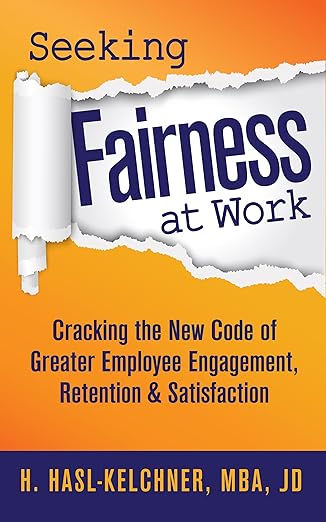
Seeking Fairness at Work by Hanna Hasl-Kelchner is a sharp, compassionate, and thoughtful exploration of what fairness really means in today’s workplace. The book opens with candid, real-life stories of people pushed to their limits by unfair treatment and builds a powerful case for why fairness isn’t just a “nice-to-have” but essential for high performance, trust, and retention. Hasl-Kelchner breaks the topic down in two parts: first, by giving voice to what employees wish they could say out loud, and then by offering leaders a five-part strategy to embed fairness deeply into workplace culture. It’s a mix of research, practical advice, and a wake-up call.
This book resonated with me, as I have worked for a corporation for a decade. I’ve been both an employee and a leader, and I saw myself on both sides of the page. The stories were so real, the writing down-to-earth and smart without being preachy. Hasl-Kelchner doesn’t mince words. She gets to the heart of the matter, like how people are treated, and how easy it is for leaders to become blind to the damage their silence or inaction causes. I especially appreciated how she tied fairness to things like health, motivation, and even workplace violence. It’s not just about equity, it’s about safety and dignity. She makes you feel the stakes. And she does it with empathy, never pointing fingers, just opening your eyes.
What I loved most is how actionable this book is. Each of the five steps: trust, empathy, accountability, cultural safety, and structure, is explained clearly and with examples. The “Fairness Factors” sprinkled throughout make you stop and reflect. This book doesn’t ask you to become a superhero. It just asks you to care, to be aware, and to do better. The book challenged me. I caught myself thinking things like “But we don’t have time for that,” or “That’s just how things are.” Hasl-Kelchner anticipates those reactions and gently calls them out.
I found this book to be one of the most honest and grounded management books I’ve read in a long time. I’d recommend Seeking Fairness at Work to anyone in a leadership role, especially those who think they don’t need it. It’s for HR professionals, team leads, executives, and entrepreneurs who want more than surface-level employee engagement. If you’ve ever felt the tension between doing what’s efficient and doing what’s right, this book is for you.
Pages: 226 | ASIN : B0D1GXVKP1

Transcend: Unlocking Humanity in the Age of AI

Faisal Hoque’s Transcend is a thoughtful, refreshingly human-centered look at our relationship with artificial intelligence. It doesn’t scream “tech hype” or drown in dystopian doom. Instead, it calmly, methodically—and honestly, kind of beautifully—asks us to reflect on what makes us human in the first place. Through two core frameworks, OPEN and CARE, Hoque offers practical tools for using AI responsibly, while never losing sight of ethics, purpose, and connection. It’s part guidebook, part philosophical journal, and part wake-up call.
What really stood out to me is how Hoque doesn’t treat AI like a gadget or a trend. Right from the introduction, where he likens AI to the philosopher’s stone—a tool that could elevate or destroy us—he grounds this tech in the context of ancient spiritual and philosophical ideas. It’s bold, but it works. He isn’t afraid to talk about topics attributed to a person’s soul—truth, love, wonder—even while explaining neural networks and machine learning.
The writing isn’t always breezy. Some chapters do feel like they’re straddling a TED Talk and a philosophy lecture. But I appreciated that Hoque never talks down to the reader. He assumes we can handle nuance. The section about AI and value judgments, especially the part referencing the Bhagavad Gita, was surprisingly moving. It’s a powerful reminder that doing nothing is still a choice
Another thing I appreciated was the frameworks. OPEN (Observe, Probe, Engage, Navigate) and CARE (Consciousness, Awareness, Responsibility, Ethics) are not just acronyms. They’re practical, adaptable, and surprisingly not corny. In Chapter 10, when Hoque applies them to government and business settings, it really clicked how scalable these ideas are. He’s not just preaching mindfulness to individuals—he’s arguing for systems-level transformation. And he does it without sounding preachy or naive. It’s idealism with boots on the ground.
Transcend is a thoughtful, sometimes poetic, always grounded take on AI that’s more about people than code. It’s not a book full of hacks or hot takes. It’s more like a long conversation with someone who knows a lot, cares a lot, and wants to help the rest of us figure it out, too. I’d recommend this book to anyone feeling overwhelmed by the AI wave, especially leaders, educators, or just regular folks trying to make sense of it all.
Pages: 312 | ASIN : B0DSWM4L5L
Ambition vs Integrity

Whistleblower: Integrity in AI follows a dedicated AI engineer who faces a dilemma that threatens his career and global security and must find a path forward. What was the inspiration for the setup of your story?
My inspiration was my life experience as a high-tech entrepreneur. Like in all my books, real-life events are the foundation of the story. I have changed names and identities and augmented the story to make it more engaging.
Alexander is a talented AI engineer whose morals wind up in conflict with his employer. What were the morals you were trying to capture while creating your characters?
The main moral value I was trying to capture is the struggle between ambition and integrity. In the corporate world, this struggle is omnipresent and often a fine line to walk.
What were some themes that were important for you to explore in this book?
I love to explore how the corporate environment shapes businesspeople and push the boundaries of traditional mystery. The themes that were important for exploring were ambition, betrayal, loyalty, and integrity.
What is the next book that you are working on, and when will it be available?
Since WhistleBlower, I have published the first two books of the medical thriller series The AI Singularity Experiments: The First Patient and The Second Patient. I am now working on the third book of the series.
Author Links: Facebook | X | Website
Alexander was always willing to help, and many people he had helped became influential figures in technology and business, and they all owed him favors.
Dr Ethan Harris was a partner with Singulon Capital. Ethan’s approach had always been to prioritize transparency and ethics in the operations; for him, it was not just about the returns but how they were achieved. Ethan had a nagging feeling that there was more to Singulon Capital than met the eye. Ethan stirred up a hornet’s nest with his findings but remained steadfast and continued his pursuit of the truth, even if it meant standing alone.
Whistleblower: Integrity in AI by Noah Tuya is filled with drama, betrayal, lies, and espionage. The story was fast-paced and full of action. It was a page-turner, and I had difficulty putting it down. The suspense kept me on the edge of my seat, not knowing what would happen next. The characters were authentic and relatable.
They were introduced one at a time with a backstory. It helped a lot to get to know them and understand where they came from. The story was well-written, and with all the twists and turns, I was guessing until the end. Just as I was sure of what was going to happen, there was a twist that changed the course of the story again. I was hooked until the end.
Whistleblower: Integrity in AI

Whistleblower by Noah Tuya is a compelling dive into the high-stakes world of corporate ethics and espionage. At the heart of this gripping narrative is Ethan Harris, a newly appointed AI engineer at Singulon Capital. Ethan’s dedication to AI development soon places him at a crossroads, facing a dilemma that threatens not only his career but global security. The question looms: can Ethan bring the situation to light, or will he remain ensnared in a perilous path?
Noah Tuya masterfully explores the difficult decisions that define the corporate landscape. Through themes of espionage and illicit international trade, Tuya guides readers through a journey where uncovering the truth comes with severe consequences. The novel underscores the fine line between ethics and success in the business world, delving deep into Ethan’s internal struggles with the implications of Alexander’s past, providing rich insights into his layered thinking and emotional turmoil. Tuya’s portrayal of the corporate environment is both vivid and intricate. He examines how integrity, boundaries, and ethical dilemmas influence decision-making, painting a realistic picture of the pressures and complexities within a powerful enterprise. As readers follow Ethan’s journey, they gain a perspective on the psyche of the corporate world, understanding the intensity and potential fallout of decisions made in such high-stakes scenarios. Ethan’s cautious navigation through these challenges is a testament to the delicate balance between virtue and survival.
Whistleblower by Noah Tuya is highly recommended for anyone interested in the intricate dynamics of corporate politics and power. With its unexpected twists and deep dive into the murky waters of the tech world, Whistleblower is a thrilling technothriller that keeps you on the edge of your seat.
Pages: 122 | ASIN : B0D27RDRRS
Creating Better Marketing Strategies

Marketing Iceberg: Psychology of the Subconscious Mind in Marketing is a comprehensive exploration of modern marketing strategies with a unique focus on the intersection of psychology, technology, and consumer behavior. Why was this an important book for you to write?
I wanted to write Marketing Iceberg because I was really curious about how people think and make choices when they buy things. I noticed that a lot of times, what we decide to buy isn’t just because of what we see or hear about the product. It’s also about how we feel deep down, without even realizing it! So, I thought it would be super interesting to explore how understanding people’s feelings and thoughts can help in creating better marketing strategies.
How much and what kind of research did you undertake for this book, and how much time did it take to put it all together?
To make sure this book had lots of cool and useful information, I did a lot of homework. I read books, talked to smart people who know a lot about buying and selling and looked at real-life examples of how companies talk to their customers. I wanted to gather as many stories and facts as I could to help explain my ideas. This took me about two years, but it was worth it because I learned so much and got to share it in the book!
What were some ideas that were important for you to share in this book?
There were a few big ideas I really wanted to share with everyone:
The Marketing Iceberg Idea: Just like an iceberg has most of its size hidden under the water, the most important parts of marketing are the ones we can’t see because they’re all about what’s going on in our minds.
Stories Matter: I talked about how the stories companies tell us about their products can make us feel connected to them because of our emotions and what we care about.
Being Nice and Fair: It’s super important for companies to be honest and careful with the information they learn about us. They should use it to make things better for us, not just to make more money.
When considering data mining and individual privacy, what constitutes the greatest ethical challenge in the realm of marketing?
When companies collect information about what we like and do, they need to be very careful and respectful. The hardest part is making sure they use this information in a way that helps us without making us feel uncomfortable or taking advantage of our privacy. In the book, I talk about how companies can do this in a good way, by always thinking about what’s best for their customers.
Author Links: Goodreads | Twitter | Facebook | Website | Amazon
Our discussion will start with the mind, specifically its unconscious domains which have long perplexed researchers. This handbook will delve into how our understanding of the unconscious has morphed and expanded, from Sigmund Freud’s 20th Century work in psychoanalysis, to its integration with business and marketing at the turn of the century. We will then shift our focus to psychographic segmentation, and examine how this type of targeting enables firms to better understand the unconscious, and its impacts on our lifestyle and behaviour. After a brief overview of artificial intelligence, we will segue to a larger discussion about business analytics or advanced analytics, which has created untold opportunities in many industries, including marketing. This focus on data mining provides marketers with deep insights about our thoughts, enabling them to influence our behaviour in profound ways. We will then look into the value of traditional marketing activities and how the data mining activities become valuable inputs into the creation of truly impactful identities and messaging. We will conclude our discussion by highlighting some of big data’s ethical and privacy implications.
Marketing Iceberg: Psychology of the Subconscious Mind in Marketing

Marketing Iceberg: Psychology of the Subconscious Mind in Marketing by Farhad MK is an insightful and comprehensive exploration of modern marketing strategies, with a unique focus on the intersection of psychology, technology, and consumer behavior.
The author’s writing style is both informative and engaging, making complex topics accessible to a broad audience. Farhad MK masterfully blends academic theories with practical applications, creating a narrative that is both educational and thought-provoking. One of the book’s strengths is its thorough analysis of the unconscious mind’s role in consumer behavior, a topic often overlooked in traditional marketing literature. Farhad MK delves into historical and contemporary perspectives, providing a nuanced understanding of how unconscious motivations drive consumer decisions. This approach is not only enlightening but also highly relevant in today’s data-driven marketing landscape.
The exploration of artificial intelligence and advanced analytics in marketing is another highlight. The author explains these complex topics in a clear, concise manner, illustrating how they are revolutionizing the field. This section is particularly beneficial for readers seeking to understand the latest technological advancements and their implications in marketing. Farhad MK also addresses the ethical dimensions of modern marketing practices, particularly in the context of big data and privacy concerns, encouraging readers to consider the broader impact of marketing strategies on society.
Marketing Iceberg is an invaluable resource for anyone interested in the evolving world of marketing. It offers a balanced view, combining theoretical depth with practical insights. This book is particularly useful for marketing professionals, students, and anyone keen on understanding the psychological underpinnings of consumer behavior in the digital age. Farhad MK’s engaging writing style and comprehensive approach make this book a must-read in the field of marketing.
Pages: 76 | ASIN : B08QDMF2BW



 LITERARY TITAN