Blog Archives
Violations of Natural Order

Eros and Order: Love That Creates and Destroys explores the fragile boundary between love and control through literary stories of marriage, obsession, rescue, crime, immigration, and moral consequence. What drew you to the idea of examining love as a creative and destructive force?
Actually, the only story written specifically for this collection is “No Good Deed.” All the others had their independent inspirations, with three of them—“Perfect Girl,” “I Am Zico,” and “The Story of Aunt Jenny”—being derived from actual events. The unity of the collection occurred to me later as I began to assemble the collection from stories I had previously written. Then, finally seeing that the unity of the stories consisted of love’s changeable nature, I wrote “No Good Deed” as a commentary on that theme. The story’s character, Nora, has experienced a lack of normal parental love and, to compensate, has retreated from life into a Gothic cult. She has become so distrustful of what most of us regard as normal life—and love—that she hesitates to recognize it, let alone accept it, when it materializes in the character Ronnie, who is attempting to save her from herself.
The title story has a strong classical sensibility, with ideas of vows, order, betrayal, and consequence. How did classical themes influence the collection?
The ancient Greeks had a keen sense of order, which we shared in a Christianized version from the Middle Ages until it was shattered by the horrors of World War I. The Greeks also recognized that erotic love could, if allowed, challenge and even destroy that order in individuals, even if done unintentionally. Consider the myth of Oedipus, who kills his father and marries his mother, without recognizing their true identities. Nevertheless, a plague descends on Thebes, the city Oedipus rules. And to lift that plague, the double sins that Oedipus has committed must be expiated, which he accomplishes by blinding himself.
Collectively, the stories in Eros and Order deal with violations of natural order: a woman who deserts her husband and young children in the title story, a father who imposes unnatural restrictions on his daughter in “Perfect Girl,” a girl who grows up without parental love in “No Good Deed.” Once the natural order is broken, it must be restored. The fact that the rebalancing does not occur immediately may deceive us into believing that we can escape it, but just as Sandra Patterson eventually learns in “Eros and Order,” we cannot.
A wonderful source for studying the evolutionary history of love in Western culture is C. S. Lewis’s The Allegory of Love (1936).
Several stories explore the danger of confusing love with ownership, rescue, or control. Was there a particular moral question you wanted readers to wrestle with?
Yes, just what constitutes a beneficial, healthy relationship that we can recognize as love? The answer waits at the end of the collection in “The Story of Aunt Jenny,” a folktale about the Underground Railroad in the Mid-Ohio Valley of what became the state of West Virginia. Aunt Jenny risks her own freedom to help other escaped slaves, for West Virginia was still part of Virginia and therefore the Confederacy during most of her lifetime. Her actions are in sharp contrast to those of Sandra Patterson in the story that opens the collection. Sandra seeks complete personal freedom and so abandons her responsibilities to her husband and children. Aunt Jenny risks her personal freedom to help others achieve it.
Ruggiero Bellafatezza, the crime boss father of Serena in “Perfect Girl,” very well illustrates the dangers of attempting to control others as he imposes unnatural restrictions on his daughter’s romantic life for the benefit of his criminal activity by pledging her in marriage to his underboss, Ricky Lanza. Serena rebels by having a different beau for each day of the week in order to flaunt her independence until tragedy results.
“No Good Deed” offers hope while still questioning whether love can truly save someone. What do you think love can realistically offer people in moments of despair?
Well, if nothing else, the collection shows that love has a variable and elusive character, but it can be decisive in saving someone. In “No Good Deed,” Ronnie attempts to do just that for Nora, whom he has just met, despite warnings from his coworkers and quite strongly from Nora herself that he shouldn’t. But he emphasizes to her that to lift herself out of a life that at times has involved homelessness, she must create a change in herself; he can only help her do that. Thus, at the story’s resolution, Nora must decide whether she will try to change, with Ronnie’s help, or remain in her adopted family—a Goth tribal cult. Thus, for love to succeed, it must involve a commitment by both participants.
Author Links: GoodReads | Facebook | Website | Amazon
A teen fashion model who plots revenge against her father for the murder of her lover.
A Detroit factory worker who falls for a Goth girl who warns him not to.
A Moroccan immigrant who dies in the tough streets of Napoli.
A married couple mired in a Babel of their own making.
A folktale about a heroic woman and the Underground Railroad in West Virginia.
Eros and Order: Love That Creates and Destroys


Carl Parsons’s Eros and Order: Love That Creates and Destroys is a literary fiction story collection about love in its many unstable forms: romantic love, marital love, possessive love, moral love, social duty, desire, grief, and rescue. The stories move from a collapsing marriage to a murder shaped by obsession, then into a tender but uneasy attempt at saving someone from despair, before widening into immigration, communication, and historical memory. As a work of literary fiction, it is less interested in neat comfort than in the pressure people put on one another when they confuse love with ownership, salvation, escape, or control.
Parsons doesn’t rush. He lets conversations unfold, sometimes at length, and he gives his characters room to argue themselves into corners. It made the book feel less like a set of twists and more like a series of moral tests. The title story, especially, has a classical weight to it, with its references to ancient order, vows, betrayal, and consequence. At times, I felt the author was almost standing beside the characters, asking them, “Are you sure this is freedom? Are you sure this is love?” That can make the prose feel old-fashioned in places, but not carelessly so. It has a formal, almost stern rhythm that fits the book’s concern with discipline, disorder, and the damage caused when desire becomes the only law.
I also found myself reacting strongly to the author’s choices. Some characters speak in ways that are blunt, and the stories are not shy about judging certain kinds of behavior. It made me pause and think more than once. But I think the collection works best when it lets the tension remain messy. “Perfect Girl” moves like crime fiction, but beneath the crime is a sharper look at beauty, male entitlement, and family corruption. “No Good Deed” turns toward rescue and hope, though even there Parsons keeps asking whether love can actually save someone or whether it can only offer a place to begin. “I Am Zico” is short and painful, and its direct first-person voice hits differently from the longer domestic dramas. It feels like the book opening a window and letting colder air in.
Eros and Order is a thoughtful and often compelling collection for readers who like literary fiction with moral stakes. It would especially appeal to readers who enjoy character-driven stories about relationships, consequences, crime, and social order, rather than fast plots or easy answers. It asks you to sit with flawed people, watch them make damaging choices, and consider what love creates when it is patient, and what it destroys when it becomes selfish. Readers who appreciate reflective fiction with a classical sensibility and a serious view of human behavior will likely find a lot to think about here.
Pages: 142 | ASIN: B0GZ3HQNV4

The People of the Mid-Ohio Valley

Town and Country: Voices from the Mid-Ohio Valley is a collection of short stories centered around life in a Midwestern small town. What inspired you to write this collection?
The ten stories in Town and Country were written and published in various journals over a number of years starting in 2019. So the collection developed gradually, but the stories were inspired by the locale and people where I grew up. I’ve turned the town of Parkersburg, WV, and the nearby rural communities of Lubeck, Washington, and New England Ridge into the fictional Parkeston and Locust Hill, respectively. Faulkner had his Yoknapatawpha County; Thomas Hardy had Wessex; I have Locust Hill.
Is there anything from your own life included in your stories?
Very much so. In addition to the locale, the character of Livia in “The Postmistress” is based on one of my aunts—my father’s sister. She did indeed operate the local post office from her parlor and was famous for her feisty personality. Also, the general store featured in the companion stories “Disorder” and “Penny Candy” was real, with cats in the front window and penny candy in jars. Along with my schoolmates, I waited there for the school bus to come and take us to the high school on the far side of Parkersburg.
Is there one story that stands out for you? One that was especially enjoyable to craft?
Oh yes, that would be “Penny Candy.” I intended it to contain a tribute to the people of the Mid-Ohio Valley—actually the entire collection is that. But I put the words of the tribute in the mouth of Pastor Beattie as he tries to comfort the distraught Lorna Crandall, who continues to be haunted by the ghost of her son killed in Vietnam. Pastor Beattie tells her, “There’s good people here in Locust Hill, as you yourself just said. So many angels, all in their own way. As good as any I’ve seen in this world. I can say that for certain.” And I hope the people who read Town and Country will see that too.
Can we look forward to more work from you soon? What are you currently working on?
You can, but I’m not so certain about the “soon” part. I’m working on a sci-fi-paranormal-inspirational story that requires quite a lot of research. The protagonist is a chemical engineer who replaces the deceased head of research in a chemical laboratory. The deceased chemist, famous for his invention of rejuvenating tires (i.e. regrown their treads), urges his successor from the Afterlife to turn his talents to medical discoveries rather than industrial ones. To complete the novel, I just need to come up with a plausible explanation of the Afterlife and a plausible cure for cancer. No problem! The working title is The Covalence of Love.
Author Links: GoodReads | X (Twitter) | Facebook | Website | Amazon
In this collection of short stories, the reader encounters ordinary people struggling with a variety of extraordinary problems that threaten to change their lives: an elderly widower confronting a life of regrets, precocious children threatened with separation, a middle-aged couple facing the loss of their generations-old general store, and many others. Read Town and Country and meet the people of the Mid-Ohio Valley—people you may very well recognize from your own hometown.
Town and Country: Voices from the Mid-Ohio Valley
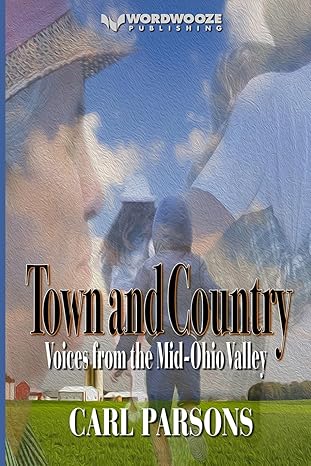
Town and Country: Voices from the Mid-Ohio Valley, by Carl Parsons, is a collection of short stories divided into two parts, each offering a glimpse into the lives of small-town and rural characters. The book delves into the experiences, regrets, and sometimes peculiar situations that define life in the Mid-Ohio Valley. Parsons brings to life a world filled with nostalgia, longing, and an ever-present connection to place, capturing the essence of this region through a cast of vividly drawn characters.
Right away, Parsons’ knack for setting the scene stands out. The details pull you in. The first story, “Regrets,” hits hard with a wave of melancholy. The main character returns to his hometown, and the changes he sees stir up deep emotions. The descriptions and streets once familiar have now been altered by time—strike a chord. They spark a bittersweet sense of longing. His journey through old memories are heartbreaking and real. Small moments, like feeding his cats or driving past old spots, anchor the story in a way that feels personal and true. At times, the writing takes its time, allowing the reader to fully immerse in the scene. In “Hot Date,” the banter between the poker buddies is a perfect example. The dialogue is realistic, capturing the easy flow of conversation among friends. While the exchanges linger, they effectively portray the laid-back pace of small-town life. Parsons skillfully uses these moments to create a vivid sense of place, grounding the reader in the leisurely rhythm of everyday life. Themes of love, regret, loss, and time are timeless but Parsons gives them fresh life. “Judith and Phillip” is a standout. The story explores young love and its inevitable heartbreak. The innocence of their relationship shines through. Their separation feels gut-wrenching. Parsons doesn’t sugarcoat reality. Things fall apart, and the pain lingers. This story, like others in the collection, taps into emotions we all recognize. But it does so with a voice that feels distinctly Mid-Ohio Valley.
Town and Country is a reflective, thoughtful collection. It resonates with anyone who feels a deep connection to a place, whether with love or a sense of being stuck. This book is for those who enjoy literary fiction. It’s for readers who appreciate character-driven stories and settings that come alive. If you’re drawn to tales of small-town America, full of complexity and heart, Carl Parsons’ work is well worth exploring.
Pages: 181 | ASIN : B0DBH3RZDT
The Devolution of America
Shantyboat: American Dystopia follows two homeless men as they navigate a labyrinth of political and moral complexities, culminating in a dramatic struggle against a backdrop of deception, murder, and a multifaceted love story. How did you develop the idea for this novel?
As with the origins of other dystopian novels, such as those by Ayn Rand and Margaret Atwood, I looked at current trends—political and cultural in particular—and asked myself, “Where might these trends, attitudes, and actions lead?” In the case of Shantyboat, I only advanced the trends about fifty years and did so without the “benefit” of an apocalyptic event to show that a dystopia can be created gradually—in fact, is much more likely to occur that way. The result in the novel is the devolution of America into a totalitarian, one-party surveillance state. The change, as mostly explained by the character Rodney, is gradual but relentless once begun. I especially wanted to distinguish Shantyboat from other dystopian novels by keeping the focus on ordinary people trying to live what were once, for them, ordinary lives.
Your characters, Dale and Rodney, have a unique dynamic and complex moral compasses. What was your process for crafting these intricate personalities?
Actually, I don’t think that Dale and Rodney are unique. At least, I didn’t intend them to be. Most Americans take their freedom for granted, just as these two did, and probably none of us knows for certain how we would react if we lost it.
But Dale and Rodney do differ from one another in significant ways. Since readers spend so much time with these two characters, I knew they had to be markedly different—in appearance, character, and voice. Also, I had the problem of letting the reader know, bit by bit, just what has happened to America between our contemporary time and the future time in the novel. I chose to give that assignment as much as possible to Rodney rather than a third-person narrator because I wanted this information to arise naturally from the action in the story. So, I made Rodney a little older than Dale, a bit wiser, and more experienced. He has served in the U.S. Navy; he has attended college for a while; he knows more about history and is more alert to current events than Dale. Thus, he becomes the one to tell us what has happened to America.
Dale, by contrast, is more adept than Rodney at practical matters. He has earned a living as a handyman and then used his knowledge of carpentry to work in the Badgett Lumber Yard, the scene of much of the novel’s action. Also, his diction is simpler, more colloquial than Rodney’s. And he is more physically robust than Rodney, who is taller but also quite thin. It is his physical traits that seem to make him attractive to Delia.
An Athene-like character, Delia adds another dimension to the novel. She has a resourcefulness and craftiness that exceed those same traits in Dale and Rodney. She has found a way to turn the state’s controls against itself. Using this knowledge, she creates a home repair business consisting of small transactions, with Dale and Rodney as her mechanics, and manages the business in such a way as to stay below the state’s surveillance thresholds.
But all three also have common experiences that bring them together in a friendship sufficient to share the risks of building a shantyboat and later of starting a business together. What they share is the loss of their livelihoods and subsequent desperation. And that desperation is so great that it prompts them to commit crimes they would not otherwise have even contemplated.
Even more dramatic than the loss of their families, Dale and Rodney share the witnessing of a horrible crime in the novel’s opening scenes. Despite the implicit dangers, Dale and Rodney become determined to build their own shantyboat even though this necessitates their stealing the building materials.
The novel tackles heavy themes such as systemic injustice and moral ambiguity. What do you hope readers take away from the discussions and dilemmas your characters face?
My intention was to show what happens when individual freedoms are lost to totalitarian rule. There are, unfortunately, more than adequate actual historical examples from the twentieth century at both ends of the political spectrum. The novel suggests these misfortunes could develop in our own country. When any government exists to preserve and advance itself rather than representing the interests of the people it is supposed to serve, then freedom gives way to conformity and slavery in various forms, such as judicial procedures that exist more for a demonstration of the state’s power than for the discovery of truth, surveillance of citizen activities by making them wear microchips in order to receive government services, use of digital money as a means for monitoring all transactions and providing a barrier to black marketing activities. We can see the means for these controls already coming into existence. At first, they are introduced as a convenience or safeguard for the citizens, but they quickly become a means of increased control for the state. We are potentially in that process with digital money right now.
Can you discuss any real-life events or personal experiences that influenced the narrative or themes of the book?
I grew up in the Mid-Ohio Valley, where the novel is set—specifically in Parkersburg, WV—and very well remember as a child seeing shantyboats along the banks of the Little Kanawha River there, a river that divides Parkersburg north and south before emptying into the Ohio River. People then (the 1940s and 1950s) often used shantyboats as a solution to the problems of homelessness and poverty. Other people simply wanted to live that way, free of the debt and taxes that come with home ownership. I’m sure this was true in many other river towns across the country. Probably, it still is. Thus, it seemed to me that a shantyboat made the perfect symbol for personal freedom to use in this novel.
Author Links: Facebook | Goodreads | Amazon
Read Shantyboat, a dystopian thriller, by the author of Trios: Death, Deceit, and Politics—both available from Wordwooze Publishing.
Shantyboat: American Dystopia

In Shantyboat: American Dystopia, author Carl Parsons crafts a dystopian narrative, weaving the lives of two homeless men, Dale and Rodney, through a labyrinth of political and moral complexities. This tale, punctuated by their struggle to align their unconventional political views with their quest for a decent life, takes a dramatic turn with the introduction of Delia, a woman ensnared in her own web of secrets. The ensuing narrative is a tapestry of deception, murder, and a multifaceted love story.
Rodney, portrayed with a blend of intelligence and questionable ethics, confronts survival and moral dilemmas. Meanwhile, Delia, shadowed by the mystery of her missing husband and a covert act, stands at a crossroads between love and loyalty. The trio’s journey through a world teetering on the edge of revolt highlights the weight of their hasty, morally ambiguous actions.
The novel resonates with contemporary societal issues, including broken homes, the challenges of the marginalized, and systemic flaws in the justice system. One particularly poignant conversation between Dale and Rodney about a crime witnessed by children underscores this, posing questions about the frequency of such injustices going unaddressed due to fear of reprisal. Parsons’ protagonists defy the archetype of morally upright characters. Though their actions, steeped in crime, are driven by a pursuit of what they perceive as a greater good, their journey is marked by a series of unexpected events that further reveal their intricate personalities.
Amidst the darker themes, moments of romance, and lighter interludes involving a cat and a child, offer a contrast to the narrative’s heavier tones. Shantyboat offers a dynamic pacing, with immersive discussions that delve deeply into its themes, complemented by a swiftly executed conclusion. This narrative rhythm enhances the book’s core strength: its profound capacity to provoke thoughtful reflections on contemporary social and political issues. It engages readers who are drawn to narratives that stimulate introspection on societal dilemmas.
Shantyboat: American Dystopia leaves a lasting impression, with its characters’ raw exposition of harsh truths and its ability to evoke a physical nod of agreement with its astute observations. Carl Parsons delivers a story that lingers in the mind, prompting contemplation long after the final page is turned.
Pages: 190 | ASIN: B0CMPNB1P7
Oh, The Tangled Web We Weave
Trios: Death, Deceit, and Politics is a gripping exploration of a family’s treacherous labyrinth of deceit, a veteran’s struggle with trauma, and one woman’s relentless pursuit of truth amidst political corruption. What was the inspiration for the setup of your story?
The immediate inspiration was the general tenor of current American politics, which seems hopelessly embroiled in accusations and counteraccusations, court proceedings, anonymous sources, whistleblowers, and the like. A truly bipartisan brew of political poison.
The more distant literary inspiration, however, was a novel that I’ve always admired—Robert Penn Warren’s All the King’s Men, Warren’s 1946 novel about Lousiana Governor Huey Long. I suppose every state in the nation has had at least one (more likely a lot more than one) political family that turned to corruption to enhance its political power. I am intrigued by just how this rise to power and subsequent fall takes place.
Your characters are intriguing and well-developed. What were some driving ideals behind your character’s development?
My original thought was to have no truly honorable characters, not even the protagonist—in this case, Rita Collins. Clearly, none of the immediate members of the Collins family are honorable—certainly not Dolf, who aspires to become governor of Pennsylvania at any cost; not his wife Marla, who recognizes the corruption but enjoys its benefits in the form of her lobbyist-paid vacations, sports car, and luxurious tan; and not their son Brian, who aspired to be just like his father. Then there is the Machiavellian character Mark Garret presiding over the entire sordid affair.
And so, I didn’t intend to let Rita escape either. But I’ve found that a magical thing often happens in the process of writing a story—namely, the characters take over. And when they do, it’s because they have a different understanding of just what turns the plot this way instead of that and just where its jagged edges are located. They start talking back, saying, “I wouldn’t do that. I wouldn’t say that. That’s not my voice. What you’ve written is not really my story. Rewrite it this way.” And I do. So, Rita became the truth-seeker (as befits a journalist) who attempt to expose deceit instead of allowing it to rule her. And in this endeavor, she is inspired by the USAF veteran Kurt Sillinger.
What were some themes that were important for you to explore in this book?
The tangled web theme most of all. Once deceit begins it requires additional acts of deceit to maintain and/or capitalize on the original deceit. Soon deceit becomes the norm for those who practice it—not a desperate final response but a first response. I’m afraid that’s what has happened in much of American politics at all levels. We’ve never had so much access to information and so little assurance of its veracity.
But the novel shows that truth-seekers still exist and can triumph over deceit.
What is the next book that you are working on and when will it be available?
I’m now about two-thirds of the way through the first draft of a dystopian novel set in the not-so-distant future. The working title is SHANTYBOAT: AMERICAN DYSTOPIA. Where I grew up in the Mid-Ohio Valley, people who were down on their luck often turned to living in makeshift shantyboats along the Little Kanawha River. I am using the shantyboat in this novel as a symbol of individualism and resistance to the forced conformity and economic depravations that the future world of this novel explores.
I’ve found that most dystopian novels focus greatly on world-building and the author’s world-view projections. Think of the novels of Ayn Rand or Margaret Atwood, for example. Too often, I believe, the characters populating these novels are unrealistic, little more than mouthpieces for the author’s viewpoint. In this novel I’m trying to keep the focus on what the characters themselves experience and how they react as realistic human beings to social tragedy, rather than representatives of an ideology. At least, that’s my intention. Early 2024 is probably the best estimate for publication.
Author Links: GoodReads| Facebook | Website | BookBub | Additional Works
Trios: Death, Deceit, and Politics


The Collins family is an intriguing and enigmatic group, marked by an inherent lack of trust and a tendency to betray one another at every opportunity. Through a labyrinthine web of deceptive lies and deceit, they continually strive to outdo each other, setting the stage for a riveting tale of political corruption and intrigue. Within the pages of Trios: Death, Deceit, and Politics, Carl Parsons skillfully weaves a suspenseful narrative that delves into the life of Rita Collins, a tenacious local reporter and writer for a prominent television station in Washington DC. It is through her eyes that we witness a perplexing turn of events, as she finds herself unexpectedly rejected by her husband, Brian, who suffered the amputation of his legs during his service in the Iraq War. Brian’s return from the war zone brings with it an unyielding refusal of Rita’s affectionate love and any attempts at rehabilitation from his profound wartime trauma.
Parsons exhibits an exceptional ability to craft a cast of characters that encapsulates the complexity of the human experience, leaving readers captivated by the unfolding tale. Among these characters, Rita stands out as a remarkable figure, demonstrating unwavering resilience in the face of her husband’s family’s web of deception and deceit. Her ability to remain steadfast amidst such adversity is a testament to her strength and serves as a magnetic force that draws readers into her story. The plot of this book is a particular highlight, immediately gripping readers’ attention and holding it steadfast throughout the journey. At numerous junctures, the narrative becomes so enthralling that it becomes difficult to put the book down. Such is the magnetic pull of the storyline, which skillfully intertwines elements of suspense and intrigue, effectively leaving readers yearning for more.
Trios: Death, Deceit, and Politics by Carl Parsons is an enthralling work that is sure to engage readers, immersing them in a world brimming with suspense. Furthermore, Parsons adeptly balances the brevity of his writing, ensuring readers are not overwhelmed while maintaining a firm grip on their attention. The relatability of the characters to the universal human experience further strengthens the book’s appeal. I recommend this book to those in search of a page-turning suspense novel.
Pages: 136 | ASIN: B0C1DVSNDC


