Blog Archives
Relatively Unexplored

M.L. Sparrow Author Interview
A Tangled Web is set against the backdrop of one of the most devastating tsunamis in Japan and follows three children as they navigate their new lives. Why was this an important story for you to write?
When I first heard about the tsunami in 2011, it was a huge thing and I remember being really intrigued by it, however, I was only a teenager and newspapers didn’t particularly interest me, though I loved reading. For some reason, what I head heard about the events stayed with me for years and when I traveled to Japan for the first time several years ago I started developing a story line – though I didn’t start writing it until my second visit at the beginning of 2016. It was important for me to write because, although there are many factual sources and several non-fiction books, in all my research I only found one fiction story about the Japan tsunami in 2011 which I think is a shame because I believe most people prefer fiction and can learn so much through it, yet it is a relatively unexplored subject. Therefore, my aim was to provide a book for YA which is both interesting and explores what happened in 2011 and afterwards, hopefully encouraging people to then go and do their own research.
The three children in this beautiful coming of age story have a lot of depth. What were some obstacles you felt were important to develop the characters?
I think it was important that at the beginning Taiyo was quite naive and selfish, a little unlikable if I’m being honest, but that gave her the opportunity to grow and develop as a character so that in the end she had the strength to deal with the catastrophe that happens. To me it was also important that Ryuu and Kairi be total opposites and yet both be likeable and relatable characters.
What were some themes you felt were important to highlight in this story?
I think friendship is a very important theme in this book; before Ryuu and Taiyo develop feelings for each other, they are first and foremost friends, as are she and Kairi. Another important theme is the value of telling the truth. Taiyo tells a lot of lies in this story and ends up so tangled in them that she can’t see a way out, hence the title. Though told for good reasons, those little lies mount up and ultimately lead to her and Ryuu being at the coast when the tsunami hits, while their friends and family are completely unaware of the peril they’re in.
What is the next story that you’re working on and when will it be available?
I’m currently working on another novella set in Japan, however, this one follows the Taiji dolphin hunt. Starting in 2009 when the documentary The Cove was released and ending in future 2018, Red Days follows and English reporter with Japanese roots who finds herself drawn to the cause and ends up fighting to save them.
Red Days is still a work in progress; I recently finished the first draft, however, it needs to undergo several rounds of editing before it will be ready for release, which will hopefully be around September this year.
Author Links: Website | GoodReads | Twitter | Facebook
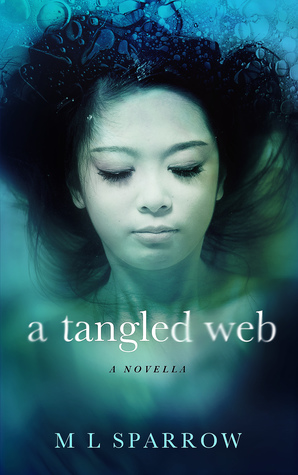 “Japan, 2011
Taiyo is a normal high-school girl living with her Grandmother in Sendai. She goes to school, partakes in club activities and hangs out with her two best friends, twin brothers Ryuu and Kairi. However, her perfect world is shattered when she begins dating Kairi but quickly discovers she’s already in love with Ryuu.
A tangled web of lies surrounds the pair, but everything is suddenly knocked into perspective on March 11th when they are caught up in a natural disaster that devastates the country and robs thousands of their homes, their possessions and their lives…”

It’s About the Chaos

Dave Droge Author Interview
The Game Changer revolves around the life of creative businessman Henk who finds himself in trouble after an art robbery takes place in the heart of Rotterdam. This book is a genre-crossing novel with elements of a romance, crime, and art history as well. Did you start writing with this in mind or did this happen organically as you were writing?
Thanks first for all the time and effort to read my book. This is a very good question and maybe therefore not easy to answer: it’s both in a mixture I would say. I started with some basic ideas and investigations, did some research on the subjects and meanwhile, on the other hand, write highly intuitive. Then I switch from these two mindsets every now and then, like in a loop that rolls forth until you get the feeling it’s almost finished. I certainly have no idea how it will end when writing and I am surprised at times about the direction the novel or characters takes… so then I change the research and idea’s to be able to go on a bit further. In the end, it takes a lot of editing, and in this process the book is also enriched a bit, blended.
The relationship between Henk and his daughter Julia is intriguing and risque. What was the driving ideas behind these characters traits and relationship?
Emancipation and seeking of one’s identity/freedom of Julia and maybe also the idea that world problems might need to be solved by women. But in this novel, it’s mainly about Henk, the businessman whom you might in some ways see as a Donald Trump kind of guy (thinking now of the open letter I read on the website of Michael Moore written to Ivanka Trump: ‘your dad is not well’, but it’s written after writing my novel). It’s about the chaos in Henk’s mind, the obsession of dominating, maybe caused by fear of women taking over power, confused with and entangled in the love for his daughter.
There is some fantastic art history in this novel. Was that intentional? Did you have to do research for this book?
Yes, I did quite some research, but in the intuitive writing process most of it is done for nothing probably, you never know for sure. The general idea I guess is indeed that art can maybe help us, it’s an investigation if so and if the answer is yes, how this can be done. What role can art play, seen from the viewpoint of the eighteen-year young Julia. She wants art to be decisive.
Why did you choose Rotterdam as the setting for this novel?
It’s close to my hometown, Vlaardingen, and plays a major role in the area where I live, historically and still from this day on, although the work in the harbour gets more automated nowadays. Furthermore, I would like to emphasize that Elias Canetti’s Auto-da-fe (‘Die Blendung’), written in 1935, was an inspiration for my novel, mainly regarding the atmosphere. As a tribute, I mentioned his name once deliberately within the novel in the middle somewhere, as well as using the term ‘stipendium’, which I came to know reading this novel and ‘Masse und Macht’. I consider this novel my personal and modern ‘die blendung’.
What is the next book that you are working on and when will it be published?
The next book is all about Julia, Henk his artistic daughter. At this point in time I feel that it can still take a while before it will be finished, although there are more than 100k words written and severely edited so far. I tend to be rather ambitious regarding goals and ideas of a new book I guess, so to finish it, to pull it off is unsure: it might not work at all. Especially since the new novel will partly be science fiction, playing in 2050, I wonder if I will manage.
Author Links: GoodReads | Facebook | Website
Sneak preview of the new novel:
 The floating pavilion called The Game Changer, peacefully located between the landscaped garden and artistic attributes crammed with solar – panels, foils and conductive basins along the eaves – is virtually deserted, a rarity. As if Providence feels there is something special happening since I will, after all these years, speak privately with her. After several decades, the moment finally arrives. The ring gives an orange signal, I will have to do sport for half an hour the least, followed by a silent meditation to bring my blood pressure and pulse combination back to acceptable levels. The nerves vultures in my throat, my nasal breathing is irregular, but I consider it too late for intense exercise; I can at best apply a short-term yoga technique, click the ring signal back to inactive and start enjoying the view. In the distance I see a dot rising, it could be the amphibian taxi, one that brings her to this magnificent pavilion, two miles off the coast of Hoek van Holland situated in the North Sea, a sea largely transformed into a sea farm: one big floating habitat of many thousands of hectares. It remains beautiful to see how the east side of our integrated Maasvlakte has become a place for handling assembly of environmentally friendly products surrounded by renewables and encapsulated between tens of thousands of wind turbines, seaweed farms and solar generating systems with modern forms of salt mining. We are a leader in the world, people! Mom will not believe her eyes. In a country like the U.S.A., they are still jealous; they have looked with uttermost suspicion at our ultra-modern business, our activities that saved the planet and ourselves, mankind, from The Great Catastrophe.



 LITERARY TITAN