Blog Archives
The Empathy of Rain


The Empathy of Rain is a lyrical collection of poems that uses rain, in all its moods and forms, as a mirror for human feeling. Each section whether “Morning Dew,” “Virga,” “Scotch Mist,” or “Thunderstorms” offers a shift in tone and imagery. The poems explore longing, memory, love, and loss through recurring symbols of weather and light. The author leans into musical cadence, often weaving music, mythology, and natural imagery into lines that blur the boundary between personal memory and universal meditation. The effect is a tapestry of emotions carried by the rhythm of rainfall.
I often felt swept up in the sheer intensity of the writing. Some poems feel like whispers, others like sudden storms, and that variation kept me hooked. I admired how the poet wasn’t afraid to be vulnerable. The words carry a kind of raw ache, especially when love is spoken of as something both eternal and fleeting. The writing is lush, often overflowing, and that abundance created an atmosphere that felt alive.
The metaphors tumble one after another. That torrent of language mirrors the theme: rain rarely falls gently for long. It arrives in waves, it drenches, and then it vanishes. The book captures that sensation perfectly, even when it risks drowning the reader in its intensity.
I would recommend The Empathy of Rain to readers who love poetry that is unfiltered and emotional. It is best suited for those who don’t mind getting lost in layers of imagery and who want to feel as much as they want to think. If you enjoy writing that leans into passion, music, and the mystical bond between nature and the human heart, this poetry book will give you plenty to return to each time you open it.
Pages: 180 | ASIN : B0FC5M62CN

Fists in the Eye that Blinks on a Pin

Dyson Russell’s Fists in the Eye that Blinks on a Pin is a collection of poetry that feels both raw and surreal, like wandering through a dream where images refuse to sit still. The book moves between moments of tenderness and moments of violence, never giving the reader a chance to feel completely safe. Themes of memory, loss, and fractured identity recur throughout, tied together by vivid and sometimes startling metaphors. It’s the kind of collection where one poem can feel like a quiet confession and the next like a scream across a darkened room.
I found myself both unsettled and deeply moved. Russell writes with a kind of reckless honesty that doesn’t apologize for being strange or uncomfortable. Sometimes the words tripped me up, and I had to pause and reread, but I didn’t mind. The language has teeth, and that’s part of its pull. What I admired most was the way the poems manage to be experimental without drifting into nonsense. Even in their most chaotic moments, they circle back to something recognizable and relatable, like grief that feels both personal and universal.
The repetition of despair, loss, and fractured imagery can weigh heavily after a while. Still, I can’t deny that the intensity is part of what makes this book what it is. Russell doesn’t water anything down, and that kind of boldness is rare. It felt like stepping into someone else’s storm and just staying there until the clouds passed.
I would recommend this book to readers who crave poetry that doesn’t play it safe. If you like writing that feels visceral, experimental, and emotionally unfiltered, this collection will stay with you long after you put it down. It’s not for someone looking for light verse or easy comfort, but if you want to wrestle with language and feel something real, Fists in the Eye that Blinks on a Pin is worth your time.
Pages: 110 | ISBN : 1763820602
The Meteor Symphony: Stories and Poems
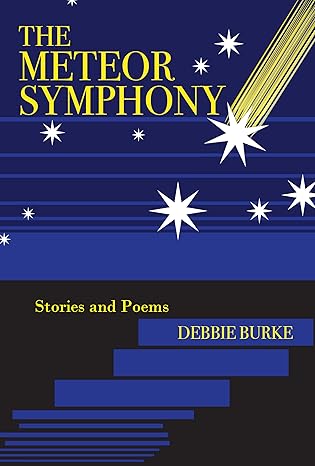
The Meteor Symphony is a colorful mix of short stories, poems, and microfiction, stitched together with music, humor, grief, and hope. It moves from tales of jazz musicians and stolen saxophones to intimate portraits of aging, love, heartbreak, and resilience. Some pieces lean into whimsy, others lean into sorrow, and many hover in the strange, honest space in between. The title story ties it all together with an imaginative search for a lost symphony, but the book itself feels like a symphony of voices, moods, and rhythms.
I enjoyed the range in this book. One page had me laughing at the absurdity of a sax heist, and the next had me sitting with the weight of a widow’s quiet grief. Burke writes with sharp clarity, yet there’s also a looseness in her storytelling that feels natural, like listening to a friend talk late into the night. I loved that she didn’t try to polish away the odd details. People misstep, conversations derail, feelings clash, and it all feels real. At times, the jumps between stories and poems felt a little jarring, but in a way, that’s what made it lively. The collection refuses to settle into one mood.
I also found myself connecting with her fascination with ordinary people. She doesn’t write grand heroes or villains, but flawed, funny, messy people. That resonated with me. Her style is direct but not cold, and she doesn’t shy away from emotions. Some of the poems hit me harder than the stories, brief as they were, because they carried that distilled punch of truth.
I’d say this book is best for readers who like variety, who don’t mind skipping from lighthearted banter to heavier reflections, and who enjoy the intimacy of short-form writing. If you’re open to being surprised, amused, and sometimes gutted all in one sitting, Burke’s collection is worth your time. I’d recommend it to anyone who loves music, who has wrestled with family, or who has ever paused at sunset and felt the ache of beauty and loss in the same breath.
Pages: 114 | ASIN : B0DTJ37FVK
Life’s Transience

Exits is a collection of poems that moves in and out of nature, memory, and mortality with a sharp eye and an unflinching voice. What inspired you to write this particular collection of poems?
Nearly all of the poems in Exits were written between 2003 and 2021, before the idea of authoring a book ever came to mind. Three years ago, I decided to incorporate what I considered to be my best work into a book entitled Line Drawings. However, during the process of selecting poems, I noticed that a substantial number were related to various aspects of mortality. This led me to curate a more concise, themed collection, and Exits was born.
How did you decide on the themes that run throughout your poetry book?
I think my focus on life’s transience — the finite nature of our biological selves — derives from three sources. First, I was raised without any religious training, so from a very young age, I was left on my own to ponder the enormity of the universe, time and eternity, and the meaning of existence. I remember being cognizant of death as early as age five. Second, as a physician and neuro-ophthalmologist, I’ve cared for numerous patients with serious and/or life-threatening diseases. And third, since 1999, I’ve had to deal with the spinal cord variant of multiple sclerosis and the ramifications of that disease.
Did you write these poems with a specific audience in mind, or was it a more personal endeavor?
During the writing process, the intended audience was always me, or, to be more precise, the facsimile of me that constantly looks over my shoulder and critiques every word I draft. The word ecstasy comes to mind. It captures the elation I feel when a line finally comes together, but it derives from the Greek ek stasis ― to stand outside of oneself.
There’s certainly nothing wrong with writing for a defined audience, or respecting the conventions of a particular genre, or exploring themes and issues that are currently in the public eye. My approach happens to be different. What matters most to me are the words on the page, how they sound in air, and meeting the standards I set for myself.
What did you learn about yourself through writing this book?
The lessons I learned while writing the poems and designing the book (which are outlined below) may be of benefit to other debut authors and/or emerging writers:
- Write poems that reflect your unique aesthetic sensibilities. Try not to be overly influenced by prevailing trends or by contemporary poetic styles.
- Edit mercilessly over an extended period. Satisfying first drafts often begin to show their flaws only after sufficient time has elapsed to afford an objective assessment.
- Begin your foray into publication by submitting poems to literary journals. This will help you determine which of your poems resonates with experienced reviewers. Before each submission, make sure that your poem is a good fit for the journal.
- Be patient. Practically every aspect of the publication process moves more slowly than expected.
- Be persistent. Exits went through twenty-two revisions over the course of a year before I felt it was ready for publication.
Author Links: GoodReads | Website | Amazon
We live our lives counting moments, those we hope will last forever, and those we fear. In Exits, award-winning poet Stephen C. Pollock transforms these moments into sublime and magical music. With language both intimate and powerful, he explores the fragility of life, the cyclical truths of nature, and the mysteries of renewal that arise from even the darkest places.
Each poem is paired with evocative artwork, creating an immersive reading experience that lingers long after the final page. From myth to mourning, from dreams to decline, and from flora and fauna to the warming of our world, Exits reminds us that beauty is never far from loss, and that every departure leaves a door ajar.
Winner of the 2024 North Street Book Prize for Poetry, the 2023 Readers’ Favorite Gold Medal, and seventeen other literary honors, Exits is a masterful collection for those who believe that poems should move you, stay with you, and change the way you look at life.
Step into these pages. Lose yourself in poetry that’s both technically exquisite and emotionally arresting. And discover why every exit is, in its own way, an entrance.
Exits
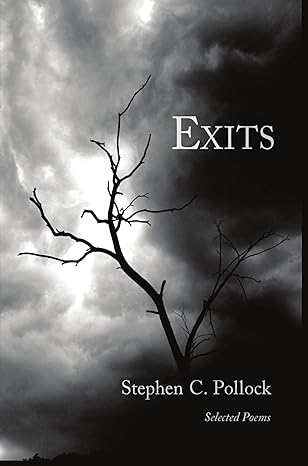
Exits is a collection of poems that moves in and out of nature, memory, and mortality with a sharp eye and an unflinching voice. Pollock balances images of birds, leaves, storms, and insects with meditations on illness, grief, and human cruelty. Each poem feels like an opening and a closing at once, a gesture toward beauty that never ignores the shadows pressing in around it. The artwork paired with the text deepens the mood, giving the reader both a visual and lyrical way to linger with themes of death, decay, and renewal.
I found myself pulled into the tension between delicacy and brutality. The spider spinning its web, the butterfly pinned by a child’s cruel hand, the leaves clinging through winter, these images stayed with me. Pollock’s language is careful, yet it carries an undercurrent of urgency, as if each word knows it has little time left. Some poems made me pause and reread, not because they were obscure, but because they struck me with a sudden intensity. Others, like “Steve’s Balloons,” were so unexpected that I had to smile even while feeling the melancholy underneath.
At times, the heaviness of the book pressed down hard. Illness, biopsy, syringe, tube, the clinical intrudes often, and it brought me back to my own brushes with hospitals and fear. That familiarity made the reading even more raw, and I appreciated Pollock’s honesty. He doesn’t romanticize suffering, but he does find ways to trace light through it. There is also a musicality to his lines that reminded me of older poets, the kind whose rhythm stays in your body long after the words leave your mouth. That mix of craft and emotion gave the book both polish and heart.
I would recommend Exits to readers who like poetry that doesn’t look away. If you’re drawn to reflections on life and death, or if you find comfort in nature as a mirror for human experience, this book will speak to you. It’s not an easy read, but it’s a meaningful one, and I think anyone who values honesty wrapped in artful language will find something to hold onto here.
Pages: 45 | ASIN : B0BXVJB79N
Feeling Driven
Bridges of Words is a collection of haikus that capture the spirit, mood, and humanity of cultures around the world. Why was this an important book for you to write?
Words are bridges, I’ve always thought. A Filipino-Australian, I have experienced the nuances of cultural differences as well as the silent need for understanding after growing up in one society and now residing in another. Born prematurely in a military hospital in Nueva Ecija—where my grandmother’s refusal to choose between saving my mother or me led to both our survival—I was named Esperanza, meaning “hope.” That word has carried me through my life.
Language has the ability to bring people together and bridge emotional and physical divides in addition to informing and persuading. Through the delicate compression of haiku, rather than through dissertations or manifestos, Bridges of Words allowed me to celebrate humanity in all its textures. A haiku can capture a universe in three lines: the echo of memory, a stranger’s grin, a city street after rain.
It was also a historical experience to write this book. Japan, which occupied the Philippines during World War II and left behind heartbreaking memories of hardship and tenacity, is the source of haiku. However, engaging with this literary genre became an unconventional act of reconciliation for me. By capturing beauty and transience in the rigid yet simple syllables of haiku, I was able to recognise sorrow without being overcome by it.
Furthermore, forgiveness itself is a bridge, isn’t it? A bridge that lets us go on instead of lingering in the depths of bitterness or rage. Every haiku became a tiny act of construction, a step toward comprehension—a means of expressing that, in spite of our differences and past experiences, we can still live amicably through our common humanity.
Can you share a bit about your writing process? Do you have any rituals or routines when writing?
In addition to the other facets of my entrepreneurial and professional endeavours, writing has always been part of my daily life, though not always in the way one might imagine. From my earliest days, words have been my companions—whether scribbling on my aunts’ college books at age 3, writing verses as a Grade 5 student who unexpectedly won in a poetry contest, serving as the English literary editor of The OLCAn in high school, or later leading The Corps as its first female editor-in-chief at the Philippine Military Academy. That role, along with becoming the Academy’s first female Journalism Awardee and first Languages Plaque recipient, confirmed for me that words could be both a personal refuge and a public responsibility.
My naval career deepened this focus, as I became the inaugural Navy Digest editor and later worked on the Navy Journal, Fleet Journal, and Polaris Magazine. Today, I still edit multiple publications professionally, which keeps me grounded in the discipline and craft of writing.
But Bridges of Words emerged differently. Almost without notice, it came like a bolt of lightning across a still sky. Often, a single sight or memory would prompt me to act immediately. I still recall sitting at my computer here in Adelaide, the morning sun streaming through the blinds, when a haiku began to take shape in my mind. It was like attempting to capture a bird in midair; I had to do something before it vanished.
My approach had been less about routine and more about spontaneity. Sometimes it was the laughter of my sons, sometimes the witty jokes of my husband, sometimes a walk along South Australia’s beaches, sometimes the Zamboanga sunsets of my childhood, or the scenic sights of Taal Lake that never left my memory. That was my rhythm: focusing on the small moments and feeling driven to convey them in words that might resonate with someone else, somewhere else.
Do you have a favourite haiku in the book, and if so, why does it hold special meaning for you?
Logically, I should be more drawn to the haikus that depict the Philippines and Australia, because they are my own countries.
The Philippines’ haiku embodies resilience, a trait I witnessed from an early age. Growing up in a land prone to typhoons and eruptions, I listened to stories and even witnessed at times how families and communities would quietly rebuild lives and spirits with steady resolve. That everyday bravery—the quiet courage of people who simply endure—was etched into me from childhood.
In comparison, Australia exemplifies diversity and unity. When I first set foot in Sydney in 2006, I fell in love instantly with its order, beauty, and openness. Years later, settling in Adelaide with my family in 2010, I discovered a deeper sense of belonging. Here, languages, faiths, and cultures cohabit and enrich one another, and that spirit of coexistence is what I sought to capture in haiku.
Together, these two countries’ haikus create a bridge that spans place and time, tying together memory and lived experience, origin and destination, past and present. Poetry is not only an art of words; it is an edifice of human experience—it speaks of the depth and resilience of human life.
That said, there’s no simple or safe way to answer this question. It feels like being asked which of my children I love the most. Every haiku in Bridges of Words has its own pulse and memory. Just as I cannot love one of my children—Huey, Sev, or Noah—more than his siblings, I cannot favour one poem over the rest. Each carries its weight; each is a bridge.
What is the next book you are working on, and when will it be available?
To be honest, I haven’t made any firm plans yet. Like Bridges of Words, I have a feeling that the next project will develop naturally, as I feel driven to capture it in the moment. For me, book writing started with intuition rather than a plan—a vision, a memory, or a passing idea that begged to be put into words. Perhaps in ways I cannot yet foresee, the next piece will continue to examine metaphorical bridges—between locations, times, or the silent, unseen moments of our everyday existence, though possibly in an altogether different way. I’m letting it take shape for the time being, trusting that the right words will emerge when the moment is right. In the end, writing is simply my way of building small bridges—one fleeting moment, one word, one resonance at a time.
Author Links: GoodReads | X (Twitter) | Facebook | Website | Amazon
Seventeen syllables.
In Bridges of Words, discover a quietly powerful collection of haikus from 57 countries—each a window into the heart of a culture. These verses don’t explain; they invite. They don’t shout; they hum.
Whether you find yourself beneath banyan trees or city lights, this book is a gentle reminder that even across oceans, we’re not so different after all.
Emotional Timing

Resonance of the Soul – Flowers and Harmonics is a heartfelt and unfiltered collection of poems that dives into the human condition, exploring themes of love, identity, culture, struggle, healing, and faith. What inspired you to write this particular collection of poems?
I was inspired by a love story—one that stirred memories of what truly matters in life. That experience, along with moments spent with patients nearing the end of their lives in hospice, reminded me how fragile and sacred our time is. A mentor also nudged me to complete my writing, reminding me that unfinished words can become unfinished healing. This collection became a way to honor those stories, those lives, and the emotional truths that often go unspoken.
Did you write these poems with a specific audience in mind, or was it a more personal endeavor?
I wrote for those without a voice—those caught in the throes of indecision, those marginalized by circumstance, and even those who seem entitled or indifferent but are quietly searching for meaning. While the journey began as personal, it quickly became communal. I wanted these poems to reach anyone who’s ever felt unseen, unheard, or underestimated. It’s a companion for the lonely, the faithful, and the quietly resilient.
What was the biggest challenge you faced in putting together this poetry collection?
Time. Not just the literal hours needed to write and revise, but the emotional timing—knowing when I was ready to revisit certain memories, and when the world might be ready to receive them. Balancing my clinical responsibilities with the vulnerability required to write was also a challenge. But I learned that when something truly matters, you make time for it.
How has this poetry book changed you as a writer, or what did you learn about yourself through writing it?
I’ve come to appreciate the effort and emotional discipline it takes to create something meaningful. Writing this book taught me that poetry isn’t just about language—it’s about listening, about honoring silence, and about crafting space for others to feel seen. I learned that my voice carries weight not because it’s loud, but because it’s rooted in truth. And I discovered that healing—whether clinical or poetic—requires presence, patience, and grace.
Author Links: GoodReads | Amazon
Each poem reflects the delicate interplay of life’s harmonics—the highs and lows, struggles and triumphs—capturing its essence with thought-provoking depth and emotional resonance. With a voice that is both evocative and intimate, the anthology invites readers to embark on a transformative journey through the intricate beauty and complexity of existence.
“Resonance of the Soul – Flowers and Harmonics” showcases Dr. Edwards’ ability to infuse profound truths into his work, creating moments of reflection and celebration that resonate universally. It is a collection that bridges the personal and the universal, making it an unforgettable literary experience.
Find a Balance

Journal of a Black Man is a lyrical exploration of Black identity in British Columbia, weaving together themes of love, faith, family, and resilience against systemic inequities. Why was this an important book for you to publish?
It was an important book for me to publish because Black people in Canada, especially in British Columbia, make up a very small proportion of the overall population. Therefore, I had to inform people about the things that we truly face. Visitors are often sold the glitz and glamor of the country, and while Canada is definitely beautiful, there are many dark moments. Also, there are a lot of things that I personally experienced, such as love. Overall, the start of the year had been tough for me, and I only made it through with family, faith, and resilience, which is why I highlighted those themes.
Many poems balance vulnerability with strength. How do you navigate writing about pain without letting it overshadow joy?
I navigated between the themes of joy and pain by understanding that there will be bright moments and there will be dark moments. Life isn’t perfect, but I know that I had to find a balance that I was truly happy with.
What were some themes that were important for you to explore in this book?
Some themes that were important to me in this book were migration, love, the nuclear family, faith, and resilience.
What do you hope readers carry with them after sitting with your words?
I hope that readers truly enjoy the book, but what I really want them to understand is that nothing is truly what it seems. Be careful with each opportunity.
Author Links: GoodReads | Amazon
I allow you to see my feelings,
I am vulnerable…
This powerful fifth collection from prolific poet Marlo Browne is an exercise in vulnerability. He
exposes personal feelings about the Black experience in Canada, his adopted home.
Topics touched on in this work include the high incidence of missing youth in provinces like
Ontario, prevalence of drug use and abuse in Ontario, exploitation within the migration process,
biases in the workplace, and more.
Experience vulnerability in a bold new way within the pages of JOURNAL OF A BLACK MAN
today!



 LITERARY TITAN