Blog Archives
The Real and the Virtual

SPARK follows a 16-year-old foster kid who runs away to a virtual reality theme park, where he meets another runaway and uncovers more than an escape from reality. What was the inspiration for the setup of your story?
We’ve known foster parents and foster kids. Everybody means well, but the system is so overloaded that kids fall through the cracks and are left in situations that are not good. These kids often have issues that the parents cannot handle and the environment turns adversarial. Will is an example of that. He is a great kid whose past sets him up to fail in the system.
As a child, I always wanted to spend the night in Disneyland – to look behind the scenes and explore. Will figures out a way to do just that in Spark.
I find the world you created in this novel brimming with possibilities. Where did the inspiration for the Solar Prime Augmented Reality Park come from, and how did it change as you were writing?
Solar Prime Augmented Reality Park was inspired by Pokémon Go. My daughters were both playing, so I gave it a try. The concept of a Pokémon being projected onto a real background captured my attention. One of the problems with virtual reality is that you lose all touch with your actual environment and can easily crash into walls, tables, and TVs while playing. It’s also easy to step on things, like pets. Augmented reality blends the best of the real and the virtual.
What were some themes that were important for you to explore in this book?
I wanted to look at the foster care system, education, artificial intelligence, and a post-war world.
Where does the story go in the next book, and where do you see it going in the future?
The second book in the series, Fire, is now available! It follows Will and Feral as they fight their way through the aftermath of Spark’s events and the notoriety that they’ve gained. Some social media themes play out and they get caught between competing factions and find themselves counseling an AI that has learned that violence can be an effective tool.
Author Links: GoodReads | X (Twitter) | Facebook | Website | Amazon
Spark


Pat Daily’s SPARK thrusts readers into a richly imagined virtual world where the stakes feel as real as life itself. At the heart of this gripping sci-fi tale is sixteen-year-old Will Kwan, a foster kid whose life has been shaped by uncertainty. His world changes when he clings to the last words from his birth mother: “Find me, save me.” Those same words appear in SPARK, the Solar Prime Augmented Reality Park, a dazzling digital universe that offers Will a sense of purpose and belonging. What begins as escapism soon turns into a high-stakes mission as Will dives deeper into the realm of SPARK and encounters Feral Daughter, a defiant runaway who has made the park her sanctuary. Together, they unravel secrets that could change everything.
This novel borrows familiar themes from classics like Ender’s Game and modern hits such as Ready Player One. Yet, SPARK stands out for its emotional depth and grounded protagonist. Will Kwan is an easy character to root for, a kid navigating the dual struggles of foster care and the existential questions that come with it. His journey feels genuine. He’s not just looking for a home but searching for identity, closure, and hope. His connection with Feral Daughter, another misfit seeking refuge in SPARK, is compelling and adds emotional weight to the story’s twists.
What’s refreshing is how the book avoids the well-tread sci-fi path of portraying technology as a lurking menace. Instead, it channels the spirit of Jules Verne, celebrating innovation and its ability to unite and empower. SPARK, as a virtual playground, is more than a backdrop; it’s a lifeline for Will and Feral Daughter, as well as countless others who feel alienated in the real world. Daily’s world-building is vibrant and imaginative, making SPARK a place readers will want to explore, even as its darker truths emerge. The stakes in the story rise steadily, intertwining Will’s personal quest with larger, often perilous, discoveries about SPARK itself. Every layer revealed about the virtual realm brings new surprises and challenges for Will.
The narrative’s pacing is taut, and the unfolding mysteries keep readers turning pages. Young adults will especially enjoy this fast-paced adventure, but older sci-fi fans will find themselves equally captivated by the dynamic characters and thoughtful exploration of technology’s role in human connection.
In SPARK, Pat Daily delivers a story that’s as heartfelt as it is thrilling. It’s a celebration of resilience, friendship, and the enduring power of hope. Whether you’re a teen seeking adventure or a seasoned sci-fi enthusiast, this book promises a virtual escape worth taking.
Pages: 458 | ASIN : B0BL193S4P

Mushroom Blues
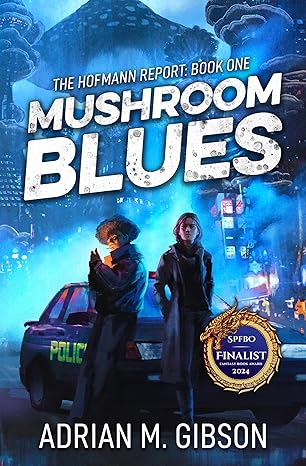
Adrian M. Gibson’s Mushroom Blues plunges readers into the “Fungalverse,” a dystopian blend of noir, science fiction, and surrealist horror. The story follows Detective Henrietta Hofmann, a weary investigator exiled to the oppressive, mushroom-drenched city of Neo Kinoko. Tasked with solving a gruesome murder, she navigates a tangled web of political corruption, cultural tension, and personal trauma in a world where humans and sentient fungal beings coexist uneasily after a brutal war.
Gibson’s depiction of Neo Kinoko—its decaying mushroom-topped towers, spore-filled air, and oppressive post-war atmosphere—was as immersive as it was revolting. I could practically smell the rotting mycelium and feel the grit of spore-laden winds on my skin. The mushroom-human dynamic adds a unique, eerie tension to the setting. The Mother Mushroom, a colossal fungal structure looming over the city, is both a symbol of cultural resilience and an unsettling presence. Gibson’s descriptions, such as the protagonist’s repulsion at fungal biology, made the world grotesquely alive. Henrietta Hofmann is a compelling lead. Her cynicism and mycophobia make her a fish out of water in the fungal-dominated Neo Kinoko, yet she’s tenacious and relatable. Her struggles with alcoholism and personal demons lend depth to her character, especially during moments of vulnerability. The story’s pacing mirrors its noir roots—deliberate and laden with tension. While the mystery at its core is intriguing, it’s the societal commentary that elevates the narrative. The portrayal of post-war xenophobia and systemic oppression is sharp and poignant, with parallels to real-world colonial histories. The protests and clashes between human authorities and the fungal populace stand out as some of the most gripping scenes, capturing the desperation and anger of a marginalized group.
Mushroom Blues is a bold and bizarre debut that will appeal to fans of genre-bending fiction. Its mix of noir grit, science fiction imagination, and social critique makes it perfect for readers who enjoy Adrian Tchaikovsky or Jeff VanderMeer. Its grotesque imagery and deliberateness are perfect for those who relish intricate world-building and morally complex characters and will find themselves enthralled—and perhaps a little spore-sick. It’s a dark, fungal-drenched trip worth taking.
Pages: 441 | ASIN : B0CTCF9TCF

Far-Reaching Impacts

The Pattern Maker follows a former astronaut now working at NASA’s Johnson Space Center whose colleagues claim they were passengers in a driverless SUV accident leading him to investigate more unsettling occurrences. What was the inspiration for the setup of your story?
I have had a fascination with simulation theory for a long time, especially the work of philosophers, such as Rene Descartes and Nick Bostrom, and from watching shows like Ghost in the Shell and The Matrix. I knew I wanted to base a series of novels on this possibility but I needed another story element to cause a high-stakes thriller plot. This introduced the Pattern Maker because of course, there would be someone who would want to take advantage of changing the world to suit their plans. This book opens with how those changes may look to us as they are happening. I also needed some events that were going to make the fact that we live in a simulation believable to the characters.
I found the science in the novel to be well-developed. What kind of research did you do to make sure you got it all right?
I follow a lot of sites and feeds that cover the latest scientific discoveries and thinking, and this information triggers ideas about how I could bring them together in a plausible way. I then build in extra layers to develop the thriller aspect of the book. To ensure that the science I’m using, and the way I’m twisting it, could work, I refer to the work that researchers have kindly shared in formal papers and scientific journals.
What were some themes that were important for you to explore in this book?
The premise of the whole series is that nature will repair itself, with a strong leaning toward Gaia theory, which suggests that the planet is self-regulating to sustain life. And, the more humans attempt to “fix” things, the worse they get. I also wanted to explore the idea of how rapidly we can now make changes to systems, at massive speeds, that can have such far-reaching impacts to all lifeforms.
Where does the story go in the next book and where do you see it going in the future?
The main plotline of the series is that by accessing and changing the simulation code, the Pattern Maker has introduced the Year 2038 problem. In a simplified nutshell, the year 2038 problem is a bug that may impact the way some computer systems store and represent time values from January 19, 2038, as they will run out of space to store dates. This could cause the computer to malfunction or stop working, or the calculation could overflow causing the system to think the date has looped and is back at the original start date of 1 January 1970, or the system could go into underflow and make the time value negative, and the system would think it was 13 December 1901. When we’re talking about computer systems, this is something that can (and is currently being) addressed. But when it happens to the simulation that we live in and are an integral part of there’s a range of extinction-level outcomes that could occur. To stop any of these disasters, the team attempts to make changes to the code but they need to somehow test their work. Using a new method of quantum time travel, Sam undertakes missions to throw his consciousness forward to the year 2040 to see if they have been successful. But a lot can happen in 18 years – not just to the world but to Sam’s life. And the Pattern Maker didn’t bow out gracefully, leaving a series of cipher blossoms, which bloom within the simulation code at the worst moments.
Author Links: GoodReads | Amazon
Its code has been breached.
Will a cyber zealot destroy our world?
The Pattern Maker is erasing their enemies by deleting their code. But this increase in data is moving the simulation toward a gravitational singularity when it will crush itself.
The only clues discovered by NASA and Homeland Security lead to the Sámi people of the Arctic. Their ancient understanding of physics may help stop the simulation overloading, while a realistic environment is developed to test reversing the changes.
Can they use an existing test model for this purpose?
Or will the Pattern Maker stop them in a deadly code battle?
The ancient role of Weaver introduces another person who can change the simulation but she can do it with her mind. Can the government task force build an alliance with her or do they have another enemy to defeat?
If you dig science fiction where reality is made surreal as it intersects with theoretical physics, this book is for you.
Author’s note:
Some readers have found this book to be quite a dense read due to its complexity. This is from hard science fiction themes, a non-linear narrative, and multiple points of view that deliver various pieces of the puzzle at different times.
If you don’t enjoy these elements of story-telling, you might want to give this book a miss.
Whatever you decide, happy reading to you!
The Pattern Maker

The Pattern Maker is a science fiction thriller set in 2024, primarily revolving around Commander Sam Perry, a former astronaut now working at NASA’s Johnson Space Center. The novel kicks off with a mysterious car accident involving Perry’s colleagues, who claim they were passengers in a driverless SUV. This puzzling event triggers a series of increasingly bizarre and unsettling occurrences. As Perry investigates, he uncovers a deeper conspiracy suggesting reality itself is a simulation manipulated by a shadowy figure known as the “Pattern Maker.” The book weaves science, technology, and philosophical speculation into a gripping story about the nature of existence and free will.
I found the writing to be sharp and engaging, with a lot of emotional intensity coming from Sam Perry’s inner monologues. The story’s pacing is fast, and the mix of technical NASA details with the eerie supernatural elements creates a unique blend of realism and sci-fi. Perry’s frustration as he navigates this convoluted reality felt authentic, especially when the surreal events started pushing him to the brink. In particular, the scene where he watches footage of a driver’s skeletal hand gripping a steering wheel is haunting, sticking in my mind long after I read it. I appreciated how the book didn’t rush through its central mystery but let the tension build as Perry pieced everything together.
Perry is the reluctant hero, drawn into a conspiracy beyond his control, and Kate Martin, one of his colleagues, serves to mostly introduce the central mystery. However, the mystery surrounding the “Pattern Maker” kept me hooked, especially as it became clear that this entity was erasing people from existence. The scene where Perry learns about his role in this cosmic manipulation sent chills down my spine. There’s something genuinely terrifying about the idea that reality can be undone like lines of code.
The Pattern Maker is a thought-provoking and eerie thriller that will appeal to fans of speculative fiction and those interested in the intersection of science and philosophy. While the book’s dense plot and technical details might not be for everyone, its suspense and exploration of reality’s fragility make it a compelling read. I’d recommend this to anyone who enjoys shows like Black Mirror or books like Philip K. Dick’s Do Androids Dream of Electric Sheep? If you love to question the nature of existence while being entertained by a gripping mystery, this one’s for you.
Pages: 293 | ASIN : B0DFTKJS7Q
Accidental Intelligence
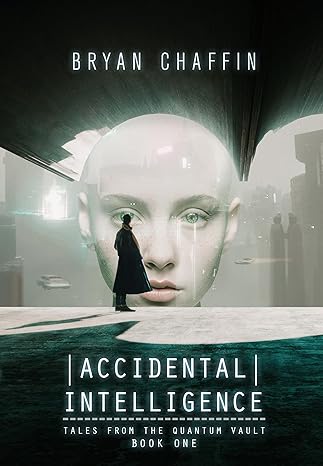

A desperate woman walks into Rider Investigations, setting off a chain of events that Mason Truman never imagined. But this isn’t your typical private eye story. Accidental Intelligence: Tales From the Quantum Vault, the debut novel by Bryan Chaffin, takes readers on a thrilling science fiction journey. From the very first page, Chaffin weaves a futuristic world that is both chillingly detailed and unsettlingly plausible. The setting, filled with virtual assistant implants and massive corporate combines, feels all too real, with news clippings at the start of each chapter grounding the reader in a world on the brink of a technological revolution. The novel asks big, provocative questions: What if AI had human rights? What if more than half of humanity lived their lives through immersive virtual reality networks like Omninet?
The story kicks into high gear when Commander Andrew Bower returns from a mission with a mysterious data cube. His cousin, private investigator Mason Truman, enlists the help of Peanut, an eccentric Omninet tinker, and a group of gamers to unravel the cube’s secrets. What they uncover is nothing short of a chance to save humanity from extinction. But as the plot thickens, it becomes clear that no one knows who’s truly pulling the strings. The story moves quickly, and though I occasionally found myself having to reread sections—likely due to the wide array of characters, some with similar or dual names—the narrative pulled me back in every time. The characters are vivid and engaging. The witty banter between Mason and his AI factotum, Sam, adds a layer of humor that balances the high stakes. My favorite character, however, is Peanut. He’s quirky, endearing, and provides much-needed comic relief. Honestly, I’d love to read a book centered solely around his story. What truly elevates Accidental Intelligence is its commentary on the future of humanity. Chaffin doesn’t lean on the distant, unreachable future common in many sci-fi novels. Instead, he offers a near-future world that feels eerily familiar, making the story even more gripping. The technology, societal shifts, and ethical dilemmas presented seem just around the corner, which gives the book a thought-provoking edge.
Accidental Intelligence is a great choice for fans of science fiction that blends action with intellectual depth. It’s both thrilling and reflective, a book that will leave you thinking long after you’ve turned the last page. I’m eagerly awaiting the next installment.
Pages: 420 | ASIN : B0CMQ295YG
Finding Self-Worth

Counterblow Clemency follows a rebellious sixteen-year-old boy who, with his friends, faces the consequences of his actions and is drawn into a conflict far beyond their control. What was the inspiration for the setup of your story?
I had a wild dream one night about being on a freeway covered in blinding digital advertisements. Then the dream shifted to the aftermath of a giant house party. I wandered through this mansion with tons of empty alcohol bottles and dirty wine glasses scattered about until I found a small office with a woman inside, crying at her desk. I won’t say anymore because I don’t want to give anything away, but it was November, so I decided to explore this world full of advertising pollution during National Novel Writing Month (NaNoWriMo) and it grew from there.
What were some of the emotional and moral guidelines you followed when developing your characters?
My characters in Counterblow Clemency are universally on an amoral spectrum. I think it’s more productive to appeal to whatever drives a person, rather than making them feel that they need to measure up to a societal standard. Bjorn and the lads are only guided by loyalty to each other. They do things their own way, which explains why they’re constantly being chased by the authorities. This is a story about finding purpose and something to believe in. Their world is full of people who have given up hope and these kids are careening around trying to find something to do with all of their energy—the energy that humans typically expend striving to leave a legacy. No one ever taught them that they could make a difference. These ideas are important to me because kids need to internalize that they never need to be perfect—they just need to persevere.
What were some themes that were important for you to explore in this book?
Counterblow Clemency explores the themes of dignity, entitlement versus social responsibility, teamwork, and the kinship of chosen family. The main character, Bjorn, is 16 and doesn’t understand why his parents feel increasingly foreign to him as he moves through adolescence—he just knows that he’s angry about it. But he can count on his friends. The important thing is that this kid isn’t alone when his whole world crumbles. Part of his journey is learning that he’s worth saving. And as he grows, he faces the fact that he’s in a position to help people—if he can stay alive. Finding self-worth, accepting help, and helping others are important milestones for young people that I wanted to honor.
I find a problem in well-written stories in that I always want there to be another book to keep the story going. Is there a second book planned?
I hope so! I deliberately ended Counterblow Clemency with enough going on that there could be a sequel or even a series. I have ideas about what adventures the lads will have next, just in case.
Author Links: GoodReads | X (Twitter) | Facebook | Website | Amazon
Promo City is blazing with advertising pollution, but all sixteen-year-old Bjorn Bear cares about is having fun, until the city’s deadliest assassins attack him. With his motley gang of friends by his side, Bjorn must evade a crime boss with a vendetta, overcome genetically-engineered mini hippos, and race against time to discover and stop whoever is out to get him—all while facing the possibility that the only family he’s ever known isn’t real.
Deep-Seated Memories

In The Logoharp, a human-cyborg hybrid, dissatisfied with her life and the abuse of political power, works as a journalist tasked with foreseeing and reporting on future events. What was the inspiration for the setup of your story?
I was a science journalist and later, a multimedia and journalism studies professor in China, Hong Kong, Indonesia, and most recently Nairobi on a Fulbright Scholarship (2018-2019). With the emergence of the Internet and the rise of disinformation, deepfakes and AI-authored news stories, much of journalism has morphed from a fact-based practice into a mishmash of opinion, partisan backtalk and skewed predictions about election outcomes, candidates, policies and ideas. Too many media organizations jump to “report the future” by cherry picking present-day events and personalities. Meanwhile, important information and context are being ignored.
Our collective media obsession with ‘eyeball’ count and celebrity allowed me to imagine a world in which there is little security and no objective reality, only the reality of trumped up journalism in “reverse.” As communication and security expert Hamilton Bean described it, “The Logoharp creates a troublesome vision of media that borders on propaganda in an AI-filled future.”
There is a lot of time and care spent with descriptions and building the setting and tone of the story. Was this out of necessity to develop the depth of the story, or was it something that happened naturally as you were writing?
The descriptions from China, Hong Kong and “Ameriguo” in The Logoharp come from deep-seated memories of these countries. I’ve lived and worked in all of them. To me, developing authentic physical landscapes in the novel was a necessity to convince readers that my heroine Naomi’s story was both believable and important.
I think it’s important for writers to pay attention to the concrete, sensory world. I started early, right after college, studying both classical and modern Chinese language and culture in Taiwan. From there, I had an extraordinary opportunity to travel and work throughout Asia, then Europe, then Africa, taking notes and photographs, producing a surround-sound mental canvas on which I populated my characters. Establishing the novel’s setting and tone was entirely organic (lots of drafts), though the descriptions of sky tunnels and ocean luges came right out of my imagination. Of course, I was inspired by the likes of Jules Verne, Ray Bradbury, Adam Johnson (The Orphan Master’s Son), Ursula LeGuin, Liu Cixin, Doris Lessing, Harper Lee, Manuel Puig and so many others. All these writers display both an acute visual and kinetic sense in their work.
Is there any moral or idea that you hope readers take away from the story?
I hope readers will think about our world’s future, our climate crisis (no, it’s not a hoax) and whether we, as denizens, should do a better job educating ourselves, researching and vetting multiple sources of information and news rather than relying on this or that media channel to do our thinking for us. When government, political parties and corporate media bosses collude, the results can be illusory and very dangerous.
What is the next book you are working on, and when will it be available?
I’m working on a sequel text about a pilot, Naomi’s son, taking a “dystopian path to utopian justice.” A meeting with a lost sister. Unexpected revolution. Change in China’s destiny.
Author Links: GoodReads | X (Twitter) | Facebook | Arielle Emmett | Website | Leaping Tiger Press | Amazon
Naomi, half-human, half cyborg, is beyond prescient. She’s a Reverse Journalist, working for China in the 22nd century. Naomi’s job is to foresee and report the events and personalities of the future. Unlike conventional journalists who frame contemporary events, Naomi extrudes the “truth of probable outcomes” to ensure the smooth progression of history.
Driven by voices she hears in her Logoharp, a universal translator of instructions and signals from sources she can’t identify, Naomi listens, speaks and broadcasts in all world languages, ensuring citizen compliance. But an encounter with a leading architect, Naomi’s former lover who abandoned her in youth, forces recollections of her human inheritance and the role that chance, culture and racism played in her early life.
Naomi is tasked with finding a flaw in the architect’s system that “balances” births and deaths on behalf of the State. But she grows uncomfortable, then furious. Guided by the dissonant Logoharp, Naomi experiences “unintentional contradiction.” The rest isn’t silence. She acts.



 LITERARY TITAN