Blog Archives
The Self-Liberation of Parson Sykes: Return to Southampton County
Posted by Literary Titan
With a victorious end to the Civil War, Parson Sykes fulfilled the goal of self-liberation, but he grew frustrated with the Reconstruction programs. At the suspension of open hostility, he recognized the need for complete emancipation. Following the defeat of the Confederacy, he must advance civil and human rights to gain real freedom. As post-war planning emerged, new challenges arose. Parson grew frustrated with the connivance practices in racial superiority and inferiority that hindered everyday freedom.
Parson experienced the chaotic end of the Civil War while serving in the Union Army. Grappling with military-civil affairs duty, political uncertainty, and the unfulfilled promises of emancipation, Parson realized the Emancipation Proclamation did not go far enough. Following the defeat of the Confederacy, vicious racial violence characterized the resistance to integrating Black people.
Parson joyously learned that Federal government created the Freedmen’s Bureau to help formerly enslaved people transition to freedom with humanitarian aid. Parson relentlessly advocated and pursued education, political participation, and full citizenship. With the creation of the Bureau, he felt less pressure.
Parson witnesses the final year of the Civil War and the chaotic dawn of Reconstruction, learning about the complex political fight for civil rights from mentors and personal observation. Parson’s insights taught him that in war, the victory is just the blossom, and nothing is more frustrating than a bloom that refuses to morph into some fruit.
Parson returns to Virginia, where he confronts the defeated confederates, including the rise of hate groups and violent insurgents. In Southampton County, the Bureau mediated sharecropping agreements between white landowners and Black families after the constitutional end of enslavement. Despite granting freedom, the federal government took little action to help Black families acquire the promised land.
Through his interactions with mentors, Parson becomes a fierce advocate for the human and civil rights of Black Americans, focusing on education, land ownership, and political participation. He navigated the legal and social struggles surrounding the passage of the 13th, 14th, and 15th Amendments, revealing both the hope they inspired and the violent backlash they provoked.
With the passage of these amendments, they guaranteed equal rights for all citizens and prohibited states from denying the right to vote based on race or color. Simply put, Parson’s efforts to gain freedom, citizenship, and equality required long-term commitment, resilience, and perseverance.
Having secured his right to vote and purchase land, Parson married, started a family, and established himself as an independent community leader in Southampton County, achieving a hard-won personal liberation despite the systemic failures of the Reconstruction era.
As revealed by Parson’s genealogy, Reconstruction has ongoing effects, especially in the importance of addressing root causes and the need for ongoing human and civil rights enhancements. Racism is an inescapable reality in the American society. Still, the complexities of social problems, with their cultural subtleties and interconnectedness, demand a deeper understanding and more nuanced approaches than those used in managing a political solution.
Share this:
- Click to share on X (Opens in new window) X
- Click to share on Facebook (Opens in new window) Facebook
- Click to share on Tumblr (Opens in new window) Tumblr
- Click to share on Reddit (Opens in new window) Reddit
- Click to share on Pinterest (Opens in new window) Pinterest
- Click to share on Pocket (Opens in new window) Pocket
- Click to share on Telegram (Opens in new window) Telegram
- Click to share on WhatsApp (Opens in new window) WhatsApp
- Click to share on LinkedIn (Opens in new window) LinkedIn
- Click to print (Opens in new window) Print
- Click to email a link to a friend (Opens in new window) Email
Posted in Book Trailers
Tags: author, book, book recommendations, book review, Book Reviews, book shelf, book trailer, bookblogger, books, books to read, booktube, booktuber, david mason, ebook, fiction, goodreads, historical fiction, indie author, kindle, kobo, literature, nook, novel, read, reader, reading, story, The Self-Liberation of Parson Sykes: Return to Southampton County, trailer, writer, writing
Self-Liberation of Parson Sykes: Return to Southampton County
Posted by Literary Titan

Return to Southampton County continues the remarkable saga of Parson Sykes, a man born into bondage who fights for his freedom and dignity during and after the Civil War. The book traces Parson’s journey from enslavement in Southampton County, Virginia, through his enlistment in the Union Army, and his eventual return home during the Reconstruction era. Mason blends vivid storytelling with meticulous historical detail, showing how Parson’s personal struggle mirrors the nation’s own messy path toward justice. Through letters, government records, and oral histories, Mason reconstructs not just one man’s fight for self-liberation, but an entire people’s uneasy awakening into a world that promised freedom yet delivered resistance.
The writing feels patient, like it breathes history rather than rushes through it. Mason’s prose is steady and careful, but it also burns with quiet passion. He doesn’t lecture. He lets the scenes do the talking. When Parson stands among the ruins of Richmond, or when he dreams of his mother’s cherry syrup, I could almost taste the air, heavy with both hope and grief. The author’s military background adds authority, yet he writes not as a soldier but as a witness—someone humbled by the courage of those who came before. At times, the detail gets dense, the kind that makes you reread a paragraph just to take it in. But that density feels earned. It’s the sound of someone who did the work and wants to honor every name, every truth.
What moved me most were the moments of quiet reflection, when Parson isn’t marching or fighting, but remembering. Mason writes these scenes with tenderness. He captures the loneliness of a man freed by law but still bound by memory. The book also hit me with anger, the good kind, the kind that comes when history is told without sugarcoating. Mason doesn’t shy away from the cruelty of the era, nor from the failures of Reconstruction. His writing doesn’t preach, it just tells the truth and lets the weight of it land.
I’d recommend Return to Southampton County to anyone who loves history told through human eyes. It’s not just for scholars or Civil War buffs. It’s for readers who care about what freedom really means when it costs everything. The book rewards patience and empathy. It’s heartfelt, grounded, and full of reverence for those who refused to give up on liberty. Mason’s work reminds me why stories like this matter, not because they’re comfortable, but because they make us remember who we are and how far we still have to go.
Pages: 243 | ASIN : B0FGQMT95R
Share this:
- Click to share on X (Opens in new window) X
- Click to share on Facebook (Opens in new window) Facebook
- Click to share on Tumblr (Opens in new window) Tumblr
- Click to share on Reddit (Opens in new window) Reddit
- Click to share on Pinterest (Opens in new window) Pinterest
- Click to share on Pocket (Opens in new window) Pocket
- Click to share on Telegram (Opens in new window) Telegram
- Click to share on WhatsApp (Opens in new window) WhatsApp
- Click to share on LinkedIn (Opens in new window) LinkedIn
- Click to print (Opens in new window) Print
- Click to email a link to a friend (Opens in new window) Email
Posted in Book Reviews, Four Stars
Tags: author, biogrpahical fiction, book, book recommendations, book review, Book Reviews, book shelf, bookblogger, books, books to read, David J Mason, david mason, ebook, fiction, goodreads, historical fiction, indie author, kindle, kobo, literature, nook, novel, read, reader, reading, Self-Liberation of Parson Sykes: Return to Southampton County, story, writer, writing
The Self-Liberation of Parson Sykes: Enslavement in Southampton County, Virginia
Posted by Literary Titan
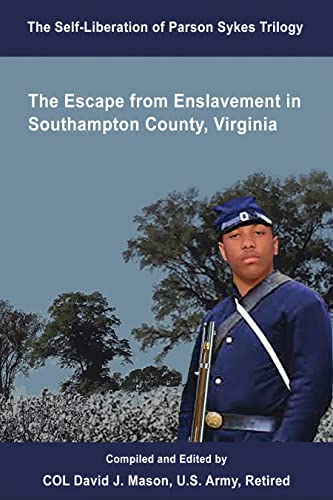
The Self-Liberation of Parson Sykes is a documentary novel based on a true story and actual events and was drawn from a variety of historic sources, including published government materials and family chronicles. A trilogy, the story profiles Private Parson Sykes’ evolution from enslavement in Southampton County, Virginia, followed by his enlistment into the Union Army, and culminating with his emancipation and return to the county. The initial part subtitled, Enslavement in Southampton County Virginia, of the trilogy, takes place in 1864 near the end of the American Civil War on the slave-holding Jacob Williams’ middle class family farm in Southampton County Virginia. During the 1831 Southampton Insurrection, the farm came under attack by Nat Turner and his insurgents, which haunts Jacob. Before the Civil War started, Parson began discussing human rights and the political implications of the abolition of slavery with his two brothers. In December 1864, he planned to liberate himself by running away from Jacob Williams’ farm and following an eastward path along the Seaboard and Roanoke Railroad to reach Norfolk, Virginia, which was a Union occupied city. Upon reaching Norfolk and in the hands of Union troops, Parson had liberated himself from bondage. The Self-Liberation of Parson Sykes also functions to draw attention to the important role Black soldiers and their White officers played during the Civil War as members of United States Colored Troops (USCT). Though less heralded, the USCT regiments were the precursors to Black army units famously nicknamed as the Buffalo Soldiers., Smoked Yankees, the Harlem Hell Fighters, Tuskegee Airmen, and the Red Ball Express.
Share this:
- Click to share on X (Opens in new window) X
- Click to share on Facebook (Opens in new window) Facebook
- Click to share on Tumblr (Opens in new window) Tumblr
- Click to share on Reddit (Opens in new window) Reddit
- Click to share on Pinterest (Opens in new window) Pinterest
- Click to share on Pocket (Opens in new window) Pocket
- Click to share on Telegram (Opens in new window) Telegram
- Click to share on WhatsApp (Opens in new window) WhatsApp
- Click to share on LinkedIn (Opens in new window) LinkedIn
- Click to print (Opens in new window) Print
- Click to email a link to a friend (Opens in new window) Email
Posted in Book Trailers
Tags: african american, author, book, book recommendations, book review, book reviews, book shelf, Book Trailers, bookblogger, books, books to read, booktube, booktuber, david mason, ebook, goodreads, history, indie author, kindle, kobo, literature, nook, novel, read, reader, reading, story, The Self-Liberation of Parson Sykes, trailer, writer, writing
The Self-Liberation of Parson Sykes
Posted by Literary Titan

Self-Liberation of Parson Sykes is a historical military memoir that delves into enslavement in Southampton County, Virginia, during the American Civil War. The author references published sources, family history, and anecdotes that narrate the true story of his great grandfather, Parson Sykes, and his quest for liberation. The book details the harrowing escape from enslavement in Southampton County during the American Civil War in 1864.
The author does an excellent job of exploring the socio-cultural environment of the time through the recorded experiences of Parson Sykes, his friends, and his family. At the age of 17, Parson is a charismatic leader in his community with great promise. The book has a compelling narrative that details his journey of escaping enslavement. Each chapter discusses the era’s events, including military movements and tactics, Mason’s military background, expertise, and how he addresses the oppressive and systematic ways that were used to dehumanize black people.
This enlightening story provides a glimpse into the brutality of this oppression, and the inhumane hardships enslaved people had to endure. Despite the vulnerability and helplessness experienced by many, the author highlights the strength and resilience of black women and women’s rights through the character of Frances Hill.
I highly recommend this informative and thought-provoking novel for its candid and realistic narration from the perspective of enslaved people and their families. Self-Liberation of Parson Sykes is a must-read for its importance and relevance in society and how many aspects of this history remain in the present day. I recommend Self-Liberation of Parson Sykes for its brilliant writing style and educational value. It’s an important topic that needs more attention and is a great educational read for anyone who wants to learn about the realities of slavery and the American Civil War.
Pages: 236 | ASIN: B0BG6954LL
Share this:
- Click to share on X (Opens in new window) X
- Click to share on Facebook (Opens in new window) Facebook
- Click to share on Tumblr (Opens in new window) Tumblr
- Click to share on Reddit (Opens in new window) Reddit
- Click to share on Pinterest (Opens in new window) Pinterest
- Click to share on Pocket (Opens in new window) Pocket
- Click to share on Telegram (Opens in new window) Telegram
- Click to share on WhatsApp (Opens in new window) WhatsApp
- Click to share on LinkedIn (Opens in new window) LinkedIn
- Click to print (Opens in new window) Print
- Click to email a link to a friend (Opens in new window) Email
Posted in Book Reviews, Four Stars
Tags: author, biography, book, book recommendations, book review, book reviews, book shelf, bookblogger, books, books to read, david mason, ebook, goodreads, history, indie author, kindle, kobo, literature, memoir, military history, nonfiction, nook, novel, read, reader, reading, story, The Self-Liberation of Parson Sykes, writer, writing
This Leads to Various Adventures
Posted by Literary Titan

Pandora’s Gardner follows a harmless gardner who finds himself between two deadly factions fighting over a piece of tech in his possession. What was the inspiration for the setup to this thrilling story?
The inspiration is drawn from multiple sources, but the main one is the Alfred Hitchcock film, North by Northwest with Cary Grant as the advertising executive Roger Thornhill, who is inadvertently drawn into a web of intrigue through a case of mistaken identity. Other inspiration was the Thirty-Nine Steps by John Buchan. In both instances, the protagonists are on the run, and getting by on their wits, not knowing who to trust. Other sources were from Saturday morning matinee and the serials from the 1930’s – I always enjoyed the way that at the end of each episode there was a unresolved question or a jeopardy, and you had to come back to find out what happened next.
Concerning the technology, I was reading an article some years ago about someone who, in desperation, waded through the local waste dump looking for a disk drive that he had thrown out. He thought it was worthless, until he realised that it contained a Bitcoin key, apparently worth a fortune. I wondered, what if it had contained something other than a Bitcoin? As technology is ubiquitous and all looks the same, how easy would it be to hide something valuable in plain sight?
Other inspiration was from early childhood and a Brothers Grimm fairy tale, the “Brave Little Tailor”. The story starts with the tailor, preparing to eat some jam and when flies settle on it, he kills seven of them with one blow. He is so proud of this feat that he makes a belt inscribed with “Seven at One Blow”. This leads to various adventures where people assume the “seven” are men, and he rises to various challenges by using his wits. I liked the idea of this misinterpretation of ability driving events.
John is an interesting and well developed character. What were some driving ideals behind his character development?
I didn’t want John to be some kind of invincible figure, I had other characters that could fulfil that role, but similarly I didn’t want him to be a wimp who miraculously transforms into a heroic figure as the story continues. He is an everyman, albeit someone who has kept himself in shape and has a sharp brain. I wanted someone who could be put in a situation, and then readers could say, “what would I have done?” rather than thinking, “well – he can do that because he is . I made John a gardener as it was as far as I could get from ex-detective, bodyguard etc A gardener embodies good honest labour, unlike some characters in the book.
The other key thing is that John isn’t entirely comfortable with the idea that some women fancy him, although he always considers women equal, (as it should be). This allowed for interesting dynamics between him and the female leads.
I enjoyed the mix of action and humor in this book. Is this indicative of your normal writing style or something you tried for this novel?
It’s the way I write. Escapism is incredibly important to me, there is more than enough of the real world to go around. When I write I need both action and humour as otherwise I could end up with full on action, (which would wear me out), or a total gag-fest which would end up being forced and not funny. For me humour and action complement each other, it’s like salt and vinegar. Too much of one can leave an overpowering taste in the mouth. I enjoy what I call the “gear change”, to be able to move between serious and humorous prose, and attempting to do it without jarring, although sometimes it’s fun to use that deliberately to keep the story varied.
What is the next book that you are working on and when will it be available?
It was my intention that Pandora’s Gardener be a standalone adventure. The problem with sequels is “second album syndrome”. How do you follow up, what if the next book is worse than the previous? That said, jotting down idle notes the other day, I realised that there is still more of the story to be told, (without over contriving or forcing it), and I was curious as to how it would end. Therefore, there will be a sequel to Pandora’s Gardener. I’m sketching out the plot at the moment. As to when it will be available, that will be a couple of years I’m afraid. The writing is the relatively quick bit – the time is in the rewrites – I do a lot of them. I’m sure with practice it will improve.
All I can say is that I’ll be expanding some minor characters to cope with an ongoing mystery of Pandora, and John is unwillingly roped in…
Author Links: GoodReads | Twitter | Facebook | Website
The key to victory is a small, seemingly harmless, piece of computer hardware, which in the wrong hands, could bring about a technological Dark Age. The race is on to find it as a trail of death is left in its path.
John Cranston is a gardener. He’s not really interested in global domination, he’d much rather mow a lawn. He’s the current keeper of that harmless looking thing.
The problem is – he’s the last person to know.
Meanwhile, Detective Inspector Sutherland and his sidekick Sergeant Bludgeon are working on the mystery of the missing accountants, little knowing that this will lead them into something darker and more sinister, as their paths cross and diverge from the gardener on the run.

Share this:
- Click to share on X (Opens in new window) X
- Click to share on Facebook (Opens in new window) Facebook
- Click to share on Tumblr (Opens in new window) Tumblr
- Click to share on Reddit (Opens in new window) Reddit
- Click to share on Pinterest (Opens in new window) Pinterest
- Click to share on Pocket (Opens in new window) Pocket
- Click to share on Telegram (Opens in new window) Telegram
- Click to share on WhatsApp (Opens in new window) WhatsApp
- Click to share on LinkedIn (Opens in new window) LinkedIn
- Click to print (Opens in new window) Print
- Click to email a link to a friend (Opens in new window) Email
Posted in Interviews
Tags: action, adventure, author, author interview, book, book review, bookblogger, david mason, ebook, fantasy, fiction, goodreads, kindle, kobo, literature, mystery, nook, novel, Pandora's Gardner, read, reader, reading, science fiction, story, suspense, thriller, writer, writing