Blog Archives
Human Tendency to Wage Wars

Galloper’s Quests follows a military scientist whose groundbreaking propulsion system allows him to journey the cosmos in defiance of his superiors. What was the inspiration for the setup of your story?
I had written a short story about an astronaut who had become alienated from the rigid ways of life on Earth and also the human tendency to wage wars. He decided to escape by blasting off into the unknown. I decided to expand the story, have him invent the wormhole propulsion system, and encounter civilizations that mirrored in exaggeration what he saw on Earth.
The science inserted in the fiction, I felt, was well-balanced. How did you manage to keep it grounded while still providing the fantastic edge science fiction stories usually provide?
I guess I tried to show individuals, even if they were alien, grappling with the human problems that we struggle with in everyday life.
Did you plan the tone and direction of the novel before writing, or did it come out organically as you were writing?
I composed numerous notes about the themes and the plot to deliver those themes beforehand. The details about what characters were feeling, the funny android, and the romantic interest emerged as I began writing.
What is the next book that you are working on, and when will it be available?
I spend a lot of time writing analyses of films in my blog, My Meaningful Movies, which is quite successful. I think my next project will be a play.
Author Links: GoodReads | Facebook | Website | Amazon
Galloper’s Quests
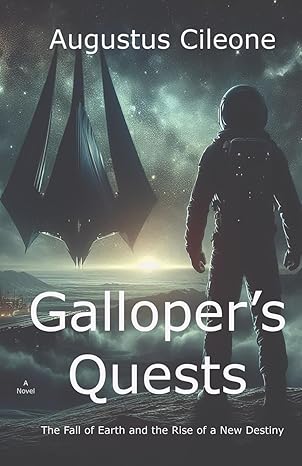

Galloper’s Quests is an ambitious sci-fi adventure that follows Captain Samuel Galloper, a military scientist who dares to defy his superiors in the pursuit of knowledge and freedom. Using his groundbreaking propulsion system, he escapes Earth’s grasp and journeys across the cosmos, encountering strange worlds, authoritarian societies, and existential dilemmas. His story, smuggled to the reader under mysterious circumstances, reads like a personal journal, a mix of raw emotion, philosophical musings, and gripping narrative. From the military’s relentless pursuit of power to the mind-numbing routines of an alien civilization, the novel explores what it means to think freely in a world determined to control you.
Galloper’s inner conflict is as compelling as the dangers he faces. He’s a man torn between duty and conscience, trapped between the structured obedience of military life and the terrifying unknown of free thought. His encounters with Admiral Rutlaw, a hardened military leader obsessed with weaponizing his discoveries, highlight this tension brilliantly. Rutlaw’s interrogation is chilling because it reveals the military’s single-minded goal: control and dominance. Galloper, however, isn’t willing to be a cog in that machine. His escape isn’t just physical; it’s a moral stand, and that’s what makes his journey so captivating.
Then there’s the planet Burc, a place that at first seems promising but quickly reveals itself as another kind of prison. The Burcs live in a rigid, cyclical society where work is endless, thinking is discouraged, and individuality is stifled. Their robotic sentries enforce order, while their Procs, like the conflicted Lask, bear the mental burden of decision-making so others don’t have to. It’s a fascinating concept, one that feels eerily familiar. When Galloper’s carefully constructed picnic table is destroyed by a robot, it’s a perfect metaphor for the futility of creativity in a society that fears change. Burc’s motto, “More work, less thought,” echoes throughout the book, a warning about the dangers of blind obedience.
But Galloper’s Quests isn’t all grim. There’s an undeniable thrill in its interstellar exploration, and Cileone has a knack for making space travel feel both wondrous and dangerous. The HOPS propulsion system, with its ability to fold space and create wormholes, is fascinating, yet terrifying in its unpredictability. The descriptions of travel bodies stretching, consciousness flickering, reality bending are some of the novel’s most immersive moments. When Galloper arrives on a new world, the awe is palpable, reminding us why we dream of the stars in the first place.
Galloper’s Quests is perfect for fans of thought-provoking sci-fi, especially those who enjoy books that question authority, challenge societal norms, and explore the weight of human choices. If you like stories that mix The Forever War’s military critique with 1984’s oppressive regimes and Star Trek’s exploratory wonder, you’ll find a lot to love here. It’s not a light read, it makes you think, it makes you uncomfortable, and at times, it makes you angry. But that’s the point. It’s a journey worth taking, even if the destination isn’t what you expect.
Pages: 235 | ASIN : B0DRTBVDM6

The Well of Souls
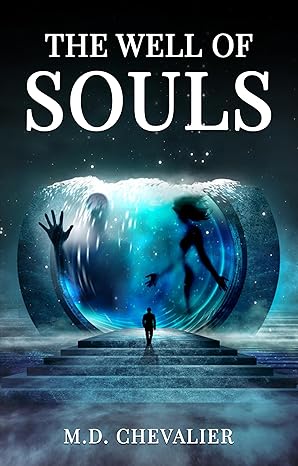
M.D. Chevalier’s The Well of Souls is a high-concept sci-fi novel that deftly balances scientific innovation, ethical dilemmas, and the enduring power of love. At its heart is Mara, an Indian student navigating life in the United States, and Salvatore, the man she falls for and marries in Spain. Their journey takes a transformative turn during a cruise, where Mara, inspired by the sight of the Northern Lights, conceives the idea of harnessing solar winds to develop a groundbreaking renewable energy source. This vision births the GRASP project—a venture as ambitious as it is controversial. GRASP quickly becomes a focal point for both hope and conflict. While Mara and Salvatore champion its potential to revolutionize clean energy, they encounter fierce opposition from forces intent on undermining the project.
The story unfolds as a gripping battle of wills, with the couple facing challenges that test not only their resolve but also the very boundaries of human understanding. As GRASP’s true capabilities emerge, the stakes soar to unimaginable heights, raising questions about its purpose and implications. Chevalier draws readers into this dramatic tale through the rich emotional dynamic between Mara and Salvatore. Their relationship forms the emotional core of the story, anchoring the high-stakes scientific intrigue with genuine human connection. As GRASP begins to reveal phenomena far beyond its original intent, Mara and Salvatore wrestle with ethical dilemmas that force them to reconsider their mission. Their love for each other becomes a guiding force, shaping their decisions as they navigate the murky terrain of discovery and responsibility. This dual focus on science and romance gives the novel depth, transforming it into both an exploration of humanity’s potential and a heartfelt love story.
Chevalier’s prose is clear and accessible, making complex technological and scientific concepts understandable for readers of all backgrounds. The dialogue feels natural and propels the narrative while the tension builds steadily, culminating in a climactic and satisfying resolution. Comparisons to works like Contact are apt, but The Well of Souls stands on its own as a singularly engaging blend of speculative fiction and emotional drama.
For fans of science fiction, this novel offers a compelling mix of innovation, ethical exploration, and human connection. Chevalier delivers a story that resonates on multiple levels, ensuring a rewarding experience for readers drawn to thought-provoking and emotionally charged tales.
Pages: 273 | ASIN : B0DDMVW5TG

Olympus Bound
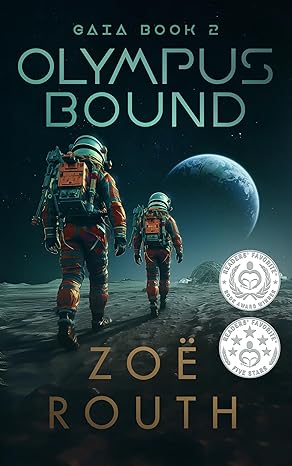
Zoë Routh’s Olympus Bound takes us to the Moon, where humanity wrestles with survival and cooperation in a harsh, unforgiving environment. The story follows Xanthe Waters, the commander of a lunar base built by Gaia Enterprises. She navigates the challenges of constructing a habitable outpost while dealing with political tensions, unexpected meteor storms, and personal struggles. Set against a backdrop of Earth’s looming climate collapse, this science fiction story dives deep into the duality of leadership, teamwork, and human ambition.
What struck me most was how vividly Routh captures the Moon’s stark beauty. The descriptions of its surface or gazing at Earth from the Atrium were breathtaking. The meticulous attention to detail in depicting life on the Moon, from the intricacies of 3D printing habitat walls to the struggle of maintaining atmospheric integrity, grounds the story in reality. It reminded me why I adore dystopian sci-fi. I love the interplay of human resilience and vulnerability. That scene with the meteor storm tearing through the Atrium left me on edge both for the characters’ survival and the symbolic loss of their view of the stars.
I think Routh also excels at character dynamics. Xanthe’s leadership is layered, balancing competence with a relatable sense of doubt. I loved her quiet moments in the Atrium, reflecting on Earth’s decline and her own fragmented past. Her interactions with Troy felt heartfelt without tipping into melodrama. The rivalry with Colonel Jin added tension, highlighting how the Moon’s desolation amplifies human conflicts.
Thematically, the book thrives in its exploration of humanity’s ambition and flaws. The contrast between the Chinese and Gaia bases underlines our tendency to compete, even when cooperation is essential. The subplot involving sabotage and past betrayals on Earth cleverly mirrors the larger stakes on the Moon. However, I occasionally found the pacing uneven. The technical descriptions are immersive but sometimes slow the narrative, particularly during the repair sequences with Athena, the base’s A.I. Still, Athena’s logs sprinkled throughout were a nice touch, offering philosophical insights that deepened the story’s themes.
Olympus Bound is a thoughtful blend of high-stakes and intimate character work. If you’re someone who loves realistic depictions of space exploration peppered with human drama and a touch of existential dread, this dystopian sci-fi book is for you. It’s a compelling reminder of why we look to the stars and why the challenges we face up there often reflect the ones we leave behind on Earth.
Pages: 500 | ASIN : B0CT567B2V
Storm on the Horizon

Vitalerium: Descent into the Void follows a rogue criminal living in the golden age of space exploration who winds up at the center of a conspiracy of a government faction looking to implement a Machiavellian vision of utopia. What was the inspiration for the setup of your story?
The inspiration for Vitalerium – Descent into the Void, though stemming from numerous influences, is first and foremost a result of my life-long love of science fiction. I have always admired the ability of sci-fi writers to extrapolate a vision of the future (and how that vision could go terribly awry) through the lens of their own knowledge and experience. The restorative property of escaping to worlds filled with technological marvels, glorious triumphs in space combat, and endless possibilities of the future is something I cherish. I also find the dystopian elements so commonly captured to be humbling in a way; reminding us that we are still human, and thus prone to err no matter how advanced the world around us becomes. There’s value in identifying potential pitfalls and unexpected difficulties that lay in wait for humanity in the uncharted waters ahead. Although progress is inevitable, we could just as easily progress into a burning building as we could greener pastures. I pull from many authors’ examples that came before me, including some of the greats in classic sci-fi writing, cinema, and video games. I even went so far as to leave small easter eggs within the first book that highlight some of my influences. That part was a lot of fun for me, and I hope the readers will enjoy finding them, too.
Other sources of inspiration came from within. “Write what you know” was a phrase I never fully understood until I started hitting the keyboard at regular intervals. I tend to pull from real-life experiences to craft narratives throughout the book. Vitalerium documents the rediscovery of purpose and the growth of numerous characters throughout their trials and tribulations. Although the stakes are certainly higher in Vitalerium than in my own experiences, the lessons learned are undoubtedly transferable. A number of the major characters in the book are based on people I know or have met that made a lasting imprint. I feel this breathes life and sincerity into their personalities. Even the dream sequences that emerge are altered versions of some of the most vivid dreams I’ve ever had. Sleep paralysis is something I experience on a regular basis. For those of you who understand the feeling associated with the phenomenon, I’m sure you understand how impactful the experience can be. Ultimately, I find that if I’m focusing on the right things, I can find inspiration anywhere, and everywhere.
Current events also provide plenty of fuel for the fire. Today’s world presents no shortage of inspiration for the potential emergence of a dystopian world. All one has to do is turn on the TV or open their preferred news app. To watch the way narratives are portrayed and subsequently spun by both sides of the aisle is like watching two different planets reporting on entirely different stories. The dichotomy of left and right today is portrayed as a vast chasm, where only the extremes are highlighted by each respective camp. The resulting weight of interpreted division is one that we carry into our daily lives, whether we realize it or not. Nuance is a thing lost to the binary world of left or right, right or wrong, win or lose, omitting the infinite shades of gray existing between them. Although this manufactured portrayal of the world is far from reality, where people have more in common than they are told to realize, its effects endure.
In Vitalerium – Descent into the Void, I forecast a world where this vision is carried forward—one where obedience means surviving, and disagreement means suffering (for those who remember their high school English curriculum, this is undoubtedly Orwellian-reminiscent). For when perceived division accelerates and is pitted against itself, and the populations lose all sense of the common ground on which they walk, the only option left is for one side to emerge victorious; and that is when all of society loses.
While it incorporates the ethical dilemmas and cutthroat politics of an advanced civilization, Vitalerium remains non-partisan. The thematic focus is on philosophical exploration, and the often-blurred lines of morality the human condition exposes us to…and yes, it’s got lots of action! So, for those of you who are sick of being preached to in every book, movie, play, or fading sticker you happen to read on a bathroom stall seeking to teach you the error of your personal leanings, don’t worry. It’s my belief that adults can make their own decisions, and I wouldn’t bore you with that horseshit.
I find the world you created in this novel brimming with possibilities. Where did the inspiration for the setting come from, and how did it change as you were writing?
I have always been fascinated with space travel. Although my professional career took me down a different path, I still maintain that childlike curiosity when it comes to new cosmological discoveries, breakthroughs in modern physics, or anything else that falls into the realm of exploring the great void. Perhaps in an attempt to fulfill my own desires to explore the cosmos, I created the element Vitalerium: the gravity-bending catalyst to accomplish such a monumental feat. However, the ability to traverse any space poses an important question: to where, then, do we go? Although the exact number is not known, it is calculated that anywhere between 200 billion and 2 trillion galaxies exist in the observable universe. Zoom in a little closer, and you’ll find there are anywhere between 100 and 400 billion stars in the Milky Way alone—each with their own potential for harboring orbital exoplanets: each with the promise of life in some form. So, why couldn’t we assume that given our current limitations in measuring such things, that a planet similar to our own exists somewhere in the celestial neighborhood (so to speak)?
For planet Deorum, where the majority of the first book takes place, I wanted to create similar conditions to Earth as I began to expound on this fabricated universe: one where a futuristic take on modern life was possible, yet even the smallest differences in conditions could lead to massive disparities in flora, fauna, and the course of evolution on its surface. A planet so close to the source of vitalerium, the book’s strange new addition to the periodic table, is bound to provoke some very interesting wildlife. As the series progresses, I plan to incorporate more planets with even stranger conditions and cultural traditions. Perhaps one planet was optimally positioned but required terraforming to be inhabited, resulting in a strange uniformity of flora, and a subsequently stark uniformity in its society. Conceivably, one planet’s surface could be covered entirely by water, creating a business hub for water and sea life commodities. Maybe I’ll create a planet where tectonic plate activity is much more extreme compared with Earth’s. To find out, you’ll simply have to read on, friends.
Another source of my perpetual curiosity lies in mythology, and the ruins of past civilizations. Understanding the roots of our species and the emergence of civilization fascinates me to no end: an unremitting cascade of inspiration. This was especially helpful in crafting the ruins readers will discover on planet Deorum. In the book, the Coalition’s perceived lack of desire to explore the remnants of this dead civilization mimics our own dearth of answers in regard to our predecessors.
The story has changed drastically since my initial mapping, and its future remains flexible to this day. Although there are major events that I plan for, I base how we get there off the characters, for whom I attempt to give a mind of their own. Currently, I’m about 150 pages into the second book, which promises to be even more exciting than the first. So, for the potential readers out there, I’ll leave you with a friendly forewarning: the first book was created with the entire series in mind, and thus some of the themes in the overarching narrative are left unrequited…for now. There is, however, no need to fret. Each new release in the series promises to provide new characters, new planets, new concepts, and technologies, and yes…closure for narrative cliffhangers, while potentially opening new ones.
What were some themes that were important for you to explore in this book? Will there be a follow-up novel to this story? If so, what aspects of the story will the next book cover?
Descent into the Void, though a gripping tale of its own, is only the beginning of what’s to come. It is a thrilling yet heartbreaking glance into spacefaring civilization in a technologically advanced, dystopian universe. In the first book, the reader is dropped into the story just prior to its tipping point. This starting line serves to shed light on how the immense external pressures of a hybrid authoritarian society form our protagonist, Roman Matthews, as well as other threads in this multinarrative odyssey. The horrific life experiences Roman endures shape the man we follow throughout the majority of the book. Readers will get a front-row view of his bitter evolution from a clean-cut boy with a bright future, to an aimless lost soul whose circumstances have forged a hardened roughneck; and then, his transformation into something else entirely.
Starting from this vantage point also allowed me breadth to illustrate how the Coalition for Prosperity—the government on planet Deorum—operates. Their centralized shift from governing to ruling creates a society where authority is the only currency that carries weight. The result is a stark transition from keeping its people safe, to keeping its citizens in line. When powerful “public servants” begin to serve themselves and their perceived greater causes rather than the populace they no longer feel obligated to, a ripple effect radiates outward from leadership with dire consequences. The resulting conditions create a harsh world where no freedom, or person, is safe. Together, these concepts provide only a glimpse of the storm on the horizon, one of blind ambitions, and a lack of understanding of the larger forces at play.
Although we dive into ethical dilemmas, political factions, and some hard-hitting action, the book also sets the stage for a much greater theme: That in the scope of the universe, humans are but a few atoms of a bacterium on a speck of dust floating through a never-ending black field. Humanity, in all its glory of exploration and colonization, when examined on the grand stage that is our plane of existence is magnificently miniscule, yet important none-the-less to the harmony of order and chaos. The universe, as we will discover, has a narrative of its own that it intends to see to fruition; ever balancing the forces of equilibrium on a scale that our consciousness may not fathom due to the physical limitations of our organic vessels.
Descent into the Void is only the first of seven books I have planned in the Vitalerium series, and that number could be a low estimate. When I first mapped out the universe and started writing, I realized the book I had storyboarded for was far too long to be a single novel. The reality hit me when I was starting chapter 15 on a flight to Boston and noticed the number at the bottom of the page: 229. Most of my writing is done on a plane due to the incessant travel requirements of my job in medical device sales. The majority of the first book was written at 36,000 feet. Whether it was the opportunity to disconnect from the internet and other distractions in life, or the fact that I was just a hair closer to the void of space itself, I’m not entirely sure. Whatever the case, I found it to be the perfect writing office for Vitalerium. Writing this series has been my proverbial construction of an interstellar spacecraft to explore and enjoy that which I can only dream of. It is my only hope that you all board, and enjoy the ride…
Author Links: GoodReads | X (Twitter) | Facebook | Website | Amazon
Nearly six centuries have passed since humanity’s discovery of vitalerium, which ushered in a golden age of space exploration and colonization. Planet Deorum’s society is centered around this illustrious, gravity-bending blue crystal. The year is 2701.
Following a near-fatal disaster, roughneck freelancer Roman Matthews becomes unwittingly trapped at the center of a harrowing conspiracy. Hunted by Deorum’s government, the Coalition for Prosperity, Roman must use his deadly skillset to survive against all odds.
Roman and his band of unlikely allies will discover that the Coalition’s indiscretions threaten the delicate balance of advanced civilization. As a sect of the Coalition prepares to implement their Machiavellian vision of utopia, the proverbial pendulum begins to swing toward chaos…
Blue Anomaly
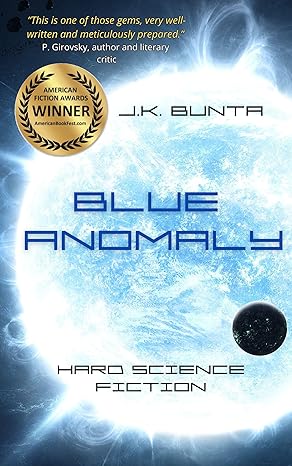
In Blue Anomaly by J.K. Bunta, astrophysicist Dr. Tristan Smolensky embarks on a mission as Earth’s primary representative to investigate signals from a distant star that potentially indicates intelligent life. As he approaches the star, Tristan’s reality begins to fragment, raising questions about whether the star or its signals harbor a more sinister nature or if the journey through space is inducing a hallucinogenic breakdown. The forthcoming answers defy both Tristan’s and the reader’s expectations.
Bunta’s novel falls under the category of hard science fiction, grounded in established scientific theory and existing technology. This genre strives for hyper-realism, with events that can be explained through biophysics, human biochemistry, and similar scientific disciplines. Bunta’s scientific background lends credibility to his storytelling, creating a narrative that is as plausible as it is captivating.
Fans of space madness films like “Moon” or Stanley Kubrick’s “2001: A Space Odyssey” may find familiar themes in “Blue Anomaly.” Despite its scientific foundation, Bunta skillfully weaves in literary elements that are both eerie and emotionally resonant. Tristan’s quest to uncover the source of the star’s signals leads to revelations, but it also opens doors to deeper mysteries. This interplay between scientific plausibility and imaginative storytelling is what defines exceptional science fiction. At its core, this book explores the pressing questions of human nature and existence while venturing into the unknown. The book masterfully balances scientific rigor with imaginative exploration, creating a journey that is intellectually stimulating and thought-provoking. The ending may leave some questions unanswered, but it solidifies the bond between protagonist and reader, ensuring that the journey is memorable.
Blue Anomaly is a compelling blend of scientific authenticity and literary creativity. Bunta’s expertise in science enriches the narrative, while his storytelling transports readers on an unforgettable journey through the cosmos.
Pages: 193 | ASIN : B0D5TM2VHD
The Intrepid: Dawn Of The Interstellar Age
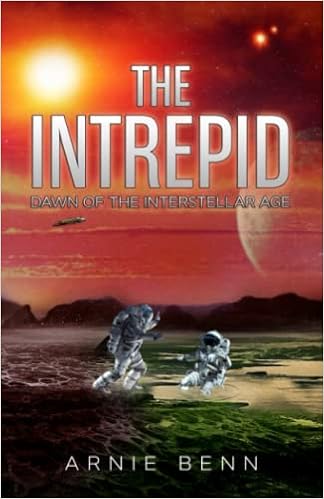
In The Intrepid: Dawn of the Interstellar Age, acclaimed author Arnie Benn masterfully constructs a narrative revolving around a team of astronauts voyaging on a multi-year mission to explore Earth’s closest potentially habitable planet. The plot intensifies as a secondary spacecraft is dispatched to lend a hand, culminating in escalating tensions amongst the crews as they encounter an enigmatic third ship near their intended destination. Upon landing and initiating their reconnaissance, they uncover perils that are not only natural but, to their profound astonishment, man-made, presenting challenges with the potential to unravel decades of peace on Earth.
From the outset, Benn goes to great lengths to emphasize the hard science fiction essence of his novel, as evident in his introductory note and the appendix. He takes pride in ensuring that the technology and scientific principles elucidated in his work have a plausible foundation, even going as far as including a comprehensive glossary of scientific terminology. Essential concepts are smoothly incorporated into dialogues, while additional complex details are artfully presented as optional reading for curious minds.
Benn meticulously devotes considerable time to his characters aboard their ships before catapulting us into the crux of the story. Although this deliberate pace initially might seem unhurried, it serves as an effective tool to foster a deep connection with the characters, ensuring the reader’s vested interest when the main storyline unfurls. The narrative’s pivotal moment, a startling discovery within a shell-like formation at the planet’s North Pole, is flawlessly delivered, validating the slow-burn storytelling method leading up to this point.
The Intrepid: Dawn of the Interstellar Age is a gripping hard science fiction novel that hits home with the plausibility factor. With exciting adventure and a mystery to solve, this story is more than your average space saga; it is a drama-filled look at what the future could hold for humans should we fail to learn from past mistakes.
Pages: 498 | ASIN : B0C1JB518G
Fall of Titan
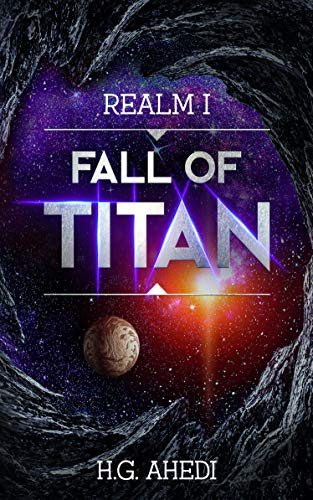

H. G. Ahedi’s novel Fall of Titan is the beginning of a sci-fi epic mostly taking place within range of the perimeter, a shield built by the spacefaring humans near Saturn to protect Earth. Constructed after, a comet named Nemesis impacts Earth and decimates the population.
The perimeter is the location where humanity makes violent first contact with an alien species dubbed the Orias. However, this becomes a much-needed shield when the humans realize the extent and power of the Orias fleet.
The space station Titan watches over the perimeter, and while the command crew faces the political ramifications caused by the appearance of the Orias, Emmeline, a young astrophysicist, strikes out with her friend, Delta, to unlock the secrets of a mysterious plaque handed down through generations in her family.
Author Ahedi immediately thrusts the reader into the action, instantly capturing the reader’s attention. Even though the book starts off with a bang, I felt it was hard to follow all of the characters’ names that the reader is introduced to within the first few pages. However, once past the opening chapter or two, the book’s pace does slow down and becomes a smoother read.
The author has created a compelling plot filled with tension as we follow Emmeline’s quest to unlock the plaque’s mysteries. This quest forms the centerpiece of the novel. The author seamlessly transitions from different character perspectives during the events on Titan station, allowing the reader to understand the emotions and thoughts of each character. Some you will be rooting for, and others not so much. H.G. Ahedi manages to fit a lot into only a few hundred pages, and all of it drives the plot forwards to its culmination in an explosive ending that does leave you wanting to know what happens next.
Fall of Titan is an epic science fiction novel with paranormal fantasy elements that keep readers on edge. This first contact series takes off with a compelling mystery taking the protagonist and readers on an adventure with lots of action as different races battle for dominance in the galaxy.
Pages: 295 | ASIN : B085BPMPWN



 LITERARY TITAN