Blog Archives
Kundu: Prince of Riverton City


Kundu: The Prince of Riverton City is a powerful coming-of-age story set against the brutal, lively backdrop of Riverton City, Jamaica. Courtney Ffrench paints a vivid world where survival is a daily fight and childhood innocence is a fragile, flickering thing. We follow young Kundu, a pale-skinned, purple-eyed boy navigating a garbage-laden, violence-soaked community, all while trying to find his place, his people, and maybe a little hope. From the first scene at Shotta’s Ball, where gunshots and ghost stories blur together to desperate kite-flying sessions by the dump, the story pulls you into the grime, the beauty, and the heartache of a forgotten place.
Ffrench doesn’t sugarcoat a single thing. The author’s writing style is raw, sentences clipped, observations sharp. When Kundu, Lorraine, and Leon sneak past men firing AK-47s into the air, I could feel the gravel digging into my knees. It wasn’t just described; it grabbed me by the collar and shoved me down in the mud with them. That rough, close-to-the-ground style made the world feel dangerous, loud, and alive. The scene where they run from the ghost-like woman in white gave me goosebumps, not because it was supernatural, but because it was too real.
Then there’s Kundu himself. I loved him, and my heart broke for him. His albinism isolates him in a brutal society where being different is dangerous. The way kids casually call him “Ghost” and how even grown-ups view him with suspicion is gutting. There’s a scene later, when Lorraine sings “Hill and Gully Rider” while they search the Sandy Gully for their missing friend, and Kundu just trails behind, silent, it crushed me. Ffrench nails the quiet loneliness of being an outsider without ever turning Kundu into a sob story. He’s stubborn, he’s brave, he’s a kid trying to build a kite out of trash in a world falling apart.
Ffrench weaves in these small, bright stitches of humanity: the fierce loyalty between Kundu, Lorraine, and Leon; Madda Tee’s patient, practical love (especially when she stirs that cornmeal porridge while talking about missing kids like it’s just another part of the day); the slapstick panic of dodging Jomo the mad dog. There’s something magical in how people in Riverton City find ways to laugh, to dance, to live, even with death sitting next door. When Kundu and Lorraine find a dead baby hidden in a freezer, it’s brutal, but the fact that they care says so much about the scraps of decency they’re fighting to keep.
I loved this book. It’s rough and sometimes painful, but it’s also full of fight and beauty. Courtney Ffrench doesn’t waste words or pretend things are prettier than they are. Kundu: Prince of Riverton City would be a great read for anyone who loves coming-of-age stories that don’t flinch, or readers who want to see life through a lens they might never have dared to look through before. It’s perfect for people who aren’t afraid to get a little mud on their shoes and maybe a little blood on their hearts.
Pages: 243 | ASIN : B0DJHGWM6H

My Life’s Ups and Downs

Chronicles of Iron: Thunder Road follows a ten-year-old boy whose father commits suicide, and he is forced to grow up quickly and learn to survive in the 1870s western frontier. What was the inspiration for the setup of your story?
Unfortunately, the setup was my life. My father killed himself when I was young, much younger than Ian but for the book I had to start at a point that would have moved the story forward in a better way. Also, I have always had a fascination with Western period movies and books so this just felt right. I had thought about how I wanted to present this for almost 14 years but I could never put it together right in my mind until recently when I thought I should base it on my own life and present it as I did.
What were the driving ideals behind the character’s development throughout the story?
This puzzle kind of fits itself together through the outline process in a way that shows Ian’s morals being formed before your eyes and making him into a hard character. Someone who is capable of being who he needs to be when he needs to be it. That process was honestly weird the way it worked out. Once I realized I should base it on my life experiences it flowed out of me like a river and it still is. The timing or storyboard if you will really is just flowing out of me right now. All the characters in the book are based on real people throughout my life and for better or for worse the story flows from that. In some of the storytelling it is more metaphorical in nature such as relationships ending with a killing to simulate the severing of the relationship and communications. I was not a good person when I was younger, I knew that the few lucky breaks I’ve had have helped me be a better person; it was an iffy proposition for a portion of my life.
One of the biggest drivers of the character development is my Psychology background, through my life’s ups and downs I was able to pay attention or look back and see the triggers and what really happened to me from a development point of view. To me, the best stories have solid character development.
What were some themes that were important for you to explore in this book?
Well, suicide was for me the biggest one. It is the most influential act that happened in my life that has made me who I am today and who I will be in the future; it is not understated to say it transforms me every day. Alcoholism was another battle I had to overcome in my life, it occupied a large portion of my childhood and adulthood, luckily for me I was able to stop when I met my wife – she has made me a better person. Violence also is a big part of life for some people, it was for me without a doubt. How Ian learns to build relationships also is another theme of building friendships that he has trouble with. It seems to me that when someone has harsh life experiences it is more difficult for them to be around “normal” people, experience is a difficult pill to swallow for some.
Where does the story go in the next book, and where do you see it going in the future?
In the next book which I do not have a name for yet, I have only written about half a chapter so far but Ian is thrust back to the past at some point so you can see what he did in those 5 years alone that were kind of skipped by. You will also get to witness a confrontation with one of Ian’s closest friends who has different ideas about life, and a reunion. In the future, Ian will learn forgiveness and how to seek redemption. Ian will also find love and set his sights on a home but how long will that last?
Author Links: GoodReads | Website | Instagram | Amazon
Fate vs Free Will

The Lost Dragonrider of Lamar follows a mysterious young woman with no memory of who she is or her past, who possesses a glowing pendant that turns out to be the relic at the heart of the ongoing war between dragonriders. What was the inspiration for the setup of your story?
The inspiration for setting up this story first started with a conversation I had with a close friend. We were talking about how a kingdom would look like if the economy was based on having heroes for hire and setting these heroes up with a celebrity status. From there the plot unfurled, I developed characters, added my magic system and it was off to the races.
What were some driving ideals behind your character’s development?
The driving ideas behind the character’s development are predominantly fate vs free will. I also play with self-discovery and try to highlight how Lark’s instinctual moral code drives her into action.
What were some themes that were important for you to explore in this book?
The main theme is good vs evil. That gets mottled up with loyalty and betrayal, power and responsibility, and the interplay of the character’s fate vs free will.
Can you tell us where the book goes, and where we’ll see the characters in the next book?
With the next book, I continue the adventure where I’ve left off at the end of book one. We explore more of Lark’s past, how it plays a role in her future, and the fate of the kingdom. I introduce a new major threat to the world as they know it and dive deeper into wielding magic. There are more dragons, dragonriders, and action that you won’t want to miss.
Author Links: GoodReads | Amazon
When Lamar’s greatest dragonrider falls in battle, the kingdom’s last hope seems lost… Until a woman is found wandering the edge of the Everburning Forest with no memory of who she is, how she got there, or why she carries the very object the dragonriders have been warring over—a Hyalite.
The Hyalite, an artifact containing the power to forge a new dragonrider and tip the scales of the conflict, has been declared stolen by the enemy. Now, with the relic in her possession, Lark—an amnesiac with no clue about her connection to the war—finds herself thrust into the center of a world poised to unravel.
Humans, elves, and dwarves clash with orcs and mythical beasts as Lark uncovers truths too dangerous to ignore. Her fighting skills rival even the most seasoned warriors, but it’s the cryptic visions haunting her dreams that continue to expose her checkered past. As the stolen Hyalite’s power stirs, kingdoms send ruthless assassins to claim it, each step pulling Lark deeper into a destiny she never wanted—and cannot outrun.
The fate of the realms hangs by a thread. Will Lark embrace the storm—or be swept away by it? Start reading The Lost Dragonrider of Lamar today!
High Fantasy

Protectors of the Light Crown centers around a gamer whose life is forever changed when a character from his dreams manifests in real life. What was the inspiration for the setup of your story?
I am operating on the concept that dreams are gateways into alternate realities. Whether or not that is seen as true or false in our human level of understanding doesn’t matter. In my novel, Protectors, Dexter Park initially struggles with the sudden strangeness of his own life after discovering that his dream experiences are indeed real ones, and not just figments of his sleeping imagination. When he accidentally yanks Tickle out of her own reality while asleep one night, it is only the beginning of a very wild ride.
How long did it take you to imagine, draft, and write the world your characters live in?
Using the “plotter” method, I outlined my characters and chapters in a very linear fashion. I’m so dedicated to the bullet-point process that Matt Posner of the School of Fiction podcast told me he’d never seen any other writer take it to such an extreme. I design my characters from their grandparents on down and tailor the story to their personal development. Once I’m sure of who and what I’m dealing with, I come up with general ideas for every chapter. Then, I fine-tune those chapters into detailed pieces and begin writing, starting with Chapter One, until I’m done and ready for rewrites and edits. That process took me ten years of stopping and starting as the rollercoaster of life got in the way. Book 2 won’t take nearly as long.
What do you think were some of the defining moments in Dexter’s development?
This is a story of superheroes in a story sprinkled with high fantasy. And superhero origins usually involved “daddy issues” or their dealing with losing parental figures, etc. Dexter is no different there, and a large part of his story arc involves deep insecurities from physical challenges and having to come to terms with having lost his mom and dad. When he joins The Protectors as a team of super-powered individuals pledged to take down an ancient evil, he’s its least effective member. I dedicated chapters specifically toward Dexter seeing himself in a better light.
What is the next book that you are working on, and when will it be available?
As I said, it took me ten years to write Protectors, but that won’t happen again. If Book Two takes more than five years, I’d be very surprised. I’m shooting for 3 years. I have other books in me, ready to go from paper to screen, but Book Two in this series trilogy is my baby. I’m presently working on that outline.
Author Links: GoodReads | X (Twitter) | Facebook | Website | Amazon
Just hours after meeting, the duo find themselves locked in battle with a giant reptile, living on a spaceship, and joining a fledgling team of heroes pledged to take down a supernatural threat from their ancient past.
The road ahead is fraught with danger and uncertainty, but the new group of unlikely friends know that standing together will give them a fighting chance in an unwinnable war against the demonic Venomous Wretch.
Aspry Jones is an Emmy nominated, live broadcast television veteran. He is currently working on a memoir and the sequel to Protectors of the Light. Crown. He lives in North Carolina and loves chess, dogs, nature, meditation, YouTube, all kinds of music, and is deeply entrenched in esoteric spiritual practices.
Fun-Loving, Intelligent Women

The Sole Sisters follows a retired defense attorney who teams up with a quirky group of women to investigate her husband’s murder. Where did the idea for this novel come from?
For the past 10 years, I have been co-leader of The Villages True Crime Book Club. Our community is sometimes called ‘A drinking community with a golfing problem’. We have over 100 members, 70% of whom are women. Our group of women resembles Noah’s Ark; we have one of everything. I took bits and pieces of the members and developed a group of fun-loving, intelligent women, all interested in solving cold cases. Thus began The Sole Sisters.
While living in Washington, D.C., the Beltway Sniper Murders took place. Eleven died as a result. A female FBI officer was shot and killed at a location I had just left. It was an easy step to have the defense attorney husband of The Sole Sisters leader shot by a mysterious sniper. Once the local law enforcement gave up the investigation, the Sole Sisters became the force driving the investigation. The crime taking place in a fictional upscale retirement community known as ‘The Hamlets’ allowed me to tie into many of the real and imagined goings-on of my own community, The Villages, FL. The Sole Sisters, who firmly believe they do not have to follow all those ‘silly rules’ imposed upon law enforcement, begin to identify small pieces of evidence that continue to grow in size.
Which character in the novel do you feel you relate to more and why?
With this being the first of a series. I had a special relationship with each character as they entered the story. A crazy psychiatrist who did his residency at a fertility clinic (who picked up walking around money by being a sperm donor), and his knockout gorgeous fiancée-attorney, provide many opportunities for me to relate to. Of course, Kate, the group leader, is a strong, dominant character. Her husband was shot, and they are going to identify the shooter, even after local law enforcement had given up all hope.
While I can relate to all of them, I suppose my favorite is Linda, who is introduced as the dark angel of death; she ends up being a guardian angel. Who cannot love a beautiful lingerie model/designer, who owns her own very successful business, and has a side job as a professional hitwoman?
How did the mystery develop for this story? Did you plan it before writing, or did it develop organically?
I’m a planner when it comes to writing; almost everything I do is thought about prior to it happening. Many of the true crime cases our book club was reading at the time involved DNA. That allowed using DNA as key evidence. This allowed me to explore how it could be used and misused. It allowed adversaries of a suspect to wrongfully accuse and prosecute that suspect. Then the surprise ending proves that DNA is not always unique.
What is the next book that you are working on, and when will it be available?
The Sole Sisters celebrate their first case success and begin looking for another. The Sole Sisters Case #2, The Hydra begins with a local high school girl’s disappearance. Her kidnapping leads to a local sex trafficking ring. What began as a local case soon goes national and then international. As usual, the Sole Sisters’ rather unorthodox methods allow them to discover items overlooked by local, national, and international law enforcement. This book is currently available on Amazon.com.
Available on Amazon.com late summer 2025 is the third in a series, The Sole Sisters, Case #3: The Crape Myrtle Murders. When naked female and male bodies are discovered at the entrance of Pelican Country Club, law enforcement is stymied. There is no way they can be identified. Just when the community begins to calm down, another two bodies are found at the Bandstand across from City Hall. No fingerprint matches, no DNA matches, no Missing Persons Reports, it’s almost as if they never existed.
Author Links: GoodReads | Facebook | LinkedIn | Reddit | Amazon
Can’t tell you much more without giving away clues, I know you will enjoy THE SOLE SISTERS..
The Last Defense: The Fight for Epsilon
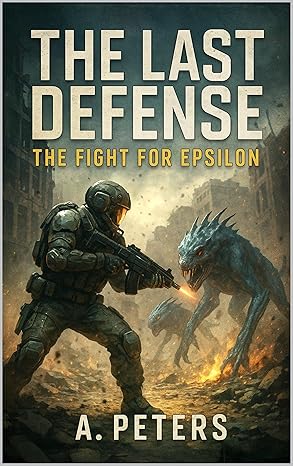

The Last Defense drops us straight into a brutal, crumbling world where Earth’s last hope rests in the hands of worn-out soldiers trying to fend off an overwhelming alien invasion. Major Jonas Cross, our gritty and deeply human lead, fights not just for survival but for family, memory, and something that feels a lot like hope. The story unfolds across the wreckage of Epsilon City, blending desperate last stands, gut-wrenching rescues, and shaky alliances into a tense, high-stakes battle for humanity’s future.
Right from the first chapter, A. Peters pulled me in with raw, vivid imagery. The opening scene where Jonas is crouched behind a slab of concrete, breathing smoke and fear, while Nightfangs hunt the ruins, slammed the urgency into my chest like a hammer. I loved how Peters didn’t waste time with long setups; you’re thrown straight into the fire. When Jonas reflects on his late wife Anna while hiding from monsters, it doesn’t feel forced or preachy. It feels real, like the kind of memory that guts you when you least need it. Peters has a knack for giving action scenes an emotional spine, and that’s a rare trick.
There were moments, though, where the pacing buckled a little under all the world-building. For instance, the section in the starport had so much tactical briefing that it almost felt like I was reading mission notes instead of a novel. I wanted to get back to Jonas, Ethan, and Selina fighting their way through the city ruins. That said, when the story veers into darker territory, like the prisoner experiments Jonas stumbles upon in the factories, it hits like a punch to the throat. That part genuinely made my skin crawl, and that’s a good thing.
What really stuck with me was the relationship between Jonas and Ethan. Their bond isn’t syrupy or melodramatic; it’s stubborn and bruised and heartbreakingly real. When Jonas risks everything to find his captured brother, dragging himself and a whole squad through hell, it made every firefight and every narrow escape count for more. And the moment Jonas finally finds Ethan, broken but alive, was pure gold. Peters writes brotherhood the way it feels: messy, guilt-ridden, and absolutely necessary.
The Last Defense is a grim, relentless ride, but it’s also filled with tiny flickers of hope that feel all the more precious because they’re so hard-won. I’d recommend it to anyone who loves gritty sci-fi war stories that don’t skimp on heart. Readers who appreciate the intense, character-driven science fiction of The Expanse or Halo: Fall of Reach will find much to admire here. Prepare for a gripping experience that demands both attention and emotional investment until the very last page.
Pages: 169 | ASIN : B0DY386H36
Daughter of Starlight
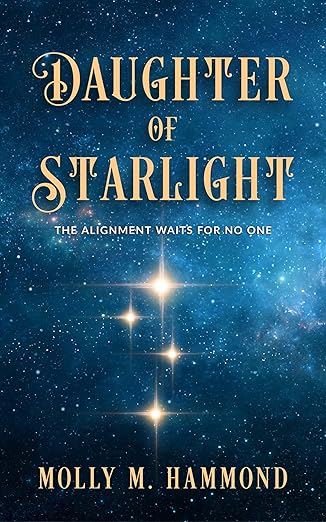
Daughter of Starlight follows Luma, a fierce, guarded young woman aging out of foster care, who stumbles across a hidden cave in the Colorado mountains and ends up transported to the magical world of Edira. There, she learns she’s no ordinary girl; she’s the one marked by the stars, the key to healing the ancient Sacred Stones and stopping a dark tide of invading wizards. With a mix of gritty real-world struggles and rich fantasy adventure, Molly M. Hammond spins a story that feels both deeply personal and sweepingly epic.
Hammond’s writing made a profound impact on me from the very first chapter. She sets up Luma’s pain, the blood on her knuckles, the loneliness, the worn kindness of her social worker Frank, with such realness that I was immediately hooked. That opening scene, where Luma picks at the scars on her palms while waiting to be lectured, felt so heartbreakingly tangible. Hammond doesn’t waste words but paints her world with quick, sharp brushstrokes that sink in deep. Even later, when Luma first hears her name whispered in the mountains during the storm, I could feel the same eerie pull she did. It’s hard to find YA fantasy that captures both grounded reality and wonder so seamlessly, but this book pulls it off.
While the middle of the book took a slightly more deliberate pace, I appreciated the deeper look into Luma’s early interactions with Corr, the gruff yet oddly endearing elf guide. Their spirited exchanges added texture to their relationship and highlighted Hammond’s talent for character dynamics. Moments like Luma’s stumbles and Corr’s teasing remarks provided a playful contrast to the story’s more intense scenes. And when the raptera attack burst onto the page, chaotic, brutal, and utterly thrilling, the story’s momentum surged, and I found myself completely engrossed once again. Hammond’s prose truly shines during these breathtaking moments of magic and mystery.
The themes explored in the novel, particularly those concerning destiny, loneliness, and belonging, resonated with me more deeply than I had anticipated. Luma’s reluctance to embrace the role of a hero and her belief that she is not inherently special felt especially poignant, reflecting sentiments with which I could personally identify.That deep reluctance, that aching disbelief in her own worth, felt incredibly real. When she finally unleashes her starlight powers to save Corr from the monstrous bird (and then immediately pukes afterward, because of course she would), I found myself grinning like an idiot. Hammond doesn’t write magic as something clean or effortless; it’s messy, painful, and exhausting. That choice made Luma’s journey feel earned instead of just fated.
I came away from Daughter of Starlight deeply moved by its heart and emotional resonance. It is a beautifully crafted fantasy that offers real emotional depth, a stubborn and relatable heroine, and a story that intertwines everyday struggles with dazzling magic. It is the kind of book that keeps you reading late into the night and leaves you sitting quietly afterward, feeling both a little wrung out and a little more hopeful as you linger over the final page.
Pages: 289 | ASIN : B0DHWBV71Q
Isolation vs. Connection
The Wake of Expectations is a raw, poetic unraveling of self in a world where dreams, disillusionment, and the pressure to perform collide. What was the inspiration for the setup of your story?
I’m totally Gen X and that rawness of self-expression—that disillusionment, too—that’s a function of my generation, a by-product of our obsession with authenticity. We were probably the first generation told we could be anything we wanted to be, but we were largely left to figure things out on our own. That contradiction creates an inevitable gap between expectation and reality.
On a more personal level, I’m a huge Kevin Smith fan. I remember him talking about not seeing his friends or his world represented on film, so he decided to make it himself. And that was mostly the impetus for writing this book: a desire to see our version of reality represented somewhere—to create something of artistic permanence to stake our claim that we were here, too. Honestly, I would rather have made a movie or a TV series, but writing a book was just more practical.
Are there any emotions or memories from your own life that you put into your character’s life?
Pretty much everything in my main character’s life is rooted in emotions or memories from my own. The story is fiction, but it’s emotionally true. Like Calvin, I wanted to be a musician. I had a girlfriend who dumped me when she went away to college. I had differences with my parents. But more than anything, I wanted to capture the longing, the frustration, the impatience—the alienation in that process of becoming. That feeling of champing at the bit, staring at a world of possibility, but being unable to get out of the starting blocks. It’s personal, but it’s also generational. Ironically, I never really felt part of my cohort, but that’s exactly what made me representative of it. I tried to capture that paradox in the book.
What were some themes that were important for you to explore in this book?
I wanted to ask questions more than present answers: What do you do when your dreams come true but don’t live up to the hype? Is it wrong to want something you can’t have? Is it sometimes better not to get what you want? And how do you become the person you’re meant to be when you don’t even know who that is yet?
A recurring theme is the desire to be fully seen—but never quite achieving it, even among people who clearly love you. That’s a major part of Calvin’s disillusionment. At his core, he’s searching for connection on his terms, not anyone else’s—and that proves elusive. He’s caught in this constant push-pull: authenticity with isolation vs. connection with compromise. And again, I think that tension is a very Gen X dilemma.
What is the next book that you are working on, and when can your fans expect it to be out?
The next book is A Pleasant Fiction: A Novelistic Memoir, and it releases on July 1—just a month after Wake (June 3). It follows the same group of characters 25 years later, and the proximity in release dates is no accident. A Pleasant Fiction is a follow-up, but not exactly a sequel. It’s a very different book—slower, more meditative—and it reframes everything in the first book. Wake is a complete work on its own, but A Pleasant Fiction is essential reading if you want to fully understand it.
I actually wrote the first draft of Wake over 20 years ago. So that book carries the reflections of a 30-year-old looking back on his twenties. The next one captures a 50-year-old grappling with the challenges of middle age. Together, they form a diptych—a two-panel meditation on the passage of time, told authentically from opposite ends of the timeline. It’s more of a dialogue than a sequence, tracing the coming-of-age through the unbecoming of middle age.
Author Links: GoodReads | X (Twitter) | Facebook | Website | Amazon
He’s just been accepted into his dream college, and his parents have won the lottery. But instead of celebrating, he finds himself drifting further from the people he loves and the future he imagined.
Set in a time before smartphones, when connection meant looking across the table instead of into a screen, The Wake of Expectations is a funny, heartfelt, and deeply human exploration of dreams deferred and dreams derailed, the courage to choose your own path, and the transformative power of love, friendship and self-discovery.
A raunchy, Gen X coming-of-age story brimming with 1990s nostalgia, The Wake of Expectations follows Calvin on an unflinching, deeply immersive journey that blends edgy humor with serious introspection, offering a biting look at the messiness of growing up. Through Calvin’s sharp, often self-deprecating lens, the novel presents a cast of richly drawn, complex characters and relationships worthy of deep literary analysis.
Mature themes and adult humor are woven throughout, so reader discretion is advised.



 LITERARY TITAN