Blog Archives
When Your Partner Dies: Moving Forward and Finding Love and Happiness Again


Millard Hiner’s When Your Partner Dies is part memoir, part guidebook, and part gentle pep talk for anyone who has lost a spouse. Drawing from his own experience after the death of his wife Sharon, Hiner walks the reader through the raw early days of loss, the unpredictable stages of grief, and the tangle of emotional, social, and financial changes that follow. The book blends heartfelt personal stories with practical checklists, self-assessments, and ideas for honoring a partner’s memory, before gradually turning to the delicate subjects of moving on, dating again, and even blending new families. His message is clear: grief is unique to each person, but with time, care, and honesty, life can hold joy again.
I found the writing deeply personal and refreshingly unpretentious. Hiner doesn’t hide from the messy truths of widowhood, like how anger, guilt, and even relief can mix together in ways that feel wrong but aren’t. The prose is simple and warm, and the anecdotes carry a weight that advice alone never could. At times, the practical sections, especially the financial checklists, feel almost jarring next to the raw emotional passages, but in a way, that contrast mirrors the reality of loss: you’re mourning one moment and calling the insurance company the next. His ability to offer comfort without slipping into cliché struck me as one of the book’s greatest strengths.
While some themes, such as allowing yourself to feel or seeking support, are revisited, this repetition can serve as gentle reinforcement for readers who may need to hear those ideas more than once. I also found myself wishing for a bit more exploration of the emotional complexity involved in finding love again, as it’s such a delicate and layered subject. Even so, his warmth, kindness, and faith in second chances come through clearly, and the sincerity behind his words is never in question.
I felt as if I’d been guided by a friend who’d walked the path before me, pointing out both the potholes and the places where wildflowers still grow. When Your Partner Dies is for anyone supporting a grieving friend, or even for those years past a loss but still carrying the ache. It would especially resonate with people who need both the heart-level reassurance that they aren’t alone and the practical road map to manage the chaos that follows a partner’s death.
Pages: 140 | ASIN : B0CWMDKVQS

Longevity for the Lazy
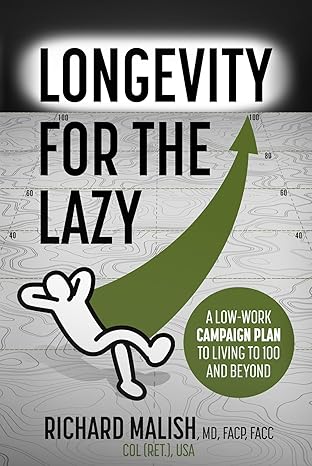
Longevity for the Lazy is a clever, practical, and surprisingly compassionate guide to extending your life without overhauling your entire existence. Dr. Richard Malish, a military physician turned longevity strategist, uses his deep knowledge of public health, cardiology, and human nature to offer a framework he calls the “Longevity Mental Model.” Rather than pitching another trendy diet or rigid routine, the book helps readers understand the major causes of early death, namely atherosclerosis and cancer, and how to fight them with minimal effort. It blends scientific research, history, and strategy into a mental map for living longer, even for those of us who’d rather do the bare minimum.
What I like most about this book is its voice. It’s equal parts seasoned doctor and war-hardened realist, but with an unexpected sense of humor and humility. Dr. Malish writes like someone who’s seen behind the curtain and is now giving you the straight truth without fluff. He acknowledges up front that most people are lazy, and rather than judging it, he embraces it. The book is packed with practical advice, yet it’s never preachy. The core message, kill your killers early and often, lands hard, but he delivers it with enough compassion and realism that I didn’t feel overwhelmed. I appreciated that he doesn’t idealize superhuman health habits. Instead, he arms the reader with simple strategies that don’t require daily marathons or going vegan overnight.
At times, I found myself surprised by how motivating the book was, especially considering its “lazy” theme. It made me feel less guilty for being myself. The military metaphors, enemies, campaigns, and offensive weapons worked better than I expected. They added urgency without melodrama. The science is solid but never dense, and the recurring “Take-Home Messages” made the lessons stick. That said, if you’re looking for glossy photos, flashy life hacks, or someone to tell you aging is optional, this isn’t the book. It’s grounded in reality, and that’s what makes it powerful. It respects your time and your intelligence.
If you’ve ever felt overwhelmed by wellness advice, or if you know what you should be doing but never seem to get around to it, this book is for you. It’s also a great fit for skeptics, minimalists, and anyone who wants to understand the science of longevity without feeling shamed into perfection. Longevity for the Lazy won’t guilt you into green smoothies and CrossFit. Instead, it’ll make you think smarter, act sooner, and want to live better.
Pages: 203 | ASIN : B0DGDBFZ94
THE MINDSET OF AN OUTLIER
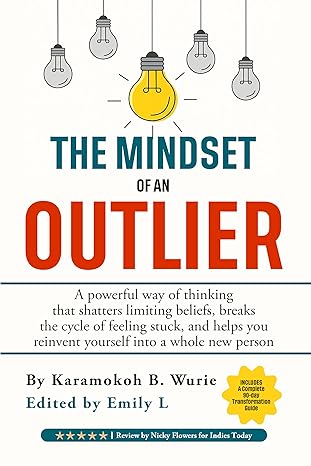

The Mindset of an Outlier is an intense and personal guide to inner transformation. In it, Karamokoh B. Wurie blends spiritual reflection, personal struggle, and motivational fire to offer a roadmap for reinventing your life. The book moves from philosophical musings about reality and consciousness to brutally honest advice on how to confront addiction, self-doubt, and trauma. Wurie argues that life is an illusion shaped by your thoughts, and that by shifting your mindset, you can shift your entire existence. Part spiritual manual, part no-nonsense coaching, it’s written in a voice that feels both raw and uplifting.
I was drawn to the book’s bold, no-filter tone. Wurie talks about suicidal thoughts, toxic leadership, childhood pain, and the feeling of being spiritually lost, but does so with purpose. His voice is fierce but warm. He challenges you without patronizing. Some parts felt like a sermon, others like a late-night heart-to-heart. What I appreciated most is how he fused spiritual language with everyday pain, making big ideas like “consciousness” or “parallel realities” feel accessible. His core message is about reclaiming your life from the inside out, and that’s something that resonates, regardless of belief system.
At times, some ideas were revisited, and a few concepts could have been clearer with more structure or explanation. I also found myself occasionally wanting a few more real-life examples or outside perspectives to help ground the insights being shared. But then again, this book isn’t about data or citations, it’s a battle cry from someone who’s clearly lived through a lot and wants to help others do the same. Wurie’s emotional honesty makes up for any lack of polish. His rawness is his strength.
The Mindset of an Outlier is for anyone who’s tired of being stuck, who’s questioning the story they’ve been telling themselves, or who simply needs someone to say, “You’re not broken. You’re just not done yet.” This isn’t a book for skeptics or cynics looking for clean formulas, it’s for the searchers, the strugglers, and the spiritually hungry.
Pages: 134 | ASIN : B0FJL6WYCJ
Introduction to Offshore Wind Industry

Paul Gorman’s Introduction to Offshore Wind Industry is a comprehensive and practical guide to the nuts and bolts of offshore wind energy development. It covers everything from foundation types, turbine components, cable installations, and vessel logistics to floating wind technology and maintenance. With a step-by-step, almost manual-like approach, alongside photos, Gorman walks the reader through the industry’s terminology, technical processes, and evolving technologies. The book contains a lot of pictures, diagrams, and real-world examples, clearly aimed at readers entering or working within the sector.
Reading this book felt like being given a private tour by a seasoned field engineer who’s seen it all. There’s a rugged, no-frills honesty to the writing that I appreciated. The explanations are straightforward and unpolished, which makes them easy to follow even when the subject matter gets complex. What stood out most to me was how grounded and realistic the content is—Gorman doesn’t sugarcoat the risks, delays, or technical issues that come with offshore wind. It feels like it was written by someone who actually installs turbines, not someone just writing about them.
The book is loaded with facts, and sometimes reads more like a training manual than a narrative. For what it is—a ground-level, nuts-and-bolts overview—it’s hard to beat. It serves a specific purpose very well: educating and preparing workers and professionals for the gritty, hands-on reality of the offshore wind sector.
If you’re brand new to offshore wind or switching over from oil and gas, this book is gold. It’s perfect for technicians, project managers, logistics planners, or anyone who’s found themselves asking, “Wait, how does this actually work?” This book’s not here to preach, it’s here to get the job done. And for that, I’d say it nails it.
Pages: 71
The Seven Tensions of Negotiation

Cash Nickerson’s The Seven Tensions of Negotiation is part philosophy, part practical guide, and part martial arts metaphor, all wrapped in a sharp, seasoned perspective on what it really means to negotiate well. The book introduces seven types of internal tensions; Relationship, Process, Power/Leverage, Timing, Outcome, Team, and Agent and explores how recognizing and managing them leads to more successful negotiations. But it’s not just a list of frameworks. Nickerson challenges a lot of popular thinking, especially the “kumbaya” collaboration-first school of negotiation, and replaces it with something grittier, more human, and ultimately, more honest.
What I loved most was how Nickerson throws the “Getting to Yes” idealism under the bus but in a thoughtful, experienced way. He’s not out to destroy collaborative negotiation; he just believes it’s incomplete. In Chapter 1, he sets the tone by describing a simple Snickers bar dilemma between two people, breaking it down into seven distinct internal tensions. That simple story cracked open a whole world of complexity in negotiation that most books gloss over. He doesn’t shy away from discomfort. Instead, he leans into it and that, to me, is the book’s biggest strength. Nickerson makes tension not something to avoid, but something to wield like a tool. It made me reframe every “tense” meeting I’ve had not as failure, but as potential I didn’t know how to handle yet.
Nickerson’s writing style is straightforward, sometimes sharp, but never stuffy. He brings in stories from martial arts, law, business, and even politics. The analogy he draws between Brazilian Jiu Jitsu and negotiation and how you can’t feel the other person unless you’re relaxed stuck with me. That moment early in the book when he talks about his UFC coach friend losing all his fighters because they abandoned training under pressure, landed. It’s not just a clever metaphor. It’s a warning: you can train all day, but if you don’t understand your own internal tension, you’ll fall apart the moment it counts. And that’s true for boardrooms as much as octagons.
He also doesn’t let the reader off easy with one-size-fits-all advice. Instead, he digs into the mess of real-life scenarios. For instance, he shares a negotiation from a condo board dispute where he uses strategic team rotation and room-switching to shift power dynamics. It’s clever, and more importantly, it’s real. He’s not theorizing here; he’s been in the trenches. His skepticism of overly academic models like principled negotiation makes sense when you realize he’s walked both paths: corporate law and academia. That blend gives him the authority to say, “Sure, win-win sounds nice, but here’s how things actually go down.”
If there’s a weakness, it’s that sometimes the martial arts comparisons go a little deep. I personally liked them, but if you’re not into that world, you might find yourself glossing over the Systema or BJJ talk. That said, even those tangents swing back around with a purpose, and his core message never wavers. Tension is not the enemy. It’s the energy of negotiation itself.
In the end, this book made me rethink not just how I negotiate but how I react under pressure in any high-stakes situation. I’d recommend it to anyone who negotiates as part of their job lawyers, execs, entrepreneurs, and HR folks, as well as to people who want to understand their own reactions under pressure. If you’ve ever walked out of a negotiation thinking “I wish I had said…” or “Why did I freeze up?,” this book will help you answer those questions and do better next time.
Pages: 240 | ASIN : B0DMV1QY1M
An Act of Love and Healing
A Legacy of Love teaches readers how to create a “Person-Centered Plan” (PCP), a living, breathing document that honors the uniqueness of their loved one and their individual needs.
What was the hardest thing to write about?
The hardest part of writing this book was sharing my personal story. Opening up about my own journey as a caregiver was both emotional and vulnerable, but I knew it was important. I wanted to offer an honest and heartfelt reflection, so others walking a similar path would feel seen, understood, and less alone.
What were some ideas that were important for you to share in this book?
One of the most important messages I wanted to convey is that, as caregivers, we have an essential role in being a positive voice for our loved ones. Our advocacy, love, and dedication can profoundly shape their experiences and well-being. I also wanted to emphasize the importance of approaching caregiving with intention, presence, and deep respect for the unique person we are supporting.
What do you hope is one thing readers take away from your book?
I hope readers walk away with the understanding that creating a Person-Centered Plan (PCP) is not just about organizing care—it’s an act of love and healing. Taking the time to truly see and honor the individual beyond the caregiving role allows for a deeper, more meaningful connection. Sometimes, we become so immersed in the responsibilities of caring that we forget to pause and appreciate the beautiful soul right in front of us. My hope is that this book helps caregivers shift from simply managing care to truly cherishing the person they are supporting.
Designing a meaningful care plan for your loved one with unique needs can be a life-changing gift—one that shapes their entire lifespan and journey. Whether you’re caring for a teen, a child, or an aging family member, this book shows you how to create a Person-Centered Plan (PCP) that caters to their individual strengths and preferences, enhancing their quality of life and making caregiving more fulfilling.
In this book, you’ll discover:Real-life stories of caregivers who transformed their approach with a personalized care plan.
Ways to recognize your loved one’s unique qualities to ensure their care is meaningful and effective.
Step-by-step strategies to build and adapt a care plan that evolves with your loved one’s needs.
Emotional insights through poems and reflections on the caregiving journey.
Practical advice to help you implement and follow through with your care plan.
You may be asking, “Can a plan really make a difference?” The answer is yes. A thoughtfully crafted Person-Centered Plan (PCP) is not just a tool—it’s a powerful way to offer care and compassion that truly honors your loved one’s unique journey. This book helps you become the guide your loved one needs, making their care not only more effective but also more meaningful. You take on the role of their voice in cases where speech may not be present.
Don’t wait for things to improve—take control of the caregiving journey today. Transform how you care, connect, and create a lasting impact on your loved one’s life.
Preserving Internet History and Culture

Framed is part confessional, part manifesto, and part digital history lesson, giving readers an unflinching look at the dark underbelly of social media from the eyes of someone who didn’t just observe the chaos but actively fueled it. Why was this an important book for you to write?
I was annoyed by how shallow social media punditry had become. As a prolific reader, I enjoyed most of the “Big Tech” books but was surprised to find that none of them had been written from the engineer’s perspective. Further, there was indication that some of them had been “dumbed down.”
In playing the software engineer and “bad guy,” I wasn’t looking for penance. Rather, I was interested in preserving internet history and culture. Writing this book came at a massive opportunity cost that I could never possibly recoup in book sales. My hope is that this book can entertain readers, drive policy discussions, and perhaps be one day seen as an important reference work.
I appreciated the candid nature with which you told your story. What was the hardest thing for you to write about?
In terms of writer’s block or “getting it right,” the Myspace chapter was the hardest. In 2022, it was nothing more than an add-on and I was trying to secure interviews and source material from people I attended middle school with. By late 2023, I was restructuring the book around Myspace being the genesis. I’ve cut thousands of words and several notable tangents from that chapter, and I could spend another two years trying to perfect it.
In terms of emotional difficulty, it was hard to reconcile that my ventures, though “successful,” paled in comparison to other operators which earned millions of dollars more than my team did.
It was also tough to face the reality that, after years of effort, I produced this cool book, but how many other “cool books” haven’t been started because we’re so distracted by cell phones? “Screengrabbing,” originally, would have been almost one hundred pages in print. It was really hard to find the right way to address this problem.
What were some ideas that were important for you to share in this book?
- The evolution of “Myspace whoring” to digital marketing automation
- Big Tech’s reversal of course on “open” APIs
- The wide spectrum of “black hat” and “white hat” in user behavior and business decisions
- Instagram growth’s reliable ~10% rate of reciprocity, established by research and aligned with my experience
- An updated take on the dead internet theory
What is one thing that you hope readers take away from Framed?
The Internet Age has brought immense opportunity but also has ushered in social and ethical decay.
Author Links: Goodreads | Website | Newsletter | Amazon
A rogue software engineer built bots that ran rampant across social media, helping clients gain millions of followers. His reputation as a rule-breaker landed him at a startup where he designed the controversial systems—news feeds and push notifications—that keep users addicted.
Framed pushes opinions on influencers, algorithms, filter bubbles, botnets, screen addiction, spam, shadowbans, black hat marketing, deplatforming, the “dead internet” theory, and why people are still buying fake followers.
And–getting banned. Read Framed while you still can.
A Legacy of Love for Caregivers

This book is more than just a guide; it’s a heartfelt letter to every caregiver who’s ever felt overwhelmed, alone, or unsure of what to do next. Jacquie Wilkinson’s A Legacy of Love lays out a gentle but firm framework for creating a “Person-Centered Plan” (PCP), a living, breathing document that honors the uniqueness of your loved one, whether they’re a child with special needs, a teenager in crisis, or an elderly parent. Through stories, templates, poems, and deeply personal reflections, the book makes its case: caring should be intentional, compassionate, and led by love.
What struck me first and stayed with me was how Jacquie’s voice comes through like a trusted friend. She doesn’t lecture. She tells stories. In Chapter 3, when she compares parenting a child with autism to landing in Alaska instead of your dream beach resort, I laughed out loud and then immediately teared up. That metaphor? It nails the feeling of being blindsided. And instead of sugarcoating, she says: yes, this isn’t what you planned, but it can still be beautiful. That balance of honesty and hope is rare. It kept me turning the pages.
There’s something powerful about the way she blends practical advice with raw emotion. She walks readers step-by-step through how to create a PCP, but she sandwiches it between stories of real parents like Sarah, who transformed her son Jack’s school experience with a few thoughtful changes. That part hit me. I’ve sat in those meetings, watched teachers misunderstand, and felt like I had no voice. Seeing how one well-made plan gave Jack peace? That was the kind of hope I didn’t know I needed.
And then there’s the poetry. I didn’t expect to cry reading a poem called “I Am the Mother of an Addict.” Because it’s not just about caregiving, it’s about grief, guilt, and that deep, aching love you feel even when things fall apart. The poems don’t feel tacked on, they feel earned. They remind us that caregiving isn’t just a checklist. It’s emotional labor, and it deserves to be seen.
This book isn’t for someone looking for cold, clinical advice. It’s for people who lead with their heart and want to feel less alone in the chaos. If you’re a parent, sibling, or adult child trying to care for someone you love and you feel like you’re constantly swimming upstream, read this. Let it ground you. Let it guide you. Honestly, even if you’re not a caregiver right now, there’s wisdom in here about empathy, patience, and what it really means to see someone. I’d hand this to anyone who wants to love better.
Pages: 45 | ASIN : B0DWXT3MP3



 LITERARY TITAN