Blog Archives
No Superheroes, Just Ordinary People

The Vulnerable follows a renowned climate activist who moves to Florida after being targeted by extremist groups, and his dreams of a quiet life are destroyed when his family faces one crisis after another. What inspired the setup of your story?
Great opening question. First, it was important for readers to know that Dick DeCosta was determined to do his part to protect the environment but not at the cost of jeopardizing the safety and welfare of his family. Next, I intentionally thrust the flawed characters into vulnerable and suspenseful situations, dealing with crimes, betrayal, family wounds, and secrets, against a backdrop of worldwide crises.
Unlike most thrillers, there are no macho superheroes or hideous villains; just ordinary people and their families confronted with emotionally crushing setbacks, leaving them vulnerable. How each one reacts to their situation is why there are multiple storylines and the latitude to touch on many social issues, including the existential crisis of our time, climate change.
My objective was to develop relatable characters that readers could sympathize with and keep reading to learn about their outcomes, while exploring social issues without belaboring them. I’m pleased that the Literary Titan and other editorial praise consistently echoed that, as did the following Amazon reader’s summation. “Customers find this book to be a compelling read with complex characters. They appreciate the storytelling, with one customer noting how it weaves family drama with broader societal issues.”
What are some things that you find interesting about the human condition that you think make for great fiction?
Capitalizing on the gamut of human emotions, introspection, or philosophical perspectives is essential to producing entertaining fiction and creative nonfiction. We’re human, not infallible. We make mistakes, we have regrets, and most of us learn from them or make more bad choices.
I’ve discovered that creating interesting stories with relatable people will evoke emotions and inner thoughts about your characters, so you can trust where they will grow and lead you next. Intricate plotting and foreshadowing are necessary and fun, too, but you have to feel for your characters or your readers will be disenchanted quickly. It may be old school and requires substantially longer stories, but I prefer writing from an omniscient third-person point of view over the typical first-person drama. I want the readers to know and feel what the characters are going through, but not know what lies around the bend.
What were some themes that were important for you to explore in this book?
As noted by your Literary Titan’s book reviewer, I did not shy away from tough topics: domestic abuse, opioids, political extremism, and corporate corruption. But I focused more on the vulnerable characters who endured: betrayal, loneliness, love, loss, grieving, and family loyalty. It was also essential to recognize the health issues that seniors often face, and how the vulnerable were affected by the pandemic, and how everyone is affected by climate change.
What is the next book that you’re working on and when can your fans expect it out?
I’ve been compiling a short story collection for a memoir, Simpler Times in The Spindle City. It’s set in my hometown during the sixties and early seventies, which ranges from the wonder years to the Vietnam War and the counter-culture. I planned to publish it by the end of the year, but book signings, tours, and marketing commitments for The Vulnerable may delay that and the start of a follow-up thriller.
Author Links: GoodReads | Facebook | Website | Trailer | LinedIn | X | Bluesky
In a world teetering on the brink, where climate change fuels devastating wildfires and a pandemic erupts, The Vulnerable plunges into the heart of interconnected lives, revealing a tapestry of crime, secrets, and suspense.
Dan DeCosta’s life implodes after he falls for Robin O’Rourke, the fiery redhead stalked by her violent ex, thrusting Dan into a terrifying ordeal with the law, financial ruin, and fighting for his life. Dan’s father, Dick DeCosta, a renowned climate activist targeted by extremist groups, had relocated to Florida to escape their wrath. But Dick is forced to return to Boston, embarking on a frantic race against time to rescue his son and find Robin. Meanwhile Dick’s wife becomes ill, and his daughter flees wildfires. Long-held family secrets threaten to erupt, testing the limits of loyalty and love.
The Vulnerable explores themes of love, loss, and betrayal against a backdrop of escalating worldwide crisis. From the blizzards of Massachusetts and the burning California landscapes to the sun-drenched shores of Florida, a relentless pursuit of justice and survival unfolds.
Will these vulnerable souls find strength in each other and withstand the perils thrust upon them? The answers lie within the pages of this gripping and unforgettable thriller.”
Hatfield 1677
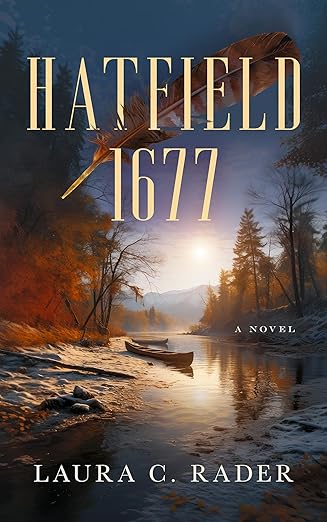

Hatfield 1677 is a vivid historical novel rooted in the real-life events of King Philip’s War. The story centers on Ben and Martha Waite, a Puritan couple whose lives are ripped apart by conflict between English settlers and Native tribes in colonial Massachusetts. When Martha and her children are captured by Native warriors, Ben sets out on a perilous mission to bring them home. Through alternating perspectives, including that of a Nipmuc sachem, the novel explores survival, love, loss, and the brutal toll of war.
From the first chapter, where Ben says goodbye to his wife and children before riding off to war, the writing has this warm, steady heartbeat. It’s historical fiction, but it never feels dry or overly formal. Rader’s prose strikes a compelling balance between lyrical and grounded. She captures intimate, sensory moments with remarkable clarity, Martha rinsing her hair in lavender water, Ben riding through the ruins of Deerfield, the tense stillness before a storm. The detail is immersive without becoming excessive. Even in the opening chapter, as Ben says a quiet, emotional goodbye to his daughters, the writing evokes a tenderness and fear that is both deeply human and hauntingly real.
What really struck me, though, was the moral weight Rader builds into the action. She doesn’t sugarcoat anything. The chapter on the Falls Fight was gutting. When Ben storms a Native camp and ends up sparing a young mother and child, it’s not some triumphant moment; it’s raw and messy. He throws up afterward. His pistol shakes in his hand. He can’t even speak about it when he gets home. It’s that emotional honesty that makes the violence and grief in this book hit so hard. And then you get Ashpelon’s chapter, a Native leader telling a parable about greedy squirrels, and suddenly, the whole war feels even more tragic. It’s layered and thoughtful without being preachy.
One thing I didn’t expect and ended up loving was Martha’s voice. She’s not just “the wife back home.” She’s smart, she’s tough, and she’s trying to survive just like everyone else. Her scene with Hannah, when they talk about love, abuse, and the impossible choices women face, felt painfully modern. There’s one line, when Martha’s holding her daughter and watching her husband ride off, where she says, “Your fair beard will need a trim when you return.” That crushed me. Because it’s not really about his beard, it’s hope, and fear, and trying not to fall apart.
Hatfield 1677 is a love story wrapped in a war story, with sharp writing and real emotional stakes. If you’re into historical fiction with heart and teeth or if you just want a book that’ll leave you thinking about it long after the last page, this one’s for you. Fans of Cold Mountain, The Last of the Mohicans, or even Outlander (minus the time travel) would feel right at home. I highly recommend this book to readers who like stories that are as much about people as they are about history.
Pages: 410 | ASIN : B0CW18FWXS

Learning Something New

Thomas Edison and the Magi Solution follows Thomas Edison’s former assistant as he finds himself on a journey to investigate allegations that Hitler has made a deal with the devil. What was the inspiration that created the fantastic journey these characters go on?
The inspiration for ‘Magi Solution’ was a piece of history I’d never known before. In the spring of 1941, Deputy Fuhrer Rudolf Hess stole a plane from the Augsburg-Haunstetten airfield and took off on a wildly improbable mission to Scotland to broker a peace between Germany and the Allies. He failed, Churchill and Hitler both deemed him insane and he was confined to the Tower of London. But was he insane? What if he possessed a secret of Hitler’s that no one has dared to imagine? And what if Hess went on to vow that only three men were worthy of this dark knowledge: Edison (who’s been dead for years), Roosevelt, who’s alive but unavailable, and John Dawkins, Edison’s intrepid assistant. And with that, the plot’s afoot!
What research did you do to understand the backdrop for your story?
A lot. When you’re dealing with a period as iconic as WWII you want to make sure you’ve got the underlying details just right so your novel has a historical foundation that allows your high-flying fiction to soar. It was work. It was also fascinating and the parallels to today’s world were startling. As Harry Truman famously said, “The only thing new in the world is the history you don’t know.”
What were some themes that were important for you to explore in this book?
Edison appears in the book as a reincarnated spirit: still feisty, determined and capable, but also diminished. As a modern-day Prospero he sadly observes, “I’m the ‘Wizard of Menlo Park. And I’ve lost my magic.” But he’s only lost his capacity to invent. He’s retained his ability to learn – and in the course of a series of hair-raising adventures, realizes that while the world is too big and too stupid to be saved, sometimes it can be helped immeasurably simply by saving one person. It’s Edison’s swan song and it’s an elegant one that’s worthy of his genius.
Can fans look forward to more historical fiction releases from you soon? What are you currently working on?
Possible. But not for now. My next project is a play and after that, who knows. I think I’ll leave Mr. Edison in retirement. He’s earned a rest. And so has John Dawkins. But John’s 10 year-old son, Josh? There’s a story brewing there. I can’t wait to see what might happen next.
Author Webpage
Fleeting Moments, Eternal Memories

Manmohan Sadana’s book Fleeting Moments, Eternal Memories is a beautiful collection of short stories, poems, and reflections that move between memory and imagination, history and myth, the everyday and the extraordinary. Sadana weaves together tales of love, loss, tradition, rebellion, and hope, set across a backdrop of Indian culture, history, and modern realities. The book dances between genres—historical fiction, mythology retellings, social commentary, and deeply personal narratives—yet it all comes together under a central theme: that life’s fleeting moments leave behind powerful, eternal memories.
The opening story An Eternity of Love hit me right in the heart. It’s the kind of love story that just melts you. Arjun, who struggles with dyslexia, and Aisha, who is blind, connect over literature, tea, and subtle gestures that speak louder than words. Their story unfolds with a soft kind of intensity. It’s so tender, so warm. That one line—“I may not see them, Arjun, but I can feel their magic”—when Aisha talks about the stars, gave me chills. This story made me believe in the kind of love that transcends sight, time, and distance.
But the book doesn’t just swim in sweetness. It dives deep into heavy, uncomfortable waters too. Take Babloo, for instance. It starts off lighthearted—Babloo is this vibrant, quirky garbage collector who radiates joy and love for his family. But then it takes a shocking, tragic turn at the end, and suddenly you’re slapped with the reality of exploitation, disability, and systemic silence. It’s not an easy read, and it’s not supposed to be. The way Sadana leaves that last scene hanging, without resolution, is haunting. That’s what made it powerful.
The chapter Love Rekindled is a quiet, emotionally rich tale about second chances and rediscovering love later in life. It follows Nisha and Arvind, once college sweethearts, now in their 60s, who reconnect after decades of separation. What makes this story special is its simplicity—there’s no dramatic twist, just two people finding warmth in shared memories, rekindling a bond that time never fully erased. Sadana writes their reunion with tenderness, capturing the awkwardness, nostalgia, and quiet excitement that comes with revisiting a past left unfinished. It’s heartwarming to see how love, even when buried under years of silence and different lives, can still bloom again with a single conversation.
This book isn’t just a light stroll through nostalgia. It’s layered and thoughtful. Some stories are sugar-sweet and soothing, others are raw and painful. The writing isn’t always polished—there are a few places where dialogue feels a little staged or too descriptive—but the heart behind it is undeniable. Sadana writes like someone who’s lived through many lives and still carries pieces of them in his pocket.
If you’re someone who enjoys emotionally rich storytelling, who loves a mix of folklore and reality, or who’s looking for a book that can make you smile and cry in the same chapter, this is it. Fleeting Moments, Eternal Memories is perfect for reflective readers, for romantics, for lovers of Indian culture, and for anyone who’s ever wanted to pause life just to remember a moment a little longer.
Pages: 202 | ISBN : 9789370093713
What Does Normal Look Like?

The Art Collector’s Wife follows a grandmother and survivor of Auschwitz raising her seventeen-year-old granddaughter, who is desperate to know the truth about her parents, while her grandmother struggles to deal with her grief from the past.
What were some themes that were important for you to explore in this book?
One of the main themes I explored in my book was the idea of what it’s like for a family to survive a world-wide tragedy and somehow come out intact on the other side. What does that new normal look like and how does a young survivor find the old nearly-erased story of her family while writing a new story for herself at the same time? The theme of feeling “othered” as a minority living in a dominant culture was also an intrinsic theme and informed the main characters’ point of view throughout. This is the idea that as a minority you don’t quite fit into the dominant culture but you must strive to assimilate nonetheless, even as you feel the pull of your own culture and identity calling and often coming into conflict with the majority’s influence.
What were some goals you set for yourself as a writer in this book?
I wanted to construct the sound structure of a thriller, but one with a literary voice and a historical context in which the characters were lively and three dimensional, flawed but mostly lovable. I wanted the story to have high stakes and the tension to be palpable and taut with nothing extraneous to the central tension.
What is the next book that you are working on and when can your fans expect it to be out?
I am working on writing a reincarnation crime thriller with aspects of magical realism in four sections, each one of the four elements. It’s in the early rough draft stage and will take at least up to 12 months to finish.
Author Links: GoodReads | Facebook | Instagram | Website
Thomas Edison and the Magi Solution
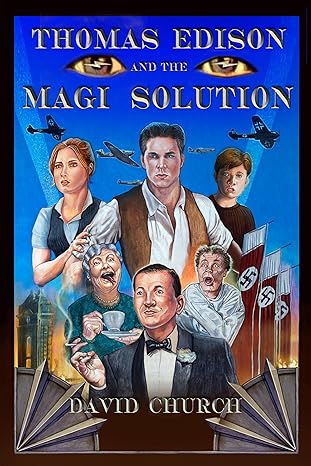
If you ever wondered what would happen if Indiana Jones met Thomas Edison, crossed paths with Groucho Marx, and then all three went on a mission to save the world from Hitler—with a dash of sci-fi and the occult thrown in—you’re in for one wild ride. Thomas Edison and the Magi Solution is the final book in David Church’s “Edison Trilogy,” and it doesn’t hold back. It’s historical fiction dialed up to eleven, a kind of high-octane alt-history caper where real figures from history go head-to-head with evil in ways you absolutely never saw in your high school textbooks.
The writing is a mixed bag in the best way. Sometimes it’s poetic and rich with mood—like the eerie prologue with Rudolf Hess making his jaw-dropping escape, or the haunting scene where U.S. troops discover the horrors of Ohrdruf. It’s rare for pulp-style fiction to pause and really make you feel the gravity of history, but Church pulls it off. Then, right after, he swerves into pure madcap adventure with moments like John Dawkins and his wife Sophie fighting off Nazi agents in their farmhouse, or a midair showdown involving fuel tanks as weapons. The whiplash is real, but I didn’t mind. It felt like switching channels between a war drama and a Saturday matinee. Somehow it works.
The book’s full of big personalities and colorful dialogue, but it’s the quieter moments that stayed with me. Like when Edison’s old radio interview plays in the background and Josh, the young protagonist, listens in awe. And that’s the weird magic of this book—it throws so much at you, but every now and then, it hits something honest and true.
The dialogue can be a little over-the-top, and the action can sometimes teeter into full-on absurdity. But I’ll be honest: I didn’t care. I was in it for the fun, and it delivers. This is the kind of book that knows exactly what it is—wildly ambitious, borderline ridiculous, but full of heart. There’s a real affection for history under all the chaos. Churchill isn’t a prop—he’s got gravitas. Same goes for Roosevelt and even the fictionalized Edison, who somehow manages to be both a wizard and an inventor without ever feeling like a caricature.
Thomas Edison and the Magi Solution is for readers who love genre-blending, who don’t mind their fiction a little messy if it means it’s got momentum and flair. If you like your history with a side of “what if,” and you don’t mind Thomas Edison being treated like a Marvel hero with a lab coat, then you’ll enjoy this book. It’s for the dreamers, the sci-fi nerds, the WWII buffs, and anyone who loves a bold swing.
Pages: 275 | ASIN : B0DPRDZL4G
Inspired by Historical Fiction

A Tapestry of Two Worlds follows a young boy growing up in 19th-century Lancashire and his family’s transition to life during the Industrial Revolution. Where did the idea for this book come from?
A Tapestry of Two Worlds tells a story based on the life of my Great-grandfather. Using the known facts of his life blended with social history, I imagine dialogue, reactions to those events, and interaction with other characters, to build the character arc. This story breaks his world into two distinct aspects; his life in Northern England compared to the last half of his life in India.
How much and what type of research went into planning and writing this novel?
I begin my stories with a timeline of factual events for my protagonist and key relationships in their lives. Layered in, I research the social history of the places during those times. Extensive research happens before and during the process of crafting the manuscript. I discovered my protagonist on a ship’s passage notice in the China and London Telegram, a paper used by the P&O Shipping line to share news from the colonies. Another great find came from a letter posted on a blog site, detailing a similar journey around the same time. As it turns out, this person travelled on the same ship my character did.
What draws you to the historical fiction genre?
We have such a rich world of stories in our history. Exploring the lives from the past can teach us about resilience, courage, and inventiveness. I love writing in this genre. Recently, I’ve explored other forms of writing from poetry to flash fiction, but still find myself inspired by historical fiction.
What is the next book that you are working on, and when will it be available?
Due in 2026! Story Synopsis:
In 1932, at the age of 47, Victor Veevers, left his Indian birthplace, Bombay, to settle his family in London, England. Born in 1885 to a British father and a mother of Portuguese and Indian descent, he lived during a period of growing unrest in India and sought economic security as well as protection from the mounting resentment his family faced in Bombay.
Vic’s skills as a photographer and cine-recorder, along with his local knowledge of India, earned him a spot on the British Gaumont Studios production team hired to film the 1933 Lady Houston Mount Everest Expedition. The daring adventure would test both aviation and photographic technology by attempting to take aerial images of one of the last frontiers of the world, Mount Everest. The story arc follows the production unit as they prepare and film the events, culminating in the Academy Award for short film in 1936.
Within a year of leaving the birthplace that rejected him and his family, Victor finds himself back in India. The story reveals challenges and triumphs on his path of acceptance as Victor explores the dual perspectives of his British and Indian heritage.
It may also include memoir pieces; the discovery of my heritage, and the mixed-race heritage influenced future generations.
Author Links: GoodReads | Facebook | Website | Substack | Instagram | Amazon
Raised in a middle-class English family during the Industrial Revolution, James Harrison Veevers escapes to East Asia in 1863. Exchanging pastoral views, dingy factories and crushing poverty in his Lancashire home, for the exotic, intoxicating culture of India. James pulls at the threads, unraveling the expectations of others. Determined to design his own life, James artistically weaves a colorful new tapestry from the filaments of his experiences gathered across two continents.
If you love stories rich with description and adventure, share the journey with James as he travels to the exotic world of India.
The Art Collector’s Wife
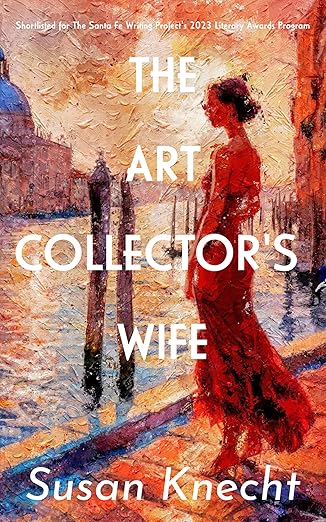
Susan Knecht’s The Art Collector’s Wife is an emotionally rich, time-skipping novel that weaves together post-war trauma, intergenerational secrets, art-world intrigue, and the sharp edges of teenage rebellion. It starts in the horror of Auschwitz, then unfolds decades later in sun-drenched Venice, following the fractured legacy of one family—particularly the women who survived and the granddaughter determined to uncover the past. It’s part historical drama, part coming-of-age, with a steady undercurrent of longing.
The prologue, set on the day Auschwitz was liberated, is devastating and lyrical—just brutal and beautiful all at once. Lila, the mother, trying to keep her friend and a pregnant girl alive, while praying for a glimpse of her son Leo, had me breathless. Knecht doesn’t hold back, and the imagery stuck with me long after I closed the book.
Then we shift to 1960s Venice, and things change gears in a really compelling way. Now we’re with Isabel, Lila’s teenage granddaughter, who’s navigating Catholic school, first love, and the weight of secrets no one will talk about. Isabel is such a great character—sharp, moody, defiant. I loved her scenes with Antonia, her chain-smoking bestie who has all the bad ideas and a heart of gold. When Isabel steals the ruby rosary and starts skipping school to flirt with Niccolo (who is equal parts charming and sketchy), the tension crackles. You can feel her aching for answers about her father and mother, and the way Knecht slowly drops hints about their story is fantastic.
But what really got me was the emotional layering. Knecht has a way of showing how grief and silence pass through generations like DNA. Lila is wrapped so tightly in control and shame, you feel her unraveling even when she says almost nothing. There’s a haunting scene at the cemetery where Isabel confronts her grandmother about her parents—Isabel demands answers, and Lila can’t speak. That silence? It screams. And Miriam, the family friend who carries so much of the emotional glue, is a favorite. She’s got this old-Hollywood flair, but also such deep loyalty and sadness. I kind of wanted a whole book just about her.
I loved this book. It’s heavy but worth it. The prose is poetic without being precious, the story moves through decades without losing momentum, and the characters feel real, flawed, and alive. If you’re into multi-generational family sagas, WWII fiction with a heart, or just crave a book that will grab you by the collar, The Art Collector’s Wife is for you.
Pages: 257 | ASIN : B0F38R8KBV



 LITERARY TITAN