Blog Archives
So You Want to Be an Extremist: A Motley Manifesto for the Motivated Maniac
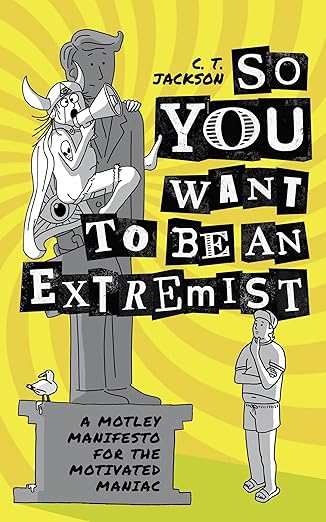

After reading So You Want To Be an Extremist: A Motley Manifesto for the Motivated Maniac by C.T. Jackson, I can say it’s a hilariously scathing, over-the-top satirical guide that lampoons modern conspiracy culture, online extremism, and the absurdities of “truth-seeking” subcultures. Structured like a how-to guide for the aspiring extremist, the book blends biting wit with dark humor as it traces the evolution of conspiracy theories and their players, from ancient Rome to the far-right fringes of social media. It walks readers through stages of “extremist enlightenment,” skewering everything from sovereign citizens and crystal-chugging wellness influencers to red-pilled incels and flat-earthers.
Reading this was like sitting through a savage stand-up special filtered through a graduate seminar in sociology. Jackson doesn’t just go for laughs—though there are plenty—he goes for the throat. The humor is raw, unrelenting, and often walks a tightrope between outrageous and uncomfortable. Personally, I found the style refreshing. It’s not sanitized or delicate. It’s brash and fearless. The jabs at figures like Joe Rogan and Marjorie Taylor Greene, or at cultural absurdities like chemtrails, 5G vampires, and moon-landing denialism, had me laughing and cringing at the same time. Jackson has a knack for mimicking the language and tone of the people he’s satirizing, which makes the parody hit even harder.
At the same time, there’s a deep undercurrent of anger here. Anger at how misinformation, grift, and willful ignorance have festered into real-world harm. That comes through in the relentless mocking of right-wing populism, internet cults, and self-declared gurus. It’s not subtle, and it’s definitely not neutral. That’s part of what I liked about it: it’s not trying to both-sides its way into approval. The parody is clever, but sometimes a little exhausting, like a meme thread that’s gone on too long. Still, when it lands, it’s fantastic.
If you have a dark sense of humor, a healthy skepticism of internet personalities, and a strong stomach for satire that cuts deep and doesn’t pull punches, this book is a fun ride. I’d recommend it to readers who enjoyed books like Thank You for Smoking or The Onion’s political commentary. It’s perfect for anyone who has ever doomscrolled Reddit or Twitter and thought, “How did we get here?”
Pages: 239 | ASIN : B0DF62LYTR

The Worst Explorers Ever

What I Did After I Died follows a man who is unaware he is dead as he enlists his family to accompany him on an unconventional treasure hunt. Where did the idea for this story come from?
I traveled north for a guys’ fishing trip in New Hampshire and a bartender told us about a lake in the mountains with free canoes. We found the lake on Google Maps and drove up a road that turned into gravel, and then into complete brush. We abandoned the car and started hiking through thickets for miles, getting totally exhausted, and never finding the lake. We were the worst explorers ever, which planted the seed to write about a disastrous mountain adventure. Maybe the ghosts idea came from all the jokes we made while hiking, that we would surely die out there. By the way, there was an alternate road that we discovered hours later, with a nicely paved trail to the lake.
What part of this book was the most fun to write?
My two prior novels, To the Top of Greenfield Street and When To Fire, are coming of age and psychic-western, respectively. Writing an adventurous quest felt different and fun. I liked the parallel of a family searching for treasure alongside a ghost searching for spiritual peace.
What characters in your book are most similar to you or to people you know?
This book is heavy on family dynamics that echo my daughter, wife, and my sister. The latter especially loved this story and urged me forward.
Can we look forward to more work from you soon? What are you currently working on?
I’m a high school teacher looking forward to writing all summer. Sometimes I read short stories that I wrote decades ago and find inspiration. So far my novels involve realism, psychics, and ghosts, so maybe my next move is aliens, haha.
Author Links: X | Facebook | Website
What I Did After I Died
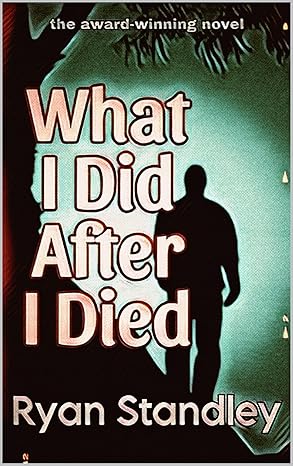
Ryan Standley’s What I Did After I Died offers a fresh and imaginative take on the afterlife through the eyes of Kevin, a man unaware of his own death. When Kevin stumbles upon a clue leading to a crashed plane filled with gold, he enlists his family in an unconventional treasure hunt. Their journey is packed with humor, adventure, and heartfelt moments, making the story both entertaining and deeply touching.
The narrative captures an intriguing premise—what would you do if you didn’t know you were dead? Kevin’s obliviousness adds a layer of comedy to the tale, while the treasure hunt serves as a backdrop for exploring family dynamics. The family’s antics, mishaps, and clever teamwork are not only amusing but also showcase their deep bonds.
Standley excels at weaving humor into heartfelt moments, creating a story that’s as emotionally resonant as it is entertaining. Despite its brevity, the story delivers a satisfying experience. The fast-paced plot keeps readers engaged from start to finish, even though some sections feel a bit rushed. However, this pacing adds to the book’s charm, making it easy to dive in and lose yourself in Kevin’s afterlife escapades.
For anyone who enjoys treasure hunts, quirky adventures, or a quick and delightful read, What I Did After I Died is a great choice. Standley’s blend of humor, warmth, and clever storytelling ensures a memorable experience. I recommend this book and eagerly look forward to reading more from the author.
Pages: 126 | ASIN : B0FD4VR557
Flawed but Loveable

Seen follows a morally grey antihero in jail for a crime he didn’t commit, who obsesses over clearing his name and getting revenge, till he spots a young woman and she becomes his obsession. What was the inspiration for the setup of your story?
I was walking to work one morning and a prison van drove passed me on its way to the courthouse in the centre of Belfast City. I noticed that it had blacked out windows and I wondered if the prisoners inside could see out. My brain immediately made the jump to ‘what would happen if someone inside saw a person on the outside and that obsession became everything’. That small notion continued to grow in my mind until I had the makings of a whole organised crime family, perhaps a sign that I had ventured too far down the dark romance/mafia rabbit hole.
While doing research for the book I visited some of the main locations and even managed to get a tour of the inside of a prison van as well as the cells within the courthouse. I wanted to show an authentic story when it came to the characters, locations, and storylines. Therefore, each book in the series contains certain societal issues prevalent within Northern Ireland e.g. Drugs and criminality in book 1, human trafficking in book 2, and book 3 will be slightly different in that it will be a sports romance, specifically boxing, and features 2 men as the main characters. Northern Ireland is still far behind other countries in relation to the acceptance of the LGBTQIA+ community so I am aiming to highlight the internal struggles of this for one of the characters in particular.
Aodhán and Nora are interesting characters who have their character flaws but are still likable. How do you go about creating characters for your story?
I always knew I wanted Aodhán to be a flawed but loveable character, someone who could be morally grey but would be a cuddly teddy bear for the right person. Nora is the epitome of every dark romance reader who loves a bad boy on paper. A woman who is both terrified and intrigued by a man with such clear red flags. When developing them and the surrounding characters I built individual profiles of their personalities, likes, and dislikes, and some of them are even loosely based on people within my life.
Are you a fan of the dark romantic comedy genre? What books do you think most influenced your work?
I was first introduced to the dark romance genre in October 2023 and became a firm fan, reading as many stories-mostly by indie authors as I could. Books to me are an escape from reality and the indie author community offered a much-needed space for raw and unadulterated stories. The romance comedy element came naturally when writing Seen as I wanted it to be authentically Belfast and we Irish are known for our dark humorous nature.
I would say I am probably most influenced by Brynne Weaver’s Ruinous Love Trilogy, CJ Riggs’ No, For An Answer, Luna Mason’s Beneath the Mask series, and Nikki J Summers’ Soldiers of Anarchy series. These stories all contained elements that resonated with me while I was building my characters and storylines.
Is this the first book in the series? If so, when is the next book coming out, and what can your fans expect in the next story?
Yes, this is the first of a 3-book series. Each book focuses on one of the O’Neill brothers. I don’t have a publication date for either of the follow-up books and I am currently writing book 2. It focuses on the eldest brother Cormac and the female character is Eireann Collins. Book 2 centres around the aftermath of Eireann, who was captured and tortured at the hands of a human trafficking ring. It focuses on her healing journey and ultimately her revenge on those who hurt her. Cormac is also working to take down the same perpetrators. Their journeys will intersect but it is made more complicated by their shared history. Book 2 is already shaping up to be darker than Seen, however, it does still retain some of the Belfast humour.
Author Links: GoodReads | Facebook | Amazon
Nora Kavanagh was just a girl who loved nothing more than chilling with her friends and fantasising about the men she read about in her books. That was until she unwittingly became snared in the sights of a man who both terrified and intrigued her.
Try as she may, to fight what the future holds, now he has seen her, nothing will stop him from capturing his shining light in the darkness and making her his.
Giving in to Vanity

In Fact Denounced as a Four-Letter Word, you offer readers a collection of aphorisms centered on topics ranging from politics to corporate culture. Why was this an important book for you to write?
There were three factors that drove me to self-publish my accidental thoughts.
First, the fear that I would hear someone say or read somewhere a thought that I deemed as invented by me. This fear grew with years but itself would probably not push me to plunge into self-publishing.
Second, the vanity, pure and simple – the devil’s favourite sin as per the concluding line of The Devil’s Advocate. As I self-police my mind to the tune well above the average I needed a justification for giving in to vanity. Here is my DIY absolution: Facebook and Instagram are powered by little more than human vanity. I am unlikely to make any sizable damage to humankind.
Third, I thought that if writing those thoughts provided me with some solace, they might console others too.
How did you go about organizing the reflections in the book? Was there a specific flow or structure you were aiming for?
When ploughing my journal for the selection of thoughts it was already organised into some categories. I have chosen a handful that I deemed to be better than the rest. When I surveyed the distillate, so to speak, some new categories appeared to me. Not all fit neatly hence the “Miscellaneous” chapter.
The sequence of the chapters was driven by my assessment as to their attractiveness to a wider audience. I put in the front those I thought would resonate with a wider audience and put at the end those that could count just on a niche appeal.
What were some themes that were important for you to explore in this book?
Sense-making, seeking solace, and trying to counter helplessness. Those three would stand for the bulk of my accidental thoughts. Picking on peculiarities and playing on words would be to other angles. Finally, pinning down absurdities that might be prevalent and yet are not obvious.
Can we look forward to more work from you soon? What are you currently working on?
I have published a series of articles on Medium.com on what I refer to as grey mosquitos. Grey mosquitos is a term I would like to think was invented by me. It refers to a concept diametrically opposite to Nassim Nicholas Taleb’s black swans. Black swans are, by definition, close to impossible to predict. Grey mosquitos are ever present, but we are nearly always blind to them. I might develop this idea to a self-publishable stage.
Author Links: GoodReads | Amazon
The Sycamore Centennial Parade (Part I)


In The Sycamore Centennial Parade, Charles McGrail spins a nostalgic, often hilarious yarn about a trio of quirky small-town characters—Babylon “Milkman” Hurley, his brother-in-law Clark “Poodle” Canderankle, and the indomitable Jericho—who bumble their way into promoting their town’s centennial celebration. Set in 1978, Sycamore, the story draws from everyday absurdity to craft a heartwarming comedy of errors, rich with banter, unlikely schemes, and quiet reflections on identity, family, and small-town life. As Jericho rallies her lovable but unreliable crew to canvas local businesses for parade support, what unfolds is less a professional campaign and more a slow-moving circus, complete with tie mishaps, dietary debates, and diner drama.
I loved the writing style. It’s alive with personality. McGrail’s voice crackles with humor, clever turns of phrase, and old-school charm. The dialogue sings—snappy, smart, and so natural you forget you’re reading. His characters? They’re ridiculous in the best way. Lovable screw-ups with big hearts and bigger mouths. And while the plot hums at a leisurely pace, I never found myself bored. Every scene feels like a short sitcom episode—tight, colorful, and just a little chaotic. The author doesn’t chase big drama. He trusts in the small stuff: banter, nostalgia, clashing egos, and the slow burn of friendships tested and reaffirmed. It’s low-stakes storytelling with high emotional payoff.
The story is long, and sometimes the jokes stretch a beat too far or the scenes linger past their welcome. But oddly, I didn’t mind much. The indulgence feels earned. McGrail clearly adores his characters—especially Milk and Poodle—and that affection is infectious. Beneath all the antics is a surprisingly tender meditation on second chances and reinvention. These aren’t just goofballs; they’re men pushed out of their old lives and forced to find new ways to matter. Jericho, too, shines as the competent, quietly frustrated linchpin who holds it all together. If you’ve ever juggled family and ambition, you’ll see yourself in her.
The Sycamore Centennial Parade is a warm and entertaining love letter to community, misfits, and starting over. It’s a small-town tale with a big, goofy heart. I’d recommend it to fans of Richard Russo or Fannie Flagg, or anyone who loves a character-driven story with quick wit and genuine soul.
Pages: 245 | ASIN : B0F2822P8C

Mythical Creatures: The Worldbuilding Guide to Korean Fantasy
Huck Kahng’s Mythical Creatures is a whimsical and insightful guide into the world of Korean fantasy folklore, woven with humor, reverence, and practical advice for writers and worldbuilders. Structured in three parts—Human, Animals, and Monsters—it introduces readers to foundational myths, clever animals, and fearsome (yet often lovable) monsters from Korean tradition. Each chapter blends storytelling with cultural context and concludes with a “Worldbuilder’s Workshop” full of exercises meant to spark creativity and deepen understanding of the lore.
What really won me over was the writing style. Kahng isn’t lecturing here—he’s inviting you into his living room, handing you a warm cup of tea, and telling you tales that have been passed down through generations, all while cracking jokes like someone who knows exactly how to make you care. The tone is breezy but deeply informed. He doesn’t bog down the reader with scholarly jargon or dry history. Instead, he pulls you into each legend with personality and punch. The bear who becomes a woman? Heartwarming and oddly inspiring. The tigers who get tricked by rabbits and scared of dried fruit? Flat-out hilarious. I laughed more than once, and I don’t usually do that when reading reference books.
Beyond the humor, there’s heart. Kahng treats these stories not as museum artifacts but as living tools for creative use. I appreciated how he encourages writers to look at mythology not just as background noise but as a guiding force in story building. His workshops at the end of each chapter are gold—practical, fun, and weirdly motivating. He makes you want to write. I walked away with half a dozen ideas for stories, games, or just odd little creatures I want to sketch.
If you’re a writer, game developer, dungeon master, or just a lover of folklore who’s tired of the same old dragons and elves, Huck Kahng’s Mythical Creatures is a breath of fresh mountain air. I’d especially recommend it to fantasy fans who want to break out of Western tropes and discover something new, strange, and joyful. It’s a toolkit, a storybook, and a love letter to Korean myth all wrapped into one delightful package.
Tales From the Roost: Roost’n Time Tales

Mike Joyner’s Tales from the Roost is a heartfelt, often humorous, and nostalgic collection of turkey hunting stories pulled from decades of woods-walking, gobbler-chasing, and camaraderie among fellow outdoor enthusiasts. This book is about the moments that make up a hunter’s life. Each chapter offers a fresh snapshot of Joyner’s exploits across the U.S., from foggy Maine mornings to sun-drenched Texas pastures. Through it all, Joyner captures not only the thrill of the hunt but also the quiet reflection that comes with time spent in nature.
Joyner’s writing is conversational. He doesn’t hide behind fancy words or inflated drama. Instead, he tells it like it happened—funny, awkward, successful, or not. I found myself laughing at his misadventures (hello, Whack O’ Mole) and nodding along during his more poignant moments of introspection, especially when he reflected on aging, loss, and the irreplaceable bond with his hunting friends and family.
The sheer volume of stories could feel a bit overwhelming at times, and some tales tread similar ground in terms of setup and outcome. But honestly, that’s how campfire storytelling goes. You don’t critique your buddy for retelling the same tale—it’s part of the ritual. What kept it fresh were Joyner’s sharp observations, his eye for detail, and his emotional honesty. He doesn’t shy away from talking about personal health scares, the passing of loved ones, or the bittersweet ache of time slipping by. That vulnerability is rare in books about hunting, and I appreciated it more than I expected.
I’d recommend Tales from the Roost to anyone who’s ever sat under a tree waiting for a gobble or just dreamed of doing so. Die-hard turkey hunters will see themselves in Joyner’s predicaments, and those new to the woods will come away with a genuine feel for what makes this pursuit so addictive. It’s not a technical manual or a how-to guide—it’s better. It’s a tribute. This book is for the storytellers, the memory-makers, and anyone who knows the joy of a quiet sunrise and a bird that finally answers back.
Pages: 287 | ASIN : B0F1MLQNMH


 LITERARY TITAN