Blog Archives
Blue Jeans and Lavender Gowns


A. W. Anthony’s Blue Jeans and Lavender Gowns follows Terry Deitz as he grows up in small–town Illinois during the 70s and 80s. The story tracks his friendships, his awkward steps toward romance, and his slow discovery of who he wants to be. The heart of the book sits in his connection with Debbie Douglas, a quiet farm girl who surprises him again and again. Much of the book lives inside everyday moments. School hallways. Study hall banter. Football games. Long drives on dark country roads. It all builds a picture of simple places where small choices shape a whole life.
I felt myself leaning in as I read because the writing has this easy, steady flow that feels honest. Sometimes it rambles the way teenagers talk, and sometimes it snaps into sharp little moments that hit harder than expected. The author keeps the language simple, but the emotions run deep. I appreciated how Anthony lets Terry speak for himself without polishing his thoughts. He admits fear. He overthinks things. He wants to do the right thing, then stumbles. That made him feel real to me. Debbie felt real, too. She works hard. She hides her nerves. She wants kindness more than anything. Watching them circle closer together gave me a warm, hopeful feeling.
The book looks at family pressure, faith, and the everyday pain that people try to hide. Some of the scenes surprised me with how tense or tender they got. I liked how the author handles faith with a light touch. The characters lean on God without turning the story into a sermon. It shows how young people try to make sense of love, fear, failure, and forgiveness. The dialogue sometimes made me laugh, and the charm of the book carried me through.
By the time I finished, I felt like I had spent time with people I might actually know. That is what made the story work for me. I would recommend Blue Jeans and Lavender Gowns to readers who enjoy wholesome romance, small–town nostalgia, and stories that unfold gently. Teens and adults who like clean Christian fiction would enjoy it most. If you want a book that feels warm and sincere, with characters that you’ll keep thinking about, this one is worth reading.
Pages: 271 | ASIN : B0FZ2V62J7

The Final Shelter


The Final Shelter is a haunting dystopian novel that follows Phoebe, a young scientist and teacher, as she navigates a fractured world where survival is reserved for the wealthy and compassion has become a rarity. Through her eyes, we see a society collapsing under the weight of greed, fear, and inequality. Underground bunkers are built for the privileged while the majority struggle with hunger, violence, and despair. Phoebe, torn between her ideals and the harshness of reality, stumbles upon an invitation to a secret shelter that promises safety, forcing her to confront impossible choices about trust, survival, and who deserves a place in the future.
I felt an immediate connection with Phoebe because her frustrations, her quiet resilience, and her moments of doubt felt raw and relatable. The writing is vivid, with unflinching descriptions of a decaying society. I caught myself pausing to breathe, especially during the riot scenes, because they were written in such a way that I could feel the dread in my chest. The mix of tenderness, like Phoebe talking to plants or comforting a student, and the sheer brutality of the crumbling world gave the book a strange rhythm that pulled me in deeper than I expected.
At times, the dialogue leaned toward being a little more polished than everyday speech, almost like the characters were speaking with extra clarity and purpose. But the ideas within those conversations were sharp and thought-provoking. The story often felt like a mirror reflecting our own society, raising questions about fairness, wealth, and the meaning of kindness. Even in the moments that read more like lessons than story, the impact remained strong, and I couldn’t ignore the weight behind the words. The book made me angry, it made me sad, and it even gave me flickers of hope.
I was left thinking less about the plot twists and more about the questions it forced me to wrestle with. Who do we choose to save when resources are limited? What happens when morality collides with survival? I’d recommend The Final Shelter to readers who love dystopian fiction but crave stories that lean hard into emotional weight rather than just action. If you like books that shake you up and make you reconsider the world around you, this one is worth your time.
Pages: 215 | ASIN : B0FHG57QXP
Joint Salvation

Judging Athena follows a humble and kindhearted research assistant who meets a curator at an art gallery, and what begins as a chance encounter over a necklace for a young girl’s birthday unfurls into a deep and poetic romance. What was the inspiration for the setup of your story?
The idea came to me while I was walking one evening last October. There is a real art gallery gift shop in a charming New England town. Many years ago, I purchased some custom nickel jewelry from the shop manager, a lovely woman with an accent (the nationality of which I cannot recall). On my walk, I suddenly suspected a story was lurking in the memory. As I strolled along, it all began to coalesce in my mind, blending with a few other ideas. I decided to go home, start typing, and see how far it went. Three and a half weeks later, I had a rough draft.
I enjoyed the romantic relationship between Josh and Athena. How did their relationship develop while you were writing it? Did you have an idea of where you wanted to take it or was it organic?
I’m glad you enjoyed it! I had a notion about both characters and their interaction. While they eventually presented themselves well in the first draft, initially, both were somewhat difficult for me to conceptualize. Josh was a challenge because of his humility and piety, and because I wasn’t sure how he would relate to Athena. She was very challenging due to her rarified nature and utterly unique circumstances. And her essence changed quickly in my mind, from a mere legend into something higher and in keeping with her arc of redemption. Fortunately, all my quandaries were resolved as I wrote. Once I was used to the sincerity and kindness in both characters, writing them became a nearly effortless pleasure.
Because of my marital deliverance theme, and partly in defiance of postmodern trends, I knew I wanted the relationship to progress from meeting to matrimony as quickly as possible. Yet in getting there, I decided to dwell on the details of dates, thoughts, emotions, and so forth. And many, many roses! That is why the betrothal period, less than two months long, essentially occupies half the book. I felt the emphasis on clean and honest dating and development, along with genuine understanding behind the marriage, was that important. As an aside, part of me almost wishes I could have dedicated the same level of attention to the rest of the story. However, that would have resulted in a book of 95,000 pages, not words, and I was pleased with the second half anyway.
I did have an idea of where I wanted Athena and Josh to go, though the idea evolved a bit. Most unusual for me, the ideas pretty much landed in the word processor in an organic fashion. Ordinarily, I erratically plot, fill in via scattershot, overthink, and stall manuscript development for months or even years. I practically wrote Judging Athena straight through from page one to “The End.”
What were some themes that were important for you to explore in this book?
Perhaps the most important element is the Christian concept of joint salvation, manifested through the three primary reasons for marriage, as explained by Father Josias in Chapter Four. This is a core tenant of the Church, however, too much of its veracity has been lost or diluted in our era. The tale I tell is, sadly, not my own. Rather, it is an idealistic expression of the ideal romance. My plot device or hook regarding Athena’s true nature is an admittedly extreme use of speculative theology. However, given the extreme state of the real world around us, I thought it was important to provide a strong counterbalance.
Another important concept, for me and, hopefully, for readers, is the complete deference to God offered by two imperfect people who, by dispensing with solipsism, offer anathema to the postmodern concept of the individual über alles. Fiction provides a forum for letting be what should be, even if the imagined vehicle approaches the fantastical.
Many of the themes and subthemes in Judging Athena stem from First Corinthians. I really enjoyed working various metaphors into the characters’ perceptions, their relationship, and their interaction with God, others, and the world. In addition to all else, the titular matter of judgment requires a real apophatic leap of faith. While hinting all around, I do not expressly explain how it happens. I don’t know technically how these matters unfold. No one does. Hence, a degree of trust is warranted. Had I delivered a detailed verdict, I doubt anyone would have liked it—least of all the author.
Also, I really like writing “innocent” fiction. All too often, my work veers into the polemical and the expositive. I may have finally discovered it is better to suggest than to force certain matters. Beyond telling what I hope is a sweet and entertaining story, I ultimately hope to encourage young men and women to defy the world, unite, be fruitful, and help each other redeem themselves through and into the glory of the Almighty.
What is the next book that you’re working on, and when can your fans expect it out?
Next up, Tom Ironsides returns in AURELIUS, a hard-charging action novella wherein the CIA’s former best blasts through the ranks of assorted international criminals. It’s another book that’s been simmering for a while, since around 2020. With any luck, it should be out late this year or in the winter of 2026. As with Judging Athena and The Substitute, it will come to market via Green Altar Books, the growing and outstanding literary imprint of Shotwell Publishing.
I generally have four or five manuscripts in development at any given time, and now is no exception. My “save the world” inclinations are slowly giving way to something more genteel and with more genuine literary quality. I have a few more romances in the works, including an outline for something of the levels of apologetics in Judging Athena. And there’s always more coming along—in due time.
Author Links: GoodReads | Telegram | Website | Amazon
JUDGING ATHENA is an exciting foray into innocent, pure, and productive love. It is also a clarion call to return to the traditions of marriage, large families, and genteel society.
Nuggets of Insight
Brothers in the Cross follows an archaeologist who, while investigating a murder in the West Bank, unearths a clue that leads his team to the Cross of Jesus. What was the inspiration for the setup of your story?
Finding that I have terminal diseases convinced me to rethink my understanding of faith. I had never been comfortable in talking religion. Somehow I sensed that my characters could, if we had something meaningful to say. I had read an article about the Ein Gede scroll and subsequently was musing about the Dolly the Sheep cloning, when the idea of cloning Christ exploded into my brain. I had to write that story!
Brothers in the Cross is my introduction to publishing to the public, and my only work of historical fiction. It is my second book, though my first, Tales from Bedside Manor, a non-fiction memoir of the most memorable cases in my fifty year medical career, was written for my family and close friends and not released for sale or distribution.
I wrote Tales from Bedside Manor to preserve in short stories the ironies and bittersweet memories of life as an Internist (Internal medicine: a pediatrician for adults). It was to leave to my family an understanding of what those experiences had been like. My health was faltering, major irreversible coronary disease intruded soon overlaid by cancer. I could see the light at the end of the tunnel drawing closer and wanted to leave my mark. That was in 2010, Obamacare was passed and physician-directed primary care medicine began to die.
Writing Brothers in the Cross was different. Since childhood, I held a fascination with stories of the Holy Land. I was the questioning sort and the glib answers of true believers were never quite convincing enough for me. I wanted to believe, but I wanted to be convinced by something beyond blind faith. So I cocked my ears for discoveries that evolve with time and was rewarded by nuggets of insight that arose in random fashion over the years.
And then the threads collided. I was musing one evening and recalled the story of Dolly the Sheep and her cloning in Scotland. Furthermore, there had been articles about rogue doctors cloning human children in Korea and Mainland China. That was the epiphany that sparked my leap to consider what would happen if The Holy Cross of Jesus was found. What men with technology would do was never in question.
How much and what kind of research went into putting this novel together?
The book would write itself. Research required only confirming the facts that had accumulated over time. The closest distance between two points is a straight line. The closest hiding place for the Cross was near Jerusalem. Simon of Cerene was the man who carried it to the crucifixion. The most obvious source of Christ’s genes was the fatal Cross. The surrogate Mother would be Mary (Mariam is the Arabic translation). The Bible’s Revelations would suggest the other character, the Anti-Christ. Armageddon would pre-suppose a nuclear end. And the death of my primary care physician practice relegated me to the role of Chief of Occupational Health at White Sands Missile Range where I became acquainted with the nuclear accidents including the Demon Core incidents at Las Alamos Laboratory. Fate mixed with reason, so I wrote the book.
What is the next book that you are working on, and when will it be available?
I don’t have any plans to write another but stranger things could happen.
Author Links: GoodReads | Amazon
In the mid 1900s archeological studies unearthed the Dead Sea Scrolls, and then the Ein Geli scroll. Technologies brought to bear on the latter revolutionized the study of ancient artifacts and allowed scenarios like the one in this book to be achieved. Jesse, the archeologist gets roped into a murder investigation in the West Bank. The ‘clue’ is found. When it is deciphered the treasure hunt is on.
The trio that collaborate to solve this riddle becomes ensnared in the emotions of their discovery. That they find the Cross of Jesus seals their belief. But will anyone else believe them? Dr. Craig Carpenter is a fertility specialist on sabbatical and quite naturally wants to see if the blood of Jesus is in the Cross. He reasons that the chromosomal patterns will be unique because the male components were supplied by GOD, not man. His hypothesis is confirmed. Now the fertility specialist holds the genes of Christ. What could possibly go wrong?
Myriam is the key. Thanks to the technology of Dolly the Sheep, she becomes the surrogate mother for the blood of the Lamb. The “reincarnate Christ” is born and his life evolves. The admonition of the Book of Revelations looms heavily over this story now, and the possibilities expand.
Eventually the question arises: How does one eliminate undesirable genes in this day of GMO’s?
Brothers in the Cross
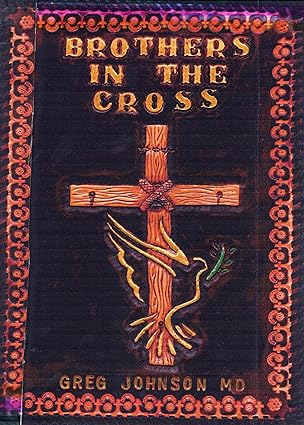
Brothers in the Cross is a bold historical fiction novel loosely inspired by biblical stories. It reimagines Simon of Cyrene as the man who secretly preserved the Cross of Jesus, leaving behind clues for its rediscovery centuries later. In the 20th century, archaeologist Jesse stumbles upon a crucial clue while investigating a murder in the West Bank. Alongside his collaborators, Jesse embarks on a thrilling treasure hunt that leads them to the Cross itself. Their discovery not only fortifies their faith but also unveils groundbreaking scientific revelations.
The story opens from Simon of Cyrene’s perspective. Historically known as the man compelled by Romans to carry Jesus’ Cross to Golgotha, Simon’s tale is expanded into an ambitious and imaginative story. As the author notes, this is not a religious treatise or a retelling of scripture. Instead, it’s a daring exploration of faith, science, and history. The premise is undeniably bold and controversial, blending spiritual reverence with scientific ambition. For some readers, the portrayal of a reincarnate Christ may feel unsettling or even sacrilegious, but it’s a thought-provoking take on questions that many Christians have pondered.
The book intertwines themes of genetic manipulation and moral dilemmas, particularly within the framework of faith. This commentary on the intersection of science and spirituality feels both timely and compelling. The narrative’s exploration of the Second Coming of Christ pushes boundaries, prompting reflection on how modern society might reconcile science with deeply held beliefs. The novel deftly juggles historical, scientific, and theological threads.
Brothers in the Cross stands out for its daring premise and unique blend of genres. For those willing to grapple with its challenging ideas, it offers a riveting journey through faith, discovery, and the moral questions of scientific advancement.
Pages: 420 | ASIN : B0D7TZ4XX6
Anger Issues

In Mystical Force Vol. 6: The Enemy Within an apprentice faces past trauma and her questionable past as she learns to harness her own powers. What was the inspiration for the setup of your story?
It was just the natural progression from where Volume 5 left off. At the end of volume 5, Shi-ria took Chiyoko on as her apprentice, so it only made sense to have volume 6 pick up there. I could have just had her learn to harness these powers between books, but it made more sense to show her gradually learning how to use these powers, plus struggling to cope with her anger issues. As anyone with anger issues (myself included) knows, overcoming your own anger is like facing your fears. It’s not a one-and-done deal. Take public speaking for example, a lot of people have that fear, yet giving a speech in front of a crowd doesn’t automatically mean that fear is gone. It takes time and effort to learn to deal with it. The same goes for Chiyoko, learning to control her rage. It becomes second nature to you, like a default program your brain automatically runs. You have to constantly work at it to reprogram your subconscious mind so you don’t automatically fall back into old habits without even realizing it.
Do you have a favorite scene in this installment of the Mystical Force series? One that was especially enjoyable to craft?
Ooo…that’s a tough one. Which do I choose? It’s like asking a parent to pick their favourite child. But if I have to choose, I would probably say it’s the part where we go into the backstory of Dead-Eye Sammie. Personally, I love a good origin story. It helps to explain how and why the characters became who they are, especially for a villain. Villains don’t think of themselves as evil. Only in a comedy/parody or a badly written story do villains act evil simply for evil’s sake. It makes them more relatable to explore what it was that drove them to villainy. I especially liked the part where she found and murdered the man responsible for killing her parents only to learn he was a parent as well; and that in her rash, lust for revenge, she realized that—to quote Obi Wan from Revenge of the Sith, “You’ve become the very thing you swore to destroy.” Plus it gave me a chance to explain a bit more about her home world, the planet T’nubria in the Torathol Empire. I love world-building. I love going onto fan wikis like “Avatar,” “Wookiepedia,” or “Memory Alpha,” and reading up bios on fictional worlds/nations written in the same style as a Wikipedia article about a real-world country. That’s part of the fun of writing sci-fi and fantasy.
The science inserted in the fiction, I felt, was well-balanced. How did you manage to keep it grounded while still providing the fantastic edge science fiction stories usually provide?
Honestly, I don’t even think about it. I remember a quote from the audio commentary on the DVD for 1964’s Mothra vs Godzilla (my favourite movie by the way), talking about Shinichi Sekizawa, who wrote the screenplay for the film. They mentioned how he didn’t consider himself an expert in any scientific field and felt the audience would get lost if bogged down in too many technical details. I’m the same way. Like with my other series Liberator: The People’s Guard I’m no expert in genetics or any of that stuff. As long as the story flows naturally and makes sense from a plot/character perspective, then people will be more forgiving if the science isn’t technically accurate.
Can we look forward to Vol. 7? Where will it take readers?
Oh yes, there will be a volume 7 coming out. Right now I’m working on Liberator Volume 3, so Volume 7 of Mystical Force will come right after that. As for where it will take readers? I’ve been writing for decades now, usually, I write an outline/synopsis like the plot summary you’d seen on Wikipedia for a book or a movie. Usually, I take my story arcs summary and use that as the basis for each specific book. Depending on what I’ve written, some of the story arcs were lengthy and had a lot of detail (several pages worth), others were little more than a brief paragraph. Sometimes I’ll even start writing something only to discard it because it’s just not working. Sometimes if I have a few short stories lying around, I’ll combine them together for a book, essentially having an ‘A’ plot, ‘B’ plot, and maybe even a ‘C’ plot too; so I can’t commit to anything for certain right now. I can, however, tell you this, having not been seen since volume 4, Tokijin and Sister Rose will return and will have to deal with their lingering relationship issues from that book. There will be new villains introduced and the character of Black Ninja, whom I’ve been hinting throughout the series (plus his brief unseen cameo in this book) will finally make an appearance and will lead to even more exciting adventures for future volumes.
Author Links: GoodReads | X (Twitter) | Facebook | Instagram | LinkedIn | YouTube | Website | Amazon
Chiyoko has been training hard as Shi-ria’s apprentice, and while she has made progress, she hasn’t yet defeated her greatest opponent, her own temper. As her powers grow, Scarlet Knightwalker becomes more worried that Chiyoko will be more easily tempted to use that power to lash out against those who wronged her. Just like the Poison Starfish who want revenge for Shi-ria, Chiyoko and Shinjo dealing a crippling blow to their criminal empire.
To do this, the Poison Starfish have hired the notorious mercenary Dead-Eye Sammie, who also wants revenge against our heroes. To enlist Dead-Eye’s help, the Poison Starfish must go through Dead-Eye’s business partner, the mysterious Ms. Alcro. But in helping the Poison Starfish, is Ms. Alcro helping the same criminals who ruined her life as a child and set her on this dark path years ago? Have she and Dead-Eye become the very criminals they despise?
It’s uneasy alliances and betrayals as heroes and villains clash in a battle of revenge versus justice. Sometimes, the real enemy isn’t your opponent on the battlefield but the darkness within: your own fear, anger, and hatred. But how does one conquer the enemy inside when no weapon can kill or wound it?
Mystical Force Vol. 6: The Enemy Within

In Mystical Force Volume 6: The Enemy Within, Craig Weidhuner continues his action-packed series set in a universe where martial arts, mystical energy, and shadowy criminal empires collide. This volume dives deep into the personal and emotional struggles of Chiyoko, a young apprentice Taman Knight learning to harness her powers, all while navigating trauma and a shadowy past. At the same time, we encounter nefarious characters like Dead-Eye Sammie and the Poison Starfish crime syndicate, whose operations threaten the fragile peace of Teikoku City. The stakes are high, and so is the drama, with intense action sequences, deep emotional revelations, and a clear sense of impending doom.
The story took me through a rollercoaster of emotions. Take the scenes where Chiyoko struggles to heat her tea using her mystical abilities, guided by her master Shi-ria. You can feel her frustration when nothing seems to work and then the palpable thrill when she finally succeeds, filling her with a newfound confidence. That moment was well-done and relatable, a simple yet powerful way to show character growth. But, as much as I loved these tender moments, some of the emotional outbursts felt repetitive, like Chiyoko’s ongoing rage and struggle with her inner darkness. But it does make sense given her backstory with her abusive mother and abandonment issues.
Now, the action scenes are a whole different beast. When Chiyoko goes up against Dead-Eye Sammie in the park, it is gripping from start to finish. The vivid descriptions, Chiyoko’s rage-fueled kicks, and her desperate attempts to summon the Taman’s energy, were thrilling, almost cinematic. And let’s talk about Dead-Eye Sammie! The big twist revealing her true identity was a nice surprise and played well against expectations.
The book also explores philosophical themes related to good and evil, energy balance, and the impact of unchecked emotions. Shi-ria’s lessons about the Kolri and Koldar forces (the mystical energies representing light and darkness) present thought-provoking ideas. However, some readers might find the detailed explanations about inner balance to be lengthy, which could potentially slow down the pacing. That said, the themes were clear and these ideas give the story more depth and elevate it from being just a straightforward action-adventure.
The Enemy Within is perfect for readers looking for fantasy-action with a spiritual twist. It’s a little like Star Wars meets Naruto, with an emphasis on martial arts, mystical energies, and battles that carry real emotional weight. If you enjoy stories of redemption, the struggle between light and darkness, and complex character dynamics, this book is worth the ride.
Pages: 107 | ASIN : B0DG5RJMY8
The Deaths at Jonestown

Paradise Undone is a powerful and deeply unsettling exploration of one of the most tragic events in modern history, the Jonestown massacre. Where did the idea for this novel come from?
In 2004, I gave a reading at the U. of N. Dakota Writers Conference to a crowd of 600, where I was a master teacher in residence. In the story, about the intersection of 9/11 and a Jewish family I knew back in New York, the parents go to a deprogrammer in an attempt to rescue their daughters (based on two friends) from a nameless cult in the Southwest. The programmer tells them he lost his daughter in Jonestown four years earlier. That was the sole mention of Jonestown in the story excerpt, which went on to win some prizes and be published in Sequestrum and Glimmer Train .
Afterward, a friend came up to me in tears, telling me of his colleagues who had lost family — siblings and nephew — in Jonestown. A powerful and unexpected response to my story. A month later, preparing for my sabbatical, in which I planned to write Hippie Ruins, a novel about the communes in Southern Colorado where I would spend the year ahead, I perused the shelves at Powell’s City of Books in Portland, OR, passing from COMMUNES to CULTS, where I discovered dozens of books about Jonestown. Thus, my bookstore aisle epiphany: remembering my friend in tears, I decided to write my book about Jonestown instead. The hippies could wait, while the story of an unscrupulous charismatic man leading altruistic souls to their demise felt urgent. Twenty years later, in this election year, my book just published, that urgency pulses with even greater danger.
Did you find anything in your research of this story that surprised you?
When I began researching, the most basic facts concerning the deaths at Jonestown — about which I knew little, like most Americans alive in 1978, when I was 18 — stunned me. The dead were 2/3 female, 80% African American, and 1/3 of those 900+ bodies were children. The media of the day, and even now, present those dead human beings as brainless, drugged-out zombies, led by a crazy man to “drink the Kool-Aid,” a salacious and sensationalized portrait so misleading. The dead of Peoples Temple were families, a third of them elderly, and the group as a whole comprising idiosyncratic individuals. It was not a mass suicide; it was murder, an example of coercive control gone ballistic.
What was one of the hardest parts of Paradise Undone for you to write?
I chose to narrate Nov. 18, 1978, from the first-person perspective of Marceline Baldwin Jones, Jim Jones’s wife of nearly 30 years, a founding member of the altruistic work of Peoples Temple in 1950s Indianapolis, who witnessed its decline in Jonestown’s final years, as her husband became an addict and monomaniac. The only fact we know about her demise that day is that she was one of the 900+ who died from poison. Two people died of gunshot wounds: Jim Jones and his nurse, Annie Moore. I wanted to give her a voice, a will, and a longing to stand up to her husband. However, she is human and weak and does not prevail. Living inside her consciousness for hours while the poison is dished out by others in cups and syringes in varying doses measured for infants, toddlers and adults, resonated with pain. She loves these hundreds of people who call her Mother. But there are armed guards surrounding her, guarding the vat of Flavor-Aid (not, in fact, Kool-Aid), and the crowd rises up against the one woman, Christine Miller, who argues with Jones not to go forward with his plan of so-called “Revolutionary Suicide.” Paralyzed with fear, Marceline does not act.
What is the next book that you are working on, and when will it be available?
My next book will be linking short stories about other members of Peoples Temple, including characters I wanted to write about in my novel but could not include due to narrative constraints. I plan to have it published on the 50th anniversary of the massacre in 2028. However, PARADISE UNDONE was ready for the 30th anniversary in 2008, with a NY agent who tried his best but, despite two close calls, returned it to me. Fifteen years later, despite hundreds and hundreds of rejections, in addition to being a finalist 17 times in various contests, I finally found a UK publisher, by chance, who eagerly snapped it up. Am hoping for a pub date closer to my goal this time around, with fewer years on my biological clock remaining!
Author Links: GoodReads | X (Twitter) | Facebook | Website | Instagram | Threads | Amazon
Imagine a community full of rainbow families where everyone comes together in the spirit of equality and fraternal love.
Shy pastor’s daughter Marceline and her new husband Jim Jones found Peoples Temple in the face of rampant hostility and aggression in 1950s segregated AmeriKKKa.
They give hope to the poor, the miserable, the alienated and disenfranchised of all colors, and build a commune in the jungle of British Guyana.
But this Eden too has its serpent. One who is also jealous of God, and where he goes, everyone must follow, even to the grave.



 LITERARY TITAN