Blog Archives
Psychological Layers

In Delphi, a woman struggling to find balance between the past and present embarks on a journey of self-discovery, seeking the wisdom of an oracle. What was the inspiration for the setup of your story?
The seed was planted in the first novel Dancing the Labyrinth when one of the Minoan characters was bitten by serpents and saw her future as establishing the Oracle for Gaea at Delphi (500 years before Apollo). This is interwoven with a contemporary narrative. I wanted to use the main character Cressida as a sounding board for society’s expectations of women to fit patriarchal culture, especially in the entrenched institutions of marriage and finance. I didn’t anticipate deep diving into Cressida’s backstory and work through generational trauma. That evolved through the writing process. It makes sense though, that in making major decisions, we need to know ourselves – what is right for us. Cressida comes from a dysfunctional family and has no confidence in her choices, so she sets off to Delphi to seek the Oracle’s advice because of what is written on the temple of Apollo ‘Know thyself.’ She is unaware she is an integral part of a major plot being played out within a mythological timeframe. Inspiration for this component came from writing in situ. I have a felt-sense of place and when added to my research, compelling stories find their way to my page.
What is it that draws you to mythology?
When I was young, I was drawn to Greek mythology rather than fairy tales. I once read that there are only seven original stories and in all my creative work I have sought the corresponding Greek myth – whether or not I have incorporated it into the narrative. As an adult, I am interested in the psychological layers they offer, but I am also learning other versions of the same myths from archaeological research that do not necessarily confer with the known version, i.e. the voice of the occupier/conqueror. For example, the story of the Minotaur comes from Minoan history, not Greek/Mycenean. There is a stark difference between their accounts.
What was your writing process to ensure you captured the essence of the characters, specifically Cressida?
Because Delphi is a sequel, and Cressida was already my protagonist, she has a definitive voice. Four years on she is older and more confident with life, but she still responds to triggers – her fight/flight tendencies. She is in a process of healing and so to authenticate her life experiences I researched and read about healing from childhood wounds and trauma. I enjoy writing her and getting caught up with her impatience and frustrations. She is deeply flawed but (I think) likable.
I believe everything we create contains personal elements. My characters have specific attributes I recognise that can be explored in the context of plot to express their own nuances and idiosyncrasies, whether subtly or exaggerated. Many of the places, and some of the experiences mirror my own, but from another perspective that enhance my understanding but also adds an honesty to the work.
What is the next book you are working on, and when will it be available?
I am currently working on a travel memoir of when I lived in Crete for a year and wrote Dancing the Labyrinth. As I’d like to get Delphi translated into Greek and do a book tour through Greece next year, I’m planning for the memoir to be ready for release in 2026.
Recently, I released a quirky humorous nonfiction collation of illustrated memes and quotes called The Little Book of Red Flags. I’m planning to follow this up with The Little Book of Apologies (for those who find it so hard to say sorry).
Author Links: GoodReads | Website | Facebook | X (Twitter) | YouTube | Instagram | Threads | Amazon
With a rich tapestry of snakes and prophetic visions, and a captivating heroine in search of her own truth, Delphi offers a spellbinding exploration of the human spirit. Prepare to be swept away by a story that seamlessly weaves the threads of ancient lore with a young woman’s unyielding quest for understanding.
Delphi straddles history and mythology. Sequel to Dancing the Labyrinth, it can be enjoyed as a stand-alone novel. It is the third book in the thematic series Women Unveiled, which blends myth, history and imagination in the telling of (almost true) stories.
Delphi


In Delphi, by Karen Martin, the reader is invited into a world where the boundaries between myth and reality blur as the protagonist, Cressida, embarks on a journey of self-discovery. Torn between her love for Gorgios and her reluctance to accept his marriage proposal, she grapples with a profound dilemma: how to shape her future while navigating the complexities of her present, including a secret pregnancy that weighs heavily on her mind. To find clarity, Cressida seeks out the wisdom of an oracle, hoping for a vision of her destiny and a deeper understanding of herself. Her path takes her to Delphi, where ancient stories come alive, supernatural forces intervene, and myths unravel in unexpected ways.
Martin masterfully intertwines history and fantasy, creating a narrative rich in detail and imagination. The novel’s vibrant depictions of gods and legendary creatures, from tales of Artemis and Apollo to encounters with the Minoans and matriarchal societies, captivate the reader. These elements are woven seamlessly into Cressida’s transformative journey, where even familiar myths, like the tale of the Minotaur and the labyrinth, are imbued with new meaning. The labyrinth serves as a compelling metaphor for the shadows we all carry, embodying both light and darkness, and it enriches the book’s thematic depth. The fantastical elements shine brilliantly. Each mythical encounter and supernatural event is vividly described, capturing the wonder of ancient legends and drawing in lovers of fantasy. Particularly striking is Cressida’s meeting with the oracle, a pivotal moment that illuminates her internal struggles and propels her forward on her quest for truth.
The narrative skillfully portrays Cressida’s turmoil and introspection, presenting her inner voice with an authenticity that resonates, even though it is written in the third person. Her fears and hopes are palpable, and her contemplation of how her choices impact those around her, especially concerning her pregnancy and her feelings for Gorgios, is compelling and deeply relatable.
I do feel that the storyline feels like it has many characters and events introduced in rapid succession. This lack of narrative focus occasionally detracts from the central arc of Cressida’s emotional and spiritual growth. For example, I believe that the relationship between Cressida and Aunt Margaret, which holds significant potential, could have benefited from more development.
Delphi is undeniably a unique and magical book. Its lush and engaging characters, along with its intricate tapestry of myths and legends, paint a world that fantasy enthusiasts will find hard to resist. The novel’s rich imagery and imaginative storytelling transport readers into a realm of sirens, oracles, and Greek deities. Karen Martin’s Delphi is a celebration of myth and self-discovery, offering a rewarding experience filled with beauty, complexity, and wonder.
Pages: 261 | ASIN : B0DHQLMXTB

A Valkyrie Should Be An Athlete
“Valkyrie” follows a college-age woman living in modern times who discovers her biological father is actually Odin, the leader of the Norse pantheon. What inspired the setup of your story?
My earliest notes on “Valkyrie” date from many years ago and eventually led to the first chapter as a stand-alone story. I had notes even then about how to continue the story. Some aspects changed; at one time I thought she might be the reincarnation of a Valkyrie, and this changed to Odin’s daughter. The invention of Colin Lokisson came later.
What was your inspiration for Christine’s character, and how did you craft her outlook on life?
I think it is reasonable that a Valkyrie should be an athlete. Christine is kept grounded by having her family and friends back home on Earth, e.g., she keeps hurrying home for dinner with the family. She rides her scooter, not a horse. (The scooter is almost a major character in the story.) She is a good Christian (notice her name) and is disposed to like the various people she meets on her travels. She loves to eat and never gains a pound, which may be amusing.
What were some themes that were important for you to explore in this book?
One recurring idea in the book is the idea of family. Christine has her family on Earth and learns that she has family in Asgard as well, and also that she is related to many others as well. By the end of the book, she may have other connections as well.
Another idea is of education. She is a college student, but she learns a great deal and her world expands when she travels here and there doing errands for Odin.
Is this the first book in the series? If so, when is the next book coming out and what can your fans expect in the next story?
I am definitely interested in writing a sequel. I have plans and notes for it. I hope to get under way on a sequel sometime soon and I hope (but cannot guarantee) that it will be done by sometime in 2025.
Author Links: GoodReads | X | Facebook | Website
fúath slugair
Fractured State follows a man entrusted with safeguarding a community of Druids who must navigate a perilous world where reality, mythology, and technology intersect and face relentless threats to survival. What was the inspiration for the original and fascinating idea at the center of the book?
Great question. Fractured State occurs within the world of The Blighted Earth, where humankind is both the planet’s dominant species and ‘the blight.’ Thus, the level of frustration and even disdain for humanity which bleeds through in the narrative leads the reader to question the narrator’s origin and species—High Sentient? Likely, an elemental or Guardian Spirit. For the series, the downstream story arcs were fleshed out first, and I had to map primary story arcs back to Book One to set the stage and create the conditions for what was going to happen later. I needed a great character who captured our species’ duality—flawed and yet possessing great potential; an aspect of the human condition which so vexes the High Sentients. As a combat veteran myself, I am intimately familiar with the challenges and struggles facing many of our military veterans, and as an obscure, religious minority, Druidry presented a likely target for discrimination while also possessing strong ties to nature. Finally, I needed an effective counter to Chaos’s shadow campaign to weaponize human emotion, which spawned the concept of the fúath slugair or ‘Hate-eater’—hence, Arden was born!
I find the world you created in this novel brimming with possibilities. Where did the inspiration for the setting come from and how did it change as you were writing?
To “set the table” for the Blighted Earth series, I needed the right set of conditions for Chaos to exploit in His relentless pursuit to initiate the Great Cascade and bring about the Discordant on Earth. The makings of environmental catastrophe (extended drought, wildfires, natural habitat erosion, human over-settlement, etc.) have been present and worsening for some time, with climate change driving more destructive weather extremes. Additionally, the novel was written during the trials and tribulations we all endured during the COVID pandemic and the unfortunate events in the aftermath of the 2020 Presidential election. When coupled with all the emerging threats, conflicts, and uncertainty which have emerged in last few years, as well as their corresponding negative effects on our collective state of mind and emotions, the real world itself provided all the drama and necessary ingredients for ruinous potential at continental scale. The final step was to inject the enduring struggle of otherworldly entities and supernatural beings into volatile mix—and “voila”—this author had everything he needed to create the “fractured state.” As far as changes during the writing process, extraordinarily little changed in the overall setting in the United States, but local places, encounters, and characters within Arden’s story arc changed as his supernatural powers and the overall impact he was to have in the series gained greater fidelity. These factors then shaped more ‘tactical’ aspects of the novel, such as finding the right settings and locations within the state of Texas.
What were some themes that were important for you to explore in this book?
I explore several themes in Fractured State, and to me, some of the more important ones are:
- Human belief systems and the huge impacts they have had on the environment and biodiversity of our world: How would things be different if we all adopted the Lakota philosophy of “we are all relatives?” We are the planet’s dominant species, but that does not place us ‘above’ other living things; non-human species are not just resources to be exploited. Humankind’s role obligates us to serve as the Earth’s stewards for the benefit of all life. Taking this concept another huge step further, how would our approach to life and living change if we were all children of a sentient planet?
- The adverse impacts of our technology: Human innovation and the ability to “make tools” to enhance our abilities and our lives has always been a strength, but it also has the negative corollary effects of extending the reach, influence, and power of bad actors. I would go as far as to say that, in many ways, technology is contributing to our “devolution” as a species.
- The rise of incivility in our civilization: The human attributes which enabled our meteoric rise to the top of the food chain—cooperation, communication, community—are being rent apart by divisiveness, corruption, and dishonesty within society. It is like a contagious disease which is fundamentally changing us for the worse and causing us to turn our backs on the things that made us “great.”
- Storytelling, one of humanity’s other great attributes, is also being co-opted to insidious ends: This is nothing new in our relatively short history as a species, but the line between exaggeration and lie has gone from blurred to practically nonexistent. Worse, the power of lies proliferated by influential people has been exponentially magnified by our own technologies.
- The process of radicalization and the rising threat of ‘homegrown’ violent extremists to our American democracy: In a world where life resources are becoming ever more limited and contested, while the gap between the “haves” and “have-nots” continues to grow, the numbers of disenfranchised citizens continue to grow. They are the target population for radicalization, and everything previously mentioned amplifies the ability of extreme actors to make more converts more quickly … and they do not even have to be in the same room, or state, or even in our country!
When will book two be available? Can you give us an idea of where that book will take readers?
Great news: Blighted Earth fans can expect to see Long Leg from the Blight Earth sometime next year. I am pretty far along in knitting together and refining the manuscript from the initial draft. In fact, I actually have the rough drafts completed for the next three books in what is currently planned to be a nine-book series. In terms of Book Two expectations: expect the unexpected! Another story arc begins with a new cast of characters who will have to accept the baton and carry the gripping narrative forward in the Natural Order’s struggle against Chaos and his minions. Where will Book Two take place? Hint: pay careful attention to Parim’s words towards the end of the Fractured State epilogue. Lastly, though it is hard to pick favorites, Book Two is one of the stories I really want to share with the world!
Author Links: GoodReads | Instagram | Website | Book Review
His objective: initiate the Great Cascade and bring about the Discordant on Earth. His target: North America, where the Chaotic flashpoint within human civilization has occurred…in Texas?
The eternal struggle between order and chaos is an inescapable condition of the universe. Caught in the middle is the delicate balance necessary for life to exist and prosper in our world. On Earth, the opposing sides in this timeless conflict are Earth Mother’s Natural Order and Chaos’s Force Corrupted-the En’Troop-EE. The Great Cascade is underway, and with the High Sentients of the Natural Order reduced and in disarray, there may be no stopping Chaos this time.
In Fractured State by R.M. Tembreull, the reality of existence on Earth is reinterpreted, where all living things are seen as the children of a sentient planet. Our immortal souls are gifts from Earth Mother, and all living beings progress through many lives within the Hierarchy of Sentience. If our world could feel, would this change how you perceive our world?
Fractured State

Fractured State by R.M. Tembreull is a riveting fusion of mythology and dystopia, set in a future America where Texas has seceded and fallen under extremist control. The protagonist, Arden, a distinguished veteran, is tasked with safeguarding a community of Druids known as Hearthstone Grove. Branded as religious deviants by the new Texas republic, Arden and his community must navigate a perilous world where reality, mythology, and technology intersect, facing relentless threats to their survival.
Tembreull’s writing is a tapestry of vivid imagery and intricate world-building. From the very first chapter, the reader is plunged into a narrative that oscillates between the human and the supernatural, the real and the mythic. The prologue, “Purgatorium,” sets the tone with its exploration of a metaphysical state that restricts spiritual growth, offering a powerful metaphor for the constraints facing the characters and, by extension, humanity. Tembreull’s ability to weave together such high-concept ideas with grounded, relatable human experiences is one of the novel’s standout features. One of the novel’s strengths lies in its character development. The characters, both human and otherworldly, are well-crafted and multi-dimensional. The Sentient Winds and Elementals, like Nilch’i and Parim, are not just forces of nature but entities with personal vendettas and deep emotional landscapes. The human characters, such as Kieran McBride, embody the struggles and resilience of those living on the margins of society. This duality is best exemplified in the interactions between the elemental beings and their human counterparts, which are fraught with tension and profound moments of insight. The narrative is rich with lore and exposition, which, while fascinating, can occasionally overwhelm the reader. The detailed descriptions of the universe’s creation and the Inani’s home world, Calisphaer, are particularly dense. While these sections add depth to the story, they also slow down the pacing. Readers who enjoy meticulously crafted worlds will appreciate this attention to detail, but those looking for a more straightforward narrative might find it challenging.
Fractured State is a compelling read for those who enjoy deep, intricate world-building and complex characters. Tembreull’s narrative is both a cautionary tale and an epic fantasy, blending real-world issues with mythic elements to create a story that is as entertaining as it is thought-provoking. This book is highly recommended for fans of speculative fiction and those who appreciate a richly detailed universe that challenges the reader to think critically about the world around them.
Pages: 299 | ASIN : B0D7LRZN75
Power, Duty, and Loyalty

The Mantle of the Past follows the inhabitants of a vast kingdom where their king has died, who now face an uncertain future as different factions battle for control. What was the inspiration for the setup of your story?
I studied history at university and the ancient mediterranean has always fascinated me. Tales from the history of Greece and Rome as well as kingdoms such as Egypt and the Achaemenid empire are where I get most of my inspiration and so often in their stories it is when the strong ruler falls that their history changes. I wanted to explore that situation myself.
I find the world you created in this novel brimming with possibilities. Where did the inspiration for the setting come from and how did it change as you were writing?
Kolgennon is largely inspired by the ancient mediterranean in the classical and hellenistic periods as I have always enjoyed the history, but also the literature that we have from that period. I wanted to create a world that felt familiar, but also somehow alien to a modern reader, with a hint of the classical epic in the stories I told there. As I wrote I found more and more of my inspiration coming from different cultures of the ancient world, it started as very heavily inspired by the Greeks, but I increasingly found myself drawn to Egypt, Persia and many other places and cultures for ideas and concepts. I think I also found myself delving into myths and legends more than just history as I developed my ideas further as well.
What were some themes that were important for you to explore in this book?
I wanted to explore power and the pull of duty and loyalty, but the major theme was to look at the absence of those. Tekolger, the all conquering king, is deliberately presented as almost the main protagonist in the story, but has died before the book begins. So there is a void where the hero should be, I found that a fascinating idea to study, what happens when the hero is gone and others have to pick up the pieces? Is his legacy a good thing, or has he just created problems for the world?
When will book two be available? Can you give us an idea of where that book will take readers?
I am working on book two right now, but i think it will be a while before I am finished yet. Maybe in a year or so. It will take readers deeper into the heart of the empire of the Doldun, but also further explore some of the more metaphysical elements of Kolgennon and perhaps answer some of the questions that are implied in the fringes of the first book.
Author Links: GoodReads | X | Website
The dust has only just begun to settle on the conquests of Tekolger, King of the Doldun, who exploded out of the east to forge an empire not seen since before the ancient cataclysm known as the Dusk. His body has not yet been brought home, his armies have not yet returned from his final campaign, but already plots have begun, factions are forming, and rivalries ancient and new are starting to stir.
All the while old powers thought long passed into memory, or simply fictions of fevered imaginations, are once again troubling the minds of men and showing themselves on the fringes of civilisation.
Will the rise of the Doldun prove to be a false dawn? Or will the conquests of the King usher in a new age of peace and prosperity for Kolgennon.
The Halls of Valhalla
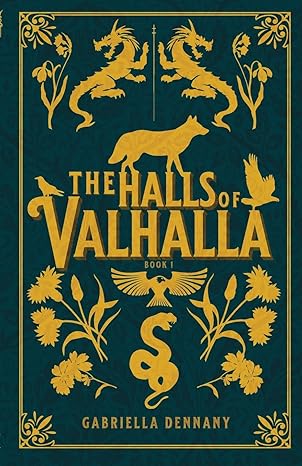

The Halls of Valhalla is a thrilling journey through a reimagined Norse afterlife, where fallen warriors must navigate battles, prophecies, and their own pasts to protect their sanctuary. The story centers around Milo Bohr and his companions as they are thrust into the mythical halls of Valhalla, faced with the daunting task of defending it from an impending doom that intertwines with ancient prophecies and the machinations of gods.
From the very beginning, the author captivates readers with a vivid depiction of Milo’s awakening in Valhalla, disoriented yet filled with a sense of purpose. The detailed world-building is one of the book’s strongest points. The descriptions of Valhalla, from its grand feasts to the eerie, ever-present threat of Ragnarok, are both immersive and imaginative. I loved the way the author, Gabriella Dennany, intertwines traditional Norse mythology with her own creative twists, giving familiar myths new life and adding depth to characters like Milo, Silas, and Thalia.
The book introduces a multitude of characters and mythological elements that, at times, can be overwhelming. For instance, the constant introduction of new realms and creatures, such as the Spøgelse spirits and the Dragur army, although fascinating, sometimes made it challenging to keep track of the main plot. That said, these elements also contribute to the rich tapestry of the story, making it a double-edged sword.
One of my favorite aspects of this book is the character development. Milo’s journey from a confused, newly-dead warrior to a determined protector of Valhalla is compelling and heartfelt. His interactions with Thalia and Silas provide a mix of camaraderie and conflict that feels genuine. The emotional weight of their quest is palpable, especially in scenes like the solemn farewell to Silas, where the pain of loss and the hope of reunion are beautifully portrayed.
The Halls of Valhalla is a must-read for fans of Norse mythology, young adult adventure novels, and epic fantasy. Dennany’s writing is engaging, and her imaginative take on ancient myths offers a fresh perspective that keeps readers hooked.
Pages: 446 | ASIN : B0D3JS1YZZ



 LITERARY TITAN