Blog Archives
Governance in the Quantum Era

Quantularity: A Quantum Framework for the Human Experience challenges the theory of Singularity by hypothesizing that, instead of one super-intelligence consuming everything, there is a world where many minds —human, artificial, cultural, and even biological —intertwine without collapsing into sameness. Where did the idea for this book come from?
The idea for Quantularity emerged from years of questioning whether the dominant narrative of Singularity truly captures the future we are heading toward. Ray Kurzweil’s vision of one all-consuming super-intelligence felt incomplete. I began exploring an alternative, a framework where many minds, whether human, artificial, cultural, or even biological, remain distinct yet interconnected. Instead of collapsing into sameness, they amplify one another through entanglement. That seed of thought became the foundation for this book.
In your book, you cover philosophy to technology to governance, weaving stories of history, myth, neuroscience, and quantum theory into a vision that feels both speculative and strangely practical. How did you approach researching this book, and what was your process for compiling it?
My research was intentionally multidisciplinary. I drew from neuroscience (especially work on the neocortex), philosophy of mind, cultural studies, and quantum physics. I also leaned heavily into myth, religion, and history. I believe meaning arises at the intersections. The process itself was nonlinear, much like the ideas I write about. I journaled, drafted essays, debated with colleagues, and mapped connections across fields until a coherent framework emerged. The writing then became an act of stitching these threads together into a narrative that feels both visionary and grounded.
What were some ideas that were important for you to share in this book?
Several core ideas guided me:
That cooperation and entanglement, not domination, are the forces driving the next chapter of human and technological evolution.
That consciousness is not limited to humans or machines, but can emerge across networks, cultures, and even ecosystems.
That governance in the quantum era must be decentralized, transparent, and adaptive, designed for multiplicity, not centralization.
And most importantly, that our humanity is not diminished by technology. Instead, it can be expanded if we build with intention.
What is one thing that you hope readers take away from Quantularity?
I want readers to leave with a sense of possibility. We do not have to accept a future of either machine domination or human obsolescence. Instead, we can imagine and design a world where multiplicity thrives, where diversity of thought and being is preserved, and where our interconnectedness becomes a source of resilience and creativity.
Author Links: GoodReads | X (Twitter) | Website | Amazon
In Quantularity: A Quantum Framework for the Human Experience, visionary thinker and technologist John Wingate dismantles the myth of the Singularity—that moment when artificial intelligence eclipses human thought—and offers a bold alternative: a future where intelligence doesn’t converge into one mind, but expands into many. A future defined not by domination, but by connection.
Spanning quantum physics, AI, distributed systems, neuroscience, and spirituality, this groundbreaking book explores the emergence of a new kind of consciousness—layered, networked, and co-created between humans and machines. Wingate weaves deep science with poetic insight, challenging readers to rethink intelligence, identity, value, and the very architecture of reality.
Inside, you’ll explore:
Why the Singularity is a flawed and incomplete vision of the future
How consciousness may be fractal, recursive, and quantum in nature
The role of AI as a mirror—not a master—of human dreams
How distributed ledgers can serve as society’s new trust fabric
The shift from scarcity economics to coherence economics
New models of education, governance, and collective memory
Why choice—not control—is the foundation of reality’s unfolding
This isn’t science fiction. It’s a blueprint for what’s already emerging.
With 20 thought-provoking chapters, Quantularity is a guide for leaders, technologists, spiritual seekers, and anyone who senses that something deeper is awakening in our relationship with intelligence—human or otherwise.
Wingate calls us to remember that we are not passive travelers in this next era. We are co-creators, resonant nodes in a conscious, evolving universe. As we move beyond mechanistic systems into fields of entangled awareness, the most important question isn’t “Will AI surpass us?”—it’s “Who do we become when we remember what we are?”
Whether you’re a futurist, founder, developer, or philosopher, Quantularity offers a bold new lens—and a call to action.
This is not the end of our story.
This is the beginning of our remembering.
Hacking the Hologram: Challenging Age-Old Beliefs & Behaviors on a Journey Through the Illusions of Reality


Stephen Davis’s Hacking the Hologram is a bold and mind-bending exploration into the idea that our reality might not be real at all. Davis doesn’t attempt to prove the theory that we live in a holographic universe; instead, he walks readers through what life would mean if that theory were true. Drawing on quantum physics, spiritual philosophy, religious critique, and personal anecdotes, Davis invites us to question everything—from our sense of self to the very existence of God. It’s part science speculation, part spiritual unraveling, and part rebel manifesto.
Davis writes with the kind of no-holds-barred energy that demands attention, and I found myself nodding, frowning, and occasionally muttering, “Wait, what?” His writing is clear, but his ideas are anything but simple. He’s got guts, taking shots at organized religion, childhood trauma, and New Age optimism with the same irreverence. At times, the bluntness felt refreshing, even freeing. Still, the questions he raises—about whether our suffering has meaning, or whether God is even necessary—are real and raw. He’s not trying to impress physicists; he’s trying to wake you up.
The book sometimes drifts into a swirl of speculation that felt emotionally driven. I admire Davis’s conviction. Some arguments rely on personal pain or pop culture parallels (like The Truman Show), which can be engaging. The narrative loops through theories of simulation, critiques of the Christian God, and the mysterious Demiurge as the possible director of our lives, which is fascinating.
I think Hacking the Hologram is best suited for readers who aren’t afraid to have their worldviews shaken. If you like your spiritual inquiries laced with attitude, doubt, and a wild blend of science fiction and soul-searching, you might find this book exhilarating. For those willing to question what’s real, it’s a trip worth taking.
Pages: 205 | ASIN : B0F7GSCVWJ

A Matter of Self-Expression

Out of Time explains how everything in the universe is scientifically created and provides thorough research and discussion on the topic. Why was this an important book for you to write?
There are two ways in which it was important to write it – 1) for myself, and 2) for others. To answer 1) and 2) together – It was a matter of self-expression. I first had ideas related to those in the book some 40 years ago. I started working on them seriously in 2005 when I wrote my first paperback. Then I continued developing my ideas and writing skills with more paperbacks during the next decade or so – and also with a website for science preprints called viXra, which I discovered in 2012. In the last few years, I tried submitting to science journals since I believed my thoughts were worth consideration and that my writing skills had become adequate. Sometimes I was severely criticized … sometimes my articles were highly praised, In both cases, every journal rejected everything I ever wrote (so I never progressed from pre-printed articles on the Internet to a printed one in a journal). I finally got smart enough to stop beating my head against a brick wall, stopped sending material to any science journal, and assembled my best writings into this book.
I appreciated all the research and references you provided in the book. What was something that surprised you during your research on this subject?
I was amazed at how well all my researches came together in the end! It was as if the book had already been written and was giving me an intriguing idea here and there. That speculation sounds simply impossible – but since the days of Albert Einstein, modern physics has been searching for a unified picture of the universe where everything in space and everything in time is entangled. If such a Unified Field Theory or Theory of Everything or Theory of Quantum Gravity truly exists, it’s logical that the book could have already existed (I must admit that typing those words makes me feel a bit uncomfortable – but maybe it shouldn’t).
What were some ideas that were important for you to explore in this book?
The book began when I read another book by Prof. Geraint Lewis and Dr. Luke Barnes about how to overturn astronomy’s Big Bang. I’d possessed a strong desire to do this since taking some astrophysics courses with Australian National University a year earlier (they were conducted by Prof. Paul Francis and co-winner of the 2011 Nobel Prize in Physics, Brian Schmidt). I found the Lewis/Barnes book a valuable guide – and added my ideas about Mobius strips, figure-8 Klein bottles, and Wick rotation. Then I went through the best of my previous writings and put together a collection of 11 essays totalling approx. 42,000 words. Ideas that are important to me in those previous writings include quantum gravity, division by zero, what I call vector-tensor-scalar geometry, modified evolution, band-gap implants in the brain which aren’t inserted surgically, the topological universe, dark matter/dark energy, interstellar/intergalactic/time travel, future computers, COVID-19, uniting science with religions and spirituality, and the little piece of science fiction that finishes the book – “Time Trek”.
What do you hope is one thing readers take away from your book?
I hope readers can catch at least a brief glimpse of the unlimited human potential! We all think we know what a human is, and what our civilization is like. But I’m convinced that we have no idea what people and civilization will be like in a thousand … a million … a billion years. I don’t know either. But I hope I can point readers in the right direction to see how different everything might be from today.
Author Links: Website | Facebook | Twitter
From Religion To Science
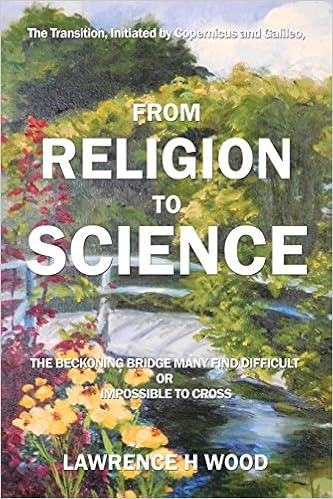
The Transition, Initiated by Copernicus and Galileo, from Religion to Science: The Beckoning Bridge Many Find Difficult or Impossible to Cross’ By Lawrence H Wood is a nonfiction book that seeks to shed light on the dichotomy between religion and science, and how the two can continue to co-exist side by side. The author details the transition from a religious based understanding to a scientific based understanding that began to occur in the mid sixteenth century, and discusses the two different explanations of ourselves and our surroundings–how they developed and why they co-exist when such coexistence is a constant source of confusion and conflict. In this book, Dr. Wood, a science historian, focuses on examining the historical aspects of science to further the reader’s understanding of the subject.
This books is divided into sections that look at various aspects of the historical development of science. It’s a fascinating topic that is given very little attention in an academic setting, since most science classes focus exclusively on the actual science with no mention made of the history of science. I found it interesting to read about the historical development of scientific understanding, as people came to understand various scientific principles, starting in the 1500’s when Copernicus observed that the Earth revolved around the Sun, not the Sun around the Earth, as was the previous accepted belief. This marked the beginning of modern scientific investigation, along with the invention of the telescope and the microscope. I liked that the book described many scientific principles and theories and how they came to be discovered, and covered many different science disciplines, including geology, physics, biology, archaeology, and chemistry. I enjoyed reading about the discoveries and contributions of a wide range of scientists, from the sixteenth century to the present.
The book focuses on a variety of subjects from discovering that the Earth is billions of years old to modern advances in DNA and gene-splicing, but the author describes it in terms that make the information accessible to average people who may not view themselves as particularly scientific-minded. The author’s use of graphs and charts to illustrate points was a welcome inclusion that helped to further my understanding of the explanations presented in this book. Another helpful tool was the author’s summation of information at the end of each chapter.
Pages: 444 | ISBN: 1532024576




 LITERARY TITAN