Blog Archives
The Limits: Walking the Mind’s Bogs (Second Edition)


The Limits: Walking the Mind’s Bogs, by Dan M. Mrejeru, is a philosophical memoir and speculative nonfiction work about the boundaries of human thought, especially the tension between linear and nonlinear ways of understanding reality. The book moves through reflections on evolution, consciousness, science, spirituality, memory, illusion, and personal transformation, using recurring images of bridges, rivers, tunnels, and journeys to explore how the mind reaches for what it cannot fully explain.
I found the book ambitious in a way that feels deeply personal. Mrejeru isn’t simply presenting ideas. He’s walking through them, sometimes circling the same thought again and again until it opens from another side. That repetition can be demanding. But I also think that restlessness is part of the point. The book feels like a mind refusing to accept a flat map of reality. It wants depth, motion, and hidden structure. It wants the bridge.
I appreciated the author’s choice to blend science, mysticism, memory, and self-questioning without drawing hard borders between them. The result is somewhat uneven, but fascinating. Some passages read like philosophical inquiry, others like a dream journal, and others like a private lecture on consciousness and complexity. Even if you don’t follow every turn, you’ll respect the seriousness of the search. There’s a candid vulnerability beneath the abstract language, especially when the narrator admits uncertainty, obsession, and the desire to remake his own thinking.
I like how sincerely the book treats thinking itself as an adventure. Thinking becomes travel, conflict, discovery, confusion, and renewal. That gives the book energy, even when the ideas are dense. I especially liked that the author is willing to let uncertainty stay visible. He asks big questions without pretending every answer is within reach, and that makes the book feel more honest than a purely argumentative work.
I recommend The Limits to readers who enjoy reflective philosophical nonfiction, especially those drawn to consciousness studies, metaphysics, nonlinear thinking, and books that blur the line between intellectual exploration and inner journey. For someone willing to wander through a dense, strange, and searching landscape of thought, this book offers a singular experience.
Pages: 204 | ASIN : B0GZ3D6YNS

Ego Degradation: Pulling Back the Veil of Illusion to See Your Mind’s Programming


Ego Degradation: Pulling Back the Veil of Illusion to See Your Mind’s Programming by Alexx Shaw is a spiritual self-help book that blends psychology, neuroscience, philosophy, trauma language, and metaphysical ideas to explain what Shaw calls “ego degradation,” a painful but potentially clarifying breakdown of the mind’s old programming. The book argues that the ego creates our perceived reality through duality, judgment, expectation, and control, and that awakening begins when we learn to see those patterns instead of blindly living through them.
The writing has a direct, almost coaching-like energy, and at times it feels less like reading a quiet guide and more like sitting across from someone who is trying to shake you awake. I appreciated that intensity, especially when the book talks about trauma, attachment, and the way people mistake old coping habits for identity. Some claims stretch into spiritual territory. The book wants to give language to experiences that can feel frightening, private, and impossible to explain.
Shaw moves between Freud, Eastern religion, brain regions, karmic lessons, mindfulness, and non-attachment, which makes the book feel wide-reaching and ambitious. Sometimes that range is energizing. The central idea kept pulling me back: what if the stories I tell myself are not facts, but programs I keep running because they once helped me survive? That is the strongest part of the book for me. Under the spiritual vocabulary, there is a very human question: how much of my suffering comes from reality, and how much comes from my grip on reality?
I would recommend this book to readers who already enjoy spiritual self-help, consciousness writing, shadow work, trauma reflection, or books that mix personal growth with metaphysical thinking. For readers who are open to inner excavation and a genre that treats healing as both emotional and spiritual work, Ego Degradation offers a challenging, candid, and sometimes bracing invitation to look more closely at the mind behind the curtain.
Pages: 264 | ISBN : 1917704607
The Shift Worker’s Paradox

R.E. Hengsterman’s The Shift Worker’s Paradox lays out a clear and unsettling picture of how shift work breaks down human biology, piece by piece. The book moves through personal stories, science, and practical guidance, weaving together research on circadian disruption, metabolism, hormones, and the daily realities of working against the clock. It explains how sleep loss, mistimed eating, and chronic stress grind away at the body over time. The tone blends clinical insight with lived experience, and the message is steady and stark. Working nights or rotating shifts has a cost, and that cost shows up everywhere from cognitive performance to metabolic health to emotional stability.
The writing is plainspoken, almost blunt at times, and that worked for me. I never felt lectured at. Instead, I felt nudged, reminded, and sometimes warned. The book mixes biology with stories of real people in a way that hits harder than any abstract health advice. I could feel the frustration in the author’s voice when describing tragedies on the drive home, and I could feel the weight of his decades in healthcare shaping every paragraph. Some chapters made me pause, especially the parts explaining how the body’s internal clocks fall out of sync. I knew shift work was rough, but I didn’t fully grasp how many systems it drags down at once.
What surprised me most was how personal the book becomes. When the author admits to his own struggles, the tone shifts from educational to intimate. It felt like someone pulling up a chair and telling the truth that usually gets swallowed in break rooms and morning commutes. The mix of scientific detail and emotional honesty felt unique. Shift workers aren’t dealing with one problem. They’re dealing with an entire stack of them, and the writing mirrors that tangled reality. I found myself moved, sometimes unsettled, and sometimes hopeful when the author talked about small changes that can help realign a life that’s drifting.
This book is a lifeline for nurses, factory workers, first responders, warehouse workers, and anyone else who trades daylight for survival. It’s also helpful for families who want to understand what their loved ones go through. I would recommend it to anyone who works outside a typical schedule or cares for someone who does. The book is honest, practical, and quietly compassionate, and it might be the first time some readers feel truly seen.
Pages: 394 | ASIN : B0G2SK9QDM
Making Neuroscience Engaging & Intuitive

Baby Senses: A Sensory Neuroscience Primer for All Ages shares with readers the world of nervous systems and how they have developed into the senses we have. Why was this an important book for you to write?
Thank you for this great question! I’ve always been passionate about making science engaging, relatable, and accessible to the interested lay audience. As an artist, I’ve also found the actual forms in biology incredibly complex and beautiful. As a tutor with Reading Partners, I wanted to share my love of neuroscience, art, and reading with the kids I was tutoring, but a search of the existing neuroscience books for children left me disappointed in the lack of truly engaging neuroscience content for beginning/emerging readers. And there a germ of an idea was born – to illustrate and write a children’s neuroscience book with accurate visual representations of sensory systems. I wanted my book to also impart fundamental principles of the scientific endeavor, for example, to convey that knowledge is built over time, with many researchers from diverse backgrounds working together (or apart) to gather facts in small steps. Related to this was my desire for Baby Senses to be a stand-alone educational resource for classrooms and families laid out in a scientific format. I think than an early introduction to how diversity in nature makes all animals special is important to encourage an appreciation of our ecosystem and why its delicate balance needs to be conserved. This was coupled with the intent to spread the subtle message that what makes us different is often our strength and neurodiversity is to be celebrated.
How much research did you undertake for this book, and how much time did it take to put it all together?
As an auditory and visual neuroscientist, I was already very familiar with several sensory systems before I decided to write Baby Senses. Some of the facts included in the glossary are in fact inspired by my doctoral dissertation. There were some systems I was less familiar with before writing my book, and for these I read several research articles and textbooks to gain a deeper understanding of each of these systems. I then condensed them down into narratives and ‘fun facts’ to highlight, as well as how contemporary research into these areas relate back to the lay audiences’ daily lived experiences.
The idea of writing Baby Senses really crystallized for me during the COVID-19 global pandemic. I’d been working on creating a series of neuroart paintings since 2018. The realization that I’d created a series of paintings that tied together into a narrative about the beauty and complexity of the many ways in which brains have evolved to do extraordinary things, coupled with the realization that there are not many neuroscience books available to early readers, really motivated me to sit down and start working on this project. I took about 8 months to finish my first draft of the book including the expanded glossary, the rhyming dialogues, and all the illustrations. I then spent several months researching publishing options and timelines, choosing my publisher, revising my book, and working on the cover images. Overall, it took a year and 5 months for my book to be published from when I started working on it.
What were some goals you set for yourself as a writer in this book?
In my experience, children are easily inspired or discouraged from pursuing further learning in topics based on demographics and gender, as well as how scientific topics are taught. An important goal for me was to make neuroscience engaging and intuitive so that children are inspired to pursue it, regardless of gender or demographics. When I take a step back to look at the bigger picture, the challenges facing neuroscientific endeavors are complex and large. To solve them requires team-science efforts, new ideas, collaboration within and across diverse teams, and an open-science, data sharing approach. All of these require that people from diverse backgrounds are drawn to and remain in research careers, and in the long-run, I hope that Baby Senses will contribute to that goal.
Another major goal for me in writing Baby Senses was to use multi-modal ways to engage diverse minds (neurotypical and neuroatypical), and of all ages. I wanted to maintain the balance between writing an engaging and relatable narrative while not shying away from scientific terminology. To do so, I used subtle cues like the parent-child bond as the context of these question-and-answer conversations to make the content relatable. More scientific choices like including the full references list were also deliberate. A related goal for me was to dispel scientific misconceptions, such as the all-pervasive idea that humans only have ‘5 senses’ and that having a ‘6th sense’ was somehow an anomaly. As humans, we have more than 5 ways to sense our internal and external environments, with research still ongoing to better characterize all the ways in which we sense our environment; for instance, how our gut microbial environment influences our brains through the gut-brain axis is an active area of research.
What is the next book that you are writing, and when will that be published?
I would certainly like to write more – I’ve a couple of ideas I’m playing around with right now. As a first-time indie author, I’ve learned a lot about the publishing process and am still learning so much with Baby Senses, so I am not ready to completely move onto the next project yet. I also have ideas about further expanding the reach of Baby Senses by for example, turning it into a sing along project. A lack of ideas has never been an issue for me so stay tuned for updates on my website https://babysensesbook.com/, where you can also sign up to receive my newsletter with events and updates or follow me on social media platforms!
Author Links: GoodReads | Twitter | Facebook | Instagram | Website
Baby Senses: A Sensory Neuroscience Primer for All Ages
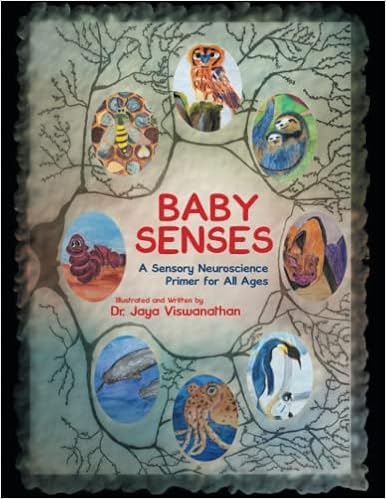
Baby Senses: A Sensory Neuroscience Primer for All Ages is an illuminating book by the creative mind of Dr. Jaya Viswanathan, an author whose passion for unraveling the intricate workings of the human brain was ignited at the remarkably young age of 14. Throughout history, the enigmatic complexities of the human brain and those exhibited by our fellow creatures have been the subjects of ceaseless fascination. Thanks to remarkable strides in scientific understanding, we stand on the precipice of delving ever deeper into the labyrinthine mechanisms governing the nervous system and the human brain itself.
In the pages of Baby Senses, a mesmerizing tapestry of creatures, from serpents to lemurs, penguins to worms, are unveiled to illuminate the 16 systems emerging from the bedrock of our five fundamental human senses: vision, hearing, touch, taste, and smell. This extraordinary odyssey unfolds through the lens of young animals inquisitively engaging their elder counterparts, who bear exceptional attributes such as night vision and reaping enlightening revelations in return.
One facet that conspicuously distinguishes this work is the inclusion of an all-encompassing glossary nestled at its conclusion. Personal encounters with sensory organ descriptors had left me grappling with their essence and role. The addition of this invaluable glossary not only demystifies these terminologies but also bestows an enriched grasp of their functionalities. The vivid and visually compelling graphics interwoven within the narrative further elevate the reading experience.
Baby Senses by Dr. Jaya Viswanathan is a wellspring of education. Beyond inspiring wonder and curiosity, this book stands as a repository of indispensable educational wisdom.
Pages: 74 | ASIN : B0C36NXZJ2
A Misunderstood and Misrepresented Mushroom

What was the idea, or spark, that first set off the need to write Fly Agaric: A Compendium of History, Pharmacology, Mythology, & Exploration?
There were really two sparks that gave life to this book. The first spark was to produce the book that I had always wanted. When I first developed an interest in this mushroom as a teenager there was very little written about the mushroom that was accessible and the articles and books that were available were frequently vague on a number of important points. I had always wished I could find something that was comprehensive and that could provide a solid background on the history, pharmacology, and mythology surrounding this mushroom. The second spark was the realization that in the decades since I first developed an interest in the Fly Agaric there remained an incredible vacuum in the literature on this mushroom. Thus, the goal of producing the book was to simultaneously fill this vacuum and to produce the book that I had always wanted.
What was the collaboration process like with so many people contributing to this book?
The collaboration aspect was one of the thrilling elements of putting this book together. There were challenges in selecting and contacting the authors and researchers that I wanted to participate but I couldn’t be happier with the selection of individuals who agreed to contribute to this book. Some of the contributors had previously published their work elsewhere, but many of these pieces had been out of print for years or decades and were difficult for readers to find. This provided an opportunity to re-introduce readers to some very interesting literature on this mushroom. It was also great to work with authors on new works, to discuss topics, and lay-outs, and to take a more active editorial role. There were also several chapters that I co-authored, and I feel honored to have had the opportunity to work with each of these individuals as a collaborator.
What is one thing about Fly Agaric that you think is misrepresented in the media?
One thing the media is frequently guilty of is using images of the Fly Agaric (Amanita muscaria) in articles about Psilocybe mushrooms, frequently referred to as “magic” mushrooms. While the Fly Agaric is also psychoactive it is quite distinct from Psilocybe mushrooms, both in its appearance and in its pharmacology. There is potential for this misrepresentation to lead to confusion among readers, which could lead to unforeseen and potentially harmful consequences.
What is the next book that you are working on and when will it be available?
There are no books currently in the works though I am presently working on several research articles related to the Fly Agaric, which will likely be published within the next two years.
Author Links: GoodReads | Facebook | Website
How to recognize and identify over a dozen types of psychoactive Amanita species, subspecies, and varieties occurring in North America, and how to distinguish them from look-alikes.What psychoactive and other active compounds are found in psychoactive Amanitas, and how they affect the mind and body.The differences between the effects and experiences produced by psychoactive Amanitas and psychedelic Psilocybe mushrooms.How the Fly Agaric can be detoxified and safely prepared for the dinner table.The history of medicinal and homeopathic use of the Fly Agaric.How the Fly Agaric can be used topically and internally to treat conditions such as pain, inflammation, insomnia, and anxiety.Theories regarding the historical and religious use of psychoactive Amanitas around the world based on archaeological, folkloric, and other evidence.
Fly Agaric

Fly Agaric is what happens when a bunch of mushroom nerds get together and geek out about their favorite fungus- the Fly Agaric. The result is brilliant. The book is designed to be beginner-friendly. No prior knowledge is needed, because the book covers absolutely everything you would need to know, and Feeney has ensured that all the information in the book is 100% approachable. Something in the book is sure to grab your attention and, before you know it, you’ll be dragged into the weird and wonderful world of Fly Agaric fans.
This comprehensive book is divided into five parts, each with a different theme. It begins with a very useful beginner’s guide to mushroom hunting and identification. This section is full of helpful guides and safety information for any fledgling mushroom hunters. The second part is my personal favorite. It is a rundown of appearances of possible allusions to Fly Agaric use in religion, culture, and folklore. This informative book is very well researched, well written, and will likely change how you view some parts of history. Some of the conjecture used in this part is then backed up in part three where Feeney’s experts analyze archaeological evidence. The book then takes another turn in part four, where it becomes a Fly Agaric cookbook. It opens by telling stories of cooking with the mushroom and why doing so is a good idea. Feeney then takes over and tells us everything we need to know about cooking the mushroom. From nutritional information to actual recipes. Finally, the book ends in part five with the science of the Fly Agaric. This section is not too dry and is just as approachable as the rest of the book. The section has everything you could want to know if you wanted to experiment with Fly Agaric yourself.
Fly Agaric is a fantastic tool for anyone that wants to dive into this fascinating topic as it is extensive, thorough, and accessible. This enlightening guide would also make a great coffee table book. You’ll find yourself picking through it, reading the bits you find most interesting until you find you’ve consumed the whole thing. The book is a great read and Feeney and his writers have done an excellent job sharing their passion with the rest of the world.
Pages: 508 | ISBN: 0578714426
Song of the Blue Whale

Song of the Blue Whale is a beautifully illustrated children’s book that educates readers on whales, whale hunters, ocean pollution, and what we can do to help whales and clean up our water.
This educational picture book surprised me with how many opportunities for learning were packed into so few pages. We’re first introduced to a whale with a barnacle on its tail. A cute image accompanied by a short rhyme. But readers are then taken on a trip through the ocean where we learn about the dangers whales face against hunters. With a few short simple rhymes readers are also educated on ocean pollution and provided some simple steps we can all take to help clean up. I can imagine this book being a great piece for teachers to include in their curriculum about marine biology and oceanography. The book is filled with beautiful art pieces of whales in the ocean. Some of my favorite art pieces from this book are from the bottom of the ocean looking up at whales as sunlight comes through the clouds and water. Contrast this with the dramatic scene where whalers are hunting and you really do get to experience the full range and beauty of a whale’s life in this book.
Song of the Blue Whale is a picture book that will educate as it entertains young readers. With magnificent art on nearly every page, any child is sure to appreciate the majestic nature of these animals and come away with a better understanding of what whales face in the open ocean.
Pages: 34 | ISBN: 1916184847



