Blog Archives
Cutler’s Wonderful Creations: A Children’s Book About Finding Your God-given Identity


Cutler’s Wonderful Creations by Aaron P. Gordon is a thoughtfully written Christian children’s book that invites young readers to explore identity, purpose, and belonging through a gentle, faith-centered lens. The story centers on Mr. Cutler, a craftsman who owns a small shop where he creates forks, spoons, and knives. When he designs a special set of utensils for his daughter, Alina, each piece longs to be useful and to matter. As Alina grows, the utensils begin to notice differences in how often they are used. Spoon appears essential, while Fork and Knife are left waiting. Comparison creeps in. Discouragement follows. Over time, each utensil comes to understand that it was created with intention and that its purpose will be revealed at the right moment.
What makes this book especially effective is the clarity and warmth of its central message. It speaks directly to children without talking down to them. The story gently challenges the habit of comparison and rejects the idea that worth is defined by visibility or frequency of use. Instead, it affirms that every child is intentionally created, deeply loved, and uniquely designed by God. The utensil metaphor is simple yet powerful, turning an abstract spiritual truth into something tangible and accessible. Fork’s desire to be like Spoon, followed by his eventual realization of his own value, mirrors a struggle many children experience as they navigate feelings of inadequacy or being overlooked.
Patience and trust are also woven seamlessly into the narrative. Mr. Cutler understands his daughter’s future needs long before the utensils do. This dynamic reflects the Christian belief that God, as Creator, sees the full picture even when His creation cannot. The story reassures young readers that purpose often unfolds over time. Waiting does not mean being forgotten. Disappointment does not mean being unimportant. These ideas are presented with tenderness and hope.
The illustrations enhance the story beautifully. They are warm, expressive, and emotionally clear, allowing children to easily connect with each character’s experience. From Fork’s quiet sadness to the shared joy at the story’s resolution, the artwork deepens the emotional impact. The inclusion of children of color is especially meaningful, offering representation that helps more readers see themselves within the story.
The book concludes with discussion questions, memorable quotes, and song lyrics, extending the experience beyond the story itself. These additions invite families to reflect together and engage in meaningful conversation. Cutler’s Wonderful Creations is a reassuring and faith-filled read. It encourages children to value their individuality, trust God’s timing, and understand that difference is not a weakness, but a vital part of who they were created to be.
Pages: 54 | ASIN : B0G275TPXX

The Legacy of Prairie Winds: Third Edition

The Legacy of Prairie Winds is a sweeping historical fiction novel that follows young Johann Gehring, a German immigrant who leaves everything he knows in 1881 to build a life on the wide-open prairie of Nebraska. The book opens with vivid scenes of his family conflict, his difficult voyage across the Atlantic, and his first uncertain steps into a new world. From there, it widens into a multi-generational story about hardship, faith, love, and the slow shaping of a family’s place on the land. The tone shifts between raw struggle and quiet beauty, giving the reader a sense of how fragile and powerful hope can be in an unforgiving landscape.
I kept feeling as if the author were guiding me by the elbow, pointing out details I might miss on my own. The depictions of the Sandhills, for example, stay with me. The grasslands are described with a kind of reverence, but they’re never sentimental. They’re hard, windswept, and sometimes lonely, which makes Johann’s determination feel all the more human. I rooted for him from the start. His fight with his father, his fear on the ship, and his first shaky steps in Nebraska all felt believable because they’re grounded in everyday sensations. The book doesn’t rush. It lets moments breathe, even the uncomfortable ones.
I also appreciated how the story handles the emotional weight of immigration. The scenes of steerage life on the ship, the seasickness, the smell, the fear of disease, and the simple joy of fresh air form a collage of what leaving home really costs. Yet the author doesn’t lean on drama alone. There are tender beats too, especially Johann’s fleeting friendship with Astrid, which adds a spark of warmth in the middle of all the uncertainty. Some passages read almost like oral history, others like a quiet journal entry. The rhythm switches between short, sharp observations and longer, reflective stretches, mirroring the uneven pace of real life. It made me slow down and sit with the characters instead of just watching them move.
By the end, I felt the book was less about the events themselves and more about how people hold on to themselves while the world shifts under their feet. The prairie becomes a character. So does the wind. So does hope. If you enjoy historical fiction that feels intimate rather than sprawling, or stories about immigration, family legacy, and the grit behind ordinary lives, this book will speak to you. It’s a gentle but steady read, ideal for someone who wants to be immersed in a place and a time rather than hurried through them.
Pages: 380 | ASIN : B0FC2Z7SP8

Faith in Faith

Miracles Beyond the Crowd is a heartfelt call to push past spiritual passivity and step into a faith that moves, reaches, climbs, and refuses to settle. What is a common misconception you feel people have about living their faith?
Faith is not a theory or an empty ritual. A common misconception is that faith just exists without investigation and exploration. The truth is, everyone must wrestle with what they believe and practice how to hold fast to that conviction. It is personal, and it is relational. It is a firm conviction so powerful that it can turn a hopeless situation into a hope-filled pursuit.
There is a saying that says: We do what we believe, and we don’t do what we think is futile. Many people have faith in faith, but when challenged, they find it hard to pinpoint what their faith is ultimately built on. Faith must have a foundation, a source, or a place where believing can stand. This kind of faith is dynamic and alive, not static. It grows, shifts, matures, and deepens as we live it out.
Now, how we live by faith is different and looks different for everyone. It is easy to believe what you can trust. I believe in God, His promises, His nature and character, His history, and His word. I trust His integrity and His capacity to do what He says. That makes it easy for me to live by faith.
What were some ideas that were important for you to share in this book?
Heaven has not run out of miracles. For those willing to press through fear, doubt, and societal pressure, a deeper encounter with God awaits. My hope and passion for every reader of this book is that by reading what I have written, it will awaken a relentless, persistent, and resilient faith in the person, promises, and goodness of God. To those who pursue Jesus wholeheartedly, miracles are not accidents. My heart is that people will be inspired to look beyond the obvious distractions, troubles, and obstacles of everyday life and see that pushing deeper into God is where miracles can be found.
I also hope every reader will see they are not disqualified, unworthy, or broken beyond God’s ability to renew, restore, and bless their life. It is scandalous what grace can do when a life is surrendered to God! I pray the love of God bacons all to hear their life is valuable and important.
What do you hope is one thing readers take away from Miracles Beyond the Crowd?
I hope they take away hope! Big, crazy, and impossible hope. Hope is the beginning of faith. If hope lives, then faith is not far behind.
Author Links: GoodReads | X (Twitter) | Facebook | Website | Amazon
Step into a 10-week journey of powerful persevering faith and transformation. Based on the popular book Miracles Beyond the Crowd, this 50-day interactive devotional helps you move from watching miracles to living them. It is an invitation into faith that moves — not just in Sunday moments, but in the ordinary walk of life.
Across 10 weeks, you’ll explore what it means to:
• Press past the noise and hear God’s voice
• Reach beyond barriers and touch Jesus
• Walk in obedience before you see the path
• Finish strong when the crowd has left
Inside you’ll find Scripture, original excerpts from Miracles Beyond the Crowd, daily reflection questions, faith-in-action exercises, and a full 100-question application questionnaire to help you embed what you discover and carry it forward.
Ideal for personal study, small groups and corporate settings. This devotional workbook will guide you beyond survival into possession, beyond visitation into habitation, and beyond promise into fulfilment.
This is not a book for spectators—it’s a roadmap for those who dare to move beyond the crowd.
– FOR BEST EXPERIENCE it is recommended (not necessary) that this devotional workbook is used with the original book ‘Miracles Beyond The Crowd- The Power of Persevering Faith ‘ by Nico Smit. Whether used individually or in a group, this workbook is a tool, a challenge and a commission—to rise in faith, move forward with purpose, and passionately pursue the presence of God, no matter the cost.
Inner Enlightenment

Blessings Abound is a short, sweet inspirational guide designed to help readers stop and take notice of the blessings already in their lives and how to identify them. Why was this an important book for you to write?
Blessings Abound takes the reader to a deeper level of gratitude that benefits them and the surrounding world they live in. More than just saying thank you for gifts received, it opens the door to a deeper appreciation for friends, family, and blessings we too often take for granted. A grateful person focuses on goodness, and goodness is what God is all about. The more we focus on appreciating goodness, the more goodness we receive. The more goodness we receive, the more we feel loved.
What were some ideas that were important for you to share in this book?
The secrets of the universe that evoke a sense of wonder and curiosity.
All life is interconnected.
Profound truths carried down through the ages.
Sacred spaces of quiet exist with vast reservoirs of wisdom.
New pathways to inner enlightenment can be found through gratitude.
What advice do you have for readers who want to shift their mindset from complaining to appreciating but struggle with making the first step?
Reading opens our minds to new worlds.
Understanding is the capacity to interpret, feel, and experience.
Love is the ultimate pathway.
Find one thing a day to be grateful for. To appreciate is to love.
What is one thing that you hope readers take away from Blessings Abound?
Life is a privilege, a precious journey, and a blessing. Blessings Abound has the potential to inspire everyone to see everything in a new light of love and understanding.
Author Links: GoodReads | Amazon
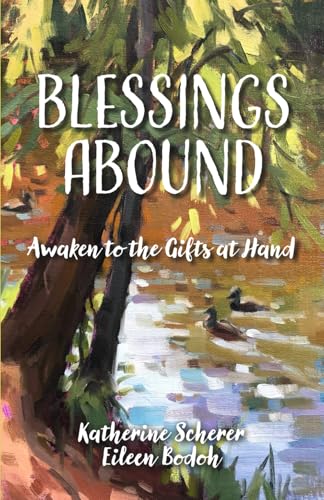
With this book, Katherine Scherer and Eileen Bodoh serve as our guides to revealing them, glorifying them, and super-charging them. Drawing upon inner experiences and wisdom, from ancient and contemporary sources, including Native American lore and the Christian Bible, and from a diverse selection of many who have gone before such as Wordsworth, Thoreau, Whitman, Tagore, and others, the authors guide readers as they embark on a journey to discover and appreciate their own inner and outer blessings. With a connection to spirit and their personal divinity, Katherine and Eileen empower readers with the truth, magic, peace, and gratitude inherent in the words.
Discover blessings in human and divine love, in unassumed places, in the natural world, in music, and in our everyday lives. The power and awe of blessings comes forth in waves as the book allows us to realize the unlimited nature of all that we encounter, even aspects of our lives we may think of as painful or trite.
Move away from the mundane if only for a few moments as you read these passages and learn to appreciate the joy that all of our blessings contain and proliferate.
Blessings Abound does that for you.
Miracles Beyond The Crowd

Miracles Beyond the Crowd is a heartfelt call to push past spiritual passivity and step into a faith that moves, reaches, climbs, and refuses to settle. Author Nico Smit weaves together vivid Gospel narratives with pastoral insight, showing how people who pursued Jesus with grit and hunger were the ones who encountered breakthrough. The book traces stories like the woman with the issue of blood, Bartimaeus, the paralytic lowered through the roof, and the Canaanite woman, and shows how each miracle came to someone who would not stay in the safety of the crowd. The message is simple and clear, yet full of fire. Faith walks. Faith presses in. Faith does not back down. Smit invites readers to become people who step toward Jesus even when blocked, ignored, or discouraged.
I was surprised by how personal the writing felt. The tone is warm and direct. It almost reads like a conversation with a pastor who refuses to let you drift into complacency. I felt challenged in ways that caught me off guard. Certain lines made me nod along, and others made me stop and stare because they hit something inside me. The stories are familiar, yet Smit retells them with a kind of urgency that made me feel the tension in each moment. When he describes the woman crawling through the crowd or the friends ripping open a roof to get to Jesus, I could almost feel the dust and desperation. The writing moves quickly and stays clear, and it stirred up old questions for me about what I have quietly stopped believing God for.
I also appreciated how honest the book is about resistance. Smit does not pretend that faith is polished or pretty. He talks about faith that crawls, shouts, stumbles, and keeps going anyway. I felt a kind of relief reading that. It made space for the days when hope feels thin, and the crowd feels loud. The tone is bold and I could feel it pushing me to examine the ways I settle for proximity to Jesus without actually pursuing Him. There were moments I felt encouraged, and others where I felt exposed in the best possible way. The writing carries a strong emotional pull. It made me want to stand up and believe again for things I had quietly filed away.
Miracles Beyond the Crowd is a passionate and stirring read. I would recommend it to anyone who feels stuck, weary, or spiritually dull, and especially to those who believe in Jesus but have lost the fire to chase after Him. It is a great fit for people who love practical faith stories, people who enjoy devotional style encouragement, and anyone longing for fresh hope.
Pages: 122 | ASIN : B0FX5ZH62M
The Diary of Vivienne – Is hope enough?

The Diary of Vivienne unfolds as a layered and haunting story. It follows a hidden journal discovered in the ruins of a future society that has scrubbed away its own painful past. The entries from Vivienne Rose, her partner Richard, and the ethereal teachings of Neferatu paint a world that swings between collapse and renewal. War tears through nations, faith shakes, and reforms itself, and ordinary people cling to hope as their only compass. The book wanders through violence, prophecy, political decay, and spiritual awakening, then suddenly shifts into a bright new age where humanity tries to forget what nearly destroyed it. The result is a narrative that asks, again and again, if hope can save us or if forgetting our darkness only guarantees its return.
I found myself caught between admiration and discomfort as Ashby moves from intimate confessions to sweeping political commentary. Sometimes the writing feels like a storm that refuses to settle. Other times it quiets into soft moments of grief or tenderness, especially when Vivienne speaks of her daughter or her friends. I loved those parts. They felt raw and human. But I kept circling back to the idea of Neferatu. His teachings land with a strange mix of poetry and severity. I felt drawn in, then pushed back out, unsure if I was reading wisdom or warning. That tension made the experience oddly addictive. I kept turning pages just to sit with that uncertainty.
The political edges of the book hit me differently. Ashby writes with open frustration about the collapse of governments, the decay of social trust, and the failures of institutions. Those sections made me pause because they echoed fears many people carry but rarely spell out so boldly. Sometimes I nodded along. Sometimes I winced. The diary style makes these passages feel personal rather than preachy. Still, the blend of prophecy, politics, mysticism, and dystopia can feel dizzying. But I liked the daring mix. The emotional swings, though, are what give the book its pulse. I felt alarm, sadness, wonder, and even hope that felt shaky but real.
I would recommend The Diary of Vivienne to readers who enjoy stories that blur the line between spiritual reflection and dystopian fiction. It fits anyone who likes a narrative that thinks out loud, pokes at uncomfortable ideas, and makes you question what you believe about society, faith, and the future. If you want a book that lingers in your mind long after you close it, this one will do just that.
Pages: 288 | ASIN : B0F6TFS5DG
Blessings Abound: Awaken to the Gifts at Hand

Blessings Abound is a short and sweet guide designed to help us spot the good things in life. Katherine Scherer and Eileen Bodoh wrote this book to help readers wake up to the gifts they already have. The authors break the content down into three main buckets. These are blessings we receive. There are blessings we ignore. And there are blessings wearing masks. The pages are packed with quotes from famous folks like Rumi and Abraham Lincoln. It explores how nature and music and friendship make life rich. The main goal is to shift your mindset from complaining to appreciating. It acts as a roadmap to peace and wonder.
I honestly felt a wave of calm washing over me while reading this. It is not trying to be a hard textbook. It feels like a warm hug. I really liked the way they used so many quotes. It felt like a greatest hits album of wisdom. Sometimes self-help books try too hard. They use big words to sound smart. This one keeps it real. It is simple. That is its superpower. The section on nature really resonated with me. I felt lighter after finishing it. It pushes you to use your heart more than your head.
The authors talk about blessings in disguise. This part made me think. It is hard to see the good when things go wrong. But they make a solid point. They mention people like Edison, who failed but kept going. That was inspiring. I also noticed the book gets pretty spiritual near the end. It talks about God and the Bible. They included Native American prayers, too. It felt like they wanted to welcome everyone. The focus on gratitude as a tool to fix a bad attitude is smart.
I think this book is a solid pick for anyone feeling a bit burnt out. If you need a mental reset. It works well as a coffee table book. You can pick it up and read a page or two. It does not demand a lot of your time. It just asks for an open heart. I would gift this to a friend going through a rough patch. It reminds you that the world is actually pretty cool if you look closely. Give it a shot if you want to smile more. It is a quick read with a long-lasting impact.
Pages: 58 | ASIN : B0FBSTLR27
Sacred Celebrations: Designing Rituals to Navigate Life’s Milestone Transitions

Sacred Celebrations is a warm and soulful guide to marking life’s transitions with intention and love. Elizabeth Barbour weaves stories from her own life with practical teachings about rituals, ceremonies, and the ways we gather around beginnings and endings. The book moves through birth, marriage, loss, illness, and the everyday moments that often slip by. It shows how rituals can help us slow down, breathe, and feel anchored in a world that moves too fast. Her stories are tender and sometimes raw, and they shine a light on the human need for connection during joyful and difficult times.
Barbour’s writing carries an honesty that caught me off guard, and I kept pausing just to sit with her words. The scene where she describes her mother’s final days was emotional. I felt the weight of that love and conflict. I also laughed at simpler moments, like the chaos of celebrations that go sideways or the small joys tucked into everyday rituals. Her style is comforting. It’s like listening to a friend who has lived a lot and is willing to tell the truth about how messy life can be. I appreciated how she took rituals out of the realm of “big spiritual practices” and grounded them in regular life. This made the whole idea feel doable for anyone.
What struck me most was how gentle her guidance felt. She never pushes. She invites. The book nudged me to look at my own transitions, even the quiet ones I usually gloss over, and I found myself thinking about the moments I rushed through without honoring how they shaped me. Some parts made me emotional because they stirred up memories I didn’t expect to revisit. Other parts lit me up with curiosity. I kept thinking about how simple actions, like a walk to a creek or lighting a candle, can shift the way we move through the world. The book feels both practical and mystical in a way that surprised me. I kept underlining sentences and dog-ear pages.
I would recommend Sacred Celebrations to people who crave meaning in their routines, anyone moving through a major transition, and those who want to deepen their emotional or spiritual life without anything too complicated. It’s also a lovely fit for caregivers, coaches, therapists, ministers, or anyone who holds space for others. The book feels like a soft place to land, and it left me wanting to create more intentional moments in my own life.
Pages: 252 | ISBN : 0972468692



 LITERARY TITAN