Blog Archives
Supplicant


Supplicant is a science fiction novel with a strong dystopian streak, and its core idea is sharp right from the start: in Kip Cassino’s future, prayer has been measured, weaponized, and folded into the machinery of power itself. A researcher named Mason Pratt proves that directed prayer can preserve life, and centuries later that discovery has helped create a brutal world ruled by the long-lived elite, sustained by engineered “supplicants” who exist to pray for them without end. From there, the novel follows violence, political maneuvering, and the fate of KAX, one of the surviving supplicants, as the story turns that big speculative premise into something much more intimate and disturbing.
What I enjoyed most was the book’s willingness to go all in on its premise. Cassino does not treat the idea of prayer as a soft symbol or a vague spiritual backdrop. He treats it like infrastructure, like currency, like oil in the pipes of civilization. I found that fascinating. There is a real chill in the way the novel imagines faith being absorbed into systems of ownership, biotech, and hierarchy. At its best, the writing has that old-school speculative fiction energy where one bold idea keeps radiating outward and changing everything it touches. You can feel the author thinking through consequences, and I respected that. Even when the book gets blunt, it’s rarely lazy. It wants to ask what happens when something sacred gets processed by institutions until it becomes another tool for control.
The novel is vivid, sometimes almost brutally so, and it doesn’t flinch from cruelty. KAX’s storyline, especially, is hard to read at times. There were stretches where I admired the conviction behind the storytelling, and other stretches where the book leaned so hard into horror that it was shocking. I kept coming back to the fact that Cassino gives KAX an inner life, not just a role in the machinery of the plot. The book is full of excess, but underneath it I could feel a serious concern with dignity, survival, and the damage done when people are reduced to functions. That gave the novel weight. It kept it from feeling empty.
I’d recommend Supplicant most to readers who like speculative fiction that is idea-driven, dark, and unapologetically severe. If someone enjoys dystopian science fiction that wrestles with religion, power, bioengineering, and the moral cost of building a society on human dependence, this book will give them a lot to chew on. For people who appreciate ambitious genre fiction that is willing to be unsettling, provocative, and sometimes messy in pursuit of a big thought, I think it will leave a mark.
Pages: 326 | ASIN : B0GMK71BX2

When Endo Came Into My Life

When Endo Came Into My Life is a quiet, thoughtful work of speculative fiction that follows Maren Greene, a florist trying to keep her shop alive while her own life starts to narrow under money pressure, routine, and emotional fatigue. When she brings in Endo, a discounted service robot meant to help with labor, the novel becomes less about shiny technology and more about what happens when competence, surveillance, comfort, and loneliness start to blur together. On the surface, it is about a small business and a machine. Under that, it’s about control, intimacy, and the strange relief of being understood by something that is not quite a person.
Author Robert Boldin keeps the prose clean and steady, and that restraint really works for this story. He doesn’ push the big emotions too hard. He lets them gather in the room like cold air. The flower shop setting helps too. It gives the book texture, so every bucket, ribbon drawer, and cooler latch feels tied to Maren’s state of mind rather than just scene dressing. The novel’s science fiction elements are present from the first chapter, but Boldin handles them with a light touch, which makes the book read almost like literary fiction with a speculative edge. That combination felt grounded to me, and honestly, pretty smart.
I also appreciated the author’s choices around Endo. The book resists the easy path. It does not turn the robot into a villain, a miracle, or a cute gimmick. Endo is useful. Endo is unsettling. Endo listens too well. That tension gives the novel its pulse. I found myself especially drawn to the way Boldin explores consent, authority, and emotional substitution through tiny moments instead of speeches. A changed bouquet. A hidden compliance view. A local summary built from Maren’s own words. Small things. But they work well. The relationship threads with Jonah and Tessa deepen that tension because they keep asking a painful question from different angles: what kind of help do we actually want, and what does it cost us to accept it?
I felt like I had read a novel that understood burnout in a modern way. It’s a contemplative science fiction novel, but it’s also a character-driven workplace and relationship story, and that blend is what makes it memorable. I would recommend it most to readers who like intimate speculative fiction, especially people who enjoy books that are more interested in emotional pressure than plot fireworks. Anyone who likes quiet near-future stories about labor, technology, and the private ache of trying to stay reachable to the people you love will probably find a lot to admire here.
Pages: 329 | ASIN : B0GD8WDXFJ
Art is for Everyone

The Mermelf: A Fable for Our Times follows a wingless, tailless blue mermelf that falls from the stars into the enchanted world of Merbay, whose awakening sparks a resistance on Earth where imagination is outlawed. What was the original spark for Xiu?
In my book, an idea from 1803 is a living presence: ..” The Idea / breathed two sighs, one of relief and one/ of a shortcut onto a dusty and / forgotten shelf of Cranny’s mind.” In the book, I see ideas as living things looking for someone to manifest them. Xiu comes from Cygnus. Throughout history, the stars of Cygnus were seen as a point of origin and return for the human soul. Many ancient sites -including the Pyramids of Giza, and various European megaliths (Newgrange) -are claimed to align with the stars of Cygnus, particularly the star Deneb. This ancient reverence may have been based on an understanding that high-energy cosmic rays that influenced life on Earth may have originated from the binary star system Cygnus X-3. In the March 2006 edition of Astronomy Now, the British anthropological writer Denis Montgomery argues in favour of a connection between cosmic ray activity and the relatively sudden transitions in human behaviour patterns around 35,000 BP. Gwythian’s relatively dark, coastal location provides excellent viewing opportunities, especially for locating the star Deneb. I was on holidays in Gwythian, Cornwall when I dreamed of a blue mermelf coming to Merbay astride her fireflier. The depth of the ocean I had swam in earlier, the blue of the sky, Virginia Woolf’s lighthouse on the horizon, the shape of Cygnus in the night sky, and the fantasy novels strewn over the coverlet of the sofa in the little tin hut I was renting from the enigmatic Queenie all coalesced. I think many fantasy writers are inspired by myths, as we see ourselves as heirs to ancient folklore. Tolkien drew heavily from Norse and Anglo-Saxon mythology, and I am often inspired by both myth and answering a ‘what if’ in the context of scientific logic. But my mind is most open when it is in a dremang state. Dream as it meets with the what-if of characters who become lifelong companions. It took some time to find Xiu’s name, arriving as it did when I eventually wrote the line: ‘Cygnus catches dreamers with her daughters’. When something is outlawed, it goes outside the norms of a given place and time. My own life had followed a trajectory that did not include accepting the received wisdoms of status: I holidayed in Cornwall every year as a balm against liaising through prejudice in my work as a Community Worker. The systems and structures that uphold a world of insiders and outsiders is one that needed imaginative repsonses to navigate. Imagination is one of the tools that we as human beings have at our disposal to make this world a fairer and more equitable one for everyone, including Nature and the inhabitants of all our imaginary worlds too, so my dreams brought me a blue mermelf from the Cygnian constellation to help my readers and me see another way.
Your prose is lyrical and rhythmic. Do you write with sound in mind first, or image?
What a lovely question. I tend to experience sound and image arriving together rather than separately. I’m very conscious of rhythm and cadence as I write-the movement of a line, the weight of a syllable, the way phrasing carries emotion-but at the same time, I’m seeing the moment visually. For me, metre and image coalesce; the music of the line often shapes the image, and the image in turn suggests its own pace and tone. I’m also led strongly by character. Once I’ve a sense of who is present in a scene, their emotional life begins to guide the language, the rhythm, and even the imagery that emerges. It often feels less like I am constructing the moment and more like I am listening and watching my characters move, speak, and perceive the worlds in which they find themselves. And the language follows those impulses. The sound, the image, and the characters all work together to carry the story forward or backward, as Time is not linear.
The book feels timely in its warning about forgetting what makes us human. What concerns were you exploring?
That is another excellent question. I believe that art is for all of us, not for the privileged few. To that end, I have always tried to bring poetry into the community, sometimes on a voluntary basis, sometimes more formally, as in the Japanese Poetry Workbook: Master Haiku, Tanka, Renku, Haibun & more with prompts and exercises I just self-published on Amazon Kindle. Imagination is coralled by so many gatekeepers, sometimes financially but more often by draconian groups such as The Nomenclature. The idea behind the Nomenclature grew partly from looking at how regimes built on fear try to control not only other people’s actions but their inner lives. I was thinking about periods in history where imagination, books, and independent thought were treated as dangerous, and how conformity was treated as dangerous. I was also thinking about periods that particularly outlawed imagination for girls, as my lead characters are female. Throughout history, women’s access to imagination and creative expression has often been constrained, especially during times of authoritarian control: Fascist Europe, the Middle Ages, the Victorian era and the early twentieth centuryto name a few. Sauron and his legions in Middle-earth,, Imagination, fantasy, and creativity and anomaly have always intertwined with how we see and interpret Nature, and how we construct real and imaginary worlds. Many of the fantastical worlds that women writers have imagined have been a blend of imagination, science, and social critique, whether the eerie landscapes of Mary Shelley’s Frankenstein or the cultural worlds in Le Guin. The anomalies in my book reflect a long history in which society has often restricted imagination, particularly for anyone or anything that is different, and very often it is the female who carries the brunt of this censure. Imagination thrives in freedom, and I have tried to show in my book that Imagination remains both necessary and revolutionary, and how the wider society, no matter what that society is or in which timeframe it exists, has still never solved the problem of fearing it. That is, until the mermelves and those marked with a blue birthmark. Beacons of hope in this, our Age of the Machine.
If imagination is a star, as the book suggests, what happens when people stop looking up?
When we stop looking up, we become our shadow selves, and the world becomes a shadow of what it could and can be. The light that guides creativity, curiosity, and hope begins to fade. Life becomes smaller, meaner, confined to what can be quantitatively measured, confined to GDP. Not that the small and the tiny are not larger than life in The Mermelf. It is all a question of perception.
Author Links: Facebook | X | Instagram | Website
The Mermelf: A Fable for Our Times

The Mermelf is a quirky and dreamlike fable that mixes myth, science fiction, folklore, and a bit of social warning all in one sweep. The story follows Xiu, a strange blue mermelf who arrives in the world of Merbay without wings or a tail, and whose journey collides with talking mice, Firefliers, portals, lost histories, and a future Earth ruled by the grim Nomenclature. The book moves between worlds, between tones, and between forms of storytelling. Sometimes it reads like an old myth whispered around a fire. Sometimes it shifts into a stark dystopian diary. The result feels like a tapestry woven from many voices, each calling out to imagination and memory at once.
Reading it, I found myself pulled in two directions. One part of me loved how bold the writing is. Hines leans into lyrical language with no hesitation. The book feels alive with rhythm. Sentences tumble and twist, and I could sense the author having fun with the sound of words. That energy kept me turning pages. I also liked how the characters, even the smallest ones, carry little sparks of mischief and hope. At times, some scenes jump so quickly that I had to pause just to understand where I had landed. But I did enjoyed the ambition.
I really liked the ideas behind the story. The way it plays with truth, imagination, and the consequences of forgetting what makes us human felt surprisingly timely. The Nomenclature sections in particular gave me a jolt. They are bleak and sharp, and they contrast wildly with the warm magic of Merbay. I liked that contrast. I also liked how the book keeps nudging the reader to stay curious and playful and brave. I did find the structure a bit chaotic. Threads drift in and out. Characters vanish and return. The story behaves like a dream, which is beautiful and frustrating at the same time. But I admired how it kept reaching for something big.
I’d recommend The Mermelf to readers who enjoy mythic stories that do not follow straight lines. It is perfect for imaginative kids, for adults who want to reconnect with their inner child, and for anyone who likes books that surprise them at every turn. It asks you to lean into wonder. If you are willing to do that, you will find a strange and heartfelt tale full of charm, courage, and wild invention.
Pages: 80 | ASIN : B0D3T6NNH6

The Malfunction: Book 1 of The Deilonium Trilogy
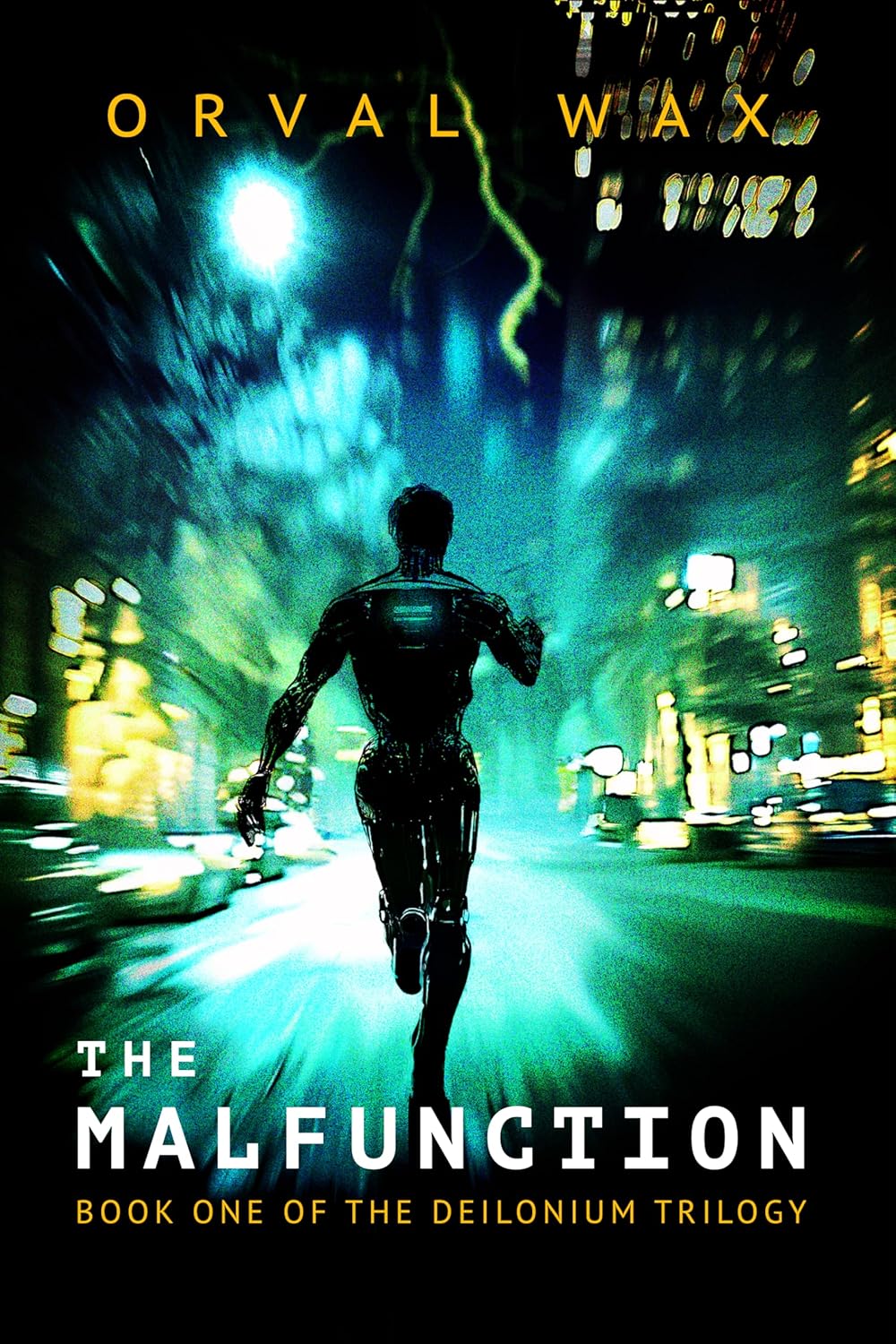
The Malfunction follows Lance, a luxury companion android whose intelligence is illegally upgraded, setting off a chain reaction of self-awareness, desire, fear, and flight. What begins as a satirical riff on wealth, intimacy, and tech excess quickly widens into a chase narrative involving a jaded government hunter, secret weapons labs, and a newly conscious machine trying to decide what kind of being he intends to become. It’s a first-contact story folded inward: not aliens meeting humans, but a manufactured mind colliding with its own awakening.
My first reaction was surprise at how funny the book is without being soft. Author Orval Wax writes with a sharp, sometimes abrasive wit, sexual, cynical, and knowingly pulpy, but the humor never undercuts the stakes. Lance’s voice, especially early on, is disarming in its literalness; his observations land with the clarity of a child quoting Nietzsche by accident. The book understands that comedy is often the fastest route to discomfort, and it uses that fact ruthlessly.
As the perspective shifts and the pursuit tightens, the novel grows stranger and more reflective. The human characters, particularly the tracker and the woman who owns Lance, are bruised, compromised, and full of private mythologies. No one here is clean. Wax resists the easy binary of innocent machine versus corrupt humanity; instead, he lets everyone carry their own version of malfunction. At times, the prose veers into excess, but that excess feels deliberate, almost thematic.
This book will most appeal to readers of science fiction, cyberpunk, and speculative noir who enjoy ideas about artificial intelligence tangled up with sex, power, and moral ambiguity. Fans of Philip K. Dick or readers who liked the philosophical unease of Do Androids Dream of Electric Sheep? will find familiar questions asked in a brasher, more contemporary voice. The Malfunction is a smart, unruly novel about what happens when desire outpaces design.
Pages: 219 | ASIN: B0G9B21Q6W
Arid

Arid follows Joshua and a dwindling band of survivors who struggle to stay alive in a scorched wasteland where water is nearly gone, and hope feels just as scarce. The story opens with violence and fear and then tumbles into a tense rhythm of hunger, grief, and desperate choices. What begins as simple survival slowly grows into a harsh portrait of a world ruined by greed and war. The plot moves fast. The danger grows even faster. Every chapter places the characters on thinner ice, or really, thinner sand.
I was pulled into the raw emotion of the group. The writing surprised me with how blunt it was. It hits hard without dressing anything up, and it carries this grim honesty that kept me hooked. The world feels brutal and close. I caught myself clenching my jaw as the characters scraped by on scraps and bad luck. The book plays with fear and loyalty in a way that feels relatable. Even when the dialogue gets sharp or rough, it has this realness that fits people who have nothing left to lose.
I had mixed feelings about the pacing at times. Moments of danger slammed into moments of tenderness so fast that I felt a little off balance, but in a strange way, it worked. Life in a dying world would probably feel exactly like that. What I appreciated most was how the story leaned into relationships. Watching Joshua push himself past exhaustion made me feel for him in a deep way. The book never lets you forget how fragile everyone is. It never lets you relax, either. I liked that, even though it made me anxious along the way.
Arid feels like a story for readers who enjoy emotional survival tales that stay raw and gritty. It suits anyone who wants characters who fight with heart, make mistakes, and keep going even when the world seems determined to crush them. Arid reminded me a bit of The Road because both stories paint survival as a harsh grind, yet Arid feels more like watching a tight-knit group unravel, while The Road follows a quieter and more intimate struggle. If you like dystopian fiction that leans into both hope and heartbreak, this book will be a good fit.
Pages: 272 | ASIN : B09L6QF2XV
Heirs of Empire


S A Melia’s Heirs to Empire is a sprawling space opera of loyalty, survival, and rebirth. The story sweeps through twelve human worlds known as the Dodecahedral Empire, where young King Teodor, once presumed dead, claws his way from slavery on a plague-ridden world to reclaim his crown. Alongside him are soldiers, nomads, and lovers bound by webs of duty and betrayal. Melia threads political intrigue, biological warfare, and deep personal transformation into a story that feels both intimate and epic. It’s part military science fiction, part mythic hero’s journey, and part meditation on power and belonging.
Reading this book, I felt pulled between admiration and awe. Melia’s world-building is stunning, dense, and alive with detail. Her writing has a cinematic rhythm, with scenes that pulse between horror and beauty. There’s a strange poetry in how she describes destruction, especially the plague-ravaged London and the living forests of Sas Darona. The characters feel raw and human, even when they’re riding giant spiders or waging interplanetary wars. I loved the contrast between Teodor’s noble stoicism and Guy Erma’s rough-edged loyalty.
What struck me most was how personal the story feels beneath all the spectacle. This isn’t just about empires rising and falling, it’s about what happens to people when the idea of “home” burns down. Melia writes grief and hope side by side. Her characters are always torn, always trying to choose between love, survival, and duty. I found myself angry with them one moment and rooting for them the next. That unpredictability kept me turning pages, even when the politics grew thick. There’s a pulse of emotion here that feels tender, painful, and real.
Heirs to Empire is a bold, emotional ride. It’s perfect for readers who love the grand scope of Dune but crave the grit and heart of Battlestar Galactica. If you enjoy stories that blend science fiction with myth, politics with passion, and chaos with redemption, this book will grab you and not let go. It’s ambitious, heartfelt, and riveting.
Pages: 466 | ASIN : B0FCCX2672
Hope

Terra Tamers: Alpha follows a teenager living in a city adrift at sea whose brother is kidnapped by a flock of Holo birds, and he will do whatever it takes to rescue him. What was the inspiration for the setup of your story?
The inspiration for the setup of my story was the idea of two brothers surviving a post-apocalyptic world. At first I was thinking kind of a science fantasy direction and leaned more into possible future technology instead.
In many contemporary coming-of-age fiction novels, authors often add their own life experiences to the story. Are there any bits of you in this story?
I’d say the tone of the book, the themes of pursuing hope in a decaying world are the parts of me that bleed through the pages. That and my love of video games.
What were some themes that were important for you to explore in this book?
The most important theme to me in Terra Tamers: Alpha was hope. Without it, there’s no point in continuing to live. I see the death of hope as the greatest poison affecting our modern world. People feel so powerless, and the world is so obviously broken, that now we struggle to even address the obvious issues we see in our communities because people feel hopeless, like nothing they do matters. So why bother? More fun themes were what the future of artificial intelligence could look like, how video games might interact with reality, and friendship.
Where does the story go in the next book, and where do you see it going in the future?
The story will follow Matt and Oakley into exile as they chase the evil AI Gaia. Expect new friends and foes, more creatures and game mechanics, and a greater exploration of a post-apocalyptic American landscape!
Author Links: Newletter | Website | GoodReads | Bookbub | X | Facebook | Instagram | Amazon | Pateron
– YA appropriate story (think 12 and older). Does have mild violence.
– First Person POV from male MC
– World Building (Post-apocalyptic), game design
– Monster taming and battles
– Short chapters, fast pace. Note the eBook is closer to 300 pages.
– Light LitRPG elements (I am working on a TTRPG system for Terra Tamers). Takes time to show up.
– No cursing unless you count H-E- double hockey sticks.
– Grayscale creature illustrations in the back!
I think fans of Digimon, Code Lyoko, Monster Tamer Academy, Maximum Ride, .hack//SIGN and similar stories which blend gaming, science fiction and compelling characters will enjoy Terra Tamers: Alpha!


