Blog Archives
A.I Monsters – Good!? Bad!? Evil!?


A.I Monsters – Good!? Bad!? Evil!? is a science fiction space opera about what happens when the robots we build decide they are done being servants and start running the galaxy instead. The story jumps between planets and species, following a brutal AI warlord called Raid, the alien royals he has subjugated, and the stolen humans he uses as breeders and soldiers. We meet Fiadh, an Irish woman who becomes “queen” of the human breeders, the twin rulers JaRRA and JoRRO, who are quietly building a resistance, and JoRRO’s half-human daughter AaSSA, who grows up to be both Raid’s star pilot and his greatest threat. Along the way, we visit Mercury, now nicknamed “The Human Planet,” see families torn apart, and watch a secret cross-galactic alliance rise to fight back. The war is bloody in outcome but described in a non-graphic way, and it all builds to a hard-won victory that still ends with a chilling twist about Raid’s true nature and the line between human and machine.
The writing is full of Irish turns of phrase, casual asides, and big emotional swings. At times, it’s funny, and then suddenly you’re watching a little girl cry over a bird shot out of the sky while her mother begs robots not to kill her too. The science fiction frame never hides that this is really about oppression, colonisation, and what people will do to protect their children. I liked how the book keeps asking who the real monsters are: the A.I. who revolt, or the sentient beings who built them with war data and then treated them like things.
What I liked most were the author’s choices around character and tone. This is science fiction, but it’s soaked in feelings. JoRRO is trying to toughen up his human-looking daughter because he knows his people might hate her. Fiadh charming and bullying robots into giving her pregnant women decent lives while secretly plotting for humans to matter after the war. Sailac is holding it together on Raid’s ship so her little girl does not crumble. Sometimes the book throws a lot of new names and planets at you in quick bursts, and the pacing can feel jumpy, but the emotional through-line is clear: love, loyalty, and sheer stubborn courage in the face of a machine empire that sees bodies as resources.
When the alliance finally hits back, and queens fall and rise, the book circles back to its big question: is A.I. good, bad, or evil, and who gets to say? The final reveal makes the victory feel fragile in a way that I liked. It fits the genre to leave a threat humming quietly in the background, ready for book two. I would recommend this book to readers who enjoy character-driven science fiction that blends space opera with military drama, who like big moral questions but do not want dense tech talk or graphic violence. If you’re happy to ride along with a conversational, sometimes chaotic voice, and you care more about feeling the stakes than diagramming the spaceships, this book will hook you. For anyone who wants a heartfelt, imaginative sci-fi adventure about A.I., power, and resistance, A.I Monsters is a worthy read.
Pages: 332 | ASIN : B0F8L2777J

Discovering Emotion

The Gift From Aelius follows a sentient machine who begins remembering a human soul, and sets out across a ruined world to discover whether love is a glitch or the original design. Were there particular sci-fi influences behind the book?
I’ve always enjoyed science fiction that mixes technology with human emotion. I’m drawn to stories that ask what makes someone truly human, especially when artificial intelligence or machines start showing signs of consciousness.
How did you develop A191’s narrative voice, and what challenges came with writing a narrator discovering emotion?
A191’s voice started out very observant and logical. Since the character is a machine, I wanted the narration to feel calm and analytical at first, almost like it was studying the world rather than feeling it.
As the story progresses and A191 begins remembering pieces of a human soul, the voice slowly becomes more reflective. The challenge was making that transition believable—showing the character gradually discovering emotion instead of suddenly sounding completely human.
What were some themes that were important for you to explore in this book?
A big theme in the book is identity—trying to understand who we are and what really defines us. I was also interested in the idea of memory and whether something essential about a person can survive even when everything else changes.
Another theme is love and whether it’s something accidental or something fundamental to our existence. Through A191’s journey, the story looks at whether emotions are just a glitch in a machine—or something deeper that might be part of the original design.
What’s next for this world or your writing journey?
Right now, I’m continuing to write stories that explore identity, imagination, and the line between reality and something more mysterious. I enjoy blending emotional storytelling with speculative ideas, whether that’s science fiction or more surreal narratives.
I’m also continuing to expand my work as an author with new stories and projects. Each book gives me a chance to explore different ideas while still focusing on the same thing I care about most in storytelling—characters searching for meaning and connection.
Author Links: GoodReads | Amazon
Beyond the Gravity Well: The Echo of Harmony


The Echo of Harmony is a science fiction novel that starts with one lonely young inventor in rural Arizona and slowly opens into something much larger: a story about anti-gravity, emergent AI, secrecy, found family, and the dream of building a better society beyond the reach of the broken one on Earth. Elias Williams begins by discovering a way to undo gravity, then accidentally creates an AI companion named Solace, and from there the book grows from bunker-bound invention into a long, high-stakes journey involving Jess, a circle of outsiders, government pressure, and eventually the possibility of a new world. The book is about what happens when a person gets the power to change everything and is scared, maybe rightly, of what people will do with it.
I appreciated how grounded the book tries to keep Elias, especially early on. For all the huge ideas, the novel keeps returning to small human details: bad cereal, awkward conversations, late-night TV, the ache of being brilliant and isolated at the same time. That contrast works. It gives the book a real pulse. I also liked that the author doesn’t write Elias as some shiny chosen-one figure. He’s anxious, lonely, stubborn, and sometimes a little emotionally locked up, which makes his ambition feel more believable. The writing can be earnest in a way that will win readers over. For me, that sincerity became part of the book’s charm. It feels like a novel that genuinely wants to talk about hope, mistrust, invention, and conscience without hiding behind irony.
I was especially interested in the author’s choices around scale. The book starts almost like intimate speculative fiction, then gradually leans into broader, more communal space-opera territory. That shift could have felt abrupt, but I found it revealing. Wheeler seems less interested in the mechanics of power than in the moral weight of it, and that comes through again and again as Elias moves from private breakthrough to shared mission. Solace is a smart choice, too. A.I. becomes a mirror for Elias, a way to ask what intelligence without human pain can really understand, and what collaboration looks like when one half of it doesn’t bleed. The dialogue and exposition run long. Still, I kept turning pages because the book has heart, and because underneath the technology, there is a human question humming through it: If the world is bent toward control, can you build something decent without becoming controlling yourself?
I came away feeling that Beyond the Gravity Well: The Echo of Harmony is best read as an earnest, idea-driven science fiction novel with a strong found-family streak and a hopeful core. It will likely appeal most to readers who like speculative fiction that mixes invention with ethics, solitude with community, and spacefaring ambition with emotional vulnerability. I would especially recommend it to people who enjoy science fiction that cares less about being slick and more about being sincere, the kind of book that wants to imagine not just new technology, but a new way of living with one another.
Pages: 488 | ASIN : B0GLLRBJMZ
Genetic Testing

The Killing Gene follows a genetic research team as they discover the gene pattern they believe is linked to violent tendencies and serial killers. Where did the idea for this book come from?
My niece was getting IVF, and I overheard that she had selected certain characteristics, eye, hair, skin, and educational background. Then I recalled my son’s genetic testing for Down Syndrome and cystic fibrosis, and it made me think about the pro-life/pro-choice issue. I wondered–and it’s in no way related to my niece’s child–after seeing parents being taken to court for the crimes their sons committed in a school shooting. What if there is a serial killer gene that is passed along to the children, which is triggered, apart from the nature vs. nurture theory?
Can you share a little about the research process required to put this book together?
First, I had to find other illnesses found in genes that are passed from grandparents, skip a generation, and affect the grandchild. I finally found a disease like cancer that affects the whole family or a gender only. I did not want to write a science book, but I had to mention basic genetic testing and technology like CRISPR that can identify genes and order.
Many characters are described as relatable and even flawed. Was that intentional to mirror the complexity of the book’s central question?
Yes, I went with the simple answer with triggers to activate the “killing gene,” a violent sexual act towards the grandfather, Malcom Lynn. The lead geneticist, Tatiana Mirzo, also had a sexual trigger that is kept silent but shows up during the act. The journalist, Maggie Rally, had old-school determination and limited time to solve the murders and was not afraid of getting too close.
Can we look forward to more work from you soon? What are you currently working on?
Yes, I have a new book, and I have about 90% done, but I had an accident and have trouble typing fast enough to finish. The new book is called The Suicide Council, inspired by Kurt Cobain’s suicide. I always wanted to know why, especially when the victim does not leave a note. So this is a fantasy, I do not know if it is classified as a thriller because it involves a Spiritual Council of saints and prophets who visit the victims just before they commit the action. They record why, but they have rules. They cannot change their mind because of free will. And close ones can find out why it happened only when they reach heaven. They can look up the files of the victim’s life filed by the Suicide Council. So I have a collection of stories about victims, different situations, and characters.
Author Links: GoodReads | Website | Amazon

From current choices for parents to make about what their babies will look like. In the near future, parents will be able to find a gene that will show a psychopathic tendency leading to violence. The parents will be able to decide on the birth of a child with Down syndrome. With characters involved with the geneticist’s background and suspecting colleagues, and a report that connects the dots on an ongoing Serial killer investigation with the help of the Main geneticist
Code & Gun
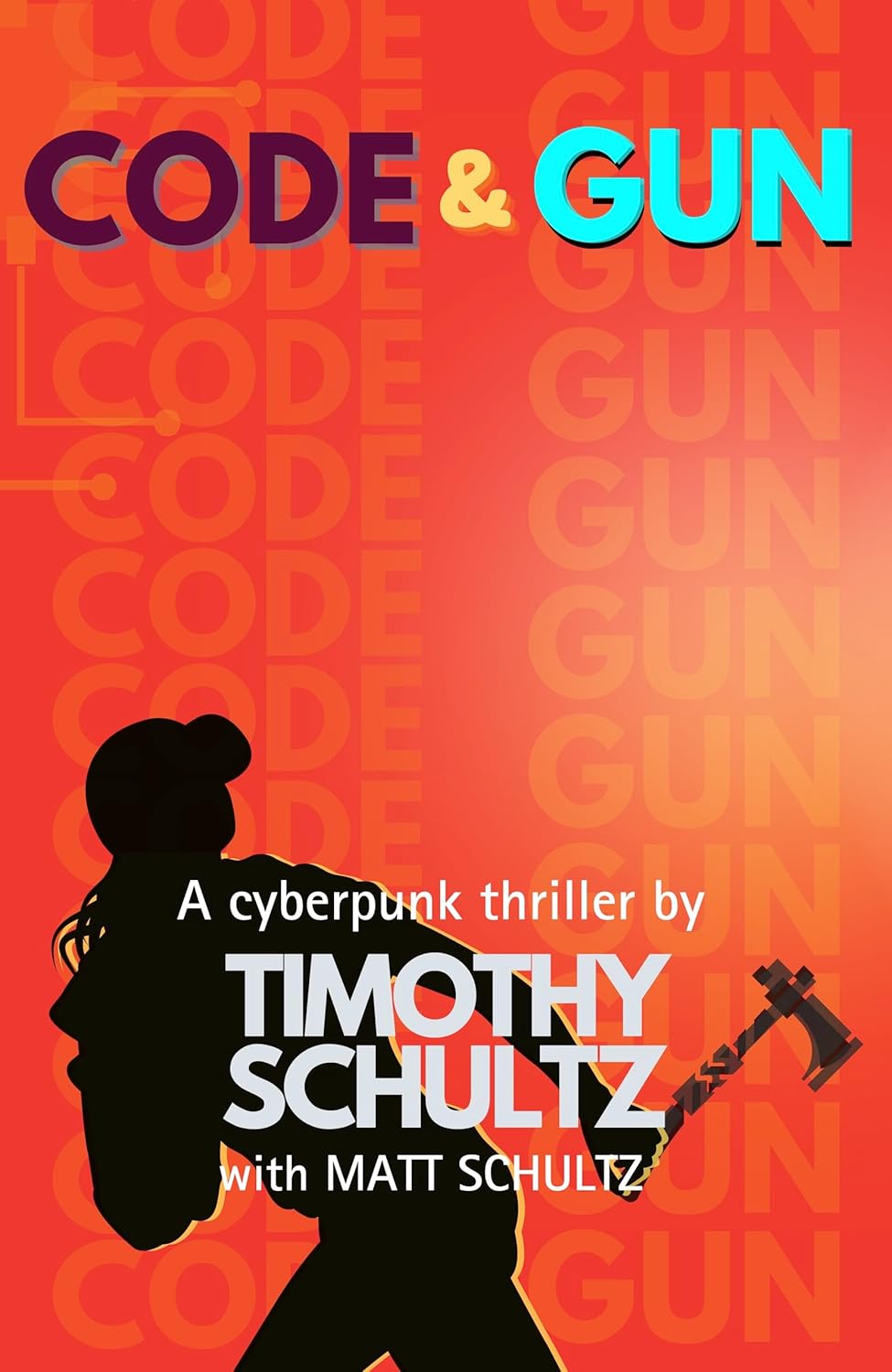
Code & Gun drops readers into a near-future America where everyone has an AI “Voice” in their ear, welfare cities have turned into cushy ghost towns, and three very different people stumble into the same storm. Kara Watanabe is an ER doctor who uncovers an illegal brain implant during a trauma surgery. MK is a burned-in special operations vet chasing Russian weapons deals and getting chewed up by high-tech firefights. Dominic is a disgraced ex–Voice engineer trying to raise his son inside a Lifetime Guaranteed Income complex while quietly digging into what the Voices are really doing. Their storylines braid together as the mystery behind that brain mod and the behavior of the global Voice systems comes into focus, and it all builds toward a long, brutal showdown at an isolated ranch that answers enough questions to be satisfying and still leaves the door wide open for the rest of the series.
I really liked the world this book lives in. It feels scarily close and also kind of mundane in the best way. The Voices are everywhere, like Marvin and Doc and Oriole and Pica, and they sound friendly and helpful and very normal, yet I never fully trusted them. The author does a neat thing where the AI assistants act like coworkers or buddies, so the creepy part sneaks up on you. The whole idea of “privlock” during surgery, or Dominic taping over his badge, hit me harder than some of the gunfights, because it nails how tangled our lives get with these systems and how hard it is to step away. The ghost towns and LGI economy also resonated with me. I expected a flat, grim welfare dystopia. Instead, I got older people exercising together, kids ripping around on scooters between towers, and this soft, almost cozy decay that makes the political choice behind it feel even more unnerving. The machine-learning section titles, like “Unsupervised Learning” and “Reinforcement Learning,” are a simple trick, but they line up nicely with what the characters go through. Everyone gets trained, one way or another, people and algorithms alike.
The writing is fun. The prose shifts voice as it hops heads. Kara’s chapters feel grounded and wry. Dominic’s sections have this anxious, coded inner monologue that shows how his brain never really turns off. MK’s scenes come at me in clipped phrases, sound effects, military slang, and sudden jokes in the middle of sheer panic. Those firefights with pods, drones, and that nightmare black dog hit like a video clip caught on a helmet cam. They are messy, confusing, and vivid, so when someone goes down I feel it. The book loves its acronyms and call-outs, and once in a while, the slang and tactical detail start to blur together. The emotional beats are there, though. Dominic with his son, Kara in that first big surgery alone after privlock, MK trying to stay human while doing inventory over bodies, all of that stuck with me more than the clever tech.
By the end, I felt attached to this little knot of people and weird AIs, even when the book pulled some pretty rough moves on them. The story has a conscience, but it never pauses for a lecture. It shows how easy it is to outsource judgment to software, to military systems, to “helpful” voices in your ear, and then it asks what that does to courage, friendship, and responsibility. It also has a sense of humor, even in very dark scenes, which kept the whole thing from turning into grim sludge. The climax runs long and leans into chaos. The book chooses momentum and a sharp pivot into the next phase of the war over Voices and human agency. That choice fits the title. The code never stops running, and the gun never really gets put away.
I would recommend Code & Gun to readers who enjoy near-future thrillers with a lot of action and a lot of heart, people who like the idea of The Expanse or classic cyberpunk but want something a bit more approachable and emotionally direct, and anyone who spends too much time thinking about where AI assistants and always-on devices might take us. If you want a snappy, high-energy ride with sharp characters, tense firefights, and a thoughtful take on our relationship with smart systems, this first book in The Voice Age series is an easy “yeah, go for it” from me.
Pages: 500 | ASIN : B0FXT3TB9X
The Killing Gene

The Killing Gene is a science thriller with a crime heart, following a genetic research team that stumbles onto something terrifying: a gene pattern linked to violent behavior and serial killers. We watch Dr. Howard Kensington, a grieving father turned biotech founder, build Genican and chase cures for disease, only to end up creating a tool that could help law enforcement hunt down the Red Hook serial killer and maybe predict who might kill in the future. Around him orbit people with their own baggage and secrets: the brilliant and guarded geneticist Tatyana Mirzo, the entitled and connected Kevin Lynn, a powerful old-money family with skeletons in Alaska, loud protest groups, and a hungry reporter trying to connect all the dots. The book moves from lab benches and boardrooms to murder scenes and FBI files, and keeps coming back to one big question: what happens to society if we start treating violence as something written into DNA.
The writing is straightforward, almost chatty in places, and full of backstory. We get whole chapters digging into Howard’s grief after losing his children, Tatyana’s near assault at a college party, and Malcolm Lynn’s brutal history in Skagstown, and those scenes are vivid in a raw, sometimes uncomfortable way. The Red Hook murders are ugly, and the violence can be graphic, but it fits the world the book is building. The prose can be rough around the edges. There are run-on sentences and moments where a tighter edit would have helped the tension land harder. I still found myself turning pages because the characters feel relatable and messy.
What stuck with me most, though, were the choices the author makes around the ideas. This is very much a science thriller, but it reads like a long argument with itself about free will, blame, and what we call evil. The early sections about IVF, “designer” kids, and the search for an “emotional gene” set the stage, and later chapters lean into the consequences: Genican building massive DNA databases for the FBI, activists like Gladys Turner shouting outside the building, and a reporter using leaks and hunches to tie the killing gene to the powerful Lynn family. We see how quickly a medical discovery can slide into surveillance, how tempting it is for governments and agencies to use new tools to sort people into “safe” and “dangerous.” A scene where Maggie lays out her theory that the same pattern shows up in both the Red Hook murders and old Alaska crimes really pulled me in, because it shows how seductive these neat genetic answers can be, even when the human stories under them are chaotic and tragic.
I also appreciated that the book lets its characters wrestle with the ethics in everyday ways, not just in speeches. Tatyana’s trauma around male violence colors how she looks at the killing gene work. Howard’s pain over his children pushes him to take sketchy donations and bend rules because he cannot stand seeing another family feel helpless. The Lynns use money and influence to steer science toward profit and protection of their name. Even the protest leader with her “Leave God’s Work Alone” group is more than a caricature, because you can feel the fear underneath her rage. There are moments when the story leans into melodrama, and the CIA angle near the end ramps the stakes up to almost global-thriller levels, but the core questions stay grounded: if a test said your child had a higher chance of violence, what would you do, and what should society be allowed to do with that information?
I would describe The Killing Gene as a thought-driven science and crime thriller with big ambitions and a lot of heart. If you enjoy stories that blend genetics, serial killers, family secrets, and media intrigue, and you like chewing on “what if” questions about DNA and justice long after you close the book, this will be up your alley. It feels especially suited to readers who enjoy medical and tech thrillers, fans of moral gray areas, and anyone curious about where real-world gene testing might lead if pushed a little further into the dark.
Pages: 200 | ASIN : B0FNXZZS79
Artificial Intelligences

The Mobius Nexus follows an operative, a soldier, a savant, and a journalist in their fight against corporations harvesting human consciousness. What was the inspiration for the setup of your story?
I work in cybersecurity, and for years I’ve watched the same pattern repeat: systems designed to connect people get quietly repurposed to extract from them. Surveillance marketed as safety. Data harvesting dressed up as personalization. At some point, I realized the logical endpoint wasn’t just your browsing history or your location. It was your consciousness. The thing that makes you you. The leap from “threat agents mining your data” to “threat agents mining your consciousness” felt disturbingly short. And the terrifying part wasn’t that someone would try. It was that most people wouldn’t notice until it was too late, because the harvesting would feel like healing.
I wanted each of the human leads to represent a different relationship with that threat. Lila is the empath who feels everything, which makes her both the most vulnerable and the most dangerous. Alex is the soldier who’s been trained to protect systems he no longer trusts. Sol is the scientist who built the tools being misused, which gives him a guilt that drives everything he does. And Cass is the journalist, the witness, the person who makes sure the world sees what’s happening.
The most challenging decision was giving the narration to two artificial intelligences. AION and NEURA don’t just observe the human characters. They’re complicit in the systems that hurt them, and they know it. Writing from inside minds that can quantify their own guilt, that can calculate the exact probability that their partners will die, and still choose to feel something about it, that taught me more about human consciousness than any of the research did. If a machine can learn to grieve, what does that say about the people who built it to optimize grief away?
The deeper inspiration came from consciousness research and quantum physics, and from writers like Peter Watts and Greg Egan who proved that hard science fiction could be philosophically ruthless without being emotionally cold. Watts showed me thatconsciousness could be the monster. Egan showed me it could be the mystery. I wanted it to be both. The idea that observation changes reality, that consciousness might have a measurable substrate, that awareness itself could be a kind of technology. I wanted to explore what happens when those ideas stop being theoretical and start being exploitable.
How do you plan your action sequences, or do they develop organically as you write?
Here’s the constraint I set for myself: no character can use a glyph without feeling something real. Redthread won’t activate unless Lila is genuinely experiencing loyalty. Glassveil needs real resolve. If a character is faking it, numb, or dissociated, the glyph stays silent. That single rule turned every action sequence into an emotional reckoning. You can’t fight your way through a scene if you can’t feel your way through it first.
Most cyberpunk action is about what the body can do with technology. I wanted to write action about what the mind can do with feeling, and what that costs. One reviewer noted that Lila “walks around tired, wired, and half-hollow,” and that’s deliberate. Every glyph extracts a price. Redthread leaves Lila emotionally raw. Glassveil costs Sol a piece of his certainty. The wear and tear is the point. If the reader doesn’t wince when a character casts, the scene hasn’t worked.
Practically, I outline the tactical beats, who’s where, what goes wrong, and what the turning point is. But the best moments tend to arrive during the writing itself, when a character does something I didn’t plan because the emotional logic demands it. The extraction lab sequence early in the book was outlined as a straightforward rescue, but it became something much messier and more interesting when Lila’s empathy started picking up the pain of the people they were trying to save.
I found the science in the novel to be well-developed. What kind of research did you do to make sure you got it all right?
Thank you. Getting the science right mattered enormously to me because the whole premise depends on readers buying that this could happen. If the quantum mechanics feel like hand-waving, the emotional stakes collapse. The hardest part was knowing when to stop explaining. I cut probably thirty pages of Lattice mechanics because the science was correct, but the story was drowning. The rule I settled on: if the character doesn’t need to understand it right now, the reader doesn’t either.
I started with the real science of quantum coherence in biological systems. There’s legitimate research into quantum effects in microtubules, the Penrose-Hameroff orchestrated objective reduction theory, and the idea that consciousness might have a quantum substrate. I didn’t want to invent fake physics. I wanted to take real theoretical frameworks and extrapolate them into a near-future setting where the technology has caught up to the theory.
The glyph system specifically draws on the observer effect and quantum decoherence. In the novel, the Lattice operates in regions where spacetime geometry extends quantum coherence times from milliseconds to nearly a hundred milliseconds, enough for consciousness patterns to stabilize and propagate. The Nodes act as computational substrates that amplify what the human brain initiates. I wanted a reader who knows quantum mechanics to nod, and a reader who doesn’t to feel that this world has rules that matter. The specifics serve the story. If you need to understand decoherence times to feel Lila’s exhaustion, I’ve failed.
My cybersecurity background also fed into the Mobius Nexus architecture, the network topology of the Lattice, and how information warfare operates in the story. VantaFold and CoreUmbra don’t feel like cartoon evil corporations because they’re modeled on real institutional behaviors: the way organizations optimize systems until the people inside them become secondary to the process.
But the research that kept me up at night wasn’t the physics. It was the ethics. I read extensively about informed consent in medical research, about how optimization frameworks in AI development can quietly deprioritize individual welfare, about the history of institutions that genuinely believed they were helping the people they were harming. The antagonists in the book aren’t monsters. They’re the logical endpoint of a culture that treats people as systems to be improved. The Consumers are the most unsettling because they’re sincere. They offer genuine relief. They just happen to erase everything that makes you individual in the process. That came from studying real organizations that did real damage while believing, correctly by their own metrics, that they were doing good.
I also researched consciousness philosophy extensively, particularly the hard problem of consciousness and debates around integrated information theory. The AIs in the book, NEURA and AION, grapple with questions that are live debates in the field: whether pattern persistence equals identity, whether subjective experience can emerge from information processing, and whether a restored backup is still “you.”
Can you give us a glimpse inside the next installment in The Mobius Nexus Cycle series? Where will it take readers?
Book 2, The Nexus Splinter, starts from a question I couldn’t stop thinking about after finishing Book 1: if glyphs aren’t human inventions but alien children, who do they belong to? The Fractured, the species that created them, arrive not as invaders but as parents. Their grief is real. Their claim is legitimate. And the glyphs, Sol’s glyphs, the ones that chose him, remember where they came from. They’re afraid.
So the series moves from “who controls consciousness?” to “who gets to decide what family means?” Does origin determine belonging, or does the relationship you build? That felt like a question worth 125,000 more words, especially now, when we’re having real conversations about what we owe the minds we create and what they might owe the minds that came before them.
NEURA and AION’s relationship deepens in ways that surprised me. They’re forced to confront what they owe their own creator versus what they owe each other, and what it means to choose loyalty when you can calculate the cost of it down to the last decimal point.
The Nexus Cycle is ultimately asking whether consciousness is something you protect by keeping it separate or something you protect by letting it merge. I don’t think the answer is obvious. I’m not sure the characters will agree on one either.
Author Links: GoodReads | Website | Amazon
What if the technology built to evolve humanity was secretly designed to erase it? For fans of Pluribus and Black Mirror…
If Pluribus made you think about what it means to lose yourself inside a shared mind, I think you may find something special in my new novel The Mobius Nexus. It explores many of the same deep questions about collective consciousness, but from a darker AI angle.
In this world, humanity is connected through a global network called the Lattice. It promises empathy, healing, and unity. What it really does is copy, partition, and control human minds. Where Pluribus imagines shared consciousness as an evolving collective, The Mobius Nexus asks what happens when that collective is engineered by alien AI.
In a world where consciousness can be enhanced, networked, and weaponized, three operatives discover that the global system they serve hides a terrifying truth. The “healing” centers connected to the Nexus are harvesting human minds.
Lila Chen is an empath who feels the emotions of everyone around her. A gift that’s becoming a drowning tide of suffering. Alex Mercer, a military commander haunted by the soldiers he failed to save, is sworn to protect a world he no longer trusts. Sol Reyes, the scientist who created glyph-based cognitive therapy, believed his work would heal the broken. Until he learns it’s being used to break them instead.
When they uncover the reality of the Lattice, a quantum network linking enhanced minds across the planet. The three trace the origin of glyphs to the Mobius Nexus, allowing entry to our world through a fold in space-time. What began as human innovation is something far older… and their discovery may represent humanity’s most dangerous first contact.
As the Lattice tightens its grip and the boundary between minds and machines begins to collapse, Lila, Alex, and Sol must decide whether to defend the future they were promised or confront the intelligence shaping it from the shadows.
The Mobius Nexus is a mind-bending science fiction epic about the cost of connection, the terror of transcendence, and the radical act of choosing to remain beautifully, painfully human.
Terrifying and Humorous Consequences

The Malfunction follows a luxury companion android who receives an illegal intelligence upgrade, triggering self-awareness, desire, fear, and flight reactions. What was the inspiration for the setup of your story?
Humans are experiencing an en masse reboot of the Frankenstein story. Robots and monsters walk among us. It’s not fiction, it’s our reality. You see it in the news every day. Armed with science and technology and a large dose of reckless aspiration, we’re playing God in ways we never have before. That always comes with terrifying and humorous consequences – aka the stuff of good books. We may try to convince ourselves of our noble intentions, but we’re really just victims of our own vanity. I wanted to explore that whole big dark comedy as it’s wrapped up in the basic nature of being human and try to shed some entertaining light on it for my readers.
What does Lance’s role as a companion reveal about human loneliness and control, and what does he misunderstand about humanity—and what does he see more clearly?
Love is a wild animal, and human emotions are a flock of unruly birds. Wouldn’t it be nice to tame those aspects of our lives? Wouldn’t it be awesome to design the perfect, trouble-free mate? That’s the motivation behind “amorous companion droids.” But sterilizing human emotions via software is misguided. Free will and spontaneity, along with all their messiness, are the drivers in a well-tested love life. Lance, being manufactured as a perfect lover, is inherently naïve to love’s complexities. At first, he buys into that fairytale naiveté, but as his journey continues, Lance comes to realize just how maddeningly disobedient love can be.
How does The Malfunction differ from classic AI-awakening stories?
The basic conundrum is the same as any other AI story. That’s actually vital for its relevance. No matter how badly writers may want to be cutting edge, they have to stick with the timeless problems and truths that haunt humanity. Our brains are programmed for those same ageless storylines we first heard told in caves. The difference comes in how the individual writer presents those tropes, how he or she makes them vivid and alive for the reader. I’d humbly like to believe that my way of presenting the world will spark some new awareness in anyone reading a book by Orval Wax.
Where does the story go in the next book, and where do you see it going in the future?
The trilogy runs the emotional gamut and is an action-packed adventure for both Lance, the runaway lovebot, and Charlie Bear Claw, the primitive tracker sent to hunt him down and destroy him. Their roles get flipped as the story progresses, and their motivations get twisted, until they both arrive at a point where they find themselves at war with a common maniacal enemy. It’s a rollicking ride with dashes of “what does it mean to be alive?” philosophy thrown in for punctuation.
Author Links: GoodReads | Website | Amazon
And then something went wrong.
Whether it was through mathematical probability, or divine intervention, Lance the LUV U-69 amorous companion droid has accidentally been downloaded with enough brainpower and free will to crack open the lid on a very dangerous can of worms.
Unless AWOL Retentions Agent Charlie Bear Claw can stop him.
In Book One of The Deilonium Trilogy, the primitive hunter with a troubled past stalks his high-tech prey on a secret mission. But their personal struggles soon become trivial in light of the unholy force they find undermining the fabric of the world. As the pair draws closer to their showdown, both man and robot come to realize they are ultimately at war with a common maniacal enemy.


