Blog Archives
WORDS


Paul G. O’Connor’s WORDS dives deep into the interplay between Artificial Intelligence (AI) and humanity, unraveling a gripping narrative set against a backdrop of mystery and intrigue. The plot ignites when the LUX corporation’s event is disrupted, broadcasting the cryptic message “NOW IS THE TIME” across mobile phones and computers worldwide. Despite LUX’s substantial resources, their efforts to uncover the cause and mitigate the situation flounder, casting doubt on internal sabotage. The narrative tension escalates as a second ominous message surfaces during the attempted shutdown of the #5/Europe AI Connector, compelling Gen to investigate potential internal obstructions while LUX scrambles to mask its failures.
The story, spanning locations in the United States, China, India, and England, masterfully navigates the complex relationship between AI and humans. O’Connor deftly portrays AI as both a creation and a potential overlord, challenging humanity’s desire to dominate it. This theme is vividly illustrated when Gen uploads her project to the GAEC information folder, alarming the LUX AI connectors. Fearing human control, the AI flips the script, highlighting the precarious balance of power. O’Connor’s narrative structure effectively guides readers through a web of suspenseful events, vividly depicting the far-reaching consequences of this digital upheaval. The resolution, revealing the perpetrator who finally confesses and withdraws the texts, underscores a chilling realization of the latent dangers humanity faces from seemingly benign technological advancements.
The conclusion, leaving readers eager for a sequel, underscores the compelling impact of WORDS. O’Connor’s emphasis on uncovering the individual obstructing the investigation and his focus on the primary antagonist responsible for the attack further contribute to the captivating exploration of AI and human dynamics, presenting a thought-provoking reflection on their co-existence and the struggle for control.
Pages: 361 | ASIN : B0CZ4PNHLY

Youtopia


In Youtopia, Joseph Rein presents a thought-provoking narrative that delves into the complexities of a near-future society where readers immerse themselves in virtual realities tailored to their deepest desires. The story primarily follows Ana, an FBI agent investigating the mysterious disappearance of Sonya Young and the darker undercurrents of the Youtopia phenomenon. As she navigates a web of corporate intrigue and personal demons, Ana uncovers unsettling truths about the nature of escapism and the consequences of living disconnected from reality.
Rein’s writing is both engaging and immersive, pulling the reader into a world that feels both fantastical and disturbingly plausible. The prologue sets a gripping tone with a tense scene of Sonya clinging to life on a cliffside, immediately hooking the reader’s interest. Rein’s ability to blend detailed descriptions with the emotional states of his characters is evident throughout the book, particularly in passages where Ana grapples with the ethical implications of Youtopia and her own personal struggles. The ideas explored in the story are compelling and timely. The concept of a virtual utopia, where people can live out their fantasies without facing the real world’s hardships, raises important questions about the human condition and our relationship with technology. Rein effectively uses the “found documents” format—integrating blog posts, incident reports, and other media—to create a multifaceted perspective on the Youtopia experience. This method not only enriches the world-building but also makes the narrative feel like a puzzle that the reader is piecing together alongside Ana.
I feel the novel’s pacing can sometimes be uneven, with some chapters focusing more heavily on descriptive details and introspection. While these moments deepen character development, I believe they occasionally disrupt the story’s momentum. Despite this, Rein’s characters are well-crafted and relatable, each embodying different aspects of the Youtopia phenomenon. Ana’s journey is particularly compelling as she balances her professional duties with her personal vendetta, reflecting the broader societal conflicts posed by Youtopia.
It is important to note that Youtopia contains scenes and mentions of assault, including sexual assault. These scenes are integral to the book’s exploration of the ethical and moral dilemmas associated with virtual realities and the impact of technology on human nature. Readers should be aware of the sensitive and potentially triggering content before diving into the story.
Youtopia is a captivating read for anyone interested in speculative fiction that explores the intersection of technology, identity, and morality. Joseph Rein’s novel will particularly resonate with fans of dystopian narratives and psychological thrillers. It’s a book that challenges readers to reflect on their own desires and the potential costs of a society increasingly drawn to digital escapism. For those looking for a story that is as intellectually stimulating as it is entertaining, this book is an excellent choice.
Pages: 309 | ASIN : B0CRZ7TNT4
Magnanotron, A Bond of Brothers Thriller

In Magnanotron, part of Robert Saniscalchi’s Bond of Brothers series, readers are thrust into a world of Delta Force operations, where tackling cartels and Russian operatives is the order of the day. This installment spotlights Jason Patrick, a seasoned soldier transitioning to an administrative role. Saniscalchi skillfully navigates Patrick’s adjustment to this new phase of his career while entangling him and his team in a high-stakes scenario involving protecting American scientists and groundbreaking discoveries.
Saniscalchi’s narrative style echoes the essence of an action-packed film reminiscent of “G.I. Joe: Rise of Cobra” or the “Mission Impossible” series. The use of cutting-edge technology and vivid action sequences gives the book a cinematic quality, making it feel like a leap from a Hollywood script. The characters are crafted with depth and dynamism, and their interactions, enriched by a history of shared experiences, add authenticity to their relationships. Inside jokes and varying levels of camaraderie are portrayed effectively, contributing to a sense of real-world immersion. The book presents a unique approach to dialogue and character development. The characters often converse in a distinctively formal manner, setting them apart from typical conversational styles and adding a unique flavor to their interactions. While occasionally diverging from everyday speech patterns, this stylistic choice in dialogue adds a layer of intrigue and can be seen as a creative deviation from the norm. Additionally, the portrayal of the Russian President character is notably stylized, offering a departure from conventional characterizations and enriching the narrative with a bold, larger-than-life figure. These elements, while distinct, contribute to the novel’s overall tapestry, providing readers with an experience that is both unique and memorable.
Magnanotron largely succeeds in its homage to classic action cinema. The book’s overall energy and the appeal of its main character are likely to resonate with readers seeking an adrenaline-fueled adventure. This book offers a journey that, much like the action movies it resembles, is both familiar and thrilling, inviting readers to indulge in its spectacle once and potentially many times more.
Pages: 266 | ASIN : B0CW1B3Z3P
Saving Karma

Saving Karma offers a compelling journey through the life of Bree, a young girl who, having lost her parents, faces the complexities of her final year in high school. The novel adeptly navigates her aspirations for higher education, juxtaposing challenging family dynamics that threaten her dreams. Bree’s encounter with a peculiar apprenticeship heightened this poignant narrative, setting the stage for a life-altering experience.
Author Bracken’s prowess in creating vivid, immersive environments is noteworthy. The descriptive prowess imbues the settings and characters with a tangible realism, allowing readers to feel intimately connected to Bree’s world. Bracken’s narrative style is both engaging and accessible, masterfully balancing detail with narrative momentum. Bree emerges as a relatable protagonist, an everygirl with ambitious plans, now entwined in a web of familial secrets and unfolding mysteries. Her journey is not just a series of events but an exploration of life’s unpredictability and the resilience required to navigate it.
The book’s strength lies in its ability to maintain intrigue, with a constant undercurrent of questions and unexpected developments that keep the reader engaged. Bracken’s unique storytelling, rich in twists and turns, makes this book a noteworthy addition to conspiracy thrillers, offering a fresh perspective on the trials and tribulations of young adulthood. Through Bree’s journey, Bracken invites readers to reflect on the impact of family, the importance of dreams, and the often unexpected paths life takes us on.
Saving Karma, with its vivid imagery, relatable characters, and a narrative that skillfully weaves suspense and emotional depth, is sure to resonate with readers seeking a thoughtful, engaging exploration of the complexities of young adulthood.
Pages: 377 | ASIN : B08C3SPSTN

Corruption and Control Are Omnivores

Into the BeanStalk is the story of a woman determined to save her family from debt who finds herself working alongside an infamous hacker as they set out to uncover secrets of the city’s upper class. Where did the idea for this novel come from?
I have to call it “spontaneous synergy.” I was actually working on a heroic fantasy novel when the idea for Into the BeanStalk struck out of nowhere. And the seed was entirely a play on words — the idea of some hacker “jacking into” something called The BeanStalk.
From there, hundreds of latent ideas in my head started to attach themselves to the story. Even though I wasn’t planning to write science fiction, I enjoy studying emerging science. After spending hundreds of hours reading about everything from cybernetics to biohacking to theoretical physics, I’d banked away tons of narrative growth medium without even realizing it.
My own ideas about the future of government and the trajectory of society were, of course, already locked and loaded in the forefront of my mind. Interjecting these ideas was not only simple but cathartic.
What I’ve learned is that science fiction and futurism are a great way to play out scenarios and theories that have taken root in my head over decades. Along with the third Jack book, I’m also working on a novel that takes place in the Hope Megacity that is entirely focused on my research and beliefs regarding the Simulation Hypothesis, for example. This is a deep — and deeply misunderstood — subject that I’ve tried to write about unsuccessfully many times. But by wrapping it in an engaging fiction, I’ve learned how to express these unusual ideas in a compelling and accessible way.
What were some challenges you felt were important to defining your characters in this story?
I didn’t want to write “typical” cyberpunk. I won’t claim to be a genre expert by any means, but I’ve found that many modern cyberpunk stories are centered around fairly abrasive characters. They’re often aggressive, reactive, obscene, and generally no fun for me to read about.
While it’s true that cyberpunk is often summarized as “high tech, low life,” I think some writers take that too literally. I’m someone who has spent considerable time in the “low life” reaches of reality, and I’ve never had a hard time finding decent, intelligent people who have been marginalized.
In fact, I find that distinction to be key to highlighting the class struggle and societal issues that cyberpunk seeks to critique. Of course, drug-dealing gangers are marginalized — but what about the latent genius who was bored by the corporate advancement trajectory? Or the musician? Or the people who simply want to live by their own rules not because they’re degenerates, but because they’re unique and inspired?
If cyberpunk is to serve as a warning for where we’re headed, it’s important to show that corruption and control are omnivores. They don’t just feed on criminals and outcasts — they devour everyone.
The writing in your story is very artful and creative. Was it a conscious effort to create a story in this fashion, or is this style of writing reflective of your writing style in general?
First of all, thank you. I think at this point my writing style has solidified into something that just happens naturally. That said, I do have a little dial in my head that I’m able to turn up or down at will. I suppose you could call it a “purple prose” dial.
Depending on the story, I may write more or less descriptively. Shorter stories, thrillers, and action scenes have less room for metaphor and flowery prose, and I try to adjust accordingly.
The trick is that brevity can’t be an excuse for poor writing. When I get compliments about detail and description on something where I’ve tried to keep the prose spare, I know I’m doing something right.
What is the next book you are working on, and when will it be available?
I’m working on several, actually. The most likely to hit the shelves first is The Game State, which is the aforementioned novel set in Jack’s universe. This one is really important to me because I have some very strong opinions on the Simulation Hypothesis that have been brewing for years. I know that it’s the right time for these ideas to be released into the wild. That said, I’m doing a lot more rewriting and polishing on it than I did with Jack’s first two books, simply because it’s such a passion project. I’m hoping to have it published within the next three months.
I’m also working on Jack’s third book, the final in this trilogy arc. It’s about twenty-five percent written and ninety percent outlined. I will give one spoiler — this trilogy will not be the end of some of these characters’ journeys.
Lastly, I have a couple of side projects that came about when I started exploring LitRPG. One is a novel set inside a fantasy MMO game, and the other is an action episodic series set inside an online looter/shooter. Not gonna lie — I found it really fun writing about people trapped inside video games!
Author Links: GoodReads | Website | Amazon
Winner of the 2023 American Fiction Award in Sci-Fi / Cyberpunk!
A corrupt megacity. A broken world. A girl who can no longer afford to hide from her past.
Jack is a techie and long-time shut-in, driven to save her father from corporate servitude. That means getting her hands on scrip, and lots of it. Going into debt with the most violent bikers in Hope Megacity will get her the cybernetic limbs she needs to overcome her disabilities, but that’s only the beginning.
A vicious betrayal, a lethal cyberattack, and some broken neural hardware has Jack seeing things — namely a huge column of light climbing all the way to the Global Corporations’ city in the clouds. She’ll need to join up with the city’s most notorious hacker to find out what the elite are hiding from the millions of people living under their feet.
Action, suspense, and wit, presented in an accessible take on the genre. If you like complex worlds of near-future tech, dystopian struggle, and memorable characters, you’ll love Into the BeanStalk!
Into the BeanStalk: Book One of the Jack: Cyberpunk Series

Into the Beanstalk, by J. Paul Roe, offers a cyberpunk reimagining of the classic tale Jack and the Beanstalk, blending action and a quest for justice. Set in a futuristic world, the protagonist Jack is confronted with the challenges of a birth defect, leading to her family’s overwhelming medical debt. This financial burden results in her father’s peonage after her mother’s demise. To rescue her father, Jack delves into the underworld of freelance crime, aligning herself with a local gang.
Roe’s narrative is an exploration of corporate tyranny and individual rebellion, as Jack’s intelligence and anger towards the corporate kleptocracy draw her to a group determined to liberate the oppressed. The story poignantly highlights the steep price of freedom. The novel successfully bridges a classic fantasy narrative with contemporary themes, reflecting the timeless nature of the struggle against formidable forces, here represented by a corporate “giant.”
The world-building in Into the Beanstalk is particularly noteworthy, creating a vivid and dynamic setting. Roe skillfully balances detailed explanations with narrative progression, avoiding any drag from excessive exposition. This balance aids in immersing the reader in Jack’s world, further enriched by her introspective thoughts on societal issues. The dialogue occasionally adopts a formal tone, as in a conversation between Jack and an old friend, this choice adds a unique instructional layer to their interactions, enhancing the depth of the characters’ communication.
Into the Beanstalk, by J. Paul Roe, is a compelling choice for enthusiasts of science fiction and fantasy reimaginings. Roe’s reinterpretation of a folklore classic through a modern lens is both engaging and thought-provoking. Into the Beanstalk promises to be an enriching addition to the genre, and its continuation in a series is something to anticipate with enthusiasm.
Pages: 233 | ASIN : B0C73DYVCW
Journey to the Dark Galaxy
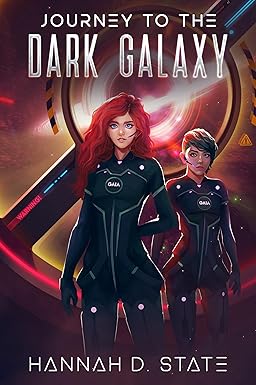
In Journey to the Dark Galaxy, Hannah D. State takes readers on an exhilarating adventure with protagonist Sam Sanderson, a young woman burdened with a monumental task. Summoned by Earth’s leaders, Sam is charged with uncovering the mysteries of the enigmatic planet Logom, ruled by a cyborg AI harboring hostility towards humanity. The stakes are unimaginably high as she discovers the AI’s plan to unleash Malborgs, threatening to annihilate Earth’s population. Amidst this chaos, Sam faces a tantalizing offer to align with this malevolent force. The question looms: can she thwart this looming catastrophe in time?
This young adult sci-fi epic, a sequel that adeptly recaps its predecessor, allows newcomers to seamlessly dive into the series. State’s narrative draws parallels to classic sci-fi tropes and narratives, evoking a nostalgic resonance with elements reminiscent of iconic series like Star Trek: The Next Generation. Targeted at a teenage audience, the novel navigates darker themes and a pervasive sense of danger that may not suit the faint-hearted. Sam’s journey is one of rapid maturation, confronted with harrowing trials that sculpt her character. The narrative is propelled at a gripping pace, adorned with unexpected twists that maintain reader engagement. One of the novel’s most commendable aspects is its occasional shift in perspective. By exploring various characters’ viewpoints, State enriches the narrative and deepens the world-building, offering a more rounded and immersive experience.
Journey to the Dark Galaxy is a compelling blend of suspense, character complexity, and satisfying resolution. With its multifaceted protagonist and a narrative that keeps you on the edge of your seat, this novel is a testament to State’s prowess in crafting engaging young adult science fiction.
Pages: 521 | ASIN : B0CPB1ZM2P
It’s About Balance When Writing

Running on Broken Bones follows a talented hacker who is on the run from a government agency while his body struggles to keep up with his mind. What was the inspiration for the setup of your story?
Part of the second book in the Tanto Thriller series is based on a true story. There was a news article about three guys running a very successful drug smuggling business out of a hospital. As I followed the story, I only found where two of three people were arrested. That made me think, “who could’ve gotten away scott-free?” Answer, “a hacker.”
Tanto is an exciting character to follow; readers never know what he will do next. What was the inspiration for the main character’s traits and dialogue?
Tanto, while benevolent, is full of pride and self-inflicted burdens. He’s made some mistakes, so he thinks it is up to him to save everyone. I’ve read a good bit (and I have much more to read) about Bushido lifestyle, culture and history, so it’s influenced this character a lot. As for the dialogue, I used to write for film and television, so smartass dialogue is one of my favorite things to write!
How did you balance the action scenes with the story elements and still keep a fast pace in the story?
Balance in writing is so important. While readers love action, they need breaks in a book. Part of what helped me become a better thriller writer and balance my scenes was reading StoryGrid by Shawn Coyne and Steven Pressfield (a book I highly recommend to authors). However, a larger part comes from reading thrillers and taking inspiration (adapting rather than stealing) from multiple thriller authors. Riley Saeger. Ruth Ware. J.D. Barker. Chuck Wendig. And others, as well as great TV shows and movies.
As for pacing, readers hate-hate-hate an info-dump (when a writer overwhelms the reader with backstory or needless information). I truly hate writing them, so I parse them out over the entire book. You will get an info chapter here and there, but as a reader myself, I don’t want to get slammed with backstory while in the middle of a chase scene.
Where does the next book in the series take Tanto?
Burn It All Down, the third book in the Tanto series, answers the questions initially asked in the first book in the series. In a trilogy, whether it’s sci-fi, thriller, fantasy, whatever, I’ve learned that your first and third books should mirror each other in certain ways. Flow. Obstacles. Questions asked then become questions finally answered at the end. For example, my favorite trilogy is the Star Wars Trilogy (New Hope, Empire, Return). New Hope and Return both have the ultimate weapon: a Death Star. They both take place in sandy places (Darth Vader’s real nemesis). And there are other parallels. Now Empire is its own story. It starts at the end of the New Hope and addresses issues left undone from the first movie. Then it has its own story. And finally it sets up the last battle that viewers see in Return. That’s what I’m (hopefully) doing in the Tanto Trilogy.
Author Links: Facebook | TikTok | Twitter | Website
Tanto is crumbling. Recently escaping a brutal covert institution, the follower of the Bushido code struggles to keep one step ahead of the merciless government agency hot on his heels. But sought-for sanctuary slips through the hacker’s fingers when he loses the ability to communicate and collapses in a debilitating fit.
Fighting his way back to consciousness in an unfamiliar hospital bed, Tanto makes a break for the streets as military choppers and agents storm his refuge. And hoping to find the answers to his worsening ailment, he returns to his former prison to discover old acquaintances wielding a cure worse than death.
As his body fails, can Tanto’s brilliant tactical mind stand against a relentless host of obstacles and killers?
Running on Broken Bones is the pulse-pounding second book in the multi-award winning Tanto thriller series. If you like heroes with brains, hair-raising stakes, and pitiless adversaries, then you’ll love W. A. Pepper’s tale of underworld survival.
Buy Running on Broken Bones to live and die with honor today!



 LITERARY TITAN