Blog Archives
You Don’t Know What You Have Till it is Lost

Unearthing Worlds follows a colonel and his team struggling to survive after an asteroid collision leaves them stranded in unfamiliar surroundings. What was the inspiration for the setup of your story?
The setup was inspired by my desire to explore the dynamic between the brothers, Allen and Brice, on a deeper level. In order to fully develop their reconciliation, they needed to be separated again. Until something is lost, you often don’t realize what you truly have. In book one, the brothers come back together and start to rebuild their relationship, but their reconciliation isn’t complete. I wanted to put them in situations where each faced their own unique challenges while feeling the absence of the other. This gave me the opportunity to close that part of their character arcs in a meaningful way.
How long did it take you to imagine, draft, and write the world your characters live in?
Many months. As a hard science fiction writer, I put a tremendous amount of thought and research into any world I create. My worlds are all grounded in known science, which makes the process both time-consuming and rewarding.
What was your favorite character to write, and why? Was there a scene you felt captured the character’s essence?
Marcus is my favorite character to write because he’s like an onion—there’s always more to uncover with him. One scene that really captures his essence is the dinner scene with him, Brice, and the others. It’s a moment where his layers show brightly, revealing his complexities in subtle but powerful ways.
Where will the final book in this trilogy take readers?
We’ll be revisiting the Roman Sol Empire. Readers can expect a return to this richly imagined world, along with new challenges and revelations.
Author Links: GoodReads | BlueSky | Website | Book Review
After vanishing during a high-risk mission on an uncharted world, Colonel Brice Messman and his team must find their way back through the keyholes—mysterious portals capable of bridging dimensions. Meanwhile, Dr. Allen Messman relentlessly searches for his brother, knowing that every delay could leave Brice’s team stranded in the unknown forever.
Each keyhole opens to an unpredictable world, where dangers hide in strange landscapes and new threats lie in wait. With allies growing uncertain and time running out, Brice must rely on hard-won instincts and the fragile trust of his crew. Every step forward risks disaster—one wrong move could leave them trapped on the wrong side of reality, with no way back.
A Figurative Shadow

Zephyr Trails follows a young woman living in Southern Missouri in 1866 who finds herself grappling with her own burgeoning interests, a developing epidemic, and rumors that her father, thought to be lost, may still be alive. Where did the idea for this novel come from?
I have always loved Westerns: books, movies, TV shows. I wanted to write a Western with a strong female protagonist who knew her horsemanship. There weren’t a lot of those around. I came to realize most Westerns were based in or around the Civil War. I was not a Civil War buff, but my research uncovered so many interesting and obscure facts about the war: women’s roles during and because of the war, the times leading up to the war, families separated by war, and the reconstruction era. The simple Western I meant to write took on a more literary bent. Though it’s technically Historical Fiction, I like to call it a “Literary Western.” Zephyr Trails is the second book in the Ellis River trilogy. The protagonist, Ellis Cady, started her journey in Tennessee. Life at the time could be very different from one side of the Mississippi River to the other. The more I learned, the more I became involved with my characters and their stories and how war affects people and families. At some point, the characters led the way.
Why choose this place and time for the setting of the story?
A lot was happening historically in this setting. During the Civil War, Missouri was considered a “border state.” It never officially took sides in the war. This statewide internal conflict added to my character’s internal conflict. Ellis was raised in a Quaker community (in Tennessee) that taught patience, peace, and acceptance. I imagined the difficulty of reconciling those beliefs with the reality of slavery and war. The setting of post-Civil War Missouri contributed a figurative shadow over the characters and their attitudes and loyalties. I think it helped provide an interesting tension. Also, I was born in St. Louis, raised across the Mississippi River in Illinois, and stumbled upon so much of that area’s history never taught in school. At least it wasn’t taught while I was listening. St. Louis, Missouri, was the starting point for much of the migration west, so it had to play a major role in this story. There were actually two cholera pandemics that hit the area because of the influx of people and inadequate water and sewage systems. One hit in 1849 and one in 1866 when Zephyr Trails takes place. The Pony Express originated in St. Joseph, Missouri, and though it had been out of service for four years by the end of the war, it made sense that its fictional re- establishment might start there.
What character did you enjoy writing for? Was there one that was more challenging to write for?
Picking a favorite character is a bit like picking a favorite child. I enjoy writing them all for different reasons. I’ve always had a love for horses and have been lucky enough to own and work with them through the years. They are characters in my books, and I thoroughly enjoy writing for them. All the horses in Zephyr Trails are based on actual horses I’ve known. I truly believe writing a character-driven novel is a collaboration with the characters, whether horse or human. I birth them, and they take on a life of their own. I try to guide them, but they sometimes come up with their own ideas. The more challenging ones to write for are those who don’t open up to me as much or need more coaxing to do so. Lou and Tory are rather quiet but complex men. They may have been more affected by traumatic life experiences than some, and I wanted to be as respectful as possible to their Indigenous heritage, as well.
I find a problem in well-written stories, in that I always want there to be another book to keep the story going. Is there a second book planned?
I’m delighted that Zephyr Trails can be read and enjoyed as a stand-alone, though it is the second book of the Ellis River trilogy. And, yes, there is a third book in the works. The first book, Ellis River, was meant to be a one-off, but it developed into more. Not until I finished Zephyr Trails did I know it would be a trilogy.
Author Links: GoodReads | Facebook | Website | Amazon
After waiting out winter at the Cady ranch in southern Missouri, hope blooms in the Spring of 1866. Ellis receives news of a mysterious man arriving in St. Louis. Will she find her father alive and well, or finally put his memory to rest?
Grasping at the illusive promise of her father’s whereabouts, Ellis is distracted by the intrepid trick rider, Jimmie, a woman who rides with Levi Jack’s Wild West Exhibition. Then, talk of reinstating a messenger service akin to the Pony Express rekindles a faded dream. Since the war’s devastation, important letters and messages still need to get through a Western landscape governed by Indians and outlaws. When an untimely epidemic threatens, Ellis finds herself back in the saddle, a young woman and her horse on a perilous trail.
To Try the Impossible

After the Fall: The Engineer and the Apocalypse centers around a woman in the wake of nuclear war who is trying desperately to reclaim her past. What were some driving ideals behind your character’s development?
I wanted to take someone newly in love, that first time that everything really clicks with someone, and then break it apart. That is what gave Haley the driving force to try the impossible and get home.
Also, I didn’t want an end of the world, let’s fight everyone type of book. I wanted a smart protagonist, someone who could think her way out of situations, an engineer and a nerd who could survive.
What was the inspiration for the setup of your story?
I was on a work trip and watching some disaster movie in a hotel and I thought that this would be the worst place to be at the end of the world. Not a nameless hotel near an airport, but an ocean away from home, knowing nobody and with no to get way home.
It became the idea for the novel which didn’t work, until I changed the protagonist to female engineering student. Once Haley arrived on the scene it all fell together.
The science inserted in the fiction, I felt, was well-balanced. How did you manage to keep it grounded while still providing the fantastic edge science fiction stories usually provide?
I tried to keep the science to mainly high school level, that everyone at some stage studied and could follow. Once I removed the computers and anything very high tech it became simple machines. For the end of the world survival, I relied a lot on what climate conscious people are trying. Solar, hydro and biofuels.
I still made mistakes and had test readers who corrected some errors. I’m no mechanic and had some big mistakes on the work Haley did, so having friends who knew these things helped me a lot.
What were some books or movies that you think were your main sources of inspiration for this novel?
MacGyver was a huge influence. I loved the television series growing up and I wanted Haley to be a female MacGyver at the end of the world.
I really liked Project Hail Mary and The Martian, where Weir made the science mainly simple enough for me to follow.
What is the next book that you are working on, and when will it be available?
The second book in this trilogy follows Haley and Addy as they continue their journey home, fleeing from a war is breaking out behind them. Expected at the end of 2025.
Author Links: GoodReads | Facebook | Website | Amazon
Four years later and she’s living in the ruins of Washinton State after the world ended in a cascade of nuclear bombs, computer viruses and human plagues.
When she is accused of her friend’s murder, she flees into the night, with one destination in mind. Home to Marley, the love she left behind.
To escape her pursuers, skip around the swathes of chemical and radioactive waste, avoid the Kings, a roaming gang of marauders, she will need to use every bit of engineering knowledge she has.
Can she make it across the continent and an uncrossable ocean to finally get home?
Does home still exist or did it perish in the Fall?
Unearthing Worlds- Book Two of the Keyholes Trilogy
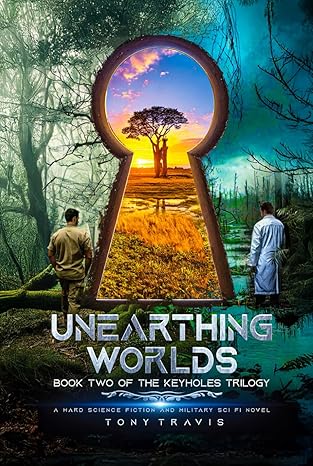

Unearthing Worlds, by Tony Travis, takes readers on a gripping journey across dimensions as Brice and his team struggle to survive in a new, unfamiliar world while searching for a way home. The story opens with immediate tension, and a catastrophic asteroid collision leaves the protagonists stranded. Their leadership and resilience shine as they set up a makeshift camp, laying the foundation for their survival in a strange land. This book weaves together themes of survival, leadership, and the complexities of human emotion.
One thing that stood out to me about the writing was its immersive descriptions of survival challenges. For instance, when Brice discusses the consequences of staying on Niflheim with Florence, the rawness of their predicament is palpable. The camaraderie and friction among the team make the story feel real. Florence’s cautious scientific approach is a perfect foil to Brice’s leadership, emphasizing the need for balance between practicality and innovation. Her insistence on testing the honey and local plants before use is a highlight of pragmatic, logical, and much-needed voice of caution.
Another compelling aspect of the book is the emotional undercurrent. Allen’s regret about past choices and his deep-seated concern for his brother Brice are especially touching. These reflective passages add emotional weight, making it clear that the stakes are not just survival but reconnection and redemption. The exploration of sibling bonds against a backdrop of high-stakes science fiction was refreshing. In the end, the book delivers a satisfying mix of action, emotional depth, and speculative science fiction.
Unearthing Worlds, by Tony Travis, is a must-read for fans of survival stories with a psychological twist. If you enjoy meticulous world-building, layered characters, and the tension of being stranded in the unknown, this book is worth your time. While it’s the second in the trilogy, it works well enough as a standalone but truly shines when read in sequence. Recommended for lovers of grounded sci-fi and character-driven stories. Be prepared to crave the sequel by the time you reach the novel’s conclusion.
Pages: 317 | ASIN : B0DPG9476S

Variants of Our Future

Salvation Bleeding follows two people trapped who must pass through the Void in a desperate fight to retrieve the one artifact that can help save Utopia. What was the inspiration for the setup of your story?
The Void is where all possible futures exist. We all make decisions every day that have the potential to alter the path our lives take. Imagine facing each decision—with every possible future presented before you that flows from moment to moment—knowing that even the slightest variation in the path that looks right, could lead to your demise. The message is that the reality in which we exist is of our own creation. It is the accumulation of all our past decisions that delivers us to this moment in time. Now… whenever now is. And the next decision we make will lead to another thousand variants of our future.
When in the Void, Reyne’s choices not only impact him, but also the woman he loves, Mithany, and the future of worlds; all the while facing a malevolent being within the Void that desires to consume his soul. The representation of Reyne in the Void reflects the choices we face in our own lives every day. Our choices, knowingly or unknowingly, will lead us down a path that will not only affect us individually but all those around us as well—especially the ones we love.
And then there’s the Soul Stone. The symbolic artifact that has the power to set everything right when the past has gone wrong. Maybe not always delivering the outcome we’d expect.
This is the final book in the Utopia Falling Saga. Were you able to achieve everything you wanted with the characters in this trilogy?
Absolutely! The characters and the plot were let off the leash in book 3, Salvation Bleeding. This is an epic fantasy adventure that, at times, intentionally veers into grimdark fantasy. Reyne’s struggle with his own inner demon could only have been resolved in the way it did because of everything that preceded it. Through all the twists and turns to get there, I believe Salvation Bleeding delivers a very satisfying conclusion that the readers will love.
Do you have a favorite scene in this installment? One that was especially satisfying to craft?
There are so many scenes in this book I really enjoyed writing that it’s hard to pick just one. This being the third book in the trilogy, the need to do any extensive world-building was absent and from the first page, the plot dives right into action and doesn’t let up. BUT…if I must pick only one scene, it has to be the chapter titled “Convergence Wakes” where everything comes together in a jaw-dropping climax.
Can we look forward to more work from you soon? What are you currently writing?
Thank you for this question. Yes, I am working on two projects. The first is an omnibus edition of the complete Utopia Falling Saga trilogy that I hope to have ready as an ebook by February 2025. The second is a standalone fantasy novel that imagines what if something or someone whom we all must face one day were to write a memoir of his/her experiences. I’m about 12,000 words into what I expect will be about 75,000 when it’s finished. With a bit of luck, I hope to tease out its release later this year.
Author Links: GoodReads | Website | Amazon
Reyne must face the Void once more. But he knows an evil malevolence awaits him there, and it craves to devour his soul. If Reyne can survive the Void, if he can fend off his own inner demon, if he can kill the Devil’s Blacksmith, he will deliver Utopia its salvation, and return to Mithany, the woman he loves. … If he only had the Soul Stone! …or is it already too late?
Incredible Loss

Harpazo follows a cast of characters, all of whom are grappling with losing loved ones to sudden and unexplained disappearances. What was the inspiration for the setup of your story?
Harpazo, along with the other two books in the Trib Trilogy, are inspired by events described in the Book of Revelation in the Bible.
The sudden disappearance of a quarter of the world’s population that takes place at the beginning of Harpazo is inspired by the Rapture. The Rapture is not found in the Book of Revelation, but passages describing the Rapture—a sudden, future gathering up of the godly—are sprinkled throughout the Bible.
Wondering what it would be like to be left behind after the Rapture takes place, I wanted to explore as many permutations of this as possible. So, I tried to give several points of view, but all from average, hard-working, well-meaning people.
The loss of one-quarter of the world’s population causes severe consequences that each of my characters must find a way to come to terms with. I wanted to explore several ways an average person could respond to the incredible loss felt by all.
What draws you to write books in the apocalyptic fiction genre?
Every interesting story contains a problem that the characters must solve or find a way to live with. Apocalyptic fiction takes that to a much higher level. The problem is bigger, usually worldwide, but the principle is the same as for every story.
I think the danger with most apocalyptic fiction is that it gets lost in the grandiose nature of its story problems. Huge events tend to dwarf the characters and their responses to the events taking place.
I’ve always wondered what the consequences would be if the worst scenario happened. What would happen after the unthinkable? And what could be more unthinkable than one-quarter of the world population (including all the children) suddenly disappearing?
But I wanted to showcase this earth-shattering event—and the consequences that ensue—through the eyes of ordinary people. I wanted to present the changes that can occur due to the catastrophe on an individual level…the good, the bad, and the ugly. For that, I needed to approach the story from several perspectives.
What experience in your life has had the biggest impact on your writing?
This is a really difficult question to answer as there are so many life experiences that I could point to that I believe shaped my perspective. But if I had to narrow it down to one thing, I would have to say that becoming an active Christian has had the greatest impact on my writing…as it has for my whole life.
Can you give us a peek inside the second book in the Trib trilogy? Where will it take readers?
Sure, here is the synopsis for Charagma, Book Two of the Trib Trilogy:
The meteor showers that destroyed two major cities on the eastern seaboard of North America—and heavily damaged all others—have continued unabated for weeks. Not confined to North America, the meteors have rained down death worldwide, igniting old-growth forests in an inferno of epic proportions.
Now, at the beginning of the second year of the Tribulation, a much bigger meteor plummets into the Pacific Ocean…and plunges the world into the next series of cataclysmic events. Not least is the sudden, silent change in the world’s freshwater supply from potability to deadly poison.
Meanwhile, in geopolitics, a new hope dawns.
A leader, the likes of whom the world has never seen before, emerges out of obscurity to take command. The world’s population, desperate for solutions, clings to the new leader’s promise of renewed peace and prosperity.
While most of the world’s citizens believe in the new leader’s rhetoric some do not. Even after the new leader miraculously resurrects after being assassinated!
Only a few know who the new leader really is and how dangerous he is to everyone, everywhere, all over the world.
Through the eyes of ordinary people, Charagma tells the story of the middle years of the Tribulation—a time of growing political pressure to conform to the all-powerful forces shaping the world.
Each person is faced with a choice: Conform to the new leader’s demand for complete, unwavering loyalty to his one-world government, ensuring their short-term survival. Or decline to participate in his worldwide program, ensuring total exclusion from society and the world’s wrath.
Author Links: Facebook | Website

Historically Proven Principles

Traitor’s Black Rose imagines a fractured 2088 America, where the President battles corruption and assassination attempts to save a nation teetering between collapse and unity. What was the inspiration for the setup of your story?
This is the third book that I have written; the first two books are part of a trilogy that Literary Titan has reviewed. I sincerely inspired to write dystopian books, and this endeavor has been an exceptional adventure and hobby. Regarding Traitor’s Black Rose, the current global divide and political divide in the United States inspired me to write this book. FYI, the fourth book that I am currently writing is the last book of the trilogy.
The narrative unfolds almost like a historical chronicle. Why did you choose this style, and how do you think it enhances the story’s themes?
I am a professional engineer by trade and a retired Combat Engineer officer; ironically, I enjoy studying history and philosophy. I believe that to understand our current situation in the US and the world, you must examine the past. Obviously, this fictional dystopian is set in the 2088 (the future). What we do today may lead to something that we did not desire. Too often, we tend to throw the baby out with the bathwater since many historical lessons are still generalizations, and many tend to think that exceptions to the rule are just as likely.
What were some themes that were important for you to explore in this book?
One theme is to remind all that you must be aware that your ends and desires will not justify any means. We must remember that historically proven principles should not be discarded for power or one’s idealistic goal.
Do you see the story as a warning, a reflection, or perhaps a call to action for today’s readers?
I see this story as both a reflection and a warning. I demonstrate this by using quotes and Bible verses that express reflection and warning.
Author Links: GoodReads | Website | Amazon
Harpazo: Book One of the Trib Trilogy


Harpazo begins with an explosive premise. It’s the first book in The Trib Trilogy, centering on sudden, unexplained disappearances across various characters’ lives. The story weaves through multiple perspectives, such as Tyler, a young tow-truck apprentice; Georgia, a second-grade teacher; and Bryn, a coffee shop barista. Each chapter introduces someone grappling with the surreal aftermath of loved ones and strangers vanishing into thin air, often leaving behind little but their clothes. Anchored in biblical themes, the narrative reflects on chaos, faith, and the human response to unimaginable events.
I couldn’t put the book down once I started. The opening scene, where Tyler realizes his mentor has vanished mid-drive, immediately sets a gripping tone. The author, Nathalie Bujold Ryan, paints an eerie picture with vivid descriptions—Joe’s empty work boots on the pedals, his clothes eerily intact. The pacing is tight, and the scene transitions are snappy, though I found some moments, like Tyler’s prolonged reaction to the empty truck, slightly drawn out. That said, this added a layer of realism to the shock and confusion Tyler felt, which many readers might appreciate.
One of my favorite aspects of the book is the diversity of perspectives. Georgia’s reaction in the empty classroom resonated with me. The sheer horror of seeing abandoned clothes in a once-bustling space amplified the surreal tone. However, her disbelief and anger at first made her feel human. Ryan captures the disbelief people feel in extraordinary situations beautifully. On the other hand, I felt some characters, like Bryn, could have been explored in greater depth.
Thematically, Harpazo thrives in its exploration of existential dread and religious undertones. The darkness rolling over the city, described in Peter’s chapter, mirrors the emotional turmoil many characters feel. While the book leans on its Christian foundation, particularly referencing the rapture, it doesn’t alienate readers unfamiliar with or outside that context. Instead, it’s an invitation to reflect on universal themes—fear of the unknown, the fragility of human life, and the power of faith.
Harpazo is a haunting and thought-provoking read that blends suspense, drama, and a dash of the divine. While some pacing and character development issues arise, they don’t overshadow the compelling narrative. This book is perfect for fans of apocalyptic fiction with a spiritual twist or anyone curious about how humanity might respond to the unimaginable. If you’re ready for a wild ride packed with mystery and meaning, Harpazo delivers.
Pages: 397 | ASIN: B0DSLFFZ8J



 LITERARY TITAN