Blog Archives
The Proverbial Crock Pot

Space Station Halcyon follows a middle-aged gambler coerced into managing a derelict space station as he faces both mob pressure and a doomed government inspection. Where did the idea behind this story come from?
Hoo boy. Bits and pieces fell into the proverbial crock pot over the course of a few weeks. Daryl the manatee came from an awkward encounter I once had with a real life manatee in a beach bar (I don’t want to talk about it). Hali the AI was inspired by that time Chat GPT made me cry (for reasons I’ve now totally forgotten). Joey is basically a better version of me, but also a raging alcoholic.
All of this marinated for a few weeks in a midlife crisis, and voila! Space Station Halcyon was served!
Do you think comedy makes violence hit harder, or softens it?
Comedy is like the soothing back rub on the tense shoulders of deadly violence. It should be used lovingly, sparingly. Otherwise, it’s just a nuisance.
Do you see the station as a kind of found family, even if it’s a dysfunctional one?
The station is more like a high security cell block of felons who are so socially stunted, so painfully outcast, they need an AI to prompt them not to kill each other. So, yeah, they’re just like family.
What kind of reader do you hope finds this book?
The kind who will buy lots and lots of copies of my book and sprinkle them freely about their favorite watering holes, fitness centers, and places of worship.
Author Website
(Management is not responsible for anything that happens to you)
Joey Mumbai’s down on his luck and over his head. To pay off his gambling debts, he’s forced to run an old space station at the end of the galaxy as a “legitimate business” for the mob. All Joey has to do is make money—and not attract any attention. But Space Station Halcyon is like a floating death trap, with a rage-filled manatee, a psychotically cheerful computer, and a sports bar that may or may not be possessed.
When a government code inspector and her enforcerbot drop by the station, Joey must bluff, bribe, and connive his way through interstellar bureaucracy, laser gun fights, and the worst beer in the galaxy. Can Joey turn his derelict station and degenerate crew into something resembling legality? Or is the whole place going to explode in a cloud of code violations? Or maybe both?
Space Station Halcyon is a wild and raucous sci-fi comedy about bad luck, worse decisions, and the cosmic horror of being put in charge. A Hitchhiker’s Guide-esque romp that answers the eternal question: “Who’s in charge around here?”
Caenogenesis


Caenogenesis, Book 1 of The Gemini Files, is a dystopian sci-fi novel about a manufactured soldier named Yin, a genetically enhanced rebel named Kraken, and the city-state of Ignis, where class division, genetic experimentation, and political control shape nearly every life. The opening scene sets a tense, clinical mood right away, introducing Yin as someone shaped by confinement, training, and control before the story pushes her into a world where survival requires more than obedience.
What gives the book its pulse is the relationship between Yin and Kraken. Yin begins as blunt, tactical, and detached, while Kraken is scrappy, wounded, funny, and much more emotionally open than he wants to admit. Their first meeting is violent, strange, and darkly funny, but it grows into the heart of the novel. The best parts often come from watching them misunderstand each other, protect each other, and slowly build a bond that neither of them fully knows how to name.
The world of Ignis is busy in a good way. Retro Ignis, Modernist Ignis, Scraptown, the Outsiders, Recombinants, Synthetics, council politics, gangs, surveillance tech, and medical experimentation all feed into the same larger picture. This is a society built on separation, fear, and useful lies. The action scenes are sharp and physical, but the book is just as interested in what violence costs, especially once the rebellion’s goals start rubbing against questions of mercy, loyalty, and acceptable sacrifice.
Yin is the strongest element. Her voice could’ve been stiff, but it becomes one of the book’s most memorable features because her logic is tied to longing, confusion, and a growing sense of self. Her idea of home is especially moving because it doesn’t arrive as a grand speech. It arrives through repetition, attachment, and choice. When she says, “In that case, Human Kraken is my home,” it works because the story has earned it.
As a first book, Caenogenesis feels like a character-driven sci-fi thriller with a lot on its mind: identity, personhood, rebellion, disability, trauma, and the danger of turning people into symbols. It’s conversational when it wants to be, brutal when it needs to be, and most compelling when Yin and Kraken are trying to understand each other in a world that keeps asking them to become less human. The ending opens the door to a much larger conflict, but the emotional center is already clear: this is Yin’s story of becoming someone, not something.
Pages: 390 | ASIN : B0GL9LCCN3

Lovestruck Maggot
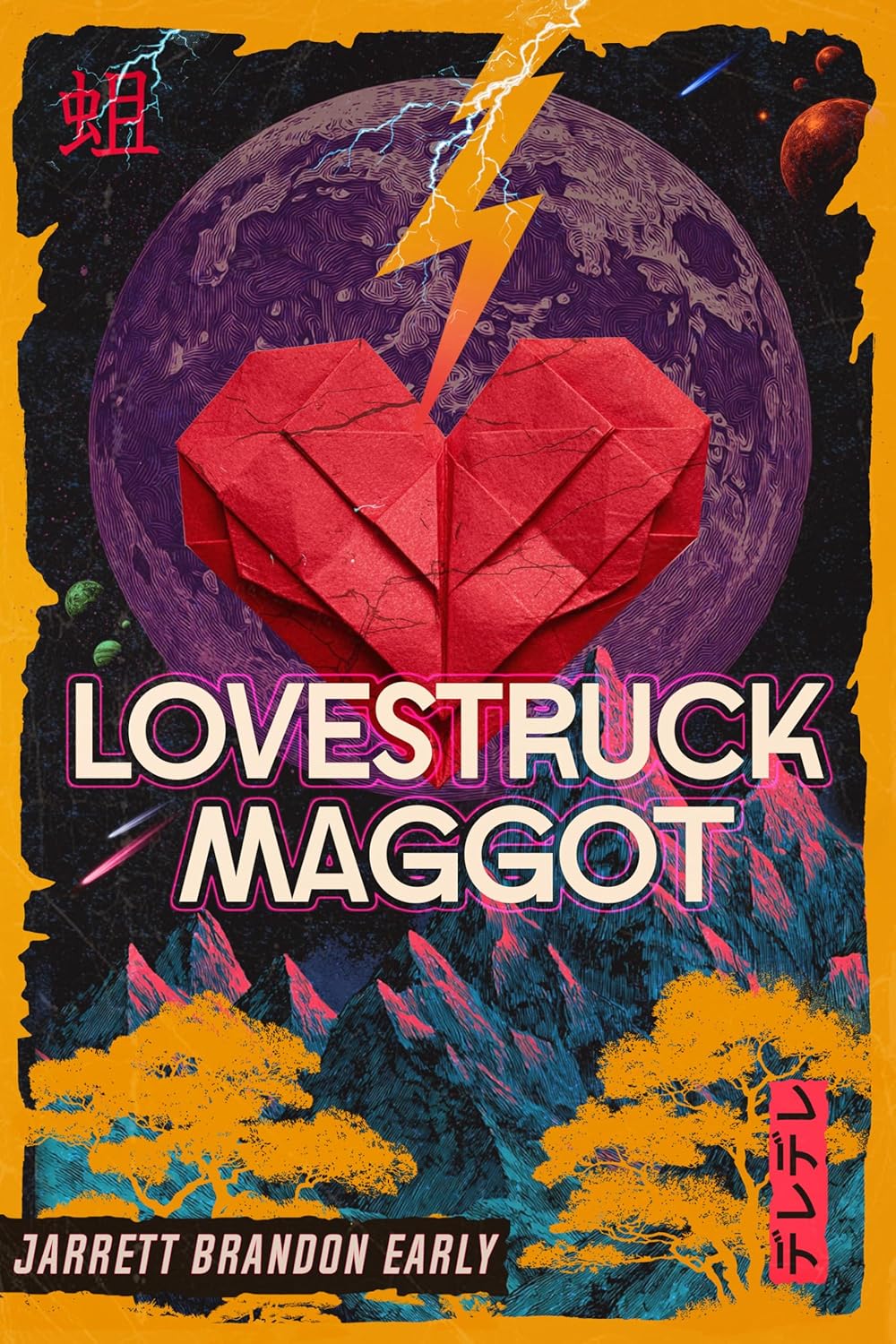

In Lovestruck Maggot, we follow Mona Ripple, scarred, middle-aged, fiercely competent, and disastrously in love—as she tries to claw a future out of the brutal colony world of Kalderra, where “Maggots” harvest volatile alien carcasses under the shadow of corporate greed, native mystery, and lethal beauty. What begins as a break-for-freedom story, with Mona dreaming of buying out her and Darien’s contracts, quickly widens into something stranger and more dangerous: a planet-scale power struggle wrapped around devotion, exploitation, and the mad hope that love might still mean escape.
What I liked most is that the novel never treats love as a softening agent. It treats it as an accelerant. Mona’s voice has grit under the fingernails: funny, vulgar, wounded, possessive, tender, and a little frightening all at once. I didn’t read her as a neat heroine; I read her as a person whose longing has warped around survival until the two are nearly indistinguishable. That gives the book a welcome asymmetry. The romance is not dainty or idealized. It’s hungry, bruised, delusional in places, and therefore weirdly moving. The author understands that desire can make people luminous and ridiculous in the same breath, and he gets a lot of charge out of that contradiction.
I was also taken by the texture of the worldbuilding. Kalderra doesn’t feel like wallpaper pasted behind the plot; it feels mined, lit from below, and faintly toxic. The opening planetary report gives the book a sly, cold-blooded frame, and then the novel drops into a much hotter register: banter, violence, class resentment, strange ecologies, and the eerie glamour of the subarashi forests. I especially admired the tonal audacity here: the book can pivot from gallows humor to menace to aching sincerity without losing its footing.
I’d hand this to readers who like space opera, science fiction, romance, survival adventure, body horror, dystopian fiction, and weird western-inflected SF with a sharp voice and a taste for the baroque. It should land especially well for people who want character heat inside a dangerous speculative setting rather than clean hard-scfi sterility. It feels closer to Kameron Hurley than to sleek blockbuster space adventure; there’s also a bit of Gideon the Ninth’s irreverent bite in the way it lets sentiment and savagery share the same room. Lovestruck Maggot is proof that even in the harshest world, love can still be the most explosive substance on the page.
Pages: 365 | ASIN : B0GPRPR53S
Trouble in Cyborgia (Night Crusaders Series Episode 4)

Trouble in Cyborgia is a compact superhero adventure with a pulpy, futuristic setup and a surprisingly earnest moral core. It is the fourth entry in the Night Crusaders series, and the book frames itself as one of the series’ shorter “companionless mini adventures,” with the spotlight falling mainly on Simeon while Thomas Givens serves as the first-person narrator who pulls readers through the story. That choice gives the novel a nice angle. Instead of feeling distant or mythic, Simeon is seen through the eyes of someone who is impressed by him, puzzled by him, and gradually changed by what he witnesses.
What the book does best is establish its world in bold, direct strokes. Georgia City, nicknamed Cyborgia, is a place where cybernetics shape public life, work, policing, media, and power. The novel leans into that setting with real conviction, turning corporate technology into the engine of both wonder and abuse. The early dungeon sequence is especially memorable because it takes a bright futuristic city and reveals the machinery underneath it as cruel and predatory. Even a line like “Because I am a Night Crusader” works with a straight-faced sincerity that tells you exactly what kind of heroic register the book is working in. It’s not coy about heroism. It believes in it.
The book is also very much a story about labor, dignity, and the spiritual cost of letting convenience replace conscience. Thomas opens the novel by asking, “Whatever happened to that good old-fashioned work ethic?” and that question ends up shaping far more than the background. It gives the whole story a distinctly moral and social frame. This isn’t just a tale about a hero punching robots. It’s a tale about what kind of society gets built when efficiency, profit, and technological expansion stop answering to anything human. The novel keeps returning to institutions, jobs, media narratives, and public responsibility, which gives the action a larger civic backdrop.
What I found appealing on a craft level is the book’s plainspoken confidence. It moves scene to scene with very little fuss, and that gives it an old-school serial energy that fits the “Episode 4” label. Simeon isn’t presented as an unreachable icon. He gets trapped, weakens, makes risky choices, falls for people, and has to rely on others. That matters, because it turns the book into more than a victory lap for a superhero. It becomes a story of exposure, endurance, and community, with journalists, coworkers, allies, and ordinary citizens all helping shape the outcome. By the time the corporate collapse and legal reckoning arrive, the novel has built a world where public evil has public consequences.
Trouble in Cyborgia is a sincere, energetic blend of superhero fiction, dystopian corporate thriller, and moral fable. It has the feel of a story told by someone who likes heroes to be heroic, villains to stand for something rotten, and settings to carry an argument about the world. Its tone is openhearted, its themes are clear, and its best moments come from how fully it commits to its own vision of justice, technology, and human worth. If you meet the book on those terms, it’s an engaging ride through a futuristic city where the fight isn’t only against machines, but against the system that built them.
Pages: 145 | ASIN : B0FZDGXPFZ
Afterburn

Afterburn is a near-future science fiction novel, but it reads with the pressure and velocity of a prison break thriller. Author Michael Bodhi Green drops us into a 2070 America shaped by racial extremism, internment, surveillance tech, and the mythology of space travel, then centers the whole thing on Alton, a teacher trying to stay human inside a brutal camp system. That choice matters. The book isn’t just interested in institutions and ideology. The story is interested in what it means to keep thinking, reading, and teaching when the world around you is trying to flatten people into categories.
Alton is not built as a generic action hero, even though the book gives him action scenes with real snap and danger from the opening pages onward. He’s a damaged, reflective, yearning guy whose love of books and longing for the stars feel equally sincere. Early on, the novel tells you exactly who he is with the line, “Even in this hellhole, he still loved to teach.” That works because the book keeps proving it. His classroom scenes are some of the strongest in the novel, not because they slow things down, but because they show how ideas, memory, and story become tools for survival.
The novel is also doing something pretty ambitious with genre. It’s a dystopian political novel, a war story, a story about incarceration, and a story about people who were raised on dreams of cosmic escape. Green keeps all of that moving without losing the thread. I especially liked the way books inside the book become part of the argument. When Alton says novels are “windows into the thinking of another time,” I think Afterburn is quietly describing itself too. It wants to be read as both a story and a cultural mirror, and that gives even the pulpy, high-energy sections a little extra weight.
There’s also a real tenderness under all the steel, dust, and fire. The book keeps returning to the gap between fantasy and maturity, between the dream of transcendence and the harder work of living among other people on the ground. By the end, that tension gives the novel a satisfying shape. The title turns out to be more than a cool image. It becomes a way of thinking about aftermath, desire, and the lingering heat of past choices. The final movement gives Alton a resolution that feels earned because it grows out of who he’s been all along, not because the plot forces a neat lesson on him.
Afterburn is an earnest, high-stakes, idea-driven novel with a big emotional engine. It’s vivid, angry, heartfelt, and surprisingly thoughtful about reading, identity, and the seduction of heroic myths. What stayed with me wasn’t just the worldbuilding or the momentum, though both are strong. It was the way the book keeps asking what kind of future is worth reaching for, and what kind of person you have to become to deserve it. That makes Alton’s journey feel authentic.
Pages: 402 | ASIN : B0FTD4DQDH
Wonderment Within Weirdness

Wonderment Within Weirdness is a science fiction and fantasy adventure novel that opens with Matthew Tiberius dying in a cave and waking up in a version of Heaven that is far stranger, more political, and more chaotic than anything he expected. From there, the book turns into a long, unruly afterlife odyssey filled with alternate takes on God, Jesus, Hell, angels, power struggles, and eventually multiverse-scale conflict. At its core, it’s a genre mashup that blends sci-fi, fantasy, action, satire, and spiritual speculation in a way that clearly wants to go big and never play it safe.
What stayed with me most was how committed Jaime David is to the bit. This book doesn’t tiptoe into its ideas. It kicks the door open. The writing is blunt, loud, and often deliberately excessive, and I think that is both part of its charm and part of what will divide readers. There were moments when I wanted the prose to breathe more, or for scenes to trust themselves instead of pushing every emotion to full volume, but I also found something refreshing in how unfiltered it is. The book has an earnestness that many cleaner, more polished novels don’t. It feels less like it was engineered in a workshop and more like it was built from pure momentum, frustration, imagination, and conviction. You can feel the author reaching for scale the whole time.
I also found myself genuinely interested in the author’s choices, even when they were messy. Recasting Heaven as a system with neighborhoods, police, class divisions, prisons, and bureaucracy is a strong speculative move. So is turning religious figures into volatile characters inside a cosmic power struggle. The novel keeps asking what authority really means, who gets judged, who gets excluded, and what happens when the people running a moral system are compromised themselves. That gave the story a current of anger and curiosity that felt real to me.
Wonderment Within Weirdness is the kind of book best appreciated by readers who value imagination, a strong voice, and bold ideas. I would recommend it most to readers who like indie science fiction and fantasy, especially people drawn to wild mythic reworkings, afterlife worldbuilding, conspiracy-heavy adventure, and stories that feel unapologetically personal.
Pages: 666 | ISBN: 1300569212

The Structure of Society

Tyrants of Gravity follows the people of Earth who have survived the first alien attack and are now preparing for future attacks, while trying to survive the aftermath of the first war. Is this story more about survival—or about what survives?
The first book in the series, Gravity of Sol-3, is more about what or who survives. The alien sentinels sought to prevent humans from acquiring black hole energy technology that could threaten the dominant galactic worlds. The aliens also tried to prevent the evolution of man’s telepathic communication, deploying eugenic attacks to exterminate neurodiverse members of the population. If the aliens could have blocked these two elements of human civilization — one technological, the other biological — then humankind would survive but stagnate.
The aliens, Tyrants of Gravity, return in the second book to eradicate the human threat now that Earth has obtained both capabilities. Humans use black hole energy to power spacecraft, and human telepathy establishes contact with alien life. The alien antagonists plan to strike our world with relativistic kinetic energy weapons—releasing more destructive energy than a million nuclear weapons. In Tyrants of Gravity, the stakes are the survival of the human race.
Your battle planning and tech feel tactile and grounded. What research or frameworks shaped that realism?
This aspect of the stories came easily to me, as I have a background in science and engineering and have designed military weapon guidance systems and commercial computing systems. I used my experience with those systems, the teams of developers, and with government and military organizations. I also ensured the story’s events obey the laws of physics as closely as possible: I have a spreadsheet titled, Physics, for each story, and this is just as important as my detailed outlines of story structure and character arcs. The realism introduces natural constraints and obstacles that the characters must overcome.
The alien forces are not just antagonists—they react, adapt, and escalate. How did you approach their psychology?
The aliens rely on machine intelligence, MI, to operate their spaceships and their society. I extrapolated beyond our current AI technology to imagine systems that threaten their organic creators. The alien life forms, the organics, still manage to exert diminishing influence over the alien MI. I gave the MI characteristics of human political organizations, along with many of the weaknesses and faults humans exhibit today. The aliens must grapple with MI and organic conflicts as they pursue the greater objective of suppressing and destroying the human threat. The alien organics and MIs are flawed characters.
As a sequel, this book expands both scale and theme. How do you see the larger arc unfolding?
The first two books of the series focus on Earth and the first contacts with alien antagonists. These books are close together in time and result in the breakout survival and advancement of the human race, making Earth’s inhabitants viable contenders in the galaxy. The worldbuilding of the first two books was a straightforward extrapolation of present-day Earth. Future books will explore how humans exploit their new capabilities to travel to the stars and interact with the alien species that first watched over and then assaulted Earth. Human neurodivergence and telepathy progress and dramatically affect the structure of society.
I have two works in progress that transit across space and time and feature significantly more worldbuilding for the alien settings, cultures, and technologies of Luyten-B and Proxima-B. Humans travel to the home world of the Luyten, Cap, to find the captain’s world subjugated by Centauri masters. Human military and diplomatic missions journey to the Centauri fleet station on Proxima-B to confront the alien civilizations from a position of strength, but grapple with the unintended consequences of their missile and cyberattacks on the Centauris.
Author Links: GoodReads | BlueSky | Website | Amazon
Humans mount a frantic defense.
The aliens launch planet killers.
Earth’s civilization and billions of human lives are at stake.
Two autistic boys, Robby and Luca, search for their lost parent–lost in the dystopia created by the alien attacks. The rogue alien officer, Cap, is thrilled by the boys’ emerging telepathy mutation and helps them in their quest.
Scott Anderson, Robby’s physicist brother, joins the Space Force weapons development team to defend against the approaching alien fleet. But man’s technology, which harnesses the energy of primordial black holes, is primitive compared to the Centauri fleet’s weapons.
I kept pulling that thread.

Verified follows a journalist, an FBI agent, and a rebel broadcaster who uncover the truth behind a verification system meant to stop the spread of disinformation, but in reality is a form of control to decide people’s worth. What first sparked the idea of a society built around biometric “verification” as truth?
It started with Mark Zuckerberg’s January 2025 announcement that Meta was dismantling its entire third-party fact-checking program across Facebook, Instagram, and Threads—replacing it with a crowdsourced “Community Notes” system modeled on what Elon Musk built at X. Not because fact-checking had failed, but because the political winds shifted. One man, unelected, accountable to no regulatory body that could actually touch him, deciding what two billion users would no longer be protected from.
I kept pulling that thread. A few months earlier, Musk had used his Department of Government Efficiency operation to target the CFPB—the very agency that had been considering regulating X. The fox didn’t just enter the henhouse. He got a government ID badge. And I realized: if the information environment gets bad enough—and I think most people would agree it already has—then the demand for someone to fix it becomes overwhelming. And whoever answers that demand gets to define what “fixed” looks like.
The biometric verification system in the novel isn’t a dystopian invention. It’s a customer service solution. That’s what made it frightening enough to write about.
I wanted to write the version of authoritarianism that arrives with a thank-you email and a user satisfaction survey.
Maya is neither naive nor rebellious at the start—how did you build her internal conflict as she begins to see the system differently?
Maya was the character I was most afraid to write, because she’s the one who looks the most like the reader. She’s not ignorant of what the system is. She’s talented, credentialed, doing important work. She wins awards. And every one of those awards is given to her by the machinery she thinks she’s holding accountable.
Her internal conflict had to be slow because real complicity is slow. I didn’t want a dramatic red-pill moment. I wanted the accumulation of small compromises—a source she doesn’t follow up on, an angle she decides isn’t worth the risk, a story she kills because it would make the wrong people uncomfortable. She doesn’t change her mind about the system in one conversation. She changes it over dozens of conversations she chose not to have.
She’s every reporter at the Washington Post who watched Jeff Bezos kill their own paper’s presidential endorsement in October 2024 and went to work the next day anyway. That’s what complicity looks like in practice—not a dramatic betrayal, but a quiet Monday morning.
I built her conflict by making her good at her job. That’s the cruelest thing I could do to her. If she were bad at it, leaving would be easy.
The novel suggests that eliminating misinformation can come at the cost of freedom. What does the novel ultimately argue about how people accept systems that limit them?
I think the novel argues that people don’t accept limiting systems despite their intelligence. They accept them because of it. The Verification system works. It does, measurably, reduce misinformation. It does make daily life more navigable. And the people who designed it aren’t cartoon villains—they’re problem-solvers who got exactly what they asked for and couldn’t stop the machine once it started solving problems they hadn’t intended.
That’s not fiction. India’s Aadhaar system has enrolled 1.4 billion people in biometric verification. It works. It has reduced fraud. An eleven-year-old girl in Jharkhand also starved to death because her family’s food rations were cancelled when their Aadhaar link failed. China’s social credit infrastructure blacklisted over 200,000 people in 2025—46 percent for something as ordinary as a contractual dispute, not crimes. The EU’s Digital Services Act—genuinely well-intentioned—enabled platforms to make nine billion content moderation decisions in the first half of 2025. Nine billion decisions. Ninety-nine percent made by algorithms, not humans. The Green Zone isn’t a metaphor. It’s a design pattern that already exists in at least three different versions on three different continents.
The novel’s argument, if it has one, is that comfort is the most effective form of control. Not fear, not violence—comfort. The moment a system makes your life easier, you develop a stake in its continuation. And once you have that stake, every critique feels like a threat to your own stability. The zones in the novel—Green, Yellow, Red—aren’t enforced primarily by surveillance. They’re enforced by the fact that Green Zone residents have good coffee and reliable Wi-Fi and genuinely cannot imagine going back.
That felt like something worth writing about honestly, because I don’t think the answer is simple, and I didn’t want the novel to pretend it was.
What do you hope readers will question about their own relationship to truth and information after reading Verified?
I hope they notice the next time they feel relieved that someone else has decided what’s true.
Not outraged. Not suspicious. Relieved. Because that’s the feeling the novel is actually about—the gratitude we experience when a platform removes a post we find objectionable, when an algorithm filters our feed into something manageable, when a system promises us that the information we’re receiving has been checked, verified, approved. That relief is real, and it’s rational, and it’s the exact mechanism by which we hand over the authority to define reality to institutions that may not deserve it.
I don’t have a clean alternative to offer. The novel doesn’t either. The information environment is genuinely broken, and the people who say “just think for yourself” are underestimating the problem as badly as the people who say “let the algorithm handle it.” What I hope the book does is make that tension uncomfortable enough to sit with. Not to resolve, but to feel.
If a reader finishes Verified the same week Meta officially shut down fact-checking on Facebook and Instagram—not because the system failed, but because Mark Zuckerberg decided it was no longer politically convenient—and feels a flicker of something they can’t quite name, that’s the book working. That flicker is the moment before you decide whether the absence of a fact-check banner is freedom or abandonment. The novel lives in that pause.
Author Links: GoodReads | Website
Fourteen years after the Verification Act reshaped American society, a biometric implant behind every ear broadcasts who you are, what you’re worth, and whether you belong. The system was built to end an age of disinformation — and it worked. The deepfakes stopped. The conspiracy theories died. So did the freedoms no one thought to miss until they were gone.
Maya Chen is a star journalist at the Washington Herald, winning awards inside a system designed to make her work harmless. When a classified document crosses her desk, she begins to see the architecture of the cage she’s been decorating. Marcus Webb, a decorated FBI agent haunted by his father’s role in building the Verification system, follows a thread of falsified data into its rotten foundations. And in the Red Zone — where the Unverified survive without status, without medicine, without names — a former federal prosecutor named Emma Brennan runs a pirate broadcast network, willing to sacrifice everything for the revolution. Everything except the daughter the state took from her three years ago.
As their paths converge, Maya, Marcus, and Emma must decide what truth is worth when the system that defines it can erase you with a single scan. In a world divided into Green, Yellow, and Red — where your zone is your destiny and compliance is your currency — the most dangerous act left is to speak.
Verified is a novel about surveillance and complicity, about the seductive comfort of certainty and the terrible cost of letting someone else define what’s real. For readers of Kazuo Ishiguro’s Never Let Me Go, Dave Eggers’ The Circle, and Christina Dalcher’s Vox.


