Category Archives: Special Postings
From Idea to Reality – ‘A How To’ on Audiobooks
Introduction
Creating an audiobook can feel overwhelming for many authors—especially when you’re navigating unfamiliar equipment, new technology, and the challenge of bringing your characters to life through voice. In this candid and entertaining piece, authors and audiobook producers Susan Rogers and John Roosen share their real-world journey from curious beginners to successful audiobook creators of Dead Man’s Pose, Cobra Pose, Tree Pose, and Warrior Pose.
Susan and John provide a behind-the-scenes look at the trials, laughter, mishaps, and surprising moments that shaped their audiobook experience. Their story is a reminder that creativity often flourishes through experimentation, persistence, and a willingness to “give it a go.”
Whether you’re considering producing your first audiobook or simply curious about what the process looks like from the inside, their journey offers both encouragement and inspiration.
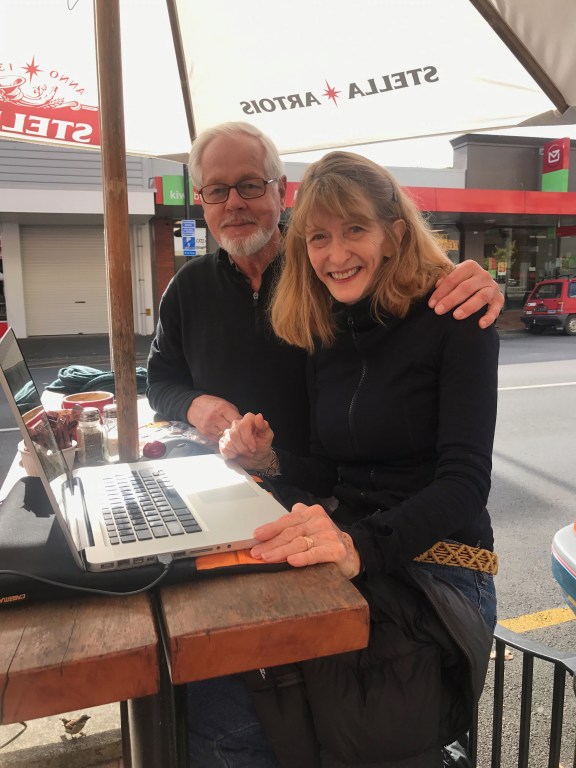
By Susan Rogers & John Roosen
Almost four years ago, we knew nothing about how to produce an audiobook.
After reading our book series to each other (about 50 times each), we knew we wanted to try and create a quality audiobook.
It’s almost undefinable what drove us to start this new and complex project. Some would say we’re addicted to writing. Our children and friends complain that we don’t answer the phone or respond to emails.
“Time choices” we say to them.
Our real passion is telling a good story … but it must be wrapped in the best art of storytelling. Creating an audiobook and producing it? Well, that’s an entirely different story.
Blending two styles.
To begin with we are two completely different personalities. We met in Officers Candidate School in the US military. Our last names started with the same two last letters, and we stood beside each other – it was destiny ‘At attention’ of course.
John is tall, a long-distance runner and a person who is good at predicting future events. Susan is a slender woman, who is like a firecracker full of action and a long list of things that must be done today!
On most topics, we see things differently, and our ways of expression are a stark contrast.
How could we come together and write as one voice? By necessity, we’ve had a lot of practice. Through our wide-ranging occupations and projects over the years in multiple countries, we’ve learned to blend our styles to make a unifying approach for most things …including cooking.
John cooks, and Susan says how great it is. [“Such a deal,” Susan confides.]
Producing a DIY audiobook.
You know all those Experts who say: “Do It Yourself’ is soooo EASY”?
We now wonder if that is AI speaking.
We did try to create an audiobook ourselves. There are all kinds of articles, videos, podcasts and influencers trying to influence you one way or the other in creating your own audiobook.
We bought all the equipment from a local electronics store.
“Ever done this before?” the salesperson with the crew cut asked.
“No, we haven’t,” we enthusiastically replied.
‘It’s Non-Refundable,’ he reminded us.
We crafted our closet into a sound stage leaving our clothes there to absorb sound and hanging up a wool blanket to cancel echoes.
We sat in our bedroom closet with our sound equipment perched on our sports clothes and the mike hanging from wooden coat hanger but could still hear the street traffic.
Extra blankets were borrowed from a neighbor who wanted to know what we were doing in the summer with the blankets. Duct tape sealed the door jam. The door chimes were disabled. And we decided not to answer the door … for anyone.
We thought about calling the airport about all those aircraft landing at a nearby airport. We didn’t think we’d have much success with that.
Then there were the thousand dogs that seemed to have recently moved into the neighborhood. That became a never-ending mission of negotiation and dog treats.
Finally, we resorted to using camping mattresses and five sleeping bags over windows and doors to create our sound set. It sort of sounded quiet. But we felt like we were in a small igloo in Antarctica.
We listened to the playback. John’s voice was scratchy in places. Susan sounded like a sultry 1930’s movie star vamp with a heavy breath delivery. We considered other possible use for her voice.
We listened to more playback and knocked over one of the cabinets in the closet—
we laughing so hard.
“This isn’t working,” John suggested.
“Let’s hire a narrator,” Susan replied.
The World of Narration
There is a bountiful number of narrators ‘out there’. They are called lots of things: narrators, readers, voice performers, voice actors, golden voices, storytellers and relators to name a few.
Actually, the first person that gave us a sample of their voice performing talents WAS our real estate agent. He was interested in changing his career, so he didn’t have to depend on the ups and down of the real estate market. We avoided mentioning his sample for almost two months, until we broke down and said he was such a great agent and the market was clearly picking up.
In the interim we subjected ourselves to 20 digital voice demos per day from everywhere on the planet until we were hearing voices … even when we weren’t listening. It felt like the Chris Young’s country western song where he sings, “I hear voices all the time”. After a few months, our neighbor, who is a psychologist told us to put pillows over our heads and hope the voices would go away.
AI Enters the Marketplace
When Artificial Intelligence started making a greater debut, it seemed like a possible option. We listened to dozens of AI generated voices who clearly could mimic anyone, but never really had the same type of feeling that any of the organic human narrators or voice performers could conjure up.
It was like your car telling you to check the back seat when you were leaving the car … and about as romantic. The worse part was AI didn’t know how to deliver a line the way we envisioned it.
“It’s doing, but not feeling,” John said.
“Duh,” Susan strongly responded. “It’s not feeling anything and never will.”
We Have a lot of Characters
The truth is—we have a lot of characters. Anyone reading to our books will see and know we delight in creating a wide spectrum of characters. They are from every demographic, every age and every personality.
Each book has a smorgasbord of these characters. The challenge of course, is to make each character seem authentic and multi-faceted. This includes characters that may have quirky characteristics that allow them to be visualized in the reader’s mind. We also rely on the readers’ imagination to mold our characters to the people they might know or think about. It is part of the partnership of willing participation between us and the readers.
How could we get that same type of quirky emotion into the audiobook version?
And worse, our stories do have a few killers, psychopaths, sociopaths a serial killer or two running around. There are heaps of romantic scenes, sprinkled with all the tension, suspense and thrills that we can wring out of any given page.
How was anyone going to act out all that?
After year of listening to all these voices, we decided one day that it would be our last day of searching.
The Voice
We were living in Sydney, Australia at the time. The day began with an ominous thunder and lightning rainstorm. We had difficulty with our internet. And power was sporadic. Perfect for trying to communicate with the last handful of people we wanted to connect to narrate our books
We held our communications dongle out the window for our very last call of listening to voices from around the world.
When the connection wasn’t happening, John decided hanging out the window further while holding a Wi-Fi device connected by a wire to a power point during an electrical storm was A-okay.
“Don’t worry Susan. I’m heavily insured and there’s always that military burial,”
Rupert Degas picked up on that last call. This extraordinary voice performer, who only works with you if he ‘likes your stuff’. We sent him a copy of the first book … and He liked our stuff! Sat up and read the entire book all night.
And in what was total irony … it turned out that Rupert Degas was living in Sydney, not far from us.
We so love irony. It was “The Voice – at first listen”.
Give it a Go
Have we had fun in all this writing and producing of Audiobooks?
You bet … we certainly have met that goal. And while there are moments of tension and frustration, Susan suddenly stands up, signaling we must practice the kissing scene again so we can describe it just right.
“Rupert will need this description so he can act it out during the audiobook performance,” Susan suggests.
“Alright Susan,” John says. “I’m happy to Give it Go.”
Author Links: Website | SoundCloud | GoodReads | Instagram | YouTube | Linkedin | BlueSky | Mastodon
Ultimate List of the Best Book Review Blogs

Kindlepreneur has created a comprehensive list of book review blogs that gives authors one more piece to their book marketing puzzle.
Their article on the ‘Ultimate List of the Best Book Review Blogs‘ includes a long list of book reviewers and also provides the information author swill need to understand how verified purchase reviews are used on Amazon, ‘the mentality of the buyer’, and different types of blogs before presenting a long list of reviewers broken down into their preferred book genres.
What I found most helpful was their section on ‘How to Get Your Book Reviewed by a Blog’. This section provides a lot of great information that will help authors get the most out of the lengthy list of reviewers that they provide on their site.
Checkout Kindlepreneur and their article on the ‘Ultimate List of the Best Book Review Blogs‘.

And Then You Left (Poetry Video)
For Pregnancy and Infant Loss Remembrance Day by Gloria D. Gonsalves
Grieving, they say, is the cousin
of loneliness, bonded through
closeness or distant blood.
You left my body the same way.
Slipped away silently, as far kin
of my clan, and yet closer for I
still, feel the knives cutting through
the womb where I had you alive.
Our conversation was one-sided,
but I knew you were listening.
We already had names for you,
representing us, from two cultures.
We manifested you as a girl.
I had begun recalling wisdom
to share with you, our child.
When pain slowed my right leg,
I held hope that we would meet.
That night on my birthday,
I prayed, asking the virgin mother
to take you was the holiest prayer
I have ever offered to the ascended.
The pain was too much to bear
and faith guided me to let you go.
You held on tight, determined to
stay, but the boat carrying you
was sinking to the death realm.
I helped, perhaps more myself than you,
by drinking chamomile tea.
The tea drowsed, and pain floated
like a red amaryllis flower.
My beloved unborn, forgive me
as my waters failed to keep you safe.
It was a long night of life
until I dragged myself to your gravesite;
a bowl of waste and other discharges.
I heard you leave with a ‘plop’ sound,
from waters of life to the waters
of the dead and unwanted remnants.
I still wonder whether you finally rested
in heavenly waters, or you were minced
in the sewer, like a thing, not human.
I keep your existence in this world,
but a mother is not one without proof.
When in the forest, I still hear you
swimming and murmuring in the streams
and that gives me a sea of comfort;
you are still in this life, only parallel to
that which my boat sails saddened.
gloria-gonsalves.com
TUZIBEBE KANGA ZETU
TUZIBEBE KANGA ZETU
Leo siku ya simanzi
tuzibebe kanga zetu.
Tusambaze kona zake nne
zikawe ngao ya uchungu wetu.
Kanga zetu zibebe faraja
hadharani na faraghani.
Magufuli katutoka
kama jua linalozama.
Tuzibebe kanga zetu
tukasambaze matumaini.
Machozi yatutiririka
kwa kasi ya mto Ruvu.
Tuzibebe kanga zetu
tukadeki nyuso zetu.
Kilio kimetutia kikwi
tujisitiri na kanga zetu.
Waliotangulia tuwaombee
heri iwavushe kwa maulana.
Tuzibebe kanga zetu
kama mkeka wa sala.
Kanga zetu tuzifukize rehema
ili tujawe karama.
Vinyongo na visasi tupepee
vitoweke kwa haya na soni.
Marehemu wetu tuwaenzi
fedheha sio kanga yetu.
Tuilinde amani yetu
kwa umaridadi wa kanga.
Tuyavae maneno mema
kwa madaha ya utanashati.
Tuzibebe kanga zetu
tukamuage baba yetu.
Tamati ya maisha imefika
buriani haitoshi pindo.
Kanga zetu ni vigawanyio
kati ya mauti na maisha.
Sare za kanga zetu
ni shada zenye thamani.
Tutandike kanga zetu
kwenye njia ya mazishi.
Waliolala wanafarijika
kusindikizwa kifahari.
Tuzibebe kanga zetu
safari ya baba imekwisha.
Translation/Subtitles:
LET US CARRY OUR KANGAS
Today is a day of mourning
let us carry our kangas.
Let us spread its four corners
as a shield for our pain.
Our wraps should carry comfort
publicly and privately.
Magufuli has left us
like the setting sun.
Let us carry our kangas
to go spread hope.
Tears are welled up
like the speed of the Ruvu river.
Let us carry our kangas
to mop our faces.
Weeping has hiccupped us
let us shield ourselves with our kangas.
Let us pray for the gone ones
to cross over with blessings.
Let us carry our kangas
like a prayer mat.
Let us fragrance our kangas with mercy
so we may be gifted with deliverance.
Let us wave away bitterness and vengeance
that they depart ashamed and confounded.
Let us honour our late loved ones
for ridicule is not our kanga.
Let us protect our peace
with beauty of the wrap.
Let us wear good words
with pride of elegance.
Let us carry our kangas
to bid farewell to our father.
The end of life has come
farewell does not fit the hem.
Our kangas are a border
between death and life.
Our kangas as uniforms
are valuable wreaths.
Let us lay our kangas
on the road to the funeral.
Those gone are comforted
by this elegant escort.
Let us carry our kangas
our father’s journey is over.
How the heroic Irish won the American Revolution remembered this Patriot’s Day
Phillip Thomas Tucker, Ph.D. @IrishCentral Apr 15, 2019

George Washington Park Custis, Washington’s adopted son and a careful student of history, placed the significant Irish contribution to the American revolution in a proper historical perspective:
“When our friendless standard was first unfurled for resistance, who were strangers [foreigners] that first mustered ‘round its staff when it reeled in the fight, who more bravely sustained it than Erin’s generous sons? Who led the assault on Quebec [General Montgomery] and shed early luster on our arms, in the dawn of our revolution? Who led the right wing of Liberty’s forlorn hope [General Sullivan] at the passage of the Delaware [just before the attack on Trenton]? Who felt the privations of the camp, the fate of battle, or the horrors of the prison ship more keenly than the Irish? Washington loved them, for they were the companions of his toil, his perils, his glories, in the deliverance of his country.”
Yet, the role of the Irish has often been written out. No chapter of America’s story has been more thoroughly dominated by myths and romance than the nation’s desperate struggle for life during the American Revolution. Unfortunately, America’s much-celebrated creation story has presented a sanitized version of events.
The long-accepted proper imaginary of the typical American patriot was that of an Anglo-Saxon who descended from early English settlers. This popular perception became a permanent part of the national mythology, in regard to the people who were seen as having been most responsible for sustaining and winning the revolutionary struggle.
As could be expected, the seemingly endless romantic myths about…
Read More on IrishCentral.com

TOSCA LEE OFFERS COMFORT, ENTERTAINMENT WITH NIGHTLY STORY TIME ON FACEBOOK LIVE

New York Times and CBA bestselling author Tosca Lee has spent the last three weeks offering entertainment, comfort, and encouragement to the public during a nightly “Story Time with Tosca” at 9 Eastern on Facebook live. It started March 20 with a promise to read until shelter-in-place guidelines are no longer necessary… which means she currently has no idea when she’ll stop.
Lee has been reading from her 2014 ECPA Fiction Book of the Year winner, Iscariot—her bestselling novel about the life of the infamous disciple and ministry of Jesus Christ. The perennial Easter season favorite is read annually by some of her fans and was chosen in a vote the day before “Story Time with Tosca” began on March 20. Story Time happens on Tosca’s Facebook author page at www.facebook.com/AuthorToscaLee and everyone is welcome to check out past installments of Story Time live recordings plus take part in the live episodes.
Lee, the first runner-up to Mrs. United States 1998, jokes that she hasn’t worn makeup this many days in a row since her tenure as Mrs. Nebraska. She says the time has been heart-warming, with readers calling the time their favorite part of the day and a much-needed escape from the news and rigors of quarantine. “It’s been an unexpected blessing for my family in return,” Lee says. “A much-needed marker in days that otherwise feel as though they’re running together.” From days that, by her own admission, are a little extra surreal given how closely the news has mirrored her 2019 bestselling thriller, The Line Between.
FICTION MEETS REALITY
An outbreak in Washington… a run on essential supplies… schools closed… quarantined towns… borders shut down.
![The Line Between: A Novel by [Tosca Lee]](https://m.media-amazon.com/images/I/51S6FUF6KoL.jpg)
The spate of recent headlines is also the plotline of Lee’s medical thriller, The Line Between, which released January, 2019 from Howard Books/Simon & Schuster—a year before COVID-19 arrived in the U.S. The book’s sequel, A Single Light (September, 2019, Howard Books/Simon & Schuster) comes to paperback August 17.
Watching the news one year after the release of The Line Between—a Goodreads Choice Awards semifinalist for best mystery/thriller of 2019—Lee calls life “eerie and surreal.”
“Every now and then my husband and I just look at one another as we listen to the news—including the day the Canadian border shut down,” Lee says, of yet one more event she wrote about two years ago before the books went into print. “It’s a little eerie,” she admits.
Another one of the reasons Lee, herself, finds solace in Story Time with her readers.
The Line Between has been optioned by Radar Pictures (Jumanji) and Ed Burns’ Marlboro Road Gang Productions (Public Morals) and is in development for television as first reported by Deadline Hollywood: https://deadline.com/2019/01/edward-burns-radar-developing-the-line-between-thriller-novel-for-television-1202538907/
“[An] edge of your seat, heart-palpitating tale.”
—Top Shelf Magazine, for A Single Light

Lee is the award-winning, New York Times, and CBA bestselling author of 11 novels including The Progeny, Firstborn, Iscariot, The Legend of Sheba, and The Books of Mortals series with New York Times bestselling author Ted Dekker. Her books have been translated into 17 languages and been optioned for TV and film.
Tosca received her B.A. in English from Smith College. A lifelong world adventure traveler, she lives in Nebraska with her husband and three of four children still at home. To learn more about Tosca, please visit ToscaLee.com.
The Monsoon Ghost Image
Laure Siegel Interviews Tom Vater
You’ve lived in Thailand for fifteen years. Your latest novel, The Monsoon Ghost Image, the third and last part of your Detective Maier series, is largely set in Thailand and this is the first time you have chosen the country as a location for a novel. How would you define your relationship with the country and why did you finally decide to write about Thailand?
I love living in Bangkok. It’s the greatest, most liveable city in Southeast Asia. People are super-friendly and you can get anything you can possibly imagine and quite a lot of stuff you probably can’t. And I’ve been traveling around Thailand extensively for years because I’m the co-author of a German language guidebook to the country which is blessed with incredible natural attractions, decent food, good infrastructure…. And then there’s the mad, convulsive politics… so there’s a phenomenal amount of shadow and light there and it took me some time to be able to see between the extremes. I have written plenty of non-fiction about Thai culture, including the best-selling illustrated book Sacred Skin – Thailand’s Spirit Tattoos (www.sacredskinthailand.com) with photographer Aroon Thaewchatturat, but it took me a long while to take a step back to select the issues I wanted to talk about, the kind of things readers in the West can relate to and those that are too far out for anyone to relate to – the ethnic minorities, the mass tourism, the tawdry sex industry and its foreign adherents, the general air of impunity and injustice when powerful forces become involved, but also a straightforward personal singlemindedness when it comes to social justice that many Thais quietly carry with them.
Also, I can’t think of many novels set in Thailand that I really like myself. So much of the fiction about the country written by foreigners is inhabited by the very lack of sophistication its authors ascribe to Thais, which is actually a form of detachment, both from daily horrors and overwrought empathy. It’s hard to explain. When Europeans come to Bangkok for the first time, they often have this impression of a modern, thriving metropolis, cosmopolitan, brash, and money-driven with abject leers in uniforms. And that is surely all there. But then there’s this other side to the city – quiet back alleys smelling of frangipani, perfectly symmetrical lotus plants floating like deep sea oceanic apparitions in bottomless clay pots, quickly passing smiles that drip with promise, laughter so light it floats through the smog straight to heaven, someone being so incorruptible in the face of absolute venality, it might appear frightening to pragmatic western minds.
The background of the novel is the CIA rendition program which went in full force after 9/11 and which used third-parties countries to interrogate and torture people. Thailand was briefly one of those host-countries. Why did you use this theme?
The previous two Detective Maier novels had historic themes. The Cambodian Book of the Dead revolved around the Khmer Rouge genocide, while The Man with the Golden Mind touched on the CIA’s secret war in Laos in the 1960s. With The Monsoon Ghost Image, I wanted to bring the series into the recent past. Rather than have Maier sift through the detritus of long gone cruelties, I wanted him to face something that is relevant today – the war on terror, America’s endless war and the co-option of weaker nations into its realpolitik. I’m not out to blame Thailand. The pressure applied by the US to assist in its barbarism was presumably immense.
I feel that the clearly undemocratic actions of nations who talk about democracy incessantly and who pride themselves on their apparently participatory governance, need to be a much more prominent part of our common narrative if we are to create a future in which it’s worth living. And I am not sure we’re doing anything like that. The renditions were a collective failure, not just of agency people, the military, the politicians, but of everyone who waves this off as a mad minute, including Europeans. I love American arts, their music, their movies, their paintings, but the abuse of the very norms the US cherishes is so commonplace now, it comes with a sheer endless number of historical precedents and is nonetheless so fiercely defended by many Americans, that there needs to be a counter-narrative. Incidentally, most of the information I used came from the Committee Study of the Central Intelligence Agency’s Detention and Interrogation Program, published in 2012. Read that and weep.
You write many other things, political and cultural journalism, illustrated non-fiction books, guide books to well-known Southeast Asian destinations, but you seem to find solace in fiction. What do you find in fiction and which message do you want to convey?
I think you can get much closer to essential truths with fiction than with what is published in mass media. And the writing process is so solitary, the author is in control, within the limits of her skills, of the message, the characters, the plot, the whole thing. Like a painter, one goes to places by oneself, in one’s head, in one’s memories, alone. That’s always appealed to me.
What are your current projects?
I’ve just co-written a long crime story about sharks in La Reunion. That’s currently being published as a five part serial in Ecoute, a French language magazine for sale in Germany. I’ve also just finished a short story called To Kill an Arab (not a meditation on MAGA fantasies, I’m afraid) which is set in Morocco and which will be out in an anthology in the US later this year.
And I am currently on my way to Nepal for the Mekong Review, an Asia-based literary magazine, to write an essay on the changes I’ve seen there in the past twenty years, especially since the 2015 earthquake, which I had the misfortune to witness.
You are German but write mostly in English. Why? Is this a way to detach yourself from yourself?
I learned English as a teenager, not just in school, but also because my parents spoke English and because I hung out with American GIs as I grew up near a military base in West Germany. When I was 18, I moved to the UK and studied literature. I always liked Joseph Conrad for whom English was a third language. And I loved America’s literary and musical outlaw landscape from Paul Bowles to William Burroughs and Charles Bukowski, from The MC5 and Patti Smith to Captain Beefheart and The Velvet Underground. When I started writing obsessively, I was already in South Asia, where English is a prerequisite….it seemed a natural thing to do. It’s served me well. There’s more interest in Asia in English speaking markets, so I stuck with it.
What is your writing routine and would you recommend it to anyone else? How do you feel about the fact that it’s almost impossible to make money from personal writing?
I used to write a thousand words a day, for a couple of decades. But I write so much journalism now that the fiction and even longer non-fiction projects only come in intermittent bursts. But once I’m on a project, I generally don’t stop until there’s a first draft.
Making money from fiction is a huge challenge. Making money from popular music is a huge challenge. Being a painter might not earn you enough to eat either. I mean, who manages to do that? You can count bankable writers in any given country on one hand. Basically the arts are on their knees, trapped between old, broken, no-risk and elitist Swengalis who no longer function as creative gatekeepers because decisions on the merit of a story are made only with money in mind, and the Internet which has opened the floodgates for millions who write whom no one will ever read. And with Amazon both distributing unfiltered cultural waste and hogging almost all distribution channel, art will continue to die until we find a new mechanism that provides artists with a chance to create and lead a reasonably dignified existence.
In these confusing times, what can genre literature bring to our collectively troubled minds? And is the trade doing the job?
Genre literature either brings comfort or a rude shock. In rare cases perhaps both. Most mainstream crime fiction falls into the comforting kind, from Lee Child (whose single-minded tone I love) to whatever title with ‘The girl…’ in it that is being pushed this week. I don’t know if crime writers like David Goodis, Ross MacDonald or Jim Thompson would be read today. Guys like Massimo Carlotto are not on the bestseller lists.
But I also read that there’s a lot of challenging Sci-Fi out there, driving issues like climate change and gender equality. Incidentally, my favorite novel that features Bangkok is The Windup Girl by Paolo Bacigulapi, a brilliant Sci-Fi take on the city being consumed by rising sea levels.
Laure Siegel is a French journalist who has been reporting on popular culture in Europe and Asia for ten years. https://muckrack.com/laure-siegel
Tom Vater has published three crime novels and is the co-owner of Crime Wave Press, a Hong Kong based crime fiction imprint. He writes for The Wall Street Journal, The Daily Telegraph, CNN, Marie Claire, Penthouse and others, and has published some twenty non-fiction books, including the best-selling Sacred Skin. https://www.clippings.me/users/tomvater



 LITERARY TITAN