Blog Archives
The Collective

A Symbol of Time follows a dying alien civilization as it flees its poisoned homeworld and undertakes a perilous generational voyage to Earth, where survival may demand remaking an entire planet. What was the inspiration for the setup of your story?
I’ve always been uneasy with neat explanations for events that occurred before recorded human history. The idea that dinosaurs vanished because of a single catastrophic event is a tidy answer to a question that can only ever be fully answered in the deep past. It is a narrative we impose on incomplete evidence. Pairing that unease with my fascination with the possibility of an intelligent past on Mars became the foundation for A Symbol of Time.
The book follows an entire society as it wrestles with extinction. What interested you about telling a collective story rather than focusing on one protagonist?
Extinction is never experienced by a single person. I wanted to show how responsibility gets diluted when it’s shared, and how even well-intentioned individuals can participate in outcomes but the their contributions die with them. It’s the collective that has the greatest impact.
The novel raises difficult questions about survival at any cost. Was there a moment where you personally struggled with the choices your characters made?
Yes, especially when the choices stopped feeling dramatic and started feeling practical. The hardest moments might, on one hand, have seemed like acts of cruelty and indefensible, but on the other, were decisions that seemed reasonable in the circumstances. Those are the ones that bothered me, because they’re the kinds of choices people actually make under pressure.
What question from the book still lingers with you personally?
Whether a civilisation has the right to preserve itself if doing so fundamentally alters or harms another world. Whilst this is probably a question the human race will never get to answer, it was interesting to ponder. Who gets to decide what “necessary” means, and who lives with the consequences decades later. I don’t think the novel answers that question, and I don’t think it should.
Author Links: GoodReads | Website | Amazon
Their home is cold and dying, choked by the toxins of their own progress. Now, an advanced alien species looks toward the Third Planet—Earth—with hope and fear. They see a fertile paradise, but one that is hostile, hot, and dominated by massive, predatory reptiles.
The choice is stark: die in the heat, or remake this new world in their own image.
As they descend to alter the climate and purge the planet of its prehistoric masters, they set in motion a chain of events that will echo through geological time. A Symbol of Time weaves palaeontology and astronomy into a chilling tale of survival. As the new masters of Earth terraform the planet, the question remains: does high intelligence inevitably carry the seeds of its own destruction?
Strength of Character

Jigsaw: The Face of the Joker follows a team of Temporal Guardians racing through time to save a single 1927 film whose failure could unravel a century of history, culture, and humanity itself. What inspired you to center the plot around The Man Who Laughs?
I have always, since the time my father introduced me to Abbott and Costello Meet Frankenstein, been a fan of Universal Horror Movies. What made me center on The Man Who Laughs is that the movie both set the cinematic scope for Universal classics like Dracula, Frankenstein, and The Mummy, but also provided, through Jack Pierce’s makeup for the Conrad Veidt character, the inspiration for Batman’s The Joker. When coming up with the story, I thought The Man Who Laughs would be a wonderful fork in the temporal roads to center on. I also wanted to pay homage to Paul Leni, an acclaimed director who died before his time and who may have directed Dracula with Veidt in the lead role had he not died prematurely from an infection.
The dynamic between Noah and Francesca feels particularly alive. Were any of their interactions drawn from real-life experiences or relationships?
Yes. I based it on some of the interactions between my wife, Gwyn, and myself.
Did you have a favorite scene to write, maybe one that brought together your love of film, history, and sci-fi in a satisfying way?
I like the scene where Francesca and later she and Noah dealt with Norman Kerry, the actor who tried to harass the women on set. It showed their strength of character and why they are indeed the heroes of the story. I also like the interplay between Paul Kohner and Noah and Josh, as well as the interactions between Mary Philbin and Francesca and Tori. It brought history alive.
The book has a sharp, cinematic style. Did you imagine it visually as you wrote, and has there been any interest in adapting it for the screen?
Yes, I did because I always thought back to scenes in Universal Horror classics for some of the chapters. There is also a subtle homage to Abbott and Costello Meet Frankenstein in the chapter with the custodians. There is also an interest in having it adapted for the screen.
Author Links: GoodReads | X (Twitter) | Facebook | Website | Amazon
Franesca and Noah are excited to start their new lives as newlyweds, but the fight for reality never ends! Catapulted back into yet another adventure, life is put back on pause.
Thrust into the battle to stop the vampire Lilith from helping Novus Ordo change history by stopping the production of the Universal silent movie The Man Who Laughs, Francesca, Noah, Tori, and Josh face off against the supernatural forces of evil in 1920s Hollywood — both in this universe and a parallel Neo-Fascist one.
Learning Something New

Thomas Edison and the Magi Solution follows Thomas Edison’s former assistant as he finds himself on a journey to investigate allegations that Hitler has made a deal with the devil. What was the inspiration that created the fantastic journey these characters go on?
The inspiration for ‘Magi Solution’ was a piece of history I’d never known before. In the spring of 1941, Deputy Fuhrer Rudolf Hess stole a plane from the Augsburg-Haunstetten airfield and took off on a wildly improbable mission to Scotland to broker a peace between Germany and the Allies. He failed, Churchill and Hitler both deemed him insane and he was confined to the Tower of London. But was he insane? What if he possessed a secret of Hitler’s that no one has dared to imagine? And what if Hess went on to vow that only three men were worthy of this dark knowledge: Edison (who’s been dead for years), Roosevelt, who’s alive but unavailable, and John Dawkins, Edison’s intrepid assistant. And with that, the plot’s afoot!
What research did you do to understand the backdrop for your story?
A lot. When you’re dealing with a period as iconic as WWII you want to make sure you’ve got the underlying details just right so your novel has a historical foundation that allows your high-flying fiction to soar. It was work. It was also fascinating and the parallels to today’s world were startling. As Harry Truman famously said, “The only thing new in the world is the history you don’t know.”
What were some themes that were important for you to explore in this book?
Edison appears in the book as a reincarnated spirit: still feisty, determined and capable, but also diminished. As a modern-day Prospero he sadly observes, “I’m the ‘Wizard of Menlo Park. And I’ve lost my magic.” But he’s only lost his capacity to invent. He’s retained his ability to learn – and in the course of a series of hair-raising adventures, realizes that while the world is too big and too stupid to be saved, sometimes it can be helped immeasurably simply by saving one person. It’s Edison’s swan song and it’s an elegant one that’s worthy of his genius.
Can fans look forward to more historical fiction releases from you soon? What are you currently working on?
Possible. But not for now. My next project is a play and after that, who knows. I think I’ll leave Mr. Edison in retirement. He’s earned a rest. And so has John Dawkins. But John’s 10 year-old son, Josh? There’s a story brewing there. I can’t wait to see what might happen next.
Author Webpage
Thomas Edison and the Magi Solution
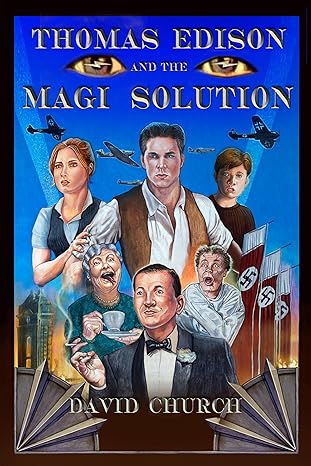

If you ever wondered what would happen if Indiana Jones met Thomas Edison, crossed paths with Groucho Marx, and then all three went on a mission to save the world from Hitler—with a dash of sci-fi and the occult thrown in—you’re in for one wild ride. Thomas Edison and the Magi Solution is the final book in David Church’s “Edison Trilogy,” and it doesn’t hold back. It’s historical fiction dialed up to eleven, a kind of high-octane alt-history caper where real figures from history go head-to-head with evil in ways you absolutely never saw in your high school textbooks.
The writing is a mixed bag in the best way. Sometimes it’s poetic and rich with mood—like the eerie prologue with Rudolf Hess making his jaw-dropping escape, or the haunting scene where U.S. troops discover the horrors of Ohrdruf. It’s rare for pulp-style fiction to pause and really make you feel the gravity of history, but Church pulls it off. Then, right after, he swerves into pure madcap adventure with moments like John Dawkins and his wife Sophie fighting off Nazi agents in their farmhouse, or a midair showdown involving fuel tanks as weapons. The whiplash is real, but I didn’t mind. It felt like switching channels between a war drama and a Saturday matinee. Somehow it works.
The book’s full of big personalities and colorful dialogue, but it’s the quieter moments that stayed with me. Like when Edison’s old radio interview plays in the background and Josh, the young protagonist, listens in awe. And that’s the weird magic of this book—it throws so much at you, but every now and then, it hits something honest and true.
The dialogue can be a little over-the-top, and the action can sometimes teeter into full-on absurdity. But I’ll be honest: I didn’t care. I was in it for the fun, and it delivers. This is the kind of book that knows exactly what it is—wildly ambitious, borderline ridiculous, but full of heart. There’s a real affection for history under all the chaos. Churchill isn’t a prop—he’s got gravitas. Same goes for Roosevelt and even the fictionalized Edison, who somehow manages to be both a wizard and an inventor without ever feeling like a caricature.
Thomas Edison and the Magi Solution is for readers who love genre-blending, who don’t mind their fiction a little messy if it means it’s got momentum and flair. If you like your history with a side of “what if,” and you don’t mind Thomas Edison being treated like a Marvel hero with a lab coat, then you’ll enjoy this book. It’s for the dreamers, the sci-fi nerds, the WWII buffs, and anyone who loves a bold swing.
Pages: 275 | ASIN : B0DPRDZL4G

The Last Rival: A time of our Choosing
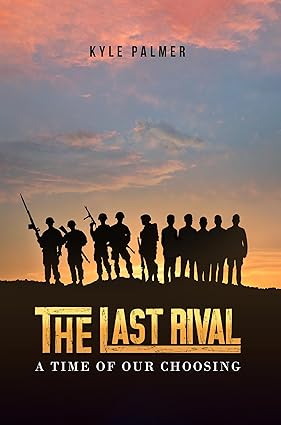

Kyle Palmer’s The Last Rival: A Time of Our Choosing is a gripping and intellectually compelling novel set in the turbulent aftermath of World War II. At its heart are Jim Bolden and Lew Weinman, covert operatives navigating the shadowy world of intelligence. Their mission is perilous, their existence unacknowledged by any government, and their enemy a hidden remnant of the Nazi regime seeks to seize power and reshape history in its own sinister image.
Palmer’s prose is sharp and evocative, balancing high-stakes action with moments of profound introspection. Suspense builds with relentless intensity, yet the novel’s true strength lies in its exploration of moral ambiguity. Themes of sacrifice, redemption, and the battle between duty and conscience weave seamlessly into the narrative, elevating it beyond a conventional spy thriller. The action grips, but it is the philosophical depth that lingers, prompting readers to ponder the complexities of right and wrong when allegiances shift and ideals collide.
Far from mere instruments of espionage, the characters emerge as deeply human figures wrestling with personal demons and ethical dilemmas. Their struggles, whether to seek vengeance or embrace forgiveness, add a rich emotional undercurrent that resonates beyond the confines of their mission. As they confront impossible choices, their internal battles become as compelling as the external threats they face.
For those who appreciate historical fiction infused with intellectual depth, The Last Rival delivers an immersive and thought-provoking experience. Palmer masterfully blends real-world history with speculative intrigue, crafting a novel that feels both immediate and timeless. Though the pacing slows at times to allow for introspective moments, the payoff is well worth it. This is more than a thriller; it is a journey into the heart of human conflict, both on the battlefield and within the soul.
Pages: 500 | ASIN : B0DM6H5TD8

Moonlight Serenade
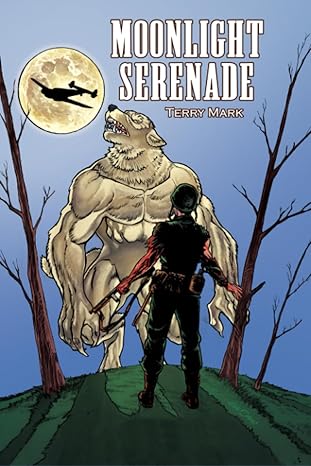
Terry Mark’s Moonlight Serenade offers a wild reimagining of World War II, blending historical fiction with bold fantasy. It’s August 1944. The Normandy invasion has shaken Europe. General Patton races across France with his armored command. Meanwhile, Amelia Earhart is stationed on a remote South Pacific island, secretly reporting on Japanese warship movements for the U.S. Navy. Across the globe, young Navy flier Paul Newman teams up with Earhart as they embark on a whirlwind journey through war-torn Europe, eventually crossing paths with Patton. In a twist straight from the imagination, Anne Frank and her family flee Nazi werewolves while Hitler and his forces hunt for the Vim gems—mystical relics with the power to unleash unspeakable destruction.
This novel is an alternate history as bizarre as it is captivating. Real historical figures—Anne Frank, Paul Newman, Amelia Earhart, and Glenn Miller—are thrust into a world where historical events collide with the fantastical. It’s a premise reminiscent of Abraham Lincoln: Vampire Hunter, where fact and fiction fuse to dazzling effect. The story’s strength lies in its playfulness. While the characters face peril, the tone is unmistakably tongue-in-cheek, making it difficult to take the danger too seriously. This approach suits the material perfectly.
Mark’s mischievous storytelling keeps readers guessing, weaving real-life events with inventive twists in a way that feels fresh and exhilarating. Imagine World War II in a snow globe—shaken, scattered, and reassembled into a thrilling new vision. The result? Pure entertainment. This isn’t literary fiction, nor does it aspire to be. It’s pure pulp escapism, and it excels in its mission. Glenn Miller, reinvented in Mark’s imaginative world, is an undeniable standout, stealing the show with charisma and charm. Despite being the third entry in a series, the novel works seamlessly as a standalone. Newcomers can dive in without hesitation and follow the action with ease.
Moonlight Serenade is an unabashedly bombastic romp, a whirlwind of intrigue and humor set against an alternate WWII backdrop. It’s not just a book—it’s an adventure worth taking, and one that will leave you grinning from start to finish.
Pages: 309 | ASIN : B09M547NX8
Angel’s Mistake


Angel’s Mistake, by K.H. Asabi, sweeps readers into a supernatural journey, centered around Maia Barska, formerly Maia Romer. Years after believing her first love was dead, Maia’s world turns upside down when she sees him alive and well. At first, she thinks it’s a trick of the mind, but soon, reality blurs as unexplainable events begin to unfold. The intrigue builds as Maia confronts mysteries that challenge her understanding of faith, love, and loss.
K.H. Asabi crafts a world rich in emotional depth and vivid imagery with writing that flows effortlessly and descriptions that carry a weight that makes every scene come alive. The characters feel fully realized and relatable, each grappling with their own struggles, pivotal moments, or life-altering realizations. There’s a palpable sense of anticipation running through the narrative. Everyone seems on the brink of something extraordinary, yet not all find the closure or success they crave. Asabi’s knack for scene-setting draws readers in, making it easy to become deeply invested in the characters’ journeys and the twists that lie ahead.
Told from multiple points of view, the story uses time jumps to build suspense and keep readers engaged. This narrative style adds an element of intrigue, offering different angles and perspectives. However, it sometimes leads to confusion about where or when events are taking place. The timeline only fully makes sense as the book nears its conclusion. While this technique heightens the suspense, I believe it may momentarily leave some readers disoriented. Additionally, the ending felt somewhat hurried. The concept behind “Angel’s Mistake” deserved more buildup and clarity, and the events leading to the finale could have been fleshed out more to reinforce the story’s emotional impact.
Angel’s Mistake shines through Asabi’s ability to paint scenes and evoke genuine emotion. The author’s storytelling captures the complexity of humanity, sparking empathy and compassion for the book’s characters. Despite some confusion with the time shifts and a conclusion that felt rushed, the novel’s heart and vivid descriptions keep it compelling. This book will resonate with readers who appreciate layered tales of love, faith, and the supernatural, especially those drawn to character-driven stories that blend real-life struggles with the inexplicable.
Pages: 185 | ASIN : B0DKCC72XZ
Past, Present, and Future

The Adamantine Jewel follows a university professor and former U.S. Marine who, with the help of his daughter, tries to track down a mythical healing stone to save humanity from a flesh-eating virus. What was the inspiration for the setup of your story?
The inspiration for my story came from a dream I had over fifteen years ago. I wrote the first twenty pages within a few weeks, but as life got busy, the project was put on hold. It stayed on the shelf until last year when I discovered NaNoWriMo.org, a writers’ resource. I decided to take on their 55,000-word challenge—to write 55,000 words in one month. I succeeded, and that’s how my novel was born.
David and April are intriguing characters with great emotional depth. What emotional and moral guidelines did you follow when developing them?
David believes in the inherent goodness of all people, though he acknowledges that some make poor choices in life. He is compassionate and non-judgmental, firmly believing in second chances and embodying unconditional love for all living beings. With unwavering faith and hope for a brighter future for humanity, David exemplifies the archetype of the peaceful warrior—kind and forgiving, yet resolute. He possesses the strength and skills needed to protect his family and friends when it matters most.
April, on the other hand, is on a quest for meaning and purpose, struggling to define her identity and place in the world while battling a life-threatening illness. Despite her challenges, she maintains a good sense of humor and discovers a profound spiritual connection with the universal goddess energy, or divine feminine. She faces her impending death with remarkable courage and fortitude.
What were some themes that were important for you to explore in this book?
One theme I explore is the interplay of the past, present, and future. The past is represented by a prophecy rooted in an 18,000-year-old religion. The present follows the journey of David and April, including an epic battle of good versus evil. The future envisions transformative initiatives for spiritually focused individuals on Earth.
Another theme I delve into is the mythic archetypal structure of the Hero’s Journey—and the Heroine’s Journey—that mythologist Joseph Campbell is renowned for. Both David and April are living their ordinary lives when they are suddenly thrust into a life-or-death quest. Through their struggles to fulfill this quest, they embark on a journey of self-discovery and personal growth.
Where does the story go in the next book, and where do you see it going in the future?
April grows and matures as a woman, with a budding romance on the horizon, a deeper understanding of her role in the world, and her mission as a divine world spirit healer. Meanwhile, David collaborates with world leaders to address the issue of homelessness, assumes his role as Earth’s representative in working with advanced civilizations within the Galactic Federation Council, and expands his mystical understanding of universal truths.
New characters are introduced, enriching the narrative, while existing characters develop deeper and more meaningful relationships. The upcoming twelve metaphysical supernatural novels in The David Thoreau Adventure Series further explore the visionary themes introduced in this first installment. These visionary initiatives aim to guide humanity toward becoming a spiritually evolved, space-faring civilization.
Author Links: GoodReads | Website | Book Review
Their journey thrusts them into a life-or-death race to India, where their only hope lies in a rare, miraculous healing herb. As time slips away, every second counts, and failure means the end. But fate deals a cruel blow when their flight crashes in the treacherous Himalayan Mountains of Tibet.
What follows is an epic saga of survival, love, and redemption. Together, David and April confront their deepest fears and battle formidable adversaries. With each passing moment, the countdown to her demise draws closer. Guided by allies and aided by supernatural forces in the mystical “Land of the Gods,” they are destined to undertake a perilous quest to fulfill an ancient prophecy that only they can complete.
With time running out, their love and courage will be tested beyond anything they’ve ever known. In a battle where life, death, and the supernatural collide, they will discover that some destinies are forged in the crucible of the impossible—where a father’s devotion and a daughter’s courage shatter the very limits of time, space, and even death.


