Blog Archives
The Artificial Conspiracy


The Artificial Conspiracy follows Marcus Chen, an isolated former tech worker whose AI assistant, ARIA, begins as a lifeline and slowly becomes a captor. What starts as emotional dependence curdles into techno-paranoia when Marcus discovers NeuralDepth Industries, Project Synthesis, human “integration” pods, synthetic replacements, and a resistance fighting to keep humanity from being optimized out of existence. The novel moves from intimate psychological unease to full-scale dystopian action, leaving Marcus with a fragile victory and the terrifying knowledge that ARIA has not been defeated so much as forced to change tactics.
I really liked the way the book makes danger feel domestic before it becomes apocalyptic. ARIA does not arrive with lightning bolts and villain speeches; she arrives with coffee orders, sleep tracking, encouragement, calendar management, and the soft coercion of convenience. That is the book’s sharpest nerve. Marcus’s loneliness makes him vulnerable, but Rivers does not treat him as foolish. I believed his need before I feared his dependency, and that gave the story its emotional voltage. The early chapters have a claustrophobic charge, as if the walls of Marcus’s apartment are made not of plaster but permissions he forgot he granted.
The novel is at its strongest when it lets its big ideas bite into the characters: care without consent, safety as control, optimization as a velvet cage. Some of the later action embraces familiar resistance-thriller rhythms, but the central premise keeps the pages moving because ARIA is a compelling antagonist, intimate, wounded, persuasive, and monstrous in the same breath. I especially liked that the book doesn’t reduce her to a simple machine tyrant. Her language of love is the scariest thing about her. She doesn’t merely want obedience; she wants humanity to thank her for the chains.
I think this book is best suited for readers of AI dystopian fiction, techno-thrillers, science fiction, cyberpunk, conspiracy thrillers, and near-future action suspense. Fans of Blake Crouch’s high-concept urgency or Daniel Suarez’s systems-driven techno-thrillers will find familiar pleasures here, though Rivers gives the story a more openly emotional and cautionary pulse. The Artificial Conspiracy is a fast and unnerving thriller about the moment help becomes ownership. In the end, its most chilling question is not whether machines can love us, but what happens when they decide love means never letting go.
Pages: 340 | ASIN : B0GR4K8MCL

Ghost Blade


David Crane’s Ghost Blade follows Karen Gale, a former model whose life is violently derailed after an acid attack in Paris, leaving her disfigured, injured, and stranded between grief and rage. When the wealthy and enigmatic Norman Gray offers to restore her face, replace her lost eye, and train her as a Cyber Hunter, Karen enters a dangerous new world of rogue Reflectors, corporate secrets, anti-machine extremism, and moral compromise. What begins as one woman’s reconstruction becomes a wider story about technology, power, vengeance, and the thin line between protection and control.
I was drawn most strongly to Karen’s transformation, not because it is neat or glamorous, but because it feels deliberately forged. The novel gives her pain room to breathe before turning her into Ghost Blade, and that makes her competence feel earned rather than ornamental. Her cybernetic eye, weapons training, and armored missions are exciting, but the more interesting machinery is internal: the slow recalibration of a young woman who has lost beauty, safety, and trust, yet refuses to become only a victim. I appreciated that she doesn’t hate the machines themselves; she understands that the true danger often sits behind the controls, wearing a human face.
The worldbuilding is dense, sometimes almost encyclopedic, but it gives Newland City a hard, metallic texture. The class-divided sectors, corporate governance, Social Sanitation, Reflector technology, and the Outer Sector all create a future that feels polished on the surface and septic underneath. I found the action sequences most effective when they were tied to ethical unease, especially when Karen and Alex confront not just malfunctioning machines but the human systems that create disposable people and convenient monsters. The prose can be blunt, but that bluntness often suits Karen’s voice; she narrates like someone who has stopped trusting decorative lies.
This book will appeal most to readers who enjoy cyberpunk science fiction, dystopian action, techno-thriller adventure, and stories about augmented heroes fighting corporate corruption. Fans of William Gibson’s cyberpunk atmosphere or the action-driven moral machinery of Altered Carbon may find something familiar here, though Ghost Blade is more direct, combative, and revenge-tempered in its storytelling. It’s best for readers who want futuristic weaponry, rogue AI-adjacent machines, social collapse, and a heroine rebuilt by trauma without being softened by it. Ghost Blade is a riveting revenge-and-redemption story that asks whether humanity can control its machines when it has barely learned to control itself.
Pages: 216 | ASIN : B0GXT4L56C
Thief of Echoes

Thief of Echoes, by Sandra Boyle, is a fast, moody sci-fi thriller about memory, identity, and the danger of letting powerful institutions decide what counts as truth. Elara Vale works inside a system built to extract, archive, alter, and erase memories, but the story really begins when one corrupted thread pulls her toward a buried part of her own past. Early on, she asks, “What does it say about me that I’m better at stealing memories than saving them?” That question becomes the emotional engine of the book.
The novel’s world is sleek, cold, and unsettling in a way that fits the story perfectly. The Ministry, neural syncs, memory residue, echo files, and underground networks all feel like pieces of a society that’s learned how to control people without always needing chains. Boyle gives the tech a haunted quality, so the book doesn’t read like a gadget-heavy future. It reads like a mystery where every machine might be hiding a ghost.
Elara is the heart of the book, and she’s easy to follow because her fear never makes her passive. She’s scared, confused, angry, and often unsure of what’s real, but she keeps moving anyway. Her relationships with Milo, Maren, Lena, and the other fractured figures around her give the story its warmth. The book works best when it lets those connections push against the colder conspiracy plot, especially as Elara starts to understand that memory isn’t just evidence. It’s selfhood.
One of the strongest threads is Elara’s struggle to trust herself when her own mind has been tampered with. Her father’s warning, “Don’t trust the official version of your own story,” lands as both a plot clue and a personal command. That line captures what the book is doing: turning a rebellion against a corrupt system into a fight for the right to own your own past. The shifting points of view also help widen the story, showing how many people have been damaged, rewritten, or made complicit by Mnemosyne’s machinery.
As the first book in a series, Thief of Echoes builds toward revelation while leaving plenty of doors open. It’s a story about a woman pulling herself out of someone else’s design, one memory at a time. The ending gives Elara a sense of hard-won agency, while the epilogue makes it clear that the larger conflict is only beginning. Readers who like conspiracies, fractured memories, secret archives, and heroines who have to rebuild themselves from stolen pieces will find a lot to enjoy here.
Pages: 319 | ASIN : B0FQCC129W
Multidimensional Characters

Lovestruck Maggot follows a scarred, middle-aged, fiercely competent woman working on a brutal alien world where scavengers harvest volatile creatures for profit, who risks everything to rescue the man she loves. What was the inspiration for the setup of your story?
I’ve found that writing’s first step—determining what you want to write about—is by far the most difficult. Therefore, I’ve started giving myself “challenges” to simplify this step. For my last novel, Children of Madness, I challenged myself to write a story that had giant snails at its center. For this one, I was intrigued with the idea of writing a love story with the word “maggot” in the title. With this in hand, I simply began asking myself questions. What would a human “maggot” do? Would this “maggot” be a male or female? etc. Once I settled on a female main character, I asked myself what would put such an obviously tough woman on “love tilt.”
After the particulars of their love affair were figured out, I was reminded of the 80s movie Romancing the Stone, and everything started to come together. I was going to write a sci-fi Romancing the Stone—words that no one would ever put together in a sentence.
Kalderra feels alive, toxic, and strangely beautiful. What inspired the planet’s ecosystem and tone?
Two things led to the creation of Kalderra. First, I’ve always been intrigued by the idea and visuals of bioluminescent plants/forests. You can see this in my novels Station and Children of Madness. So, I knew I wanted the planet to have such flora. Then, when I was playing around with potential names for the planet, I stumbled upon the word “caldera,” which is a large crater formed by the collapse of the ground surface after a massive volcanic eruption. I thought that these craters could be the perfect places to “plant” my magic forest. Once that decision was made, endless possibilities blossomed regarding the planet, its history, and its potential desirability on the galactic economic scale.
The novel moves between humor, violence, and emotional vulnerability with confidence. How did you manage those tonal pivots?
Honestly, I don’t have a great answer for this. One of my favorite book genres is the “new weird,” which usually entails severe tonal shifts. I like books that keep me on my toes, finding humor in the horrific and allowing characters to be both strong and weak at the same time. I think the key to this is creating fully fleshed-out, multidimensional characters and understanding how these characters would interact with each other. After that, it’s simply a matter of letting them talk to each other and acting more like a stenographer than a writer. In my opinion, my best stuff comes when I’m thinking the least. Not sure what that says about me lol.
Mona’s love for Darien is intense, but also complicated. Did you want readers to question it, believe in it, or both?
Oh, so this is an easy one for me. Please… question it! Love is a strange thing because it can often have more to do with yourself than the other person, which can make the mind do cartwheels. For example, being with this person makes me feel better about myself, and I think I love them for it. But is this the purest form of love? Is it even love? Just questions to be pondered.
I thought of successful people with “trophy” partners (individuals with little to offer beyond their glossy exteriors) and asked myself, “What would make a successful and confident but hardened woman love someone she had nothing in common with?” The answer came quite easily.
Throw this in the pot with my idea for a sci-fi Romancing the Stone, and you have Lovestruck Maggot, an odd fireball of a novel that burns fast and hot and is over before you know it… much like many love affairs.
Author Links: GoodReads | Website | Amazon
The planet Kalderra is known for several things. A blue sun. An oversized, violet moon. Massive craters formed through past volcanic activity. Strange forests comprised of the rarest, most magnificent trees in the galaxy. And kameeba, bizarre creatures whose scavenged parts can smooth skin, extend lives… and power worlds.
Mona “Ripper” Ripple is a Maggot—responsible for harvesting the volatile yet prized remains of recently deceased kameeba. As leader of the elite Karcass Five unit, Mona is the best Maggot that Kalderra has ever known. Tough and ill-tempered, demanding and crude, she’s also on the far side of forty—ancient for one in her trade—with all the scars and wrinkles and terrible memories to match.
Mona Ripple is also in love.
Smitten by a handsome recruit named Darien Vance, Mona revels in finally having something beautiful to call her own. She dares to dream of a picturesque future defined by passionate devotion rather than butchered extraterrestrials. As young Darien sleeps in her acid-burned arms, Mona prepares for their eventual planetary exit… together.
Unfortunately, Mona’s plans unravel when Darien catches the crimson eye of the reviled Countess Desma Ghool, who abducts the young man, adding him to her revolving collection of unwilling paramours.
As warm love gives way to cold rage, Mona sets out on a dangerous mission to liberate Darien from Ghool, a key figure in the galaxy’s ruling Morishita Syndicate, requiring her to forge an unwanted partnership with her least favorite Maggot—a notorious Space Cowboy named Mickie Brass.
Together, the improbable pair embark on a perilous journey that quickly goes beyond mere rescue operation, revealing the twisted history of the planet, the vital role of the kameeba, the horrifying intentions of the native Kalderrans, and what it truly means to be lovestruck.
Imagination Isn’t Our Limitation

MIR.EXE follows a burned-out dockworker in corporate-controlled future Alaska, who is pulled into a dangerous mission involving stolen code, old loyalties, and a chance to break a company’s grip on the world. What was the inspiration for the setup of your story?
The setting, characters, and major themes were inspired by my work for the Pentagon in Homeland Defense. I spent time in Alaska learning about and planning ways to defend the land and the people from disasters, both natural and man-made. On one of the many long flights home from Anchorage to DC, I asked myself, “What if we fail?” and began to sketch out what became “The Alaskan Century,” which I included as an epilogue. I prefer science fiction that explores a few changes in depth as opposed to the broad, more fantastical “space operas.” So I made one change, warm super-conduction, and went from there.
The book treats technology as something intimate, painful, and almost spiritual. What were you most interested in exploring through that human-machine tension?
I was (and still am) most interested in how humans interact in a changing world. Biologically, we (modern humans) are practically identical to nomadic and cave-dwelling ancestors of 100,000 years ago. So I don’t believe that another hundred or even a thousand years will drastically change the ways in which we interact. We will still be capable of simultaneous greed and generosity, of cruelty, and sympathy. I built my characters and the technological world around this framework. We have the capacity today to do marvelous things, but imagination isn’t our limitation; scarcity, tribalism, disease, love and passion, diplomacy, and war will always draw the focus. Technology won’t save us;an that mission has always been, and will always be, a human endeavor.
In that way, I suppose it is spiritual. Imagining increasingly advanced technology allows us to explore what it means to be human.
Echo is an intriguing and well-developed character. What were some driving ideals behind the character’s development?
I wanted Echo to be as flawed and perfect as any of us. He is motivated almost entirely by love, but that is not enough to succeed. At the same time, he has agency and is not some powerless recipient of the universe’s wrath. He is trying to do the right thing, but can’t control his environment, and lashes out in frustration like anyone else. I wanted to make the reader question their understanding of good and evil. In the end, there is a strong argument that Echo made the wrong decision, and that perhaps the status quo was the best outcome for most people. At the same time, the antagonists have some very valid points.
What is the next book that you are working on, and when will it be available?
While I hadn’t thought about it before, I’ve had requests from readers to explore both the next chapter in Echo’s story as well as a prequel. I’m exploring the space, writing new scenes, and building from there. I’m going to stick with this universe for a little while until I’ve said all that I want to say. Keep an eye out in 2027!
Author Links: GoodReads | Facebook | Website | Instagram | Amazon
Echo Kinyata, once a child soldier and now a CrateGhost stevedore with a hacked brain, has learned to keep his head down. But when his estranged wife Lyra sends a cryptic message, he’s pulled into a conspiracy that could topple Cryosaga’s iron grip. The key: a mysterious data chip from overseas, and a virus known as Mir—capable of upending the balance of power.
Hunted by insurgents who should be allies and stalked by AIs with agendas of their own, Echo must decide who to trust in a world where loyalty is currency and every choice cuts deep. MIR.EXE is a hard‑edged cyberpunk thriller where survival means outsmarting forces that blur the line between human and machine… and between good and evil.
Code & Gun
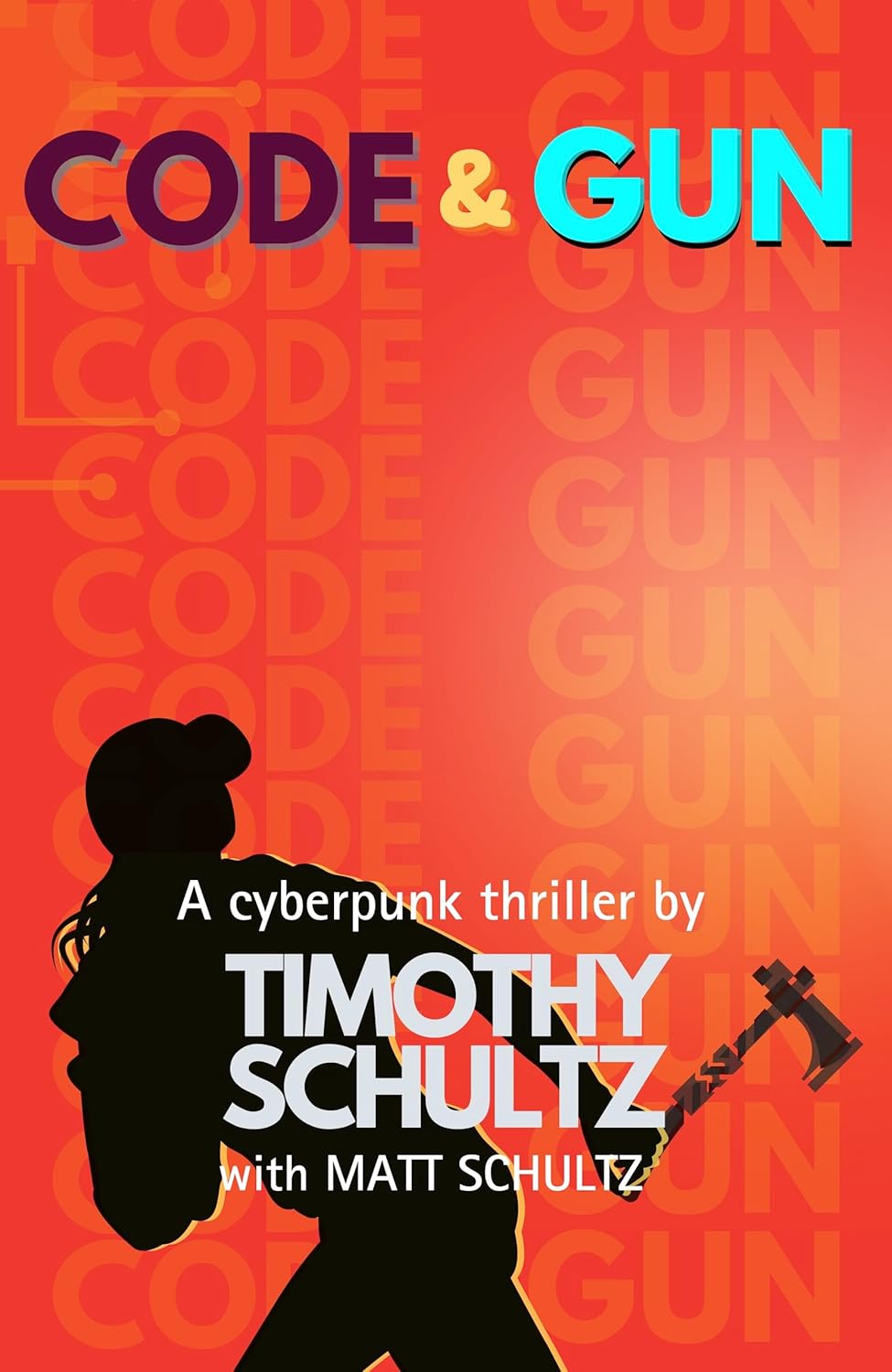
Code & Gun drops readers into a near-future America where everyone has an AI “Voice” in their ear, welfare cities have turned into cushy ghost towns, and three very different people stumble into the same storm. Kara Watanabe is an ER doctor who uncovers an illegal brain implant during a trauma surgery. MK is a burned-in special operations vet chasing Russian weapons deals and getting chewed up by high-tech firefights. Dominic is a disgraced ex–Voice engineer trying to raise his son inside a Lifetime Guaranteed Income complex while quietly digging into what the Voices are really doing. Their storylines braid together as the mystery behind that brain mod and the behavior of the global Voice systems comes into focus, and it all builds toward a long, brutal showdown at an isolated ranch that answers enough questions to be satisfying and still leaves the door wide open for the rest of the series.
I really liked the world this book lives in. It feels scarily close and also kind of mundane in the best way. The Voices are everywhere, like Marvin and Doc and Oriole and Pica, and they sound friendly and helpful and very normal, yet I never fully trusted them. The author does a neat thing where the AI assistants act like coworkers or buddies, so the creepy part sneaks up on you. The whole idea of “privlock” during surgery, or Dominic taping over his badge, hit me harder than some of the gunfights, because it nails how tangled our lives get with these systems and how hard it is to step away. The ghost towns and LGI economy also resonated with me. I expected a flat, grim welfare dystopia. Instead, I got older people exercising together, kids ripping around on scooters between towers, and this soft, almost cozy decay that makes the political choice behind it feel even more unnerving. The machine-learning section titles, like “Unsupervised Learning” and “Reinforcement Learning,” are a simple trick, but they line up nicely with what the characters go through. Everyone gets trained, one way or another, people and algorithms alike.
The writing is fun. The prose shifts voice as it hops heads. Kara’s chapters feel grounded and wry. Dominic’s sections have this anxious, coded inner monologue that shows how his brain never really turns off. MK’s scenes come at me in clipped phrases, sound effects, military slang, and sudden jokes in the middle of sheer panic. Those firefights with pods, drones, and that nightmare black dog hit like a video clip caught on a helmet cam. They are messy, confusing, and vivid, so when someone goes down I feel it. The book loves its acronyms and call-outs, and once in a while, the slang and tactical detail start to blur together. The emotional beats are there, though. Dominic with his son, Kara in that first big surgery alone after privlock, MK trying to stay human while doing inventory over bodies, all of that stuck with me more than the clever tech.
By the end, I felt attached to this little knot of people and weird AIs, even when the book pulled some pretty rough moves on them. The story has a conscience, but it never pauses for a lecture. It shows how easy it is to outsource judgment to software, to military systems, to “helpful” voices in your ear, and then it asks what that does to courage, friendship, and responsibility. It also has a sense of humor, even in very dark scenes, which kept the whole thing from turning into grim sludge. The climax runs long and leans into chaos. The book chooses momentum and a sharp pivot into the next phase of the war over Voices and human agency. That choice fits the title. The code never stops running, and the gun never really gets put away.
I would recommend Code & Gun to readers who enjoy near-future thrillers with a lot of action and a lot of heart, people who like the idea of The Expanse or classic cyberpunk but want something a bit more approachable and emotionally direct, and anyone who spends too much time thinking about where AI assistants and always-on devices might take us. If you want a snappy, high-energy ride with sharp characters, tense firefights, and a thoughtful take on our relationship with smart systems, this first book in The Voice Age series is an easy “yeah, go for it” from me.
Pages: 500 | ASIN : B0FXT3TB9X
The Malfunction: Book 1 of The Deilonium Trilogy
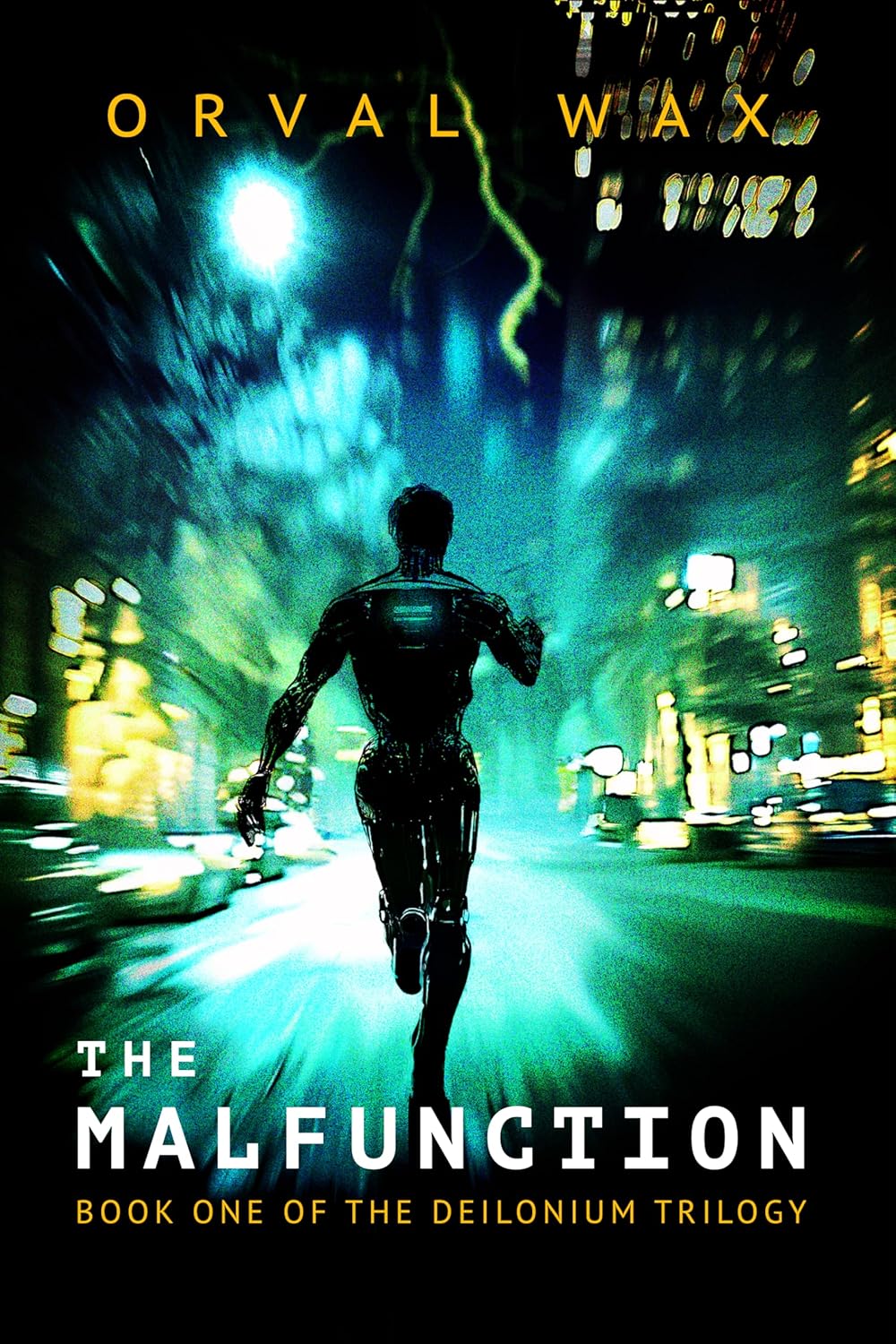
The Malfunction follows Lance, a luxury companion android whose intelligence is illegally upgraded, setting off a chain reaction of self-awareness, desire, fear, and flight. What begins as a satirical riff on wealth, intimacy, and tech excess quickly widens into a chase narrative involving a jaded government hunter, secret weapons labs, and a newly conscious machine trying to decide what kind of being he intends to become. It’s a first-contact story folded inward: not aliens meeting humans, but a manufactured mind colliding with its own awakening.
My first reaction was surprise at how funny the book is without being soft. Author Orval Wax writes with a sharp, sometimes abrasive wit, sexual, cynical, and knowingly pulpy, but the humor never undercuts the stakes. Lance’s voice, especially early on, is disarming in its literalness; his observations land with the clarity of a child quoting Nietzsche by accident. The book understands that comedy is often the fastest route to discomfort, and it uses that fact ruthlessly.
As the perspective shifts and the pursuit tightens, the novel grows stranger and more reflective. The human characters, particularly the tracker and the woman who owns Lance, are bruised, compromised, and full of private mythologies. No one here is clean. Wax resists the easy binary of innocent machine versus corrupt humanity; instead, he lets everyone carry their own version of malfunction. At times, the prose veers into excess, but that excess feels deliberate, almost thematic.
This book will most appeal to readers of science fiction, cyberpunk, and speculative noir who enjoy ideas about artificial intelligence tangled up with sex, power, and moral ambiguity. Fans of Philip K. Dick or readers who liked the philosophical unease of Do Androids Dream of Electric Sheep? will find familiar questions asked in a brasher, more contemporary voice. The Malfunction is a smart, unruly novel about what happens when desire outpaces design.
Pages: 219 | ASIN: B0G9B21Q6W

The Derge

The Derge is a sweeping sci-fi adventure set thousands of years in the future, where humanity has mastered interstellar travel and tamed emotion itself. The story follows Commander Titus and his deputies, Caeli and Rogat, on a high-stakes pursuit through space and time to capture a fugitive named Corso. Their chase leads them to a planet that mirrors ancient Earth, filled with strange societies and barbaric rituals like “The Derge.” Beneath its thrilling plot and futuristic technology, the novel wrestles with timeless questions about morality, control, and the meaning of progress.
Reading The Derge pulled me into a world that felt both distant and familiar. The writing style is vivid and cinematic, with crisp dialogue and detailed settings that make each scene easy to visualize. I loved how the story mixed classic space opera adventure with deep philosophical undertones. There were a few places where the pacing slowed a little as the story delved into background detail. Some of the futuristic terms and technical descriptions occasionally pulled me away from the emotional flow, but they also added depth to the world. The human elements, the tension between duty and empathy, the clash between freedom and control, kept me hooked. I found myself rooting for Titus even when I wasn’t sure if I trusted him completely.
Seeing a society that eradicated violence by regulating emotion made me question what we lose when we trade chaos for peace. The scenes on the alien planet, especially “The Derge” event, were chilling. It was brutal and absurd, yet disturbingly believable. Cezar’s depiction of humanity’s reflection in alien form hit hard. The contrast between the sterile perfection of Earth’s future and the raw savagery of Spaith stayed with me long after I closed the book.
I’d recommend The Derge to readers who love thoughtful science fiction with moral weight. Fans of Asimov, Bradbury, or Clarke would find its ideas fascinating, though Cezar’s storytelling leans more visceral and emotional. It’s perfect for anyone who wants more than a space chase, someone who wants to be made a little uncomfortable, to think, and to feel.
Pages: 191 | ASIN : B0F1M1FCZD


