Blog Archives
Historically Proven Principles
Traitor’s Black Rose imagines a fractured 2088 America, where the President battles corruption and assassination attempts to save a nation teetering between collapse and unity. What was the inspiration for the setup of your story?
This is the third book that I have written; the first two books are part of a trilogy that Literary Titan has reviewed. I sincerely inspired to write dystopian books, and this endeavor has been an exceptional adventure and hobby. Regarding Traitor’s Black Rose, the current global divide and political divide in the United States inspired me to write this book. FYI, the fourth book that I am currently writing is the last book of the trilogy.
The narrative unfolds almost like a historical chronicle. Why did you choose this style, and how do you think it enhances the story’s themes?
I am a professional engineer by trade and a retired Combat Engineer officer; ironically, I enjoy studying history and philosophy. I believe that to understand our current situation in the US and the world, you must examine the past. Obviously, this fictional dystopian is set in the 2088 (the future). What we do today may lead to something that we did not desire. Too often, we tend to throw the baby out with the bathwater since many historical lessons are still generalizations, and many tend to think that exceptions to the rule are just as likely.
What were some themes that were important for you to explore in this book?
One theme is to remind all that you must be aware that your ends and desires will not justify any means. We must remember that historically proven principles should not be discarded for power or one’s idealistic goal.
Do you see the story as a warning, a reflection, or perhaps a call to action for today’s readers?
I see this story as both a reflection and a warning. I demonstrate this by using quotes and Bible verses that express reflection and warning.
Author Links: GoodReads | Website | Amazon
Mushroom Blues
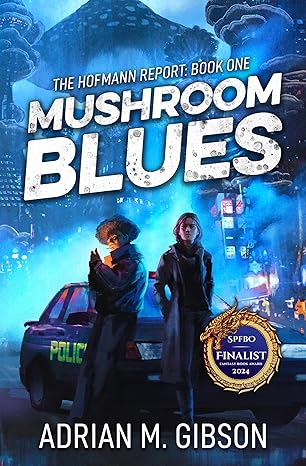

Adrian M. Gibson’s Mushroom Blues plunges readers into the “Fungalverse,” a dystopian blend of noir, science fiction, and surrealist horror. The story follows Detective Henrietta Hofmann, a weary investigator exiled to the oppressive, mushroom-drenched city of Neo Kinoko. Tasked with solving a gruesome murder, she navigates a tangled web of political corruption, cultural tension, and personal trauma in a world where humans and sentient fungal beings coexist uneasily after a brutal war.
Gibson’s depiction of Neo Kinoko—its decaying mushroom-topped towers, spore-filled air, and oppressive post-war atmosphere—was as immersive as it was revolting. I could practically smell the rotting mycelium and feel the grit of spore-laden winds on my skin. The mushroom-human dynamic adds a unique, eerie tension to the setting. The Mother Mushroom, a colossal fungal structure looming over the city, is both a symbol of cultural resilience and an unsettling presence. Gibson’s descriptions, such as the protagonist’s repulsion at fungal biology, made the world grotesquely alive. Henrietta Hofmann is a compelling lead. Her cynicism and mycophobia make her a fish out of water in the fungal-dominated Neo Kinoko, yet she’s tenacious and relatable. Her struggles with alcoholism and personal demons lend depth to her character, especially during moments of vulnerability. The story’s pacing mirrors its noir roots—deliberate and laden with tension. While the mystery at its core is intriguing, it’s the societal commentary that elevates the narrative. The portrayal of post-war xenophobia and systemic oppression is sharp and poignant, with parallels to real-world colonial histories. The protests and clashes between human authorities and the fungal populace stand out as some of the most gripping scenes, capturing the desperation and anger of a marginalized group.
Mushroom Blues is a bold and bizarre debut that will appeal to fans of genre-bending fiction. Its mix of noir grit, science fiction imagination, and social critique makes it perfect for readers who enjoy Adrian Tchaikovsky or Jeff VanderMeer. Its grotesque imagery and deliberateness are perfect for those who relish intricate world-building and morally complex characters and will find themselves enthralled—and perhaps a little spore-sick. It’s a dark, fungal-drenched trip worth taking.
Pages: 441 | ASIN : B0CTCF9TCF

One Is None

One is None, by Mark Nihlean, grabs readers from the start, weaving a dark tale of survival, mystery, and tragedy that lingers long after you’ve turned the last page. It begins with Doug McCrae and his son Ben, moving through a post-apocalyptic landscape that reveals Doug as a cold and often cruel figure, a character as compelling as he is unsettling. This fractured family, including Ben’s sister Amy, his stepmother Dolores, and a newborn sibling, lives out a bleak existence in a bunker. By the second chapter, I was hooked, already invested in this family’s tragic backstory, and curious to uncover the secrets behind it.
The early pages introduce an eerie layer: Dolores begins to believe her infant son is speaking to her through visions, an impression only strengthened by a stranger’s similar story about his own child. The mystery here is just enough to keep the pages turning, especially as the tension builds. I found myself both repelled and fascinated by Doug’s character; he’s the embodiment of toxic masculinity, a figure of cruelty who somehow manages to keep me reading. Dolores’s wisdom and resolve make her the perfect counterpoint, though it’s hard to see her bound to someone like Doug, which only adds to the novel’s emotional charge.
As the story unfolds, the family encounters other survivor communities led by twisted leaders, casting an even darker shadow over the plot. This novel veers into some heavy psychological territory, and Nihlean’s writing meets the challenge, his sharp prose bringing every tense moment to life. Though I’ve always enjoyed thrillers and survival tales, this one pushed my limits. There is a warning about sensitive content up front, and it’s justified—the disturbing treatment of children is intense and difficult to read. While these moments deepened the stakes, I feel they also made the story harder to bear. That said, Nihlean’s writing is exceptional. His command of language and pacing pulled me in, making this an unforgettable, if emotionally challenging, read.
One is None is a haunting and skillfully crafted novel that leaves a lasting impact. Mark Nihlean’s storytelling dives deep into the human psyche, exploring the resilience, fears, and darkness that emerge in desperate times. For those who appreciate well-executed thrillers that challenge their emotions and perceptions, this book is a compelling, if harrowing, choice.
Pages: 320 | ASIN : B0DNKJCY6N
Isolation
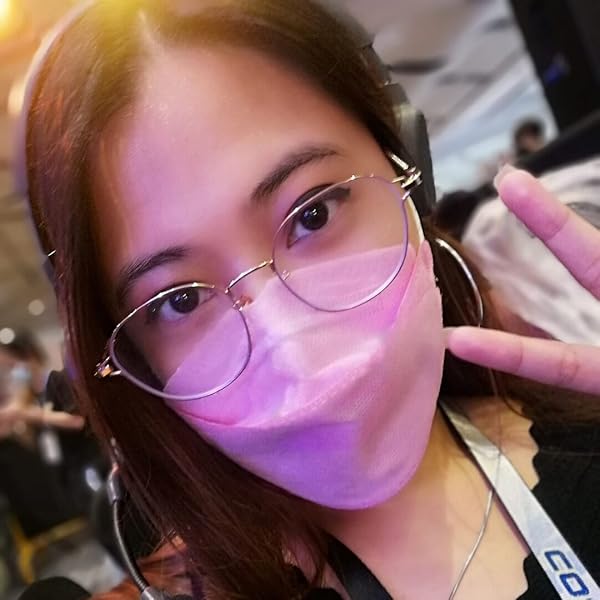
Silence follows a young girl who loses her tongue and is now trying to survive in a world that values perfection over everything else. What inspired the setup of your story?
Silence was born from my own insecurities. I always felt inferior to other people, and felt that I had to work triple time in order to keep up. One of my flaws is that if what I do and what I am is not perfect, then I’m not good enough (that’s why I’m in therapy). The concept of a tongueless protagonist came to me one rainy day in a cafe. My friend and I were sitting around a table and having coffee–and the conversation was deep and riveting. At that moment, I realized I had nothing to contribute and felt bad about it, and the image of me cutting out my own tongue suddenly shot into my mind. The rest just kind of followed.
What are some things that you find interesting about the human condition that you think make for great fiction?
Great fiction, for me at least, is when a book is able to connect to its reader. Like, “Oh, I felt like that once,” or “I get this character because I was more or less in the same shoes emotionally.” So human flaws, or how we deal with things, or our thought processes are very interesting to me. I’m so fascinated with the journey behind the reason why or how a person settled on a particular decision.
What were some themes that were important for you to explore in this book?
Without giving away much of the book, a very important theme to explore for me was “isolation.” I wanted to recreate or at least simulate what isolation felt for the reader–because I’m hoping people who had never felt it before would be given a chance to see what it feels like to some degree and encourage them to be kinder. Another reason is that if someone who feels isolated picks up this book, hopefully, they’ll feel a little less alone because someone was able to put what they feel into words. Another theme was the difference between “silence” and “silencing.” “Silence” can be good, powerful, and beautiful. But the act of “silencing” is usually debilitating, and gives way to isolation and loneliness.
Will there be a follow-up novel to this story? If so, what aspects of the story will the next book cover?
I wouldn’t say that it will be a sequel, but the second book will take place in the same universe, after the first book. I plan to write a trilogy of standalone novels so that people can enjoy each book without having to read the others. Of course, characters from the other books will appear and play a role, so I’m very excited for that! For the next novel, I plan to explore the intricacies of “belief” and the “power of voice.”
Author Links: GoodReads | X (Twitter) | Facebook | Website | Amazon
Trapped in a society where only perfection was accepted, Lily had lost her tongue. One day, a girl in a pink and green sweater appears on her doorstep, dangling an offer that she cannot refuse.
To get her life back, Lily follows Sweater Girl to the middle of the unforgiving City on the mountains. Haunted by the memories of happier days, she must overcome all odds in order to reclaim her missing tongue–and end her silence.
Internal Conflicts
Star Lost follows a woman living in a world where ignorance is reinforced as the government routinely wipes memories of the people, who starts to unravel the truth behind the dystopian state and become involved with a group trying to save their world. What was the inspiration for the setup of your story?
Well, as this review and others have mentioned it is a chillingly plausible reality, isn’t it? Though Star Lost is set in the near future it was inspired by recent frustrations. I have seen a recent decline in our society’s interest not only in the understanding and memory of historical events but appreciation for anything deemed “outdated.” That said, the book was not written to say that the be-all and end-all of human existence is old tech and books, reading, and the written word (although some book lovers might disagree), but rather to explore why we have such animosity as a society towards anything “old”, historical record, reading, and understanding of our own personal histories. Not to mention the recent influx of revisionist history and book banning. I think it best, despite our motivations for wanting to dispel it, to hold on to our history so we don’t repeat it. I also take a bit of a dig at social media, which carries over into all three books.
Luccee is a fascinating character trying to just hold on to her memories and understand what is happening to the world around her. What scene was the most interesting to write for that character?
I think Luccee is a really fun FMC all around. She has an underdog quality, but she knows how to kick things up when she needs to. I recently finished book 3 of the series and those scenes are more fresh, but in attempting to recall Luccee’s scenes from Star Lost, I’d have to say she is the most fun to write when she has realizations about herself and other people. I think any scene with Trevers where he does his best to help her see “reason” but Luccee is able to stand up to him is my favorite. I love giving Luccee opportunities to grow as a person. Her scenes with Wilda are another favorite. I love their mentor/mentee dynamic.
What were some themes that were important for you to explore in this book?
Familial discord is a big one. Family history obviously plays a big part in the narrative as well. If your MC is having a disagreement with their family, I think it’s important to explore that in-depth at some point in the narrative. It’s often the source of their internal conflicts, and usually what sets them on a journey towards something external. And since Star Lost is the first book of the series, it was necessary for me to dwell on the “past lives” of the characters, so the reader better understands them and what makes them tick in future books.
Can you tell us more about what’s in store for Luccee and the direction of the second book?
I’d be happy to! Luccee will definitely go on the journey she is meant to (and the one readers of Book 1 will be yearning for), immediately beginning with Book 2. She will go on what some readers have called “a wild ride” and whether intentionally or accidentally, meet people who have an odd connection to her she couldn’t have imagined. And her life will change in ways she never would have predicted. That will even carry over into book 3 which is coming out this fall! But if you read books 1 and 2 in tandem, it will give you the sense you’ve been transported from the status quo to a more colorful universe. From sepia tone to technicolor!
Author Links: GoodReads | Website | Instagram | TikTok | Amazon
The Essence of a Being

The Gemini Project follows a seventeen-year-old boy who discovers his entire life has been a lie and now must find a way to escape the school he lives in in order to survive. What was the inspiration for the setup of your story?
The inspiration is a bit of a spoiler alert. I had a thought what if this certain event happened, and that became a brain-worm. Each day I would expand on the story and new characters would enter my head, and I knew it wouldn’t go away until I wrote something down!
I find the world you created in this novel brimming with possibilities. Where did the inspiration for the setting come from and how did it change as you were writing?
As I wrote the story, it hit me that I was naturally writing about the future in past tense. At one point in the text, when something happens to the protagonist, I suddenly found myself writing in the present tense. Although this change in style just seemed natural to the flow, I hope that it also helps draw the reader into the experiences of the protagonist.
What were some themes that were important for you to explore in this book?
The story covers parental relationships, especially those where a parent is detached from their child, as in the case of a parent who outsources the upbringing of their child. The story also explores neurological development and tries to answer the question of what the soul consists of, or more accurately the essence of a being. Finally, the story takes place in a dystopian world, however, not a fantasy world. The overarching theme is a warning as the world that is developed is in the realm of the possible.
Is this the first book in the series? If so, when is the next book coming out, and what can your fans expect in the next story?
This is a stand-alone story, however my next novel Nothing but the Truth takes a very similar path in its style of story-telling.
Author Links: GoodReads | X (Twitter) | Facebook | Website | Amazon
Dr. William Osler works at the Academy and considers himself an amateur philosopher and would-be comedian. He befriends Jan and sees the boy’s keen desire to learn. Quietly in the background, the doctor teaches his student to read. Dr. Osler knows that the 17-year-old boy will die, the same way his older brother died, in less than two weeks. However, addicted to a designer drug, the doctor is constantly high as he tries to fight his own demons.
Tre Ericson is Jan’s father. He sees his son four times a year but feels no love for him. While desperately trying to please his father, Jan discovers a tunnel that runs under the school. The tunnel contains a dark secret, which initiates a chain of events that might save Jan’s life!
The Gemini Project is must-read coming-of-age novel that deals with a dystopian future and the world of neurology. The story of Jan Ericson will take you to unpredictable places in a battle of life and death.
Emotional Trauma & Healing

Of Ashes and Dust follows a Vietnam Veteran, now a professor, who is haunted by his past only to discover as the world is headed to Armageddon that the conspiracy theories he questioned are, in fact, truth and nothing is as it seemed. What was the inspiration for the setup of your novel?
There’s an obvious long-term cover-up by the US Government regarding the existence of ETs & UFOs, dating back to 1947. This, in part, served as an impetus for my “inspiration” to weave this narrative thread into the story arc. Also, I work with US military retirees, combat vets, many suffering from PTSD, as well as having served in the Army myself. This also added impetus to incorporate these elements into the plot.
The relationships that the characters form and, ultimately, the betrayals hook readers into watching everything unfold. What was your approach to writing the interactions between characters?
It came naturally. I’ve lived the majority of my life overseas having worked with the US military during almost all this time. Dealing with stress-related combat vets almost daily has led me to come face-to-face with their problems, often getting personally involved with their emotional trauma & healing.
What was the chosen theme of the novel, or did it develop organically as you were writing?
It pretty much “develop[ed] organically.” The story, except for one or two events toward the end, naturally unfolded for me. Wish all story arcs would do that!
What is the next book that you are working on, and when will it be available?
Working on publishing a chapbook (small poetry book), then a children’s book, and then the sequel to Of Ashes and Dust (OAAD). The OAAD sequel will most likely be more psychologically-driven & deeply delving into the troubled mindset of the protagonist & first-person narrator, Prof. Will Watson, rather than mostly event-driven as in the original.
Author Links: GoodReads | Website | Amazon
Their tale traces back to two covert operations from the Vietnam War era–a revelation about UFOs from the U.S. Air Force and the clandestine Project Sixty-Seven.
At the heart of the story is Professor Will Watson–a war-ravaged Vietnam veteran, a fervent activist of the New Hampshire Liberty Militia, and a man haunted by specters of his past. As the world edges toward Armageddon, he seeks solace in the arms of his Japanese graduate student assistant, Kimiko Tanimoto. Amidst escalating pursuit by the State Police and FBI, Watson is confronted with the harsh realities of his traumatic past and the imminent downfall of a world crumbling around him.
However, the truth about his “friendship” with Mark Mercotti, a fellow militia member with a hidden sexuality, proves to be more sinister. During their service in VIetnam, Mercotti had Watson enlisted in the enigmatic Project Sixty-Seven and arranged for a covert implant to be placed in Watson’s head. This unsettling revelation forces Watson to question his sanity, but he soon learns that Mercotti’s web of deceit runs deeper.
As Watson navigates the aftermath of his military service, he stumbles upon a reality beyond his wildest dreams: the implant was a government ploy to monitor him. Meanwhile, Mercotti is far from the friend he claims to be. His conspiracies are more than mere theories; they’re cold, hard facts.
“Of Ashes and Dust” is a relentlessly intense tale of alternate history set against the backdrop of global Armageddon. It’s a thrilling exploration of conspiracy, survival, and unforgiving intrigue, culminating in a finale as explosive as it is unexpected.
Deep-Seated Memories

In The Logoharp, a human-cyborg hybrid, dissatisfied with her life and the abuse of political power, works as a journalist tasked with foreseeing and reporting on future events. What was the inspiration for the setup of your story?
I was a science journalist and later, a multimedia and journalism studies professor in China, Hong Kong, Indonesia, and most recently Nairobi on a Fulbright Scholarship (2018-2019). With the emergence of the Internet and the rise of disinformation, deepfakes and AI-authored news stories, much of journalism has morphed from a fact-based practice into a mishmash of opinion, partisan backtalk and skewed predictions about election outcomes, candidates, policies and ideas. Too many media organizations jump to “report the future” by cherry picking present-day events and personalities. Meanwhile, important information and context are being ignored.
Our collective media obsession with ‘eyeball’ count and celebrity allowed me to imagine a world in which there is little security and no objective reality, only the reality of trumped up journalism in “reverse.” As communication and security expert Hamilton Bean described it, “The Logoharp creates a troublesome vision of media that borders on propaganda in an AI-filled future.”
There is a lot of time and care spent with descriptions and building the setting and tone of the story. Was this out of necessity to develop the depth of the story, or was it something that happened naturally as you were writing?
The descriptions from China, Hong Kong and “Ameriguo” in The Logoharp come from deep-seated memories of these countries. I’ve lived and worked in all of them. To me, developing authentic physical landscapes in the novel was a necessity to convince readers that my heroine Naomi’s story was both believable and important.
I think it’s important for writers to pay attention to the concrete, sensory world. I started early, right after college, studying both classical and modern Chinese language and culture in Taiwan. From there, I had an extraordinary opportunity to travel and work throughout Asia, then Europe, then Africa, taking notes and photographs, producing a surround-sound mental canvas on which I populated my characters. Establishing the novel’s setting and tone was entirely organic (lots of drafts), though the descriptions of sky tunnels and ocean luges came right out of my imagination. Of course, I was inspired by the likes of Jules Verne, Ray Bradbury, Adam Johnson (The Orphan Master’s Son), Ursula LeGuin, Liu Cixin, Doris Lessing, Harper Lee, Manuel Puig and so many others. All these writers display both an acute visual and kinetic sense in their work.
Is there any moral or idea that you hope readers take away from the story?
I hope readers will think about our world’s future, our climate crisis (no, it’s not a hoax) and whether we, as denizens, should do a better job educating ourselves, researching and vetting multiple sources of information and news rather than relying on this or that media channel to do our thinking for us. When government, political parties and corporate media bosses collude, the results can be illusory and very dangerous.
What is the next book you are working on, and when will it be available?
I’m working on a sequel text about a pilot, Naomi’s son, taking a “dystopian path to utopian justice.” A meeting with a lost sister. Unexpected revolution. Change in China’s destiny.
Author Links: GoodReads | X (Twitter) | Facebook | Arielle Emmett | Website | Leaping Tiger Press | Amazon
Naomi, half-human, half cyborg, is beyond prescient. She’s a Reverse Journalist, working for China in the 22nd century. Naomi’s job is to foresee and report the events and personalities of the future. Unlike conventional journalists who frame contemporary events, Naomi extrudes the “truth of probable outcomes” to ensure the smooth progression of history.
Driven by voices she hears in her Logoharp, a universal translator of instructions and signals from sources she can’t identify, Naomi listens, speaks and broadcasts in all world languages, ensuring citizen compliance. But an encounter with a leading architect, Naomi’s former lover who abandoned her in youth, forces recollections of her human inheritance and the role that chance, culture and racism played in her early life.
Naomi is tasked with finding a flaw in the architect’s system that “balances” births and deaths on behalf of the State. But she grows uncomfortable, then furious. Guided by the dissonant Logoharp, Naomi experiences “unintentional contradiction.” The rest isn’t silence. She acts.



 LITERARY TITAN