Blog Archives
Life-Long Impact

The Legacy of the Twins Platoon follows a group of young Minnesotans who enlist as Marines in 1967 and find themselves facing some of the most horrific battles of the Vietnam War. Where did the inspiration for this novel come from?
It was my calling. But due to the perceived difficulty of writing a book about 150 Marines and their experiences, it took 6 years before I set out to do what seemed to me to be an overwhelming task.
What draws you to this period in US history?
I am drawn to this period in history because it is unforgettable and is forever etched into memory. To have experienced and witnessed how the Vietnam War forever changed the lives of those who served in the military, and the life-long impact it had on their families and loved ones, is something I felt compelled to write about.
Can we look forward to more work from you soon? What are you currently working on?
My focus now is to bring awareness to the book, so that the life experiences of those I have written about can benefit other people. At a time when new books are like a “blizzard in a snowstorm,” my challenge now is to weather the storm.
Author Links: GoodReads | Facebook | YouTube | Website | The Legacy of the Twins Platoon | Amazon
They were sworn in on television at a pregame ceremony and were guests of the Twins at the game. By the end of the fourth inning, the recruits were hustled to buses whisking them to the Wold-Chamberlain Field Airport, and they flew to San Diego. Before dawn the next day, the Twins Platoon met their drill sergeants at the receiving barracks of the Marine Corps Recruit Depot. By the end of the year, the Marines were in Vietnam sprinkled across the length and breadth of the Marine Corps operating areas of I Corps, the northernmost part of South Vietnam where they experienced some of the toughest combat of the war. Khe Sanh and Hue City were just a few of the hot spots they encountered as the 1968 TET Offensive rolled across the country. Not all members of the Twins Platoon came home in one piece. Some did not come home at all. In The Legacy of the Twins Platoon, author Christy Sauro Jr. tells their complete stories from baseball to combat and their lifelong readjustment to civilian life.
Conflict & Peace: At Home with Jesus
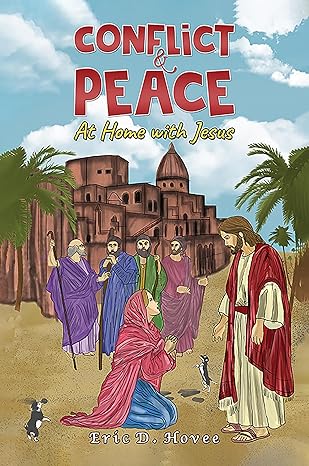

When I first opened Conflict & Peace: At Home with Jesus, I expected a familiar retelling of biblical stories, but instead I found something far richer and more layered. The book walks through twelve figures ranging from Matthew and Mark to Constantine and Luther and explores how each shaped, struggled with, or even fractured the Christian story. Eric D. Hovee doesn’t shy away from pointing out contradictions, tensions, and the uneasy balance between faith and evidence. What emerges is less a polished theology and more a raw chronicle of pioneers wrestling with belief, doubt, politics, and power. The book argues that Christianity has always lived at the crossroads of conflict and peace, heresy and orthodoxy, struggle and hope.
The writing style surprised me. It’s not slick or overly academic, and that’s what makes it work. Hovee mixes scholarship with a kind of candid storytelling that feels personal and searching. He admits where his own faith has faltered, where scholarship has raised more questions than answers, and where interpretations may lean too heavily in one direction. I appreciated this honesty. The detail can be overwhelming at times, with deep dives into language debates or church history that slow down the flow, but even then, I never felt the effort was wasted. It gave weight to his central claim that truth isn’t always clean or easy.
What I liked most, though, was the emotional undercurrent. This isn’t just about doctrine, it’s about Hovee’s father, about legacy, about the ache of wanting faith to feel real in a world of contradictions. I felt that ache with him. When he points out Matthew’s overreach on prophecy, or the way Constantine’s empire-building warped Christianity, I didn’t just learn facts, I felt the tension of a man trying to reconcile devotion with doubt. The book left me inspired. It made me look at my own beliefs with sharper eyes and a softer heart.
I think Hovee’s work is best for readers who want faith that is not easy, neat, or dogmatic. It’s for Christians wrestling with the weight of history, skeptics curious about the roots of belief, and anyone who values honesty over certainty. If you want a book that stirs you, challenges you, and leaves you thinking long after you close it, then Conflict & Peace: At Home with Jesus is well worth the read.
Pages: 401 | ASIN : B0F5641XR1

A Tribute and Legacy

Rainbow of Promise follows the budding romance between a confident and vivacious young woman and a soft-spoken Southern gentleman in the middle of WWII. What was the inspiration for the setup of your story?
My parents, Sadina and W.E., had wonderful chemistry. I wrote the story as a tribute to them as well as a legacy for my family. It’s more of a memoir than historical fiction; it’s as true and factual as I could write it.
There is so much to be said about love in this book. What do you hope your readers take away from your story?
These two had a lot in common and a lot that wasn’t. They became a great team out of loyalty, dedication, romance, desire, and understood unconditional love. I consider them my greatest role models in all that they portrayed.
What was your favorite scene in this story?
W.E. was such a romantic; Sadina was exuberantly fun as well as practical and frugal. When W.E. surprised her with yellow roses and gifts of all sorts, her life lit up like a child at Christmas. My favorite surprise was when he gave her the beautiful soft silky pink robe. Chapter 14. I still have her robe hanging in my closet.
What is the next book that you are working on, and when will it be available?
I’m writing the story of my Volga German grandparents who emigrated from Kutter, Russia, in 1913. My grandmother faced many tragedies, including WWI and II, each sadness garnering strength. I plan to publish the book in 2026 during March–The Month of Strong Women.
Author Links: GoodReads | X | Facebook | Website
Rainbow of Promise: A World War II Romance

Rainbow of Promise is a heartfelt, old-fashioned love story set in the midst of World War II, following the budding romance between Sadina “Sadie” Wagner, a confident and vivacious young woman, and W.E. “Bill” Walraven, a soft-spoken Southern gentleman stationed in Enid, Oklahoma. The story unfolds slowly but sweetly, capturing all the nervous first encounters, jitterbug dances, longing glances, and yes, plenty of sizzling chemistry. It’s nostalgic in all the best ways—like slipping into a vintage movie where the world is complicated, but love is pure.
What stood out to me first was the writing style. It’s simple but rich with period detail and genuine emotion. The dialogue pops without trying too hard, and there’s this easy rhythm to the prose that makes the whole book feel like you’re listening to someone tell a story.
Now, Sadie. She’s a force. Flirty but grounded, fun but not flaky. She’s bold enough to joke about being picked up on a street corner and sweet enough to bring a man to his knees with just a smile. Her scenes with W.E. practically crackle with energy, especially their first dance. I appreciated that the author gave her complexity—she’s not just waiting around for a man; she’s got her own hobbies and she’s protective of her independence. There’s a particularly lovely scene where Sadie turns down an impromptu dinner date with W.E. because of a club meeting—and you can just feel the tension. Her wanting to say yes. His quiet heartbreak. That push-pull dynamic is so well done.
And then there’s W.E.—Bill. This man is a walking romance novel. Polite, a little shy, smells like Old Spice, and dances like a dream. But he’s not just charming. The author gives us these lovely inner monologues where he questions whether he’s “good enough” for Sadie, whether it’s right to fall in love with war looming overhead. That kind of vulnerability made him real for me. And when he takes her to dinner at the Skirvin Hotel and orders champagne and lobster I swooned a little. But my favorite part was the way he watched her dance. That kind of longing—that ache—you can’t fake that in writing.
This book is for readers who love slow-burn, tender romance with real emotional stakes. It’s for anyone who’s ever believed in fate or had their heart flip over a well-timed glance. It might be a little idealistic at times but that’s kind of the point. Life is hard. War is brutal. But falling in love—falling madly in love—makes all of it worth it. I’d recommend Rainbow of Promise to fans of historical romance, lovers of the 1940s vibe, or anyone just needing a little hope and heart right now.
Pages: 369 | ASIN : B08BRBZMKY
For the Love of God: A Tapestry of History and Heritage in Los Altos de Jalisco, Mexico


For the Love of God: A Tapestry of History and Heritage in Los Altos de Jalisco, Mexico, plunges into the heart of Los Altos de Jalisco, Mexico, weaving history with the threads of personal memory. Liborio Gutierrez Martín del Campo, alongside his son, Jose Gutierrez Gonzalez, crafts a rich narrative that honors the region’s heritage while tracing the lineage of its people. Readers are drawn into a world where the past pulses with life, each page steeped in the traditions and struggles that have shaped this highland area. Nostalgia and reverence permeate the work, offering a window into history through the intimate lens of family pride.
The book’s intimate tone immediately captures attention. The authors convey a deep affection for their homeland, transforming the narrative into something both personal and sweeping. The region’s history, spanning from the Spanish conquest to contemporary times, intertwines with tales from the Gutierrez family’s own journey, bringing the past into sharp, vivid focus. Though dense at times, particularly when unraveling complex historical events, the detail enriches the story for those with a keen interest in Jalisco’s rich past. Dual authorship shapes the book’s structure, creating a unique rhythm in the narrative. The transition between Liborio’s original writings and Jose’s contributions flows smoothly for the most part, though the shift in voices occasionally disrupts the story’s momentum. Jose’s prologue, filled with poignant reflections, sets the stage, explaining how the book came to be and the challenges encountered during its completion. This blend of voices adds a layer of depth, making the book not only a historical recounting but also a testament to the act of preserving history itself. Anecdotes and legends peppered throughout the pages infuse the narrative with cultural depth and mystique. Stories such as the legend of Tlaloc or the mysterious occurrences at Cerro Gordo add a mythic dimension, merging folklore with historical fact. These tales do more than entertain; they shed light on the values and beliefs that have shaped the identity of Los Altos de Jalisco.
For the Love of God: A Tapestry of History and Heritage in Los Altos de Jalisco, Mexico, stands as a loving homage to Los Altos de Jalisco, crafted with both precision and passion. While those with a personal connection to the region or a deep interest in Mexican history might find it most appealing, the emotional resonance and storytelling make it a compelling read for anyone intrigued by the interplay of history, culture, and personal identity.
Pages: 318 | ASIN : B0D39LP22L
Make the Dark Night Shine

Make the Dark Night Shine, by Alan Lessik, is an evocative and intricately woven narrative that transports readers to the shores of Constantinople through the eyes of Kenzo Uchida, a Japanese foreign ambassador. Set against the backdrop of the interwar period, the novel captures Kenzo’s incredible transformation, as he navigates a complex web of love, loss, friendship, and an unexpected career shift. Lessik’s prose is rich and rhythmic, creating an almost lyrical quality that enhances the storytelling.
The novel unfolds as a recollection to Kenzo’s daughter, unknown to him, providing a deeply personal perspective on a turbulent historical era. Characters vividly recount their experiences of the First World War, setting the stage for the impending Second World War. Kenzo, along with his advisor and partner Mitsu, discovers a life starkly different from their homeland upon their arrival in Constantinople. The narrative details their adjustment to foreign customs, aided by their new acquaintances Gul and Elisa, a refugee with aspirations of high society. As the story progresses to Paris and edges closer to another war, the lives of these characters gradually unravel, depicting the subtle yet unstoppable forces of change. The novel explores themes of destiny and decision-making, emphasizing the belief that while we cannot control life’s trajectory, we can have faith in our choices. Family dynamics, both by choice and by bloodline, are central to the narrative, underscoring the interconnectedness of life. Lessik’s novel is a masterful blend of personal journey and historical context while maintaining an uplifting spirit even in its darker moments.
Make the Dark Night Shine is a testament to the resilience of the human spirit, offering a poignant and thoughtful reflection on life’s complexities. Its narrative never feels hurried or overwrought, but rather presents an honest account of one man’s journey through a life marked by both privilege and challenges. This book is a compelling read, offering insights that resonate well beyond its final page.
Pages: 334 | ASIN : B0CGYZF33J
The Past is the Past

Eleonora and Joseph: Passion, Tragedy, and Revolution in the Age of Enlightenment follows an aristocratic woman who becomes an advocate for liberty and plays an important role in forming the Neapolitan Republic. What was the inspiration for the setup of your story?
Good question, thank you! Many years ago, one sunny Saturday morning, I was walking in the streets of Naples and found in the Spanish Quarter a school that bore the name of Eleonora Fonseca Pimentel. I was surprised: this was a Portuguese name, not Italian. I had never heard of Eleonora; she wasn’t well known in Portugal as I was growing up. So, I looked up her name. Later, I read The Volcano Lover by Susan Sontag; the novel takes place in Naples during the time of Eleonora’s life. At the end of the book Sontag has several monologues and one of them is by Eleonora. I enjoyed Sontag’s book but didn’t like Eleonora’s voice: it didn’t sound quite right to me. I thought I could do a better job with her literary voice, after all I am Portuguese like Eleonora. I hope I don’t sound presumptuous, but this is exactly how I felt. So, I decided to write the novel. It took me years to complete the job.
Your novel is rich with historical details that are not well-known to the average reader. What kind of research did you do for this novel to ensure you captured the essence of the story’s theme?
I am a very disciplined person, but writing a historical novel takes a huge amount of work. Huge! I also love history, and so, this combination of discipline and love for a given theme can be quiet rewarding. Moreover, I love the freedom of imagination that fiction allows me. For credibility’s sake, a historical novel needs to be both accurate and plausible. These are different issues. Accuracy has to do with knowing the period well enough not to make gross historical mistakes about events, dates and so on. Plausibility is about filling in the historical record in such a way that what we don’t know as an historical fact (or event), could indeed have occurred. Good historians share this approach with historical novelists: think of a book like Citizens by Simon Schama, a professor at Columbia University.
Therefore, you look at historical sources and go back and forth all the time about issues. Compare sources. Check again and again, look at information from different angles. Take notes, build private maps of many lives and historical facts. Then you create your own road map. If lucky, you get close to the truth. I wrote close to the truth – not the truth itself. That doesn’t exist and historians know this as well as historical novelists. That someone was born in such a such date is just a fact, but the truth of someone’s life is something very different. It requires digging up, examining that life in dept, looking at it from many different angles, with vision and perspective.
What was one scene in the novel that you felt captured the morals and message you were trying to deliver to readers?
Another good question! We can’t look at the past as if the events we are describing took place at the time we are writing. The past is the past, no way around it.
An example comes to mind, and it has to do with Jefferson’s Monticello.
We rightfully condemn slavery today but, as horrible as it was, it was an accepted practice for centuries. I read recently a great book, Wicked Flesh by Jessica Marie Johnson. Descriptions like those of the Middle Passage are gut-wrenching. But the book also shows how people in captivity were also able to take some advantage of the conditions they were in.
I needed to be very thoughtful when describing Joseph Correia da Serra’s views of Monticello when he and Jefferson go for walks there. Jefferson was a complex man, full of contradictions. To such an extent that when he died, his family had to sell his slaves to pay a few of his debts. And later, Monticello itself had to be sold, too.
This is, somehow, beyond belief, but it did happen. There were, however, much crueler slave owners in Virginia than Thomas Jefferson. Nevertheless, to say – as I read somewhere – that he raped Sally Hemings for a lifetime is a distortion of their lives. It represents a total lack of understand of the historical period. Slave owners did sleep with slaves, and the practice was much more generalized than one tends to believe. Reproachable? Yes, certainly, and also a crime in Virginia. But Sally Hemings did succeed in having her children freed when they grew up. She wasn’t sold either, she lived as a free woman in Charlottesville after Jefferson’s death.
So, the difficulty of this kind of analysis is to find the balance of a life, any life. In the past, as much as in the present. One only needs to consider one’s own life (one among many other lives, mind you!) to notice the challenges that ‘balance’ presents.
What is the next book that you are working on, and when will it be available?
I have just returned from Istanbul, where my next novel takes place. It’s another historical novel, the set-up is Constantinople in the late 18th century. I had a great time, and a dear Turkish friend helped me enormously, but I am dealing with an artist whose work is far greater than his extant oeuvres. That is not what I was hoping for…
The soul of a place is important, but the way it touches you as an author, that’s important too! I still need to figure out how to deal with my, somewhat, disappointment. How can I say this? I wanted a particular 18th-century garden to be still there – but it isn’t! Crazy, right? So, this is how it goes: you have to imagine a setting as accurately as you can, if your work is going to be any good. Again, you need to go back to the period you are dealing with and try to figure out how it could have been. I wanted clues to help me along the way with my writing, but I was left with very few, close to none.
I don’t really like to discuss what I am writing about; I will present the work when it is finished. Then, as now, Istanbul is a fascinating city, the true meeting of East and West. I love the set-up I chose. The city is grandiose, cosmopolitan, exotic, and adventurous. But I still have a lot of work ahead. If I work consistently, I might have the novel finished within a year.
Literary Titan, thank you so very much for this opportunity.
Author Links: GoodReads | Twitter | Facebook | Website
Eleonora and Joseph. Passion, Tragedy, and Revolution in the Age of Enlightenment. A Novel.

Eleonora and Joseph: Passion, Tragedy, and Revolution in the Age of Enlightenment by Julieta Almeida Rodrigues is a captivating debut novel that brings to life the stirring tale of Eleonora Fonseca Pimentel, a revolutionary and advocate of liberty in the 18th century. Her pivotal role in forming the Neapolitan Republic is a testament to her unwavering belief in equality and the power of education, even as she faced the dire consequences of opposing the ruling class.
Born into aristocracy, Eleonora’s early acclaim for her poetic genius and intellectual prowess sets the stage for a life less ordinary. Her heartrending love story with Joseph Correia de Serra—a young man from a humbler background, and her own journey through triumph and adversity—are poignantly chronicled in her memoirs, discovered posthumously in Thomas Jefferson’s library. Jefferson, an acquaintance of Joseph and a scholar of great repute, becomes the conduit through which Eleonora’s indelible impact is revealed.
The novel is a rich tale of young love’s exuberance and the complexities of human relationships, as seen in Joseph’s life choices, including his unexpected path to priesthood and the paradoxes that define his existence. Thomas Jefferson emerges as a beacon of intellect and kindness, while Eleonora herself is portrayed as a formidable and spirited force, her intellect and rebellious nature blazing against the backdrop of societal constraints. With its exquisite character development and compelling narrative, the book vividly portrays the social stratifications of the time, marked by class, religion, and economic divisions. The rich and elaborate dialogue complements the exceptional storytelling, showcasing the author’s deep dive into historical records to create an immersive and captivating experience.
For historical fiction enthusiasts, Eleonora and Joseph is a cornucopia of passion, tragedy, and the spirit of enlightenment. It’s a celebration of a remarkable woman whose legacy endures and a journey through a time that shaped the modern world. This novel is not just a read; it’s an encounter with history’s enduring echo.
Pages: 212 | ASIN : B08K3HGZYX


