Blog Archives
Vision Storm
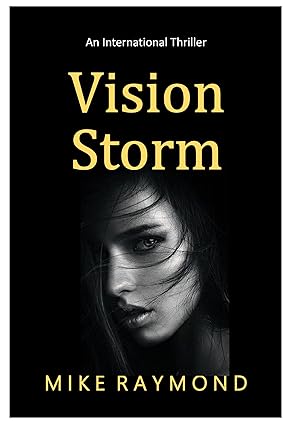

Vision Storm is a globe-spanning thriller that blends personal tragedy, supernatural overtones, and international intrigue into one fast-paced narrative. The story follows young Dannilee, a girl haunted by dreams that seem to bleed into reality, her troubled mother Janelle whose clairvoyant abilities blur the line between madness and foresight, and Marshall Dennison, a diving coach reluctantly pulled into a conspiracy that reaches far beyond what any of them imagined. From the icy cliffs of New York to shadowy power struggles involving the mysterious “Dark Agent,” the book layers suspense, betrayal, and an almost mystical sense of inevitability.
I found myself caught off guard by how quickly the story establishes tension. The opening chapter with Maggie is devastating and sets a tone of dread that lingers. The writing has a cinematic quality, sharp and quick, with scenes snapping together like film cuts. At times, the story is very descriptive, and I found the pace slowed a little as a result. Still, when the action hit, it hit hard, and I could feel my pulse jump with the characters’ fear and desperation. I cared about Aubrey and Dannilee, and I found myself rooting for Marshall in spite of his flaws.
What really struck me was the mix of realism and the uncanny. The idea of inherited clairvoyance could have slipped into cliché, but here it felt eerie and believable, almost natural in its strangeness. While a few bits of dialogue came across a little formal, the heart of the story, this battle between ordinary people and a larger, darker force, rang true. I could sense the author wanted me to feel the unease of not knowing who to trust, and it worked. I also appreciated that the villain, Pierre Dubois, was not just a cardboard cutout but a figure both terrifying and charismatic. That complexity made the threat land harder.
The book took risks with its plot, and while not every gamble paid off, I never felt bored. I’d recommend Vision Storm to readers who enjoy thrillers that flirt with the supernatural but keep a foot planted in real human struggles. If you like stories where family bonds and hidden powers collide with forces far bigger than any one person, this one will keep you turning pages late into the night.
Pages: 411 | ASIN : B0F8P5W9BB

Ultimate Sin

Ultimum Judicium: The Last Judgment follows a prophet living in a civilization that has fallen who has been chosen by God to lead the survivors on an odyssey to a place of redemption while battling his own inner demons. What was the inspiration for the setup of your story?
The current state of the world is the basis for what prompted me to explore a future doomsday scenario in my novel—a warning, maybe? There is more anger and disagreement than I’ve ever before seen or read, leading to fighting and rioting that could ultimately lead to the end of civilization—or so it did in my book.
Ultimum Judicium is a novel exploring the classic concept of good versus evil. Growing up as a Roman Catholic, and that being the largest formal religion in the world, I adopted that Christian perspective for this book. The basis for most end-of-world stories seems to be rooted in themes of good vs evil, focusing on exorcism and demonic possession governed by Catholicism. The priest I created was ordained by God, the good, and is tempted by Satan, the evil. Here, I gave him a weakness in his attraction and passion for women—an ultimate sin for a priest. The story follows the Christian Bible’s Revelation. It is the journey to Armageddon—the last battle between good and evil.
I find the world you created in this novel is haunting and full of possibilities, with both light and dark elements. Where did the inspiration for the setting come from, and how did it change as you were writing?
The future I invented occurred 200 years after all governments of the world had fallen. A reader must try to envision exactly what a world would be like after so many years without laws or any civilization whatsoever. It would likely be a horror show. We can realize this with certainty after reading about the hairline fractures of civilization called wars that history has documented so clearly. In all wars, we saw the extreme brutality of humanity.
Once I committed to embracing that reality—one of extreme brutality—I found I had created a very different place. So, I contrasted the wickedness of such viciousness with love and kindness. Hence, I gave birth to three loving romances to counteract the savagery. Also, most of the characters within the stronghold, including the Manhig, or Leader, are good and caring people, except for the few bad ones.
What were some themes that were important for you to explore in this book?
My book, Ultimum Judicium: The Last Judgment, explored good vs evil in a broken world. However, it also shows the resilience of men and women in such times. As with war, it shows humanity’s ability to overcome and survive. And ultimately, love will defeat hatred.
Where do you see your characters after the book ends?
At the end of this book, the characters judged as good went to a place some theologians refer to as the Millennial Kingdom of Saints from the book of Revelation. The evil went to be with Satan, locked in the pits of Hell for the same millennium period.
At the last minute, before this book went to publication, I removed the Aftermath written for the book. It thoroughly explained the actual places each character went and what they planned to give closure to the story.
Author Links: GoodReads | Amazon
Since the dawn of humanity, people had always survived. Cultures fell, but new ones continually emerged and thrived. Humans fought wars, but they kept rebuilding after the destruction. That pattern changed in the future—everything did.
There were predictions and warnings—both spoken and written—but no one paid attention to them. As the ominous signs grew, still, no one obeyed. The unrighteous one kept everyone from seeing what was coming, even though it was obvious; he cast veils over their eyes. Not long after the final recorded year of 2040 AD, humanity faced a worldwide economic disaster of catastrophic proportions following years of street riots. Over time, human moral transgressions led to the collapse of societies worldwide. Countries turned against each other as the world became a wicked and ungodly place. More than two centuries after the last civilization fell, people lost the ability to speak—their capacity to verbalize had ended years earlier. Our future became our past—one marked by brutality and barbarism.
Guided by angels, a prophet chosen by God leads His remaining followers on an odyssey to a place of redemption. Anointed as Manhig, or Leader, he and his armies of male and female warriors are the only hope of preserving some form of civilization, where everyone must obey the laws or be forever banished into the now-wild wastelands of the countryside, overrun with destructive intruders.
Attracted to a feisty woman he cannot have and tempted by the young and beautiful, captivating yet sharp-witted and brilliant General Helen, the manhig wrestles with his inner demons—his inability to resist the lures of Satan regarding women. If he succumbs, the way of life he spent years cultivating will unfold—all will be lost.
The manhig leads his warriors and people from one temporary stronghold to another for defense in an otherwise shattered world—a place now dominated by hordes of unhuman beings: evil cannibalistic beasts, demons, and other mutations—created centuries earlier by the science of that long-ago era. Now living in a surreal culture, while following strange laws, customs, rituals, and practices, and speaking a vernacular of the future, the manhig commands his warriors while battling these creatures alongside many evil humans: thieves, wicked gangs, slave traders, and other nefarious characters who roam the wilderness as the followers journey toward a confrontation between good and evil—the last battle before God’s judgment.
The strongholds—an attempt by the manhig to provide some form of civilization to battle-weary warriors—taverns and bars for his followers to eat, drink, and socialize. They are also a haven of temptation from the evil one. Adultery—forbidden by law by the leader—manifests within those walls of protection as the end draws near.
Warrior Mystics
A Shroud of Sorcery centers around a mystic and his companions, simultaneously navigating tribal politics and the emergence of a ritualistic killer. What was the inspiration for the setup of your story?
I visited a hillfort in Shropshire called Bury Ditches about a year before I started writing. Whilst there, I imagined what it would be like at the pivotal point in ancient British history when these Iron age tribes with their pagan beliefs and mysticism came up against the technologically advanced but brutal Roman Empire as they took over Britain. Other sites, such as the great stone circles at Avebury, inspire me to think of what spiritual and magical beliefs led the builders and successive generations to build and use these monuments. What if they were not just meeting places or locations to celebrate the dead, but, instead, they were used by tribal mystics, mages, and seers? In this book, I wanted to use these ancient sites more dramatically to weave a fantastical, yet believable tale, and still within a real historical framework.
A Shroud of Sorcery continues to explore the tensions within the Cornovii. Big characters such as Toryn remain loud and full of bluster, and just when you think he and Alba are getting along, it can change in an instant. These interactions are forced into cooperation both by the ritualistic killings and the ongoing Roman threat. It was important to me that the characters should be believable, yet colourful enough for the reader to understand their loyalties, emotions, and personal circumstances to explain how they interact. Even lesser characters like Duro had to have a personality that, whilst unpleasant, fits within a culture of its time. In this book, I explore more of Favius’s background – what made him the cold killer he became with a look at his initial history of assassinations within the Organisation. He also represents the opposite of the likes of Toryn, who airs his views and emotions (and anger) openly, whilst Favius connives and plots in secret. Both are strong, both are very different.
A Shroud of Sorcery has several moments where the darkness of the sorcerer’s actions or the threat of the Roman legions are balanced by introducing moments of humanity, and sometimes these prevail, others they do not. This was an exploration of character, and I wanted to illustrate how light and dark, good and evil are not absolutes; there are positions in between these two polar opposites, such is real life. For example, the sorcerer occasionally makes a decision not to kill, but I want the reader to understand why that is, and hopefully that comes through in the book. Favius can be brutal, but he always acts from his own reasoning or logic, dispassionate though it is. Of all the characters, he is the most absolute for there is no compassion in a void.
The sorcerer was conceived to be a complex character, not just someone who kills with barbarity. The story weaves a tale around their origin, which explains where they came from, but deliberately sets up the reader to realize that environment is not always the explainer for evil actions. Yet, there are times when a sliver of compassion hovers intriguingly about their decision to let someone live, but would you rely on it – probably not!
How did you handle balancing the power and use of magic in the story?
I wanted the use of magic to be menacing and dark, but at the same time grounded and believable. The contrast between the sorcerer (dark) and Alba (light) exemplifies how, like our own modern technology, there is no good or bad magic or technology; rather, it comes down to the people who use it for good or ill. As such, magic in the story is a tool, used to project good or evil, but it is still a tool. Because I use it in this way, it becomes an aspect of the characters, who are the real power. In contrast, Favius, who (as far as we know) is not skilled in the dark arts, uses his power to steer the Roman Empire to the will of the Organisation. He does not need tools such as magic and instead uses assets like the sorcerer or his legionary commanders to achieve his aims.
The use of magic in this book is what delivers the main threat. Even Alba, when emotionally compromised, can use it for ill, and at one point we see that when he and Toryn have one of their disagreements. It is the threat of magic and its use for evil that first brings Toryn to Alba, for even a seasoned warrior such as Toryn knows his limitations when faced with such a force.
What do you think were some of the defining moments in Alba’s development?
As a character, Alba had to be first and foremost a man who believed in the old ways – someone who viewed his culture and history as something worth protecting in the face of a powerful conquering empire that regarded him and his kind as nothing more than barbarians and subhumans.
I have set him at a time when the Cornovii’s entire way of life is under threat, including their beliefs in their own gods. Set amongst this, he is one of the last remaining warrior mystics, capable of fighting with sword or bow as well as skilled in ways of magic.
In A Shroud of Sorcery, Alba is also defined by loss. The love of his life is gone, lost to a sickness which would of course have been a constant threat two thousand years ago. Grief often leaves a hole, and for Alba, that is an exploitable weakness as we see the sorcerer take advantage of (and for other reasons!). Alba worries about his tribe becoming redundant and subsumed within the Roman empire, but there is also the doubt he has over his own skills becoming redundant. This is not merely because his is a declining art but also that his knowledge and his own skills in magic have become stale and stuck. In contrast, the sorcerer has knowledge that he does not have, and this plays out in his mind as a character flaw.
Alba’s balance is often Argyll, who, with friendship and humour, keeps him centred. I originally conceived Alba as more of a loner, potentially with just a horse or dog as a companion, but I wrote Argyll as someone who could provide a deeper interplay – someone who can hold his own in a fight, who backs up Alba in a fight, and who keeps him focused on his own abilities in the face of whatever threat faces them.
Can fans look forward to seeing Book 3 of the Alba Mysteries released soon? Where will it take readers?
Planning for Book 3 is underway, and I aim to start writing in October. I have outlined the overall plotline and visited some of the locations that will feature in it.
I have also started writing a side novel, focused on Favius and the Organisation he works for. Set in multiple locations, it explores his younger years when he was climbing the ranks of the Organisation and becoming one of their top assassins. I have not yet decided whether to release this before or after the third book – we will see!
Author Links: Goodreads | Website | Amazon
“In all the legends the child is taken and trained in the magickal arts. Seldom do they return.”
Attempting to subvert the native Cornovii to Imperial rule, the Romans are increasing their presence in one last effort to turn the barbarian to Roman rule. Legionary commanders want all-out war; an opportunity to defeat Cornovii resistance once and for all which will send a powerful message to other British tribes who resist.
The Organisation, the hidden overlords of Imperial rule, deploy a new asset to encourage the barbarian Cornovii tribe to turn to Rome for their protection. A series of brutal murders follow where victims bear witness to ritual magick and sorcery.
Cornovii warrior mage Alba must uncover an adversary who has deep knowledge of the dark arts, perhaps exceeding his own. Their identity is a mystery reaching into the most ancient myths of the craft. The killer uses illusion to subjugate their victims and soon Alba finds himself battling elemental entities, hexes and even traps laid in the dreamworld.
Chieftains, tribal elders, spies and assassins inhabitant the turbulent and often violent world of Roman Britain, where the old ways of magick and tribal allegiance slam into Empire and Imperial domination.
Set in the mysterious landscape of ancient Britain amongst stone circles, hillforts and rock caves, A Shroud of Sorcery takes the reader on a journey into the mists of another time where magick, conflict and a secret organisation will determine the future of an entire tribe.
A Shroud of Sorcery is the second book in the Alba Mysteries.
Where history meets fantasy; where magick meets reality.
Hope of Survival

Blood on the Mountain centers on a young man navigating the expectations of his family and the pain of bullying while coming to terms with his own identity and sexuality. What was the idea, or spark, that first set off the need to write this book?
Having been raised in a religious family, unlike the main character’s experience in my book, I’ve faced my own share of bullies and name-calling. This led me to reach out to others who may be going through or have gone through a similar situation while growing up. Even though the story is fictional, I drew on research about other LGBTQ+ lives and their own battles. This was my inspiration for this.
What was one scene in the novel that you felt captured the morals and message you were trying to deliver to readers?
I would say it was the picnic scene. This scene took me a while to write. The message that I wanted to deliver was one of love, strength, and hope. Love between the two characters in the scene, the emotion and the strength of one character, experiencing the horror that was happening in front of him, the strength to fight and call for help, and the support and hope of survival.
What character did you enjoy writing for? Was there one that was more challenging to write for?
I enjoyed writing about Noah. I enjoyed writing about his challenges in his life, his survival, and finally seeing him embrace happiness with Joshua. The challenging character was Paul, his bully and tormentor. I spent hours researching the effects of someone abusing drugs and the consequences to his health.
What is the next book you are working on, and when will it be available?
I am working on a story that will continue over three books. Here is a synopsis of the story:
For most of his thirty-six years, Adam Keller has lived life like a shadow—quiet, invisible, and careful not to take up too much space. A gentle, gay bookstore clerk in a city that doesn’t always love people like him, Adam has spent his life surviving: his father’s rejection, a school history laced with cruelty, and a society that punished softness in boys. He doesn’t fight back. He just endures. Until the day he almost dies.
One morning walk in the park turns savage when a group of homophobic men ambush Adam and beat him within inches of his life. Left broken and bleeding, something inside him—something long buried and ancient—wakes up.
He survives. More than that…he changes.
The first book I am aiming for in Jan 2026.
Author Links: GoodReads | Facebook | Website | Amazon
Noah Bailey is suffocating in silence.
Trapped in an oppressive home ruled by religious dogma, he’s learned to hide who he is—and what he truly wants. But everything changes when he meets Joshua Taylor, a kind, fearless stranger who sees him for who he really is. For the first time, Noah dares to dream of freedom, love… and a future that’s finally his own.
But happiness doesn’t last.
A shocking betrayal from the past resurfaces just as Joshua is left fighting for his life. As Noah clings to hope, the ghosts of his school years begin to stir—bringing threats, secrets, and a trail of lies that refuse to stay buried.
With every revelation, Noah’s world fractures.
And the deeper he digs for the truth, the more he realizes someone is watching. Someone who wants the past to stay hidden—and who will do anything to keep it that way.
Love. Betrayal. Justice.
In this gripping story of survival and self-discovery, Noah must face his darkest fears and risk everything for the one person who gave him hope.
But when trust becomes a deadly gamble…
Can he confront the truth before it destroys them both?
A Blessing and a Curse

The Haunted Purse follows a teenage girl who stumbles upon an old denim purse in a thrift store that quickly reveals its supernatural abilities with things vanishing and reappearing, adding unplanned complications to her already messy life. What was the inspiration for the setup of your story?
Believe it or not, The Haunted Purse was inspired by a true incident. When my son was a high school junior mulling over college options, we visited an auto technology school three hours from home. After the tour, I couldn’t find my car keys. I searched my purse multiple times, but the keys were nowhere to be seen.
Our tour guide assembled a search team. A dozen students combed the campus for half an hour, but the keys never turned up. The tour guide offered to call a car dealership to see if they could provide a new set of keys. While he was on the phone, I checked my purse one last time…and found the keys. Oh, the mortification! I apologized profusely, and my son and I beat a hasty retreat out of there.
I couldn’t stop thinking about those keys as I drove home. How could I have missed them during my repeated searches? Was I really that dimwitted? Or could there be another explanation? My brain chewed on that question, and by the time I pulled into our driveway, it had come up with an answer: something supernatural was going on. Some mischievous other-worldly being had infiltrated my purse and hidden my keys. I wasn’t an idiot after all—just the victim of some supernatural pranking. Oh, how I wanted to believe that!
And then I thought, A haunted purse. What a great premise for a novel…
In many contemporary coming-of-age fiction novels, authors often add their own life experiences to the story. Are there any bits of you in this story?
An angsty teen still lives inside me, so I was able to channel that spirit while writing the novel. Like Libby, I grew up in a low-income household, so I know what it’s like to want things you can’t have. And Libby’s crush on a classmate is based loosely on my early experiences with crushes and heartbreak. But that’s about it. Most of the stuff in the story is totally made up.
What were some themes that were important for you to explore in this book?
I wanted to explore adolescent friendship in all its intensity, all its messiness. Feminine beauty was also a prominent theme: as Libby discovered, it can be both a blessing and a curse. And I threw in multiple references to Cinderella to reflect Libby’s transformation over the course of the story.
I find a problem in well-written stories, in that I always want there to be another book to keep the story going. Is there a second book planned?
No, this one has a very conclusive ending, so I feel no need to continue Libby’s story.
Author Links: GoodReads | X (Twitter) | Facebook | Website | Amazon
Filled with apprehension and yet intrigued by the mounting pile of evidence, Libby digs for the truth. And eventually finds it. But the story of the purse is darker than she imagined—and its next horrific chapter is going to be all about her.
The Wisdom of Wood Volume 1 – Hazelnut

The book unfolds as a mythic tale woven through time, place, and spirit. It follows Samuel Alexander and his descendants as they become entangled with Glastonbury’s mysteries, sacred symbols, and the haunting legacy of a ring unearthed at Bride’s Well. The story moves between dream and waking life, myth and history, layering Celtic lore, Druidic traditions, and Arthurian echoes into a generational saga. Characters are guided by visions, by voices from the otherworld, and by trees themselves, whose spirits carry wisdom and warning. The narrative blends myth with personal struggle, and family with fate, to create a tapestry that is both mystical and relatable.
What struck me most was the style of the writing. It has a rhythm that feels almost incantatory. The sentences often unfold like chants, looping and layering symbols until I found myself immersed in the cadence rather than just the plot. At times, I’ll admit, I felt adrift, as if the story cared less about holding my hand and more about pulling me into its current. Yet I also liked that sense of surrender. It mirrored the characters’ own confusion when faced with forces larger than themselves. Some passages soared with imagery that felt cinematic. Others slowed down, but always with a sense that something sacred was just out of reach.
On a more emotional level, I found myself unexpectedly moved by the family thread running through the myth. Samuel’s death and the passing of his journal and ring to Eleni and Sophie gave the narrative a raw anchor in grief and legacy. The mystical voices, priestesses, and mythic archetypes would have been too abstract for me without those human losses at the center. That’s where the book hit hardest. It made me think about how much we inherit without knowing, and how myths are not just stories but shadows we live under. Still, I sometimes wished for a bit more grounding in the everyday. The dreamlike prose was beautiful, but it could also feel heavy.
I think this book is best for readers who enjoy being swept up in myth and who don’t mind when the line between story and symbol blurs. If you like Joseph Campbell or Marion Zimmer Bradley, you’ll probably find yourself right at home. For me, it was enchanting. I’d recommend it to anyone willing to slow down, sink into layered imagery, and let the wisdom of wood whisper its way through their imagination.
Pages: 381 | ASIN : B06XCPG7W1
The Solomon Archives

The Solomon Archives is a brooding and atmospheric novel that drifts between mystery, theology, and the darker corners of human obsession. At its center is Professor Theo Blake, a man caught between scholarship and the supernatural, as strange rituals and deaths ripple across the Hampshire coast. The story unfolds through storms, ancient myths, secret societies, and whispered histories, all converging on the enigma of the “Archives” and those who would kill or be killed to unlock its secrets. It is a tale of old faiths clashing with modern ambition, where memory, power, and belief are tested against the backdrop of a relentless sea.
The writing often felt cinematic, lush in description, the kind of prose that lingers on weather, shadows, and the quiet weight of ritual. At times, I loved this. The way the author could make a coastline feel haunted, or a sigil scratched into stone, vibrate with meaning. But there were stretches where the detail felt heavy, and I found myself wishing the story would move faster. Still, the patience of the prose paid off in moments when the atmosphere became so thick I felt like I was standing right beside Blake, staring out into a storm. The narrative has a rhythm that mirrors the sea it describes, calm and meditative one moment, violent and unrelenting the next.
What struck me most wasn’t the occult scaffolding of the plot, but the human themes beneath it. Legacy, belief, the seduction of power, these are the real currents of the story. The characters wrestle with faith and doubt, with what it means to guard knowledge or to unleash it. Blake’s quiet, almost reluctant determination gave the story its moral center, while figures like Lucien and Wraxall embodied the dangers of brilliance without humility. I found myself torn between fascination and discomfort, often unsettled by how close the story edged toward relatable tendencies: the hunger for control, the worship of symbols over meaning, the way ritual can both bind and blind.
I felt the novel had less interest in giving me neat answers than in unsettling me, and that was its strength. It left me staring into the dark, thinking about what we inherit and what we choose to unmake. I would recommend The Solomon Archives to readers who enjoy slow-burning mysteries that mix theology with gothic atmosphere, and to anyone who likes their fiction shadowed by questions that can’t be buried again.
Pages: 124 | ASIN: B0FHG1BXH2



 LITERARY TITAN