Blog Archives
Chasing Permanence: How Businesses on Our High Streets Can Adapt and Thrive
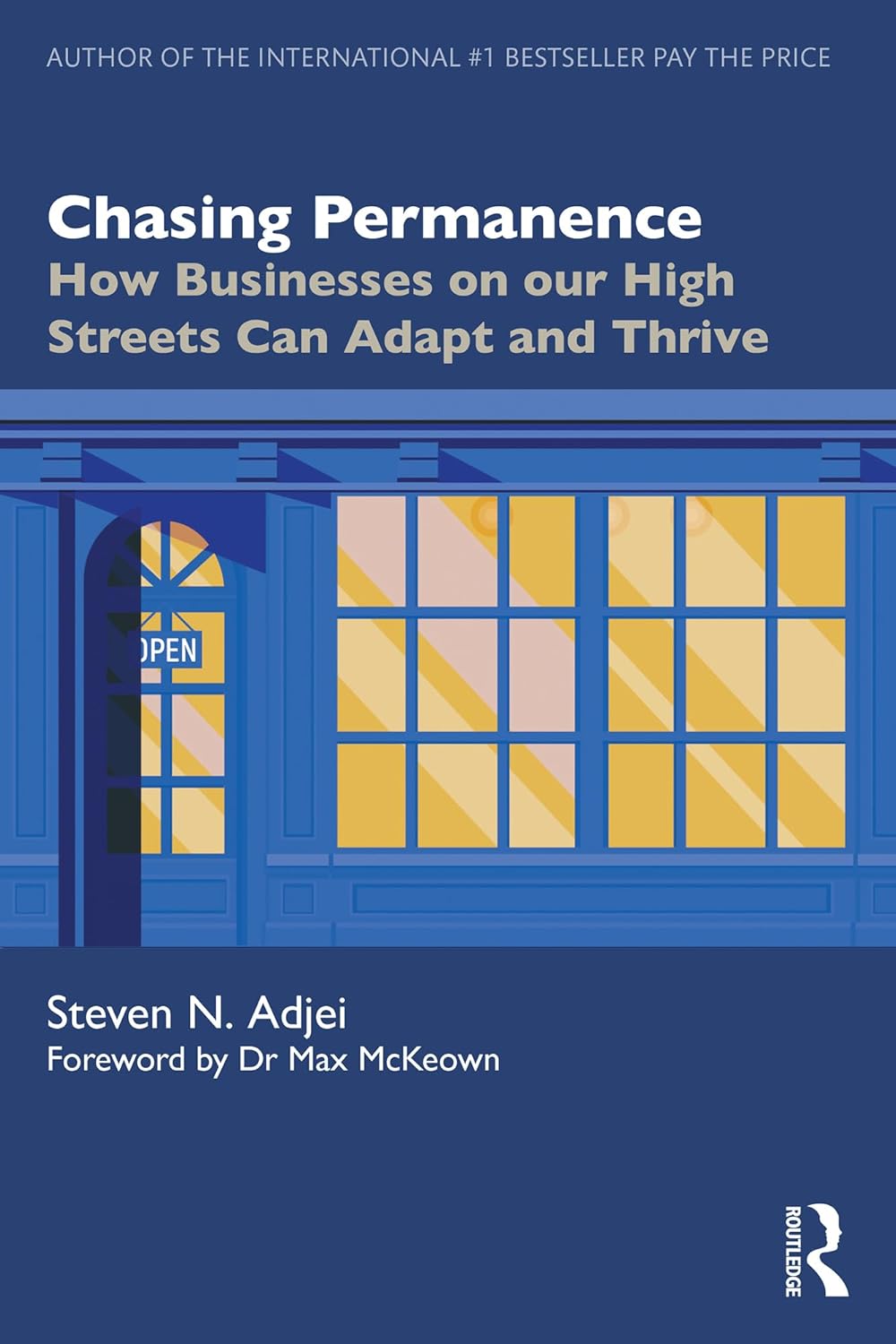

Chasing Permanence explores why some High Street businesses fade while others seem to hold on with surprising strength. Author Steven N. Adjei blends research, interviews, personal history, and real-world case studies to show how companies can adapt and thrive even as the world around them shifts. He lays out seven mindsets, five determinants, and a set of strategies that give owners and leaders a clearer way to build resilience and community in a time when storefronts close by the thousands. The book reads like a roadmap for anyone who wants to understand not just how businesses survive, but how they can shape their own future even when conditions look bleak.
Adjei writes with a kind of grounded warmth that makes the research feel personal. His stories about his mother working at Selfridges and his own early days on the High Street pulled me in right away. Those scenes made the later arguments hit harder, because they show the emotional cost behind the statistics. At times, the writing surprised me with its honesty. I found myself nodding along when he talked about the hollow excuses we make about market forces and how easy it is to blame the world instead of looking at what a business can actually change. I liked that he didn’t shy away from calling out lazy thinking. It made the whole message feel more alive and a bit braver.
I also found myself wrestling with some of the ideas. Adjei argues that businesses need to embrace collaboration, community, and what he calls Permanence, but he never paints it as a simple formula. The mix of mindset, strategy, and realism made me stop more than once and think about how often we expect business success to come from some magic trick. There were moments when I wished he had expanded on certain examples, especially when he talked about towns that felt like ghosts. Still, the rhythm of the book kept pulling me forward. His insistence that companies can shape their own destiny felt hopeful without drifting into fantasy.
The book made me look at High Streets with fresh eyes. It reminded me just how much these places mean to people and how much potential sits in the hands of owners, staff, and communities who care enough to adapt. I would recommend Chasing Permanence to entrepreneurs, local leaders, and anyone who wants to understand why some businesses hold their ground while others disappear. It’s practical, heartfelt, and surprisingly moving. And it’s a great fit for readers who want guidance, but also want a story that speaks to real human experience as much as business theory.
Pages: 391 | ASIN : B0F4R8G9BC

The Coming Disruption: How AI First Will Force Organizations to Change Everything or Face Destruction

The Coming Disruption is a blunt, high-energy warning shot aimed at anyone working inside an organization that hopes to survive the AI era. Author Fred Voccola lays out a simple message. AI is not a future trend. AI is a meteor already hitting the atmosphere, and every business, institution, and worker must adapt fast or get wiped out. He explains how AI multiplies productivity at a pace that makes earlier revolutions look sleepy, and he pushes the idea that becoming “AI First” means rebuilding the entire structure of an organization from top to bottom. The book blends history, economic analysis, and practical guidance, and it uses a vivid, almost urgent storytelling style to keep you moving through concepts that could reshape every part of modern work.
Voccola writes with a mix of confidence and impatience. Sometimes I nodded because the urgency made sense. Other times, I felt a little overwhelmed because the pace is relentless. Still, his arguments are sound. The idea that AI requires zero infrastructure change right now, and that the only barrier is leadership willingness, really resonated with me. I liked how he compared past transformations to the present because it made the speed of what’s coming feel real. I occasionally wished he explored a few examples more deeply.
What I liked most was his emphasis on internal AI. Not the headline-grabbing model wars. Not AGI speculation. The boring stuff inside every company that nobody glamorizes. I appreciated that focus. It made the book feel grounded. I kept thinking about how many organizations cling to outdated structures because they’re afraid to rip up the old playbook. His frustration with bureaucracy is loud and clear, and I found myself agreeing more often than not. His call to eliminate the “organizational deep state” is sharp, but it definitely made me think about how much waste we accept as normal. The book made me look at leadership, communication, and speed through a different lens.
I’d recommend The Coming Disruption to executives, founders, managers, and anyone who feels responsible for guiding others through change. It’s also a useful read for students and curious workers who want to understand the forces reshaping their careers. If you want a wake-up call that pushes you to think bigger, move faster, and challenge the comfort of slow adaptation, this book delivers.
Pages: 295 | ASIN : B0G2CNYPN6
Fungus Theory of Conscious Growth

Fungus Theory of Conscious-Growth is a speculative science and philosophy-of-consciousness nonfiction book that argues all life on Earth is really one vast, ancient fungus that exists to grow consciousness to its maximum potential, with humans as the spore that eventually carries that consciousness off the planet and into space. The author starts with cosmology, describing a universe that hides our true origin, limits our lifespans, and ties us to fragile biospheres, then walks through biology, evolution, technology, and psychology to claim that everything from slime mold to smartphones is part of one continuous fungal system pushing us toward “maximum conscious growth” and eventual evacuation of Earth.
Mark L. Christensen mixes straightforward explanation with capitalized concepts and acronyms. Underneath the terminology, though, the core ideas are simple: the universe is built so we can never fully know where we came from, we all die, and we are stuck on a planet that will eventually cook us, and those three constraints are what force intelligence and technology to grow. I appreciated how the chapters loop back to the same framing, so you never forget what the author is trying to prove. The long passages on cosmic expansion, black holes, and the difficulty of tracing any “true origin” were a bit dense, yet they set a clear mood of mystery and frustration that fits the book’s central question.
Where the book got most interesting for me was in the biology, technology, and psychology sections, where the fungus metaphor gets fleshed out. The idea that all plants and animals are variations of the same original fungus, and that this fungus has slowly prepared the planet for a bipedal creature with a big, hungry brain, is truly compelling. I liked the image of early fungi and plants essentially “setting the table” with rich fruits and vegetables, so a future human brain could have the calories it needs.
The technology chapter frames every tool, from early adaptations to modern spaceflight, as a kind of informational mycelium spreading through minds, with certain thinkers as “spikes” in the network that accelerate the whole system. The psychology chapter leans into this even more, describing a “void of psychosis” that opens when humans become aware that they cannot know their true origin, and arguing that our drive for identity, conflict, communication, and eventually space travel all come from trying to fill that void. I did find myself thinking about how much of my own motivation comes from not knowing, and from not wanting life to feel pointless.
I see Fungus Theory of Conscious Growth less as a strict scientific thesis and more as a big thought experiment in speculative science. It asks you to imagine the entire history of life as one fungal organism trying to launch itself into the dark, and to see humanity as the spore that might carry that effort into the galaxy. If you like big-picture questions, cosmic timelines, and philosophical riffs on evolution and technology, there is a lot here to chew on. I would recommend this book most to readers who are comfortable living with unanswered questions, who like their popular science mixed with metaphysics, and who do not mind a bold, unified theory that sits somewhere between lecture and late-night conversation about why we are here at all.
Pages: 402 | ASIN : B0CVXCNBY7
Letters From the Sand

Reading Letters from the Sand, by Scott G.A. Metcalf, felt like sitting down with someone just back from deployment and asking, “So what was it really like?” It is a military memoir that follows one soldier from the shock of stepping off the C-130 into the brutal desert heat, through the daily grind of patrols, life in canvas tents and crowded barracks, cultural encounters with Iraqi civilians, holidays spent far from home, and finally the uneasy process of coming back. The book moves in clear stages, from arrival and adjustment to stress and resilience, and then into reflection and return, so by the end I felt like I had walked the full arc of a tour alongside the narrator.
What stood out to me first was the writing. It is vivid. The heat, the dust in your teeth, the smell of jet fuel and sweat and canvas, the cramped bunks and noisy mess hall, all of it is described in careful detail that pulls you into the space rather than just telling you what happened. The style leans toward long, rolling sentences that mirror the drag of long days on base and on the road, then suddenly there is a short, sharp line that hits like a snapped command. The first-person voice helps a lot. It feels controlled and thoughtful, not like a raw journal dump, which gives the whole memoir a steady, grounded feel.
I also appreciated the way the author handles choices and ideas rather than just scenes. There is a lot here about routine and discipline, but underneath that is a constant question about what all of this is doing to the people involved. The book lingers on small human moments in the barracks, late-night conversations, card games, letters home, the way guys arrange their bunks with photos and little bits of home to hang on to who they are. It also pays attention to the civilians around them, the awkwardness of brief meetings in villages, and the mix of suspicion, fear, and curiosity on both sides. The memoir never turns into a big political argument, which I actually liked. Instead, it lets you sit with the tension between duty and doubt, pride and fatigue, connection and distance. By the time you get to the later reflections, the early scenes of arrival and “mission talk” feel heavier, because you have watched what that environment does to people over months, not days.
Letters from the Sand is a good fit for readers who like reflective, character-focused military memoirs rather than pure action stories. If you are a veteran or close to someone who has served, a lot of this will ring painfully true and might give you language for things that are hard to explain. If you have never been near this world but want to understand what “deployment” really feels like on a day-to-day, human level, this book is a patient, honest guide.
Pages: 201 | ASIN : B0G2335VNQ
The Split

The Split gathers the voices of women who faced the unraveling of marriages, families, identities, and long-held beliefs. Across these stories, the writers look directly at pain, loss, and the complicated paths toward freedom. Instead of treating divorce or separation as a collapse, the book reframes each ending as a turning point where women choose themselves, rebuild their lives, and honor the truth that wholeness can follow even the hardest breaks. By the final pages, the collection stitches together a message that is steady and hopeful. These women are not broken, and they are becoming something stronger.
Reading their words, I felt an ache in my chest more than once. The writing is striking in its honesty, and the stories breathe with real life. Brandee Melcher’s chapter opens with the raw confusion of childhood and grows into a powerful reclaiming of self, and her voice shook me because of how clear and grounded it becomes. Her journey from chaos to confidence made me root for her, and it reminded me how childhood patterns can shadow adulthood until we finally name them. I also found myself lingering on Sierra Melcher’s reflections on choosing peace over performance. Her reminder that children do not need perfect homes, they need healthy adults, resonated with me personally. The stories impact in different ways, but all of them bring a unique emotional punch.
Some chapters hit harder than others, and the shifts in tone from one writer to the next made the book feel unpredictable in a way I genuinely enjoyed. That variety gave the collection its energy. I especially appreciated the moments when the authors stepped back from the trauma and wrote about joy creeping in again. Those small wins felt huge. They made the book less about loss and more about rebuilding something real. At times, I wished a few stories went deeper into the “after” rather than the “during,” but even that unevenness felt honest. Healing rarely moves in a straight line, and the structure of the book mirrors that reality.
The Split would be a meaningful read for anyone standing at the edge of a major life change, especially women navigating separation, divorce, or the quiet breaking points that do not always have names. It would also help friends, partners, and professionals who want to understand what these experiences actually feel like from the inside. The book sits with the hard parts, and it also leaves space for light. I would gladly recommend it to anyone who needs a reminder that endings do not mean failure. They mean a new chapter is ready for you, and you get to decide what it becomes.
Pages: 144 | ASIN : B0G274WVFH
Nuggets of Gold

In Careers By the People, you present the average workday through interviews from a broad spectrum of careers, offering advice and inspiration for high school and college graduates as well as those looking for change. Why was this an important book for you to write?
Careers By the People was written because I didn’t prepare for the workforce, and I had no idea what I was getting myself into, so my goal was to put my thoughts and ideas to paper to help the next generation with career choice and career readiness. I was a first-generation, low-income student which is deemed an FGLI. About 50% of college students are in this category. So, I wanted to tell my story and note what I should have done to prepare for the workforce, so they do not make the same mistakes.
My goal was simple; get a job that pays well. Selling technology pays well, but didn’t interest me, so I was bored to tears for years. I try to drive that message home when I speak to students, as many believe money equates to happiness, so I inform them that money is great, but also to enjoy your labor, hence why I write about career readiness, speak about it, produce YouTube videos about it and more.
What was your process for selecting the interviewees for this book?
Some of the process was a joy, such as reaching out to leaders in the industry I knew in the hopes they would tell their story about how they secured elite positions. Receiving those questionnaires was a big score. Others I connected with via professional associations. Another angle was through advertising in my college’s alumni network and magazine. Basically, any angle and way I could think of to ask workers to take 15-30 minutes to fill out a questionnaire about their occupation. Many were intrigued, and many couldn’t careless.
Did you learn anything during the course of your research that surprised you?
A lot. When it came to the questionnaires, I received some from former associates who I barely knew who answered the questions succinctly whereas close friends wouldn’t take the time to fill them out.
As for the workers themselves, the ones who took risks were happier or satisfied versus the risk-averse ones. One that stuck out was a clerk who truly disliked her job, and her responses, even after many edits, were hysterical.
Another curveball was when the professional truly disliked their occupation, and on one of the last questions asking if they would do the same career again, they said yes, which is mind-boggling.
Please understand that I had to review and edit a variety to find 101 nuggets of gold. Some questionnaires were “yes/no” for 90% of the questions. The goal was to determine what it was truly like to be an x, y, or z as the only person who knows about your job/career is you, so what’s it like to be an actuary?
What is one thing you hope readers take away from Careers By the People?
The questions. I hope anyone in school, the military, or changing careers views the questions and asks people in the industries that interest them the questions so they know what they are getting into instead of guessing “Yeah, I hear that it pays well, I will do that.” I want people to do a little homework on career choice before spending time and money on an occupation that won’t last 3 years, and then they are starting from the beginning again, trying something else.
The book is a fun read and offers suggestions and ideas to help you choose what profession is best for you.
Author Links: GoodReads | Website | YouTube | LinkedIn | Amazon
After three decades in corporate America, Mike Wysocki wondered if the grass really was greener on the other side. So he put his background in sociology to work and spent years surveying industry veterans in a variety of occupations.
The responses were eye-opening: an honest, insider’s look at what workers say about their careers outside of the office.
Wysocki chose the 101 most powerful responses for the two-time award-winning Careers By the People to demystify the world of work with practical experience rather than theory. These industry profiles pair the practicality of guidance counselors with the storytelling of a networking event (without the small talk).
Told in a Q&A format, insightful answers to thought-provoking questions include:
descriptions of a day-in-the-life of the profession they chose.
truths about conflicts, co-workers, and management.
common misconceptions, issues and what pitfalls to avoid.
what’s fulfilling, what’s draining, and what’s worth it.
With humor and authenticity that doesn’t hold punches, this career guidebook will help you narrow down career choices so you can determine what is best for you.
All paths lead to retirement—which one are you on?
Careers By the People won a 2024 Bronze IPPY Award in the BEST FIRST BOOK – NON-FICTION – INFORMATIONAL Category as well as a 2025 Silver Axiom Award – Career.
It’s a great book for Careers & Technical Education as it views 101 occupations that break down into California CTE Career Pathways. In the book there are (4) in Agriculture and Natural Resources (7) Arts, Media, & Entertainment (1) Building & Construction Trades (14) Business & Finance (18) Education, Child Development, & Family Services (1) Energy, Environment, & Utilities (5) Engineering & Architecture (3) Fashion & Interior Design (10) Health Science & Medical Technology (3) Hospitality, Tourism, & Recreation (5) Information & Communication Technologies (6) Manufacturing & Product Design (14) Marketing, Sales, & Services (6) Public Services (3) Transportation.
Since the book has been published, I have spoken at many high schools and colleges about career and career readiness such as Cal State Dominguez Hills, Boston University, UMass Amherst, Univ. of New Hampshire, Suffolk University, Hawaii Pacific University, Weymouth High School, Holbrook HS, New Milford HS, Randolph HS, Maui HS, Kapolei HS, University of Hawaii Maui College, University of the Pacific as well as many others.
Careers By the People was published to help students with career choice and career readiness. It’s a story of Wysocki, a first-generation low-income average student that makes it out of college unprepared for the real world and the obstacles that one faces. Thirty plus years later, the book is out. Each person was asked 20+ questions and the majority had 5+ years’ experience. Moreover, Hollands Occupational Themes is incorporated as the chapters with modern day terminology. It entices the reader with history and humor.
The website, http://www.careersbythepeople.com, has an excerpt to download, videos of the reasons for the book, the full list of endorsements, interviews, book reviews, YouTube Channel with over 80 videos about career readiness, a speaking engagement at Hawaii Pacific University etc…
Delaware at Christmas: The First State in a Merry State


Delaware at Christmas is a richly illustrated tour of how one small state has celebrated the holiday across four centuries. Author Dave Tabler moves from early Scandinavian and Dutch settlers to later British, German, Irish, Italian, Polish, Black, and Hispanic communities and shows how each group brought its own Christmas customs into Delaware life. The book then shifts to 19th-century practices like eggnog, sleigh bells, mumming, and plum pudding, before moving into the Victorian period with holly-wreath factories, Christmas seals, and toy trains. Finally, it lands in the late 20th and 21st centuries with house tours, IBM punch-card wreaths, handbell choirs, Kwanzaa, and even Christmas in July, then closes with a reflective postscript on technology and sustainability. The structure feels like a guided walk through time, with short thematic chapters, archival photographs, and clear, accessible explanations that keep the focus on place, people, and memory.
I found the writing warm, steady, and very readable. The tone stays careful and professional, yet it feels like a neighbor telling stories over coffee, not a distant professor. I appreciated the way Tabler anchors each chapter in a concrete detail, such as the Sankta Lucia procession at Old Swedes Church, the Feast of the Seven Fishes in Wilmington’s Little Italy, or the oplatek bread on Polish Christmas Eve, and then pulls back to show how that custom grew from older roots. The references to specific churches, festivals, and streets gave me a sense of real neighborhoods, real people, real weather in December. The short chapter format keeps the pace brisk, and I rarely felt bogged down, although now and then I wished for a touch more narrative glue between topics, especially when the book jumps from one ethnic group to another in quick succession. Overall, though, the style carries a lot of research without feeling heavy, and that balance impressed me.
Emotionally, the book hit me in a quiet but lasting way. It is worth noting that Tabler does not treat Christmas as a simple feel-good backdrop; he lets harder stories in, such as Antebellum Black Christmas and the rise of independent Black churches, and he gives those sections space and dignity instead of pushing them to the margins. At the same time, there is a playful curiosity in chapters on holly wreath factories, punch-card decorations, and Christmas savings clubs, and I caught myself grinning at the sheer oddity of some of those details.
The closing pages, with their focus on Delawareans adapting to online services, digital cards, and greener holiday habits, felt surprisingly tender; they invite the reader to think about their own family rituals and how those might change, or already have changed, over time. I finished the book with a mix of nostalgia, respect, and a little itch to go hunt down a local church festival and hear handbells in person.
I would recommend Delaware at Christmas to readers who love regional history, to Delaware locals and expats who want to see their home through a festive lens, and to anyone who collects books on Christmas customs and folk traditions. It will likely appeal to genealogists, church groups, and teachers who need strong, specific examples of how culture, faith, and migration shape a holiday over time. If you enjoy dipping into short, well-researched vignettes that together build a larger picture, this will be a very satisfying read.
Pages: 130 | ASIN : B0F4NJ2KTZ
Better Choices Are Possible

Against All Odds is a blunt and emotional memoir about growing up in poverty, surviving horrific abuse, entering the foster care system, and clawing a way toward stability, purpose, and adulthood. Why was this an important book for you to write?
I grew up believing that instability was normal—new homes, new schools, new last names on the mailbox. Writing this book was my way of refusing to let chaos be the whole story. I wanted to document what that instability does to a child’s sense of identity and possibility, and to show that survival can become purpose.
It was also a letter to three audiences. To foster youth: you are not what happened to you; you are what you choose next. To caregivers and professionals: stability is not an idea, it is a practice—measured in rides to school, ceremonies you don’t miss, and promises you keep. And to the broader public: systems are made of choices; better choices are possible. The memoir gave me language to transform private pain into public service.
How did you balance honesty and authenticity with protecting privacy—yours and others’?
I followed three rules. First, I wrote from the “I”—what I saw, felt, and believed in the moment—without assigning motives to others. Second, I protected people who were not public figures by changing names, compressing timelines, and removing identifying details, while keeping the emotional truth intact. Third, I applied a dignity test: if a detail sensationalized trauma or exposed someone’s private struggle without advancing understanding, it did not belong in the book.
When possible, I sought consent from supportive adults who appear in the story and shared passages with them. I also set boundaries for myself—there are scenes I chose not to relive on the page because my present and the youth I serve deserve a healthy author. Truth and care can coexist; that tension shaped every edit.
What was the most challenging part of writing—and what was most rewarding?
The hardest part was narrative order. Lived experience is nonlinear; trauma scrambles memory. Turning 25 placements and 13 schools into a coherent arc meant revisiting rooms I’d rather forget and deciding what belonged to the reader and what belonged to healing. Writing about my mother’s death and the first nights in strangers’ homes required frequent stops—walks, prayer, and time.
The reward has been hearing from youth and caregivers who used the book as a bridge—youth who said, “Now I have words for what this feels like,” and caregivers who changed a practice so a child could keep a school, a therapist, or a ritual. Reclaiming my narrative was personal; watching it make someone else feel seen has been the joy.
What is one thing you hope readers take away from your story?
That pain is data, not destiny. For kids in care, the difference between drifting and developing is often a single steady adult plus continuity—of school, relationships, and story. If readers finish the book believing they can be that steadiness—by mentoring, fostering, advocating, or simply showing up reliably—then the pages did their job.
And for those who grew up in instability: you are allowed to build a life that is quiet, rooted, and yours. Resilience is not just surviving the fire; it’s learning to live without smoke.
Author Links: GoodReads | LinkedIn | Amazon
From a young age, Tristian’s life was marked by chaos and uncertainty. Witnessing his mother being taken away on a stretcher was a pivotal moment that thrust him and his younger brother into a turbulent existence within the foster care system. They bounced from one temporary shelter to another, grappling with abuse, neglect, and the haunting specter of trauma. But amidst the darkness, a flame burned brightly within Tristian’s soul. Dreams became his sanctuary, providing solace and fueling his unwavering determination to rise above his circumstances.
Tristian’s memoir is not just a personal narrative-it sheds light on the broader societal issues surrounding foster care. With staggering statistics, he underscores the challenges faced by children in the system and gives a voice to those whose stories often go unheard. Through his writing, Tristian aims to foster empathy and understanding, urging readers to confront the flaws and shortcomings of the foster care system within. His ultimate goal is to inspire positive change and create a more compassionate and supportive system for future generations.
Against All Odds is a powerful and necessary memoir that shines a light on the realities of growing up in foster care. Tristian’s journey serves as a testament to the indomitable human spirit and the transformative power of hope. It is a call to action, urging society to come together, support foster youth, and create a brighter future for all.



 LITERARY TITAN