Blog Archives
I’ve Made Plans


Mia J. Hanks’s I’ve Made Plans chronicles the author’s life after leaving a twenty-nine-year marriage marked by coercive control, emotional abuse, and covert narcissism. Beginning with the finalization of her divorce, Hanks shifts the focus from the dissolution of the marriage to the demanding work of creating a life beyond it. Her account follows a series of practical and emotional turning points, including confronting intimidation, rebuilding self-worth, establishing boundaries, managing isolation, and rediscovering personal freedom. When she leaves the courtroom with the realization that “My future now belonged to me,” the statement becomes the foundation for everything that follows.
The memoir’s greatest strength is its use of specific, everyday experiences to illustrate the lasting effects of abuse. A compromised storage unit, a bag of circus peanuts, a solo road trip, a broken thermometer, and an airplane journey all become meaningful markers of recovery. These episodes show how control can shape seemingly ordinary decisions and how reclaiming those decisions can restore confidence. Hanks writes in a candid, accessible voice that gives the book the intimacy of a personal conversation while maintaining a clear sense of purpose. Her willingness to examine her own people-pleasing, fear, guilt, and complicity in maintaining appearances adds depth to the narrative.
Each chapter is organized around a lesson, such as “Self-care is not selfish,” “Boundaries are necessary,” or “Freedom is priceless,” and many conclude with a journal prompt. This structure makes the book both a memoir and a reflective guide for readers navigating divorce, trauma, or major personal change. The later glossary, diagnostic criteria, list of covert narcissistic traits, and support resources extend its practical value. Some ideas recur across chapters, but the repetition reflects the gradual nature of recovery and reinforces the central themes of self-trust, autonomy, and deliberate healing.
I’ve Made Plans is ultimately a grounded account of reconstruction. Hanks presents healing as a collection of choices rather than a single transformative moment, and the construction of her new home provides an effective final metaphor for rebuilding her identity. Her concluding reflection, “I already love this life not because it is perfect, but because it is mine,” captures the memoir’s emotional center. Honest, encouraging, and thoughtfully structured, the book offers survivors a recognizable portrait of life after abuse while showing how freedom can be strengthened through boundaries, faith, self-care, and purposeful action.
Pages: 92 | ASIN : B0GX31KVYT

You Are Not Broken

The Split gives voice to women who have faced pain, loss, the dissolution of their marriages, and challenges of long-held beliefs. Why was this an important book for you to write?
This book wanted to be written. Another collaborative book was not in my plans and yet, the idea came to me in a moment of frustration as I heard yet another person reference families of divorce as ‘broken’. I pushed it off and the idea wouldn’t let go, so I knew it needed to be shared. The women I know that have gone through divorce are not ‘broken’ and neither are their families. As we discuss in the book, something is arguable broken before divorce happens. Divorce is the and the answer to a problem where no other solution has worked. Letting women know that the end of a marriage or relationship is not the end of the story, simply the end of a chapter is extremely empowering. Having gone through divorce mostly alone, I know the power of having a group of women guide you in the process is priceless.
With so many authors involved in the making of The Split, I would imagine the collaboration process was complex. Can you share with us a little about the writing process?
Surprisingly, it was more difficult getting women to join the book than it was to have them write! So many women that were interested in writing self selected out before the process really began. To choose to share a story, especially one as raw as divorce, one has to be ready to share. You want to share what you’ve learned along the way and if you’re not quite there yet, the story simply won’t come. Being ready was the most challenging part. Once the women said they were in, the writing happened and the deadlines were (mostly) met without much fuss. The Split is now a beacon in the dark for those that need it.
Did you learn anything about yourself while putting this book together?
I learned the seeds of my divorce (and so many others) were planted long before marriage was even a consideration. From a young age, our families of origin and society share a particular message of happiness, without providing a lot of room for curiosity. I realized that when I began to become seriously curious about my life and the future I wanted, I found out the story I had been told I wanted isn’t what I actually wanted.
What is one thing you hope readers take away from The Split?
I hope the readers understand that the idea of divorce is not one they need to explore alone. It can be a tough journey and I hope this book provides a guiding light and the authors in it become a part of the readers’ support system. I hope they connect with the authors that resonate with them the most and continue their healing journey.
Did you hear? They’re getting divorced.
We have a broken family.
We’ve all heard these phrases whispered in hushed tones—words laced with judgment, pity, or shame. But what if they’re wrong?
The Split: Tales of Family Renewal and Female Resiliencechallenges the narrative that divorce equals failure. These powerful, deeply personal stories reveal that splitting isn’t the breaking point—it’s the breakthrough. In these pages, women share how they reclaimed their voices, rebuilt their lives, and redefined what family, love, and strength can look like after endings that became beginnings.
This anthology dismantles generations of stigma around divorce and womanhood, replacing it with a message of renewal, courage, and collective healing. These are not broken women. They are bold, audacious, and resilient—choosing themselves, their peace, and a new path forward. Splitting isn’t the end; it’s a rebirth.
Contributors: Brandee Melcher, Dr. Katherine Humphreys, Carol Britton, Lesley Goth, PsyD, Carolina Cifuentes, Sierra Melcher, Christen E. Bryce, MS RN, Allison Banegas, Dr. Erica Anne Love, Summer Jean, LaToya Burdiss, and Jen Kennedy, MPA
The Split

The Split gathers the voices of women who faced the unraveling of marriages, families, identities, and long-held beliefs. Across these stories, the writers look directly at pain, loss, and the complicated paths toward freedom. Instead of treating divorce or separation as a collapse, the book reframes each ending as a turning point where women choose themselves, rebuild their lives, and honor the truth that wholeness can follow even the hardest breaks. By the final pages, the collection stitches together a message that is steady and hopeful. These women are not broken, and they are becoming something stronger.
Reading their words, I felt an ache in my chest more than once. The writing is striking in its honesty, and the stories breathe with real life. Brandee Melcher’s chapter opens with the raw confusion of childhood and grows into a powerful reclaiming of self, and her voice shook me because of how clear and grounded it becomes. Her journey from chaos to confidence made me root for her, and it reminded me how childhood patterns can shadow adulthood until we finally name them. I also found myself lingering on Sierra Melcher’s reflections on choosing peace over performance. Her reminder that children do not need perfect homes, they need healthy adults, resonated with me personally. The stories impact in different ways, but all of them bring a unique emotional punch.
Some chapters hit harder than others, and the shifts in tone from one writer to the next made the book feel unpredictable in a way I genuinely enjoyed. That variety gave the collection its energy. I especially appreciated the moments when the authors stepped back from the trauma and wrote about joy creeping in again. Those small wins felt huge. They made the book less about loss and more about rebuilding something real. At times, I wished a few stories went deeper into the “after” rather than the “during,” but even that unevenness felt honest. Healing rarely moves in a straight line, and the structure of the book mirrors that reality.
The Split would be a meaningful read for anyone standing at the edge of a major life change, especially women navigating separation, divorce, or the quiet breaking points that do not always have names. It would also help friends, partners, and professionals who want to understand what these experiences actually feel like from the inside. The book sits with the hard parts, and it also leaves space for light. I would gladly recommend it to anyone who needs a reminder that endings do not mean failure. They mean a new chapter is ready for you, and you get to decide what it becomes.
Pages: 144 | ASIN : B0G274WVFH
Emotional Weight

Feisty is a powerful anthology featuring essays, memoirs, and poetry by over twenty women who each share their personal struggles with shame, oppression, trauma, and the quest for self-worth. How did you decide what themes this collection would encompass?
The themes emerged organically from a single, powerful question. When we opened submissions, we asked: What does it mean to be feisty in a world that wants you silent or small?
The stories that poured in were raw, courageous, and deeply personal. We didn’t impose themes—we listened for them. Patterns naturally emerged around shame, resilience, healing, and reclamation of power. That’s the beauty of the Brave New Voices series: we trust women to tell the stories that matter most, then we build the container around that truth.
What was the most challenging aspect of curating these voices, and what proved most rewarding?
The greatest challenge was holding the emotional weight of these stories with the care they deserved. As both editor and publisher, I felt a profound responsibility to honor each woman’s individual voice while crafting a cohesive, powerful whole that would amplify their collective impact.
But that challenge became the greatest reward. I witnessed transformation—not just on the page, but in the writers themselves. For many contributors, this marked their first time sharing their story publicly. Watching them stand taller, speak louder, and fully own their truth has been one of the most profound honors of my publishing career.
What do you hope readers will carry with them after experiencing Feisty?
Above all, I hope readers feel less alone in their own struggles. There’s extraordinary strength in vulnerability, and these stories serve as a reminder that we’re all navigating complex, layered lives with courage and imperfection.
I want Feisty to be permission—permission to be louder, bolder, and more unapologetically authentic. In a world that profits from our silence and smallness, choosing to be feisty is a radical act.
The Brave New Voices series seems to be building momentum. What’s next?
Absolutely. Brave New Voices has evolved into something much larger than a book series—it’s become a movement. Our next collection is already in development, and while each book tackles a new theme, the heartbeat remains constant: amplifying voices that have been overlooked, silenced, or dismissed by traditional publishing.
Readers can expect more fierce honesty, diverse perspectives, and the kind of storytelling that doesn’t just entertain—it disrupts the status quo and catalyzes real change. We’re proving that when you give marginalized voices the platform they deserve, magic happens.
Author Links: GoodReads | LinkedIn | Website | Facebook | Instagram | Amazon
If you’re ready to rewrite all the rules and start thriving, just as you are, then Feisty is a must-read!
WARNING: This book is not for everybody. Well-behaved women rarely make history, so, check your good-girl card at the door. There is something even better waiting on the other side, if you dare venture.
Stories to inspire you to new heights of bravery, new depths of vulnerability, and new dimensions of femininity.
What does it mean to be feisty?
This collection of true tales of resistance and persistence in the face of historical oppression from cycle-breaking writers of all walks of life will defy your expectations, validate your experiences, and rally your inner warrior-woman.
Not only that, this book also teaches you how to:
Identify and share your own feisty flickers and acts of brave badassery
Release the “shoulds” and embrace your true desires
Heal from shame and trauma
Accept and embrace your authentic self
Find hope and resilience in any situation
The moment we stop judging our wishes is the moment we become capable of fulfilling them.
Order your copy of Feisty NOW!
Bonus: free, easy-to-implement tools to guide you through your personal transformation from each of these remarkable women authors.
For a limited time: download this remarkable book at its temporary introductory price!
FEISTY: Dangerously Amazing Women Using Their Voices & Making An Impact
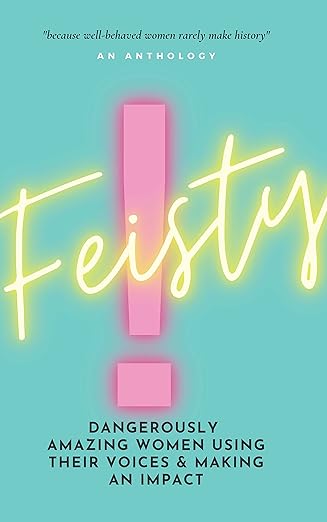
Feisty is a powerful anthology filled with essays, memoirs, and poetry by over twenty women who each share their personal battles with shame, oppression, trauma, and the search for self-worth. From raw, searing accounts of domestic abuse to triumphant awakenings of creative and spiritual freedom, this book presents a vivid mosaic of female resilience. Each story is deeply personal, yet collectively they echo a shared defiance of being called “too much,” “too loud,” or “too emotional.” Through these narratives, the authors reclaim the word “feisty” as a badge of honor.
What I loved most was the book’s refusal to sugarcoat the truth. The writing is honest, even when it’s uncomfortable. Some passages left me gutted, like Adrienne MacIain’s story of surviving assault or Mimi Rich’s slow unraveling and eventual reclaiming of her life after intimate partner violence. These women don’t pretend to be saints. They tell the truth. Their voices, different in style and rhythm, pulse with pain and fire. The range of experiences is striking, covering motherhood, racism, sexual trauma, divorce, and identity, all of which weave in and out, but each tale feels grounded in something fierce and unbreakable. As a reader, I didn’t just learn about their lives; I felt their rage, their heartbreak, and their quiet victories.
The format of the book offers a vibrant diversity of thought and emotion, allowing each woman to speak in her own way, whether through raw poetry or richly detailed memoir. Every story has its own rhythm and tone, and that variety keeps the reading experience fresh and dynamic. I found myself drawn into some pieces, surprised by others, and always curious about what would come next. These women aren’t telling one tidy story. They’re sharing their own truths, in their own style, and that’s what makes the book feel so alive.
Feisty left me both exhausted and inspired. This isn’t a book you read to escape. It’s a book you read to understand. To witness. To honor. I’d recommend it to anyone who wants to hear what courage actually sounds like, not the polished kind, but the scratchy, trembling, soul-shouting kind. This is for readers who are ready to feel something real, who might be grappling with their own dragons, and who need to hear that they are not alone, and that “too much” might actually be just enough.
Pages: 214 | ASIN : B09Q5923Y6
The Opioid Epidemic

Flirting With Extinction is a raw and unapologetic mosaic of personal essays and stories that chart a life punctuated by grief, recklessness, resilience, and searching. Why was this an important book for you to write?
I needed to process my grief in some way, and I thought that by analyzing it and finding the life lessons in all that had transpired and writing about it would help me navigate my pain as well as the pain of others who have lost cherished loved ones to the opioid epidemic sweeping America’s youth.
What were some ideas that were important for you to share in this book?
My love for my sons was not as powerful a motivating force in their lives as the cultural zeitgeist they lived with. They had moved away from their Land Before Time and Pokémon mindset into what their peers were doing in the Seattle music scene in the late 1990s and early 2000s. The 1960s bohemian fashion was in style along with designer drugs I had never heard of until one of my sons died after using the latest drug on the scene, fentanyl. And then even after rehab, the other one followed suit several years later, killing himself on meth. I was absolutely devastated.
I appreciated the candid nature with which you told your story. What was the hardest thing for you to write about?
The deaths of my sons, I cried every time I worked on that aspect of the story. It took multiple edits with my tears running into my coffee and ruining the taste.
What do you hope is one thing readers take away from your story?
If you value life, and even if you believe in an afterlife, after experiencing the death of a loved one, it’s important for one’s sanity to find the positive in the negative and nurture those seeds of positivity in everything, to make the pain more bearable. In my sons’ memory, I wear the Jewish Chai symbol that serves as a reminder to embrace life’s inherent beauty, to cherish the present moment, and to recognize the profound interconnectedness of all life.
Author Links: GoodReads | X (Twitter) | Facebook | Website | Amazon
After converting to Judaism and adopting her new husband’s name, she moved to Washington state and together with her husband, Joanna helped create a utopia on their island home, far from family feuds. As a family they explored the Pacific Northwest wilderness and played sports. Their children thrived in an environment filled with art, music, and freedom. But the idyllic life they built took a dark turn when their teenage son Micah, along with his friends, defaced a yeshiva, with one drawing swastikas and the chilling message, “this way to the gas chambers”—a reckless joke that would lead to devastating consequences.
As the law came down hard on Micah, the family faced the unbearable loss of their other son, Seth. In Flirting with Extinction, Joanna Kadish explores the deep-rooted trauma inherited from Holocaust survivors. Micah’s great-grandfather was killed in a German labor camp, and Micah’s grandfather, with his mother and sister, fled Germany shortly before Kristallnacht. Decades later, that trauma continues to haunt the family, proving that the wounds of history are not so easily healed.
These are Joanna’s stories of survival, loss, and the enduring impact of generational trauma.
Flirting With Extinction: Collected Essays & Stories

Joanna Kadish’s Flirting With Extinction is a raw and unapologetic mosaic of personal essays and stories that chart a life punctuated by grief, recklessness, resilience, and searching. The book dives headfirst into heavy themes: addiction, motherhood, loss, and the fragile line between survival and surrender. With prose that veers between unfiltered vulnerability and sharp humor, Kadish offers an intimate chronicle of a woman navigating trauma through love, memory, danger, and—sometimes—wild horses.
What struck me most was Kadish’s unflinching voice. She doesn’t tidy up her pain, doesn’t soften her edges. In the preface, she talks about clawing her way back from a state of “perpetual sadness” after losing her sons to the opioid crisis—a tragedy that ripples through many of the essays with a haunting steadiness. In “Anatomy of a Firefighter,” she captures childhood pyromania and sibling chaos in the heat-scorched deserts east of Los Angeles. It’s darkly funny, but the undercurrent of danger—both literal and emotional—never lets you forget the stakes.
Kadish’s writing is pure guts and gravel in “Calamity Jane,” where she recounts a horrifying attempt to break a rodeo bronc as a young girl. The imagery is searing: the smashed teeth, the blood, the betrayal of the body. But what lingers most is her twisted pride in lasting the “full eight seconds” before being flung like a ragdoll. There’s something electric in the way she writes pain. It’s not masochism; it’s a yearning to feel, to prove, to matter. This isn’t just about animals—it’s about people, about relationships, about the wild things in ourselves that won’t be tamed no matter how gently we try.
What I liked most about the chapter Zero Evidence was how it peeled back the layers of human fragility in the face of relentless judgment. Kadish walks the tightrope between raw confession and sharp critique, especially when she recounts the moments after her son’s overdose and the unbearable silence that followed. The way she describes the hospital room, the indifferent fluorescent lights, and the cold detachment of the medical staff—it all made my chest tighten. But it’s the emotional isolation that hit hardest. She’s grieving, furious, helpless, and still somehow worried about how others might view her as a mother. Her honesty cuts deep.
This is not a gentle collection. It won’t hold your hand or let you off the hook. But Flirting With Extinction will speak to anyone who’s lived through pain and come out the other side with scars and stories. It’s for people who can’t stop looking backward even while forging ahead. I’d especially recommend it to those who’ve wrestled with addiction in their families, lovers of memoir that bleeds fiction, and women who’ve ever been called “too much” for wanting to ride the bronc instead of just watching.
Pages: 300 | ASIN : B0DJHCQ5LT
Belonging Matters

Julie’s story, as chronicled in Belonging Matters, is a poignant exploration of identity and belonging from an adoptee’s perspective. Growing up aware of her adoption alongside her twin, Julie’s narrative delves into the complex emotions surrounding her upbringing in a loving adoptive family, juxtaposed with an innate curiosity about her biological roots. The book effectively conveys the challenges adoptees often face in forging connections with their adoptive relatives, capturing the subtle sense of being an outsider at family gatherings. The author skillfully guides readers through Julie’s internal journey, marked by anxiety and a quest for self-understanding brought on by the need to uncover her genetic history for health reasons. This quest leads her to her birth mother, raising questions of abandonment, the desire for connection, and the complexities of familial relationships.
This book’s candid exploration of adoption and the accompanying emotional landscape makes it particularly engaging. It sheds light on the nuances of adoption, addressing the often-overlooked stigma associated with it. The author’s openness in sharing her emotional experiences is commendable, offering readers a raw and honest perspective. Additionally, the book highlights the unique bond between Julie and her twin, adding a fascinating dimension to her journey. The author also acknowledges the role of the Catholic community in their adoption process, particularly their policy of keeping twins together, which is a thoughtful inclusion.
Belonging Matters is not just for those who have experienced adoption firsthand. It resonates with anyone who has ever felt a sense of disconnection from their family or questioned their background. The story is a testament to the power of self-discovery and the courage it takes to seek out one’s origins. Readers looking for inspiration to embark on their own journeys of self-exploration will find this book both motivating and insightful.
Pages: 227 | ASIN : B0C8W4254W


