Blog Archives
Raven


The book follows Delilah, a striking and deeply flawed woman whose tangled love affair with Silas drags her into a spiral of obsession, violence, and dangerous secrets. Set between Moonlit Skies and Fallen Snow from the EverGreen Trilogy, the novella shows events through the eyes of a character who is more often the villain than the victim. What makes the story gripping is the way it refuses to soften Delilah. She is not portrayed as misunderstood or redeemed but as fully aware of her own dark choices. Through pregnancy, manipulation, and power games, we see her fight to hold on to Silas while also grappling with her own sense of control, vulnerability, and twisted love.
Reading this book felt unsettling and fascinating at the same time. I found myself both repelled by Delilah and unable to look away from her story. The writing style is sharp and vivid. I could practically hear the click of her stilettos on the floor or feel the electric crackle of her faerie power humming under her skin. The tension in her relationship with Silas is raw, messy, and at times horrifying. I appreciated how the author leaned into that darkness rather than pulling back. It made the whole experience feel more honest, even when it was uncomfortable. At times, I caught myself feeling sympathy for Delilah, only to be reminded moments later of just how ruthless she could be. That push and pull kept me hooked.
What struck me most was how much the book made me reflect on the nature of love, control, and power. There were moments where the drama felt almost theatrical, yet the emotions behind it rang true. The writing doesn’t dress up Delilah’s cruelty with excuses, and that made her inner conflicts more powerful to watch. The pacing leaned on confrontation and spectacle, which left me craving a deeper look at the cracks in Delilah’s armor. But maybe that was the point. She doesn’t allow herself to be fully exposed, even to the reader.
Raven is an intense and dramatic read that doesn’t shy away from the darker corners of human desire and obsession. It’s not a comfortable book, and I don’t think it’s meant to be. I would recommend it to readers who enjoy morally complex characters, stories that blur the line between villain and protagonist, and tales that pulse with danger and passion.
Pages: 158 | ASIN : B0F4RR5L5M

The New Hunger

The New Hunger is a dystopian novella that explores a near-future society fractured by a mysterious event called the Quickening, which mutates certain young people into “Eaters,” who survive on human flesh, and “Healers,” whose flesh regenerates. Narrated by Nora, a haunted young woman hiding her monstrous truth while caught between guilt, revolution, and survival, the book dives into a queer, post-apocalyptic world full of genetic mutation, political unrest, and intimate, blood-soaked trauma. Through hallucinatory parties, whispered conspiracies, and quiet heartbreaks, Margariti crafts a narrative that is equal parts bodily horror and queer resilience.
The writing is visceral, poetic, and strangely intimate, like being let into someone’s dreams. Margariti builds a lush world. The prose is vivid, sometimes dizzying, sometimes raw. The dialogue crackles, the pacing is slow but deliberate, and the emotional stakes feel earned. I felt the hunger, the confusion, the shame, and the aching tenderness in every page. At times, it reminded me of Annihilation and Never Let Me Go, but queerer, weirder, and more guttural.
What stands out most is how boldly The New Hunger leans into its disorientation. The worldbuilding is lush and dreamlike, full of sensory detail and strange beauty, and it embraces a kind of narrative chaos that mirrors the crumbling society it depicts. The mystery around the Virus, the shifting power dynamics, and the blurred lines between friend and enemy all add to the story’s surreal, feverish tone. Rather than laying everything out neatly, Margariti trusts the reader to navigate the confusion alongside the characters. The revolution subplot, though more hinted at than spelled out, adds to this atmosphere of uncertainty. I felt it was deliberate, immersive, and true to the experience of living through upheaval. It left me curious, unsettled, and eager to know more.
The New Hunger was equal parts entertaining and emotionally stirring. It’s a queer, mutant fever dream with a pulse. I’d recommend this book to fans of body horror, speculative fiction, or anyone who’s felt alien in their own skin. If you liked Gideon the Ninth, Black Mirror, or even Euphoria with teeth, this might be for you.
Pages: 156 | ISBN : 9781590217818
The Last Defense: The Fight for Epsilon
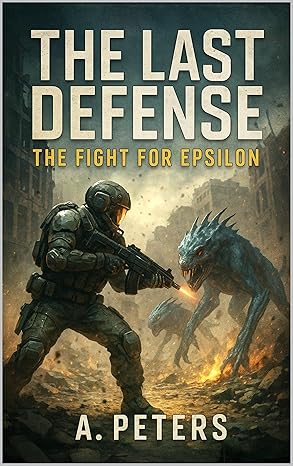

The Last Defense drops us straight into a brutal, crumbling world where Earth’s last hope rests in the hands of worn-out soldiers trying to fend off an overwhelming alien invasion. Major Jonas Cross, our gritty and deeply human lead, fights not just for survival but for family, memory, and something that feels a lot like hope. The story unfolds across the wreckage of Epsilon City, blending desperate last stands, gut-wrenching rescues, and shaky alliances into a tense, high-stakes battle for humanity’s future.
Right from the first chapter, A. Peters pulled me in with raw, vivid imagery. The opening scene where Jonas is crouched behind a slab of concrete, breathing smoke and fear, while Nightfangs hunt the ruins, slammed the urgency into my chest like a hammer. I loved how Peters didn’t waste time with long setups; you’re thrown straight into the fire. When Jonas reflects on his late wife Anna while hiding from monsters, it doesn’t feel forced or preachy. It feels real, like the kind of memory that guts you when you least need it. Peters has a knack for giving action scenes an emotional spine, and that’s a rare trick.
There were moments, though, where the pacing buckled a little under all the world-building. For instance, the section in the starport had so much tactical briefing that it almost felt like I was reading mission notes instead of a novel. I wanted to get back to Jonas, Ethan, and Selina fighting their way through the city ruins. That said, when the story veers into darker territory, like the prisoner experiments Jonas stumbles upon in the factories, it hits like a punch to the throat. That part genuinely made my skin crawl, and that’s a good thing.
What really stuck with me was the relationship between Jonas and Ethan. Their bond isn’t syrupy or melodramatic; it’s stubborn and bruised and heartbreakingly real. When Jonas risks everything to find his captured brother, dragging himself and a whole squad through hell, it made every firefight and every narrow escape count for more. And the moment Jonas finally finds Ethan, broken but alive, was pure gold. Peters writes brotherhood the way it feels: messy, guilt-ridden, and absolutely necessary.
The Last Defense is a grim, relentless ride, but it’s also filled with tiny flickers of hope that feel all the more precious because they’re so hard-won. I’d recommend it to anyone who loves gritty sci-fi war stories that don’t skimp on heart. Readers who appreciate the intense, character-driven science fiction of The Expanse or Halo: Fall of Reach will find much to admire here. Prepare for a gripping experience that demands both attention and emotional investment until the very last page.
Pages: 169 | ASIN : B0DY386H36
Redemption

Heavy Weight of Darkness follows a disgraced former officer given one last chance to redeem himself by hunting down a once-privileged woman turned revolutionary who has become a symbol of the uprising across colonies.What was the inspiration for the setup of your story?
The story continues the story of the Endless Fall of Night from the perspective of Captain Willard Bennett, former captain of the Jefferson Davis where our heroin, Cassandra Kurtz, escaped and started of movement on Mars to rid the fledging colony of imperialism, racist patriarch. In a desperate act to curb insurrection on Earth, space command’s admiralty and tribunal branch offers him redemption in the form of a new mission: track, find and kill Cassandra Kurtz. In return, he will receive his freedom, commission, life extending health care and a return to his former glory. He does find redemption but not in the way he expects.
I find the world you created in this novel gripping and immersive. Where did the inspiration for the setting come from, and how did it change as you were writing?
Drawing inspiration from Joseph Conrad’s Heart of Darkness, the Heavy Weight of Darkness is the sequel to the Endless Fall of Night where questions are answered, lives are altered, and truths come out in the final confrontation between Acting Captain Willard Bennett and the infamous disrupter, Cassandra Kurtz.
What were some themes that were important for you to explore in this book?
Heavy Weight of Darkness takes a look at Dietrich Bonhoeffer’s work that found stupidity to be the driving force of heinous crimes against humanity. It was not mere evil or malice that convinced an educated population in an industrialized, cultured society in the 21st century in the middle of a “civilized” Europe to embrace genocide, accept racism and to practice wholesale fascism, but rather it was good people who suspended critical thinking, believed one small lie after another until the “truth,” irrefutable facts became inconsequential, irrelevant and incidental. Bonhoeffer’s work is cautionary postscript of one of the darkest periods of human history while Heavy Weight of Darkness is a tale of how history can rhyme when it doesn’t repeat.
Will there be a follow-up novel to this story? If so, what aspects of the story will the next book cover?
There is another chapter in the works that will return to Casandra’s world as a new instrument of destruction, XO Robert Lee VI of the Robert E Lee, picks up her trail and is tasked with completing the mission that Captain Bennett abandoned.
Author Links: GoodReads | Instagram | Website | Blog | Second Website
In a desperate act to curb insurrection on Earth, space command’s admiralty and tribunal branch offers him redemption in the form of a new mission: track, find and kill Cassandra Kurtz. In return, he will receive his freedom, commission, life extending health care and a return to his former glory.
Originally enthused, he researches Cassandra’s origins, the once first class, full citizen from the oldest family of the Third Republic turned insurrectionist on Earth and a full-blown terrorist on Mars. But it’s after his investigation of the Delta Quarter, where it all started for Cassandra, that Bennett’s resolve diminishes.
Drawing inspiration from Joseph Conrad’s Heart of Darkness, the Heavy Weight of Darkness is the sequel to the Endless Fall of Night where questions are answered, lives are altered, and truths come out in the final confrontation between Acting Captain Willard Bennett and the infamous disrupter, Cassandra Kurtz.
Heavy Weight of Darkness

Heavy Weight of Darkness is a dystopian science fiction novel set in a future where slavery is institutionalized, patricians rule with unchecked privilege, and rebellion brews in the shadows of Mars. The story follows Captain Willard Bennett, a disgraced former officer given one last chance to redeem himself by hunting down Cassandra Kurtz, a once-privileged woman turned revolutionary who has become a symbol of uprising across colonies. Told through sharp scenes and immersive internal monologue, the book is a gritty, fast-paced exploration of power, corruption, and conscience.
This book doesn’t pull punches. Erickson’s writing is blunt, sometimes brutally so, and there’s an edge to the prose that kept me a little on edge in a good way. One of the most powerful moments for me was when Bennett visits the Delta Exchange. It’s grotesque, honestly. The smells, the heat, the masked patricians casually buying children like products. It’s a gut punch. And that’s the turning point, not just for him, but for the reader. Bennett, once a man who benefited from the system, is forced to see it for what it is, and the way Erickson layers his disgust, confusion, and growing empathy, it feels real. The writing is raw and broken, like Bennett himself. And that makes it work.
But here’s the part that surprised me: I liked Bennett. I didn’t expect to. He starts out as a selfish, complicit jerk. But his transformation is subtle and kind of tragic. He’s not some hero on a redemption arc. He’s a man caught in a machine that’s already chewed him up. And Cassandra is barely even on the page directly, but her voice haunts everything. Those intercepted transmissions, where she calls out the hypocrisy and brutality of the patrician class, gave me chills. She isn’t just a character; she’s an idea, and you can feel it spreading like wildfire.
If you’re into sci-fi with a heavy dose of political commentary and psychological grit, this book will be your jam. It drags you into the mud and makes you look around. That said, it’s also not for the faint of heart. There’s graphic content and brutal realities, and Erickson doesn’t shy away from any of it. But if you can handle the darkness, Heavy Weight of Darkness is one heck of a ride. I’d recommend it for fans of The Expanse series, or anyone who likes their dystopias unapologetically grim and their characters complicated.
Pages: 210 | ISBN : 1942708556
Accept the Adventure

The All Canadian Story Book is a collection of deeply human, often funny, sometimes heartbreaking short stories, each a snapshot of a person, a place, or a moment that feels achingly real. What was the inspiration for this collection of stories?
I just deleted my initial response to the question of inspiration, and replaced it with this, only because my book is a collection that goes back to 1983, providing fifteen unique inspirations to consider. I’m just not the guy to tackle such a task.
But I do have moments in my earlier life that, in retrospect, nudged me down the path to this milestone of my writing life. When I was fifteen, I boarded with my mother for a year while I decompressed from one of my dark and rowdy periods. We lived in Toronto and the only condition for the warm meals and the roof over my head was that I spend my time writing while she was at work. Mum was a research librarian. She was a poet, modelling herself after her grandfather Archibald Lampman, a revered Canadian poet. I lived for a year at her kitchen table, forcing myself to find something to put down on the piles of loose-leaf paper strewn at my fingertips. “Show, don’t tell,” and “just feel the words” and other such wisdoms were prompts that I at first ignored – it was more relaxing to stare out the window at the crows on the wires – but, quite suddenly, I got swept up in the task, and dug right into verse-bits and story-starts and character highlights. I started borrowing ‘writing’ books – I even returned some of them.
Two years later my ancient smoking and drinking Aunt Mary died. I was on my own again, and for some reason the family asked me to write her obituary. I loved Aunt Mary’s love for hockey, the Leafs, and her passion for feeding the birds in the depths of the Ontario winters. I wrote about those things, and I was told that some people were moved.
I kept on scratching away through some turbulent years; in spurts and spasms, (I even did some ghost-writing for Monsanto Chemicals. I’d go into a tiny, weed free office in downtown Toronto, and they would hand me a tape of some farmer in the American Midwest, in a small town diner, chatting about his farm and his tough life and his pigs and casually dropping the company’s products into the conversation) until I began to see that although ten cents a word was not my idea of a get rich quick scheme, it represented a meaning and a direction in my life. So now I can look back and see the sun rise.
When I see a weed now, I just pour some vinegar on it. Smells like a basket of fries. Dig in. Yummy.
What are some things that you find interesting about the human condition that you think make for great fiction?
Good posture and nice teeth are nice human conditions, but I love fighting; not so much the punchem-out variety – more the spirited, resilient, unbreakable type. The fight is, of course, in the character. It can be gritty, or it can be gentle, but it makes things happen and it can be disguised heavily in the garb of other characteristics. It’s not a direction so much as an engine, perhaps waiting to be fueled and fired up. I dislike Angst. I will never write a story about a martyr/ (well, I guess if they de-martyred themselves? But then would they turn Angsty because they were no longer martyrs. I don’t know, and I don’t want to find out.)
I think any human conditions and characteristics need to be pushed a little, or a lot, and need to be pumped up and pressurized before they are brought to life in the mind’s eye of a reader. A hermit living in a cave, for instance, who is never discovered in the darkness of his hole, raves at the Bats hanging above him, and perhaps scratches without purpose on the rock walls that entomb him. Why read on? He’s a goner. But the moment he tries to escape the cave, he, or she, becomes the dynamic subject of a real story. Yay, read on!
With this question, you have opened a vein in me that wants to gush out thoughts and ideas and opinions, undisciplined conjecture in all directions, and all at once. But I know, deep down, that I don’t have the skills or insights powerful enough to answer it properly. I will always rely on the goodness and humour of the humans that I most admire, in everyone’s writing and in my day-to-day life.
What were some themes that were important for you to explore in this book?
Growing up, but not just growing up – growing into something worthwhile…recognising the steps, the supports for you, hiding always in plain sight. Always remembering the past, not trying to repeat it – but using it like a tool, car jack, to change your worn down tires when needed. Smiling at everything and everyone you can, and laughing sometimes even if it makes you you cry. Getting on the boat, leaving the harbour -taking to the sea – accepting the adventure. Recognising the beauty around us, in the quiet moments, in the deep waters at our bows and swirling in our wakes.
What is the next book that you are working on, and when can your fans expect it to be out?
……….First off, I have to collect 37,000 words that I like the sound of – from my English Dictionary, or free-range from the wilds – and then I need to figure out how to arrange them somehow. Large, small, subtle, grumpy, silly and pithy, long or stubby – pretentious and blunt. All of them; they will all have a place, all their own, to live in – forever side by side – cheek to cheek, cozied up between the covers. Right now, I’ve snared 582 of the words I need. I am on my way, but the course is yet foggy and unknown. Here I am, pitching the next book to myself. It had better be interesting. It had better not be naval gazing or self indulgent. It’s got to be fun to read and create lots of surprises and mysteries. It has to have an abundance of Arletta’s wonderful illustrations in it. And…it had better have a woman in it who adopts her own son. That’s good, because that part’s done.
Author Links: GoodReads | X | Facebook | Website
This collection offers a diverse mix of previously published material alongside fresh, vigorous new pieces that add vitality and depth to the book. The writing is consistently high in quality, providing a delightful and engaging experience for readers. You’ll find a bright and adventurous journey through well-written content that reflects the richness and diversity of Canadian life. From old timers to new favorites, each piece is infused with positivity and creative flair, making it a true celebration of storytelling.
Perfect for those who appreciate a good read, The All Canadian Story Book is not just a collection but an experience that promises to entertain, inspire, and leave a lasting impression. The ‘Story Book’ isn’t just a collection—it’s an experience. It promises to entertain, inspire, and leave a lasting impression, all penned by a real-life, unapologetically human author…Peter.
The All Canadian Story Book

Right from the first story, The All Canadian Story Book hooked me. It’s a collection of deeply human, often funny, sometimes heartbreaking short stories, each one a snapshot of a person, a place, or a moment that feels achingly real. Some tales are memoir-like and nostalgic; others are quirky, surreal, or poetic. But what ties them all together is the voice—sharp, emotional, and unapologetically honest.
The opening piece, “My Hysterical Friend,” resonated with me personally. It’s the kind of story that sneaks up on you. It starts with banter and dark humor and ends in quiet devastation. The friendship between Bobby and Ben unfolds with such raw, unfiltered intimacy that you feel like you’re eavesdropping on something sacred. That final moment at the hospital, with the “flat” line on the monitor mysteriously rising upward, hit harder than I expected. It left me staring at the wall for a minute. And when Jenny dies exactly six minutes after Ben, you almost believe in fate—or magic—or at least in the kind of love that bends time.
The writing isn’t polished in a flowery way, but that’s part of what makes it sing. It’s got this unpretentious rhythm. You can feel the characters breathing, scratching their heads, and breaking down quietly in the dark. “Mentors” is another standout. It’s gritty and painful and packed with rough edges and sharp truths. Jay Smith’s story, especially his time with Franklin, a lonely old man with a goitre and a heart full of ghosts, was strangely touching. There’s humor too, like in “Chicken of the Sea.”
“The Permanent Robin” is one of those quiet little stories that sneaks in near the end of the book and catches you off guard. It’s tender, short, and full of that bittersweet kind of magic that lingers. The robin—stubborn, loyal, maybe a bit symbolic—refuses to migrate, sticking around through the cold. And in that small, simple image, the author somehow captures themes of grief, memory, and holding on when everything else has moved on.
This book is for folks who’ve lived a little—or a lot. If you’ve ever watched someone you love fall apart, or disappear, or come back different… this book might feel familiar. It’s perfect for readers who like their stories with some bite, a lot of soul, and just enough weird to keep things interesting. It’s messy. It’s tender. It’s beautifully Canadian in that understated, heartbreaking kind of way. Read it. Let it wreck you a little. Let it warm you back up.
Pages: 244 | ASIN : B0DPTVYKN5
Complex Beings

Heatseeker: A Story of the Vampire Alex Chance follows a former FBI agent turned vampire, investigating a gruesome serial killer who has to navigate the murky line between human law and vampire justice. What was the inspiration for the setup of your story?
This story was greatly influenced by a short story I wrote in my writing group back in 2015 when I came up with an idea of a modern-day lawman hunting an elusive and brilliant serial killer and getting exposed to the secret world of vampires. That short story was only five pages long and featured only two main protagonists, Alex Chance, who was a police detective in that story, and vampire boy, Jake, who hunted down child molesters with lethal precision. I later modified the story several times, and many years later, came up with a broader tale involving more characters that had enough material to turn it into a novella. And so, the Heatseeker book was born.
What were some of the emotional and moral guidelines you followed when developing your characters?
Emotional and moral guidelines in any story are important. I always loved the detective genre and introducing a supernatural element into it made it more interesting and added more depth to the story. Alex Chance is an FBI agent, trained to be strong, honorable, and devoted to his duty. The vampires are creatures of the night, who have their own codes of honor and justice system, only they operate without human bureaucracy and red tape, which makes them far more efficient. Alex Chance follows his personal and moral code even after he becomes a vampire, which I think makes him very likable. The vampire boy, Jake, on the other hand, is driven by an ancient hate for people who hurt and abuse children and his moral compass can only be affected by the elements of human law, which he breaks often in pursuit of justice.
What intrigues you about the horror and paranormal genres that led you to write this book?
Horror and paranormal genres are very intriguing because as a writer, I do find them very stimulating for the creative process. There were movies and shows that played a great part in its development, such as the vampire series Forever Knight and Moonlight, where vampires and humans must find common ground and ways to coexist. The horror element derives from the vampires’ ability to instill in morals great fascination and fear. In traditional vampire stories, the immortals are often depicted as killers, who justify their way of life by their constant need for human blood. The supernatural genre is even more fascinating. In my vampire story, I described vampires as complex beings with their own secret civilization that had evolved alongside humanity in parallel evolution. So in a way, both human and vampire worlds mirror each other.
Is this the first book in the series? If so, when is the next book coming out, and what can your fans expect in the following story?
Heatseeker is a stand-alone novella that features Alex Chance as the main protagonist. It is set in a world of vampires that were introduced in my previous vampire novels, Beyond Sunlight, Before the Dawn, and Eighteen Forever. Heatseeker is the fourth book that is related to them but follows its own path. My fans can expect a few more stories about vampires, which are currently resting on the development shelf, waiting to be picked up, analyzed and selected. Currently, I am at work on a new post-apocalyptic story that features human survival after a devastating asteroid impact.
Author Links: GoodReads | Amazon


