Blog Archives
My Bee Soliloquy


My Bee Soliloquy is a sprawling meditation on bees, both literal and metaphorical. The book dances between themes of nature, spirituality, philosophy, and even history, all framed within the fascinating world of bees. It’s a poetic and symbolic exploration of life itself, borrowing from science, mythology, and personal reflection. The structure is unconventional, feeling almost like a collection of musings rather than a traditional narrative. With chapter titles ranging from “Geometry” to “Bee Math” and even “Bloods and Crips,” it’s clear from the outset that this book refuses to fit into a neat little box.
What struck me first was the sheer ambition of the writing. It moves fluidly between subjects, often blending the mystical with the scientific. There were moments when I felt completely absorbed in the poetic flow, like in the chapter “The Bee in the Apokatastasis,” which seemed to weave together theological concepts with the natural order of hive life. At other times, there are sections that jumped abruptly between ideas. While this nonlinear style adds to the book’s unique voice, it also made some parts feel like an abstract puzzle. Still, there’s something hypnotic about the way the author treats bees, not just as creatures, but as symbols of deeper truths.
Some chapters, like “Bee Believes” and “Beeology-Theology,” delved into religious and philosophical reflections that were intriguing. On the other hand, sections like “Japanese Honey Bee” and “When There Are No More Bees” were more grounded and informative, bringing a refreshing clarity amidst the more abstract passages. There’s a lot of wisdom buried in the text, but the reader has to be willing to embrace the book’s unpredictable structure to fully appreciate it.
If you love books that blur the line between poetry, philosophy, and science—books that challenge you to think in new ways—this one is worth diving into.
Pages: 80 | ASIN : B0DX8KHQLD

Focusing on the Photos
Around the World in Eighty Photos is more than just a photography book; it’s a visual adventure that takes readers across the globe to view the often-overlooked corners of the world through the lens of an experienced traveler. What inspired you to create this pictorial travel book?
My previous book, On to Plan C: A Return to Travel, which documented my return to travel after the pandemic, was the first to include my photography. I really enjoyed the experience of putting it together, even though it required editing both the text and photos. For this book, I knew I wanted to include photography again, but this time make the photos the focus.
There are many books out there showing you photos of famous places around the world, but I wanted to steer the reader toward lesser known locations and give them some insight into how each photo was created—what caught my eye, what challenges I faced, how I dealt with less than ideal lighting in some situations, and so on.
I also wanted to include background information on each location for those less interested in the photography. For those interested, I disclose the settings I used for each photo along with a glossary of photographic terms at the end. So, it can be used as a guide to lesser known locations and/or as a guide to creating better travel photos.
What photo in this collection do you feel has the best “story” surrounding it?
The photo created inside Iglesia El Rosario in San Salvador, El Salvador. From the outside, the church looks like a concrete bunker. In fact, I wasn’t sure it was not abandoned and walked past it without much thought while exploring the area. When our local guide started eventually heading toward it, I was a little unsure of why he was taking my wife and I there.
Turns out, its nondescript concrete exterior conceals an arched roof that sheds a rainbow of natural light that spreads across the altar and bounces off the metal and rock inside. Designed by sculptor Ruben Martinez and completed in 1971, Iglesia El Rosario is radically beautiful and one of the finest churches I have ever visited.
As I don’t travel with a tripod, and it being a church with occasional visitors, made this a very challenging photo to create. I chose settings I felt would let in a good amount of light and used a shutter speed that wouldn’t cause blur being handheld. Situations like this I tend to hold my breath for steadiness and hope for the best.
What advice do you have for aspiring travel photographers?
Study the fundamentals and know your camera well so that you don’t have to hesitate when changing a setting. I have my camera setup so that I can change things like aperture or the type of focusing very quickly. Things can happen fast while on the road and you don’t want to miss them while fiddling around trying to change something.
I’m also a big believer in previsualization. This allows me to determine the lens and general settings before I even start to take photos. For instance, if a situation calls for street photography, then I’m going to use a lens in the 35mm to 50mm range with an aperture around f/8 to keep everything in focus and a minimum shutter speed of 1/250 to of a second to stop motion. This was, I can concentrate more on composition and less on adjusting settings.
What is one thing you hope readers take away from Around the World in Eighty Photos?
There are so many more places in the world than the handful that always seem to be promoted. Yes, Venice is a stunning location filled with canals, but so is Bruges in Belgium or Wuzhen in China. The world is full of surprises. For instance, the Salt Cathedral of Zipaquirá is a remarkable underground cathedral built within the tunnels of a salt mine just north of Bogotá. I hope this book inspires readers to seek out such places and take more inspired photos while there.
Author links: GoodReads | Instagram | Website
This captivating visual odyssey takes readers to the farthest corners of the earth, from bustling cities to serene landscapes, offering a window into the world’s most awe-inspiring sights. Each carefully curated photograph is paired with a short reflection or story, capturing the essence of diverse cultures, iconic landmarks, and hidden gems.
Whether you’re an armchair traveler or a seasoned explorer, Around the World in Eighty Photos is your passport to adventure, offering a unique perspective on the beauty and wonder that unite us all. Prepare to be inspired by the world’s splendor, one photo at a time.
Around the World in Eighty Photos
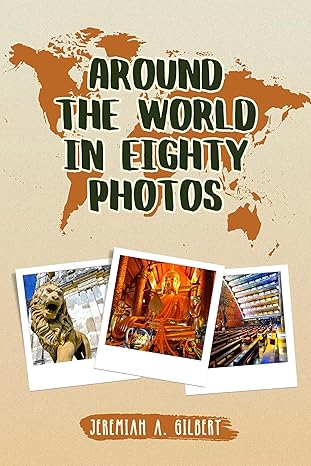

Jeremiah A. Gilbert’s Around the World in Eighty Photos is more than just a photography book; it’s a visual adventure that takes you across the globe through the lens of an experienced traveler. Instead of sticking to well-known landmarks, Gilbert hones in on the often-overlooked corners of the world, giving them the spotlight they deserve. Each photograph is accompanied by a story—sometimes historical, sometimes personal, always engaging. He also shares the technical details behind each shot, making it both an inspiring and educational experience for photographers and travel enthusiasts alike.
As a photographer, I appreciate that Gilbert doesn’t just show beautiful places—he invites us into his thought process. His image of Rano Raraku on Easter Island struck me the most. He describes setting up his shot without people, then serendipitously capturing two figures stepping into the frame, perfectly enhancing the composition. That’s what photography is about—being prepared, yet open to unexpected moments. The book is filled with these little surprises, making it feel like you’re traveling right along with him.
Another highlight is the way Gilbert balances storytelling with technical insight. In his photo of Mexico City’s Basilica de Guadalupe, he explains how he had to ride the moving walkway twice to figure out the best composition. The first trip was for analysis, the second for execution. That’s dedication. And in his shot of Iguazu Falls, he makes a conscious decision to use a fast shutter speed to capture the violent, thundering energy of the water, rather than the dreamy, silky look so many photographers go for. His approach reminds me that technical choices should serve the emotion of the image, not just the aesthetics.
This book is a must for photographers who love to travel, travelers who love photography, and anyone who dreams of seeing the world through fresh eyes. If you want a collection of images that tell stories, that teach you something new, and that make you want to grab your camera and book a flight, Around the World in Eighty Photos is an absolute treat.
Pages: 268 | ASIN : B0DY46TYP3
The Aim to Endeavor: A Fusion of Reflective Poetry & Scenic Photography

Susana Henschel’s The Aim to Endeavor is a blend of reflective poetry and breathtaking photography that takes readers on a journey of self-exploration. The book wrestles with raw emotions, moving from introspection to a hopeful embrace of life’s uncertainties. Henschel doesn’t shy away from discomfort; instead, she pushes into it, uncovering beauty and meaning through poetic musings that feel deeply personal yet universally resonant. Accompanied by stunning images of landscapes and architecture, the book invites contemplation, offering moments of quiet clarity amid life’s chaos.
Henschel’s writing is a mixture of vulnerability and resilience. Poems like “The Origin of a Poet” question the source of creativity, suggesting that pain and joy are both necessary fuel for artistic expression. Her lines aren’t flowery or overly complex; they cut straight to the heart, leaving an emotional impact that lingers. She speaks to the human condition in a way that feels like an honest conversation rather than a lecture, which makes the book both intimate and accessible.
One of the book’s standout aspects is its ability to shift between light and dark, much like the ebb and flow of life itself. In “Chasing Affirmations,” she grapples with the need for external validation, questioning why we seek approval from others when self-worth should come from within. It’s a relatable sentiment, one that many will nod along to in recognition. But Henschel doesn’t just dwell in uncertainty—she also uplifts. Pieces like “The Reward of the Climb” remind us that perseverance, no matter how exhausting, is always worth it. Her words don’t sugarcoat reality, but they do offer a guiding hand through it.
What makes The Aim to Endeavor even more special is the photography interwoven with the poetry. The images, credited to Marvin Henschel, enhance the mood of each poem. The visuals give weight to the words, grounding abstract emotions in tangible places.
This book is perfect for those who find comfort in poetry that is both reflective and empowering. If you’ve ever felt lost, uncertain, or in need of a gentle nudge toward self-discovery, Henschel’s work offers just that.
Pages: 106 | ASIN: B0BS3KVDK1
An Incredible Gift of Transformation

The Fine Art of Grieving guides readers through the deeply emotional landscape of mourning your son through evocative vignettes, photography, and various art forms to share your emotions and memories. Why was this an important book for you to write?
Before my son’s death, I found art to be an effective tool to express uncomfortable feelings and transform my own childhood trauma into meaning. Creativity gave me a voice, built my self-confidence, and made me stronger and wiser.
Although artmaking had been my salvation, my creative muse vanished when a switch flipped from child alive to child dead. How was I supposed to process grief?
Soon after my son’s death, I attended a grief group and asked the question, “How long does grief last?” The other grievers all turned to the counselor with looks of desperation. The counselor replied, “Grief lasts forever.”
I felt shocked, doomed, and then I shifted into disbelief. How could anyone survive if this relentless, excruciating, brutal thing called grief lasts forever?
Predominantly, grief is confined to culturally acceptable guidelines, often censored. Unexpressed grief is grief unprocessed. I witnessed most grievers quicksand-stuck, mouthless, or hanging unreachable in the cave of loss destined to suffer forever. No one should have to suffer forever.
My quest to prove that grief does not last forever began with defining grief—and healing. I read as many articles and research studies on grief as I could find, and although highly complicated and nuanced, it turns out that grief is a process and healing is part of that process.
I also devoured grief memoirs and self-help grief books only to find that my experience with grief—that raw unfamiliar madness—was not represented. What was missing compelled me to write a memoir about how creativity and healing were connected to the grieving process. I wanted to write a heart-opening, affirming, unabridged, unmasked depiction of what grief looks like and how it is possible to heal from grief.
In early grief, I wasn’t certain that my creative inquiry into devastating loss would facilitate healing, but I was willing to try. I intuitively suspected that I might be able to develop grief-vision—learning to see through darkness. It took me almost a year to find my way.
I discovered an unconventional pathway through grief. I turned to my camera to document myself floating down a river swaddled in my son’s blood-red blanket, surprised to experience the movements of that river as a metaphor for change—that nothing remains the same. Before the lens, I set my son’s clothing aflame to make sure there was nothing left inside those fading artifacts—a quick lesson in impermanence. I buried my face into his ashes and photographed my faceprint grimace pushed deep into the sand of him to discover my new self in place of his absence. Art performance and photography facilitated a viable means to transform harrowing loss and pain into something soulful, meaningful, and gave me purpose. A grief-can-be-healed revelation, so good, I wrote my book to offer relief and hope to all those who have or will experience grief.
“In grief, you can choose how to process your loss.” – Jane Edberg
I appreciated the candid nature with which you told your story. What was the hardest thing for you to write about?
One might assume the parts about “hearing my son is dead” or “viewing the body” would be the hardest to write, but the entire story was challenging because I was discovering what my story was about as I relived each event multiple times to write the book. My first draft of my memoir was written during the grieving process. While trying to make sense of my actions and experiences, I was processing grief while processing art while processing healing and writing to make sense of those complex relationships while following my throughline: one can heal from grief. Incrementally, I had to depict all the intricate bits that led me to accept my son’s death and show how I created a new, well-adjusted self in a new world. I wrote about how creativity allowed me permission to see, think, and behave in unfamiliar ways. There is no definitive grief manual for that. Years later—as the older, wiser, new self—I rewrote my memoir to include what I came to understand about deep loss.
While losing a loved one is sudden, and happens in a flash, the process of living without them takes years to incorporate, years to make sense of, and years of trying to accept realities that are impossible to understand. Although art assisted me in the journey from grief to healing, that process was fraught with labyrinthine struggle, deep mental anguish, and a lot of focused hard work. Writing that story was a tall order. However, if I had done nothing but give in to being swept away by grief, I believe that my grief would be delayed, and possibly last forever. My memoir is a testament to how one can heal from grief.
“Grief is in the details, so is the healing.” – Jane Edberg
What were some ideas that were important for you to share in this book?
“If there’s a book that you want to read, but it hasn’t been written yet, then you must write it.” – Toni Morrison
So, I did.
The Fine Art of Grieving—not your typical grief memoir—is an introspective and thought-provoking story that explores the profound power of art and its role in navigating through grief to healing and self-discovery. My stories demonstrate how grief offers us an opportunity for self-reflection and personal development, which leads to personal growth. I switched up the conventional grief narrative to invite the idea that grief offers us an incredible gift of transformation.
I included 50 fine art photographs—visual representations of my journey through grief—to go hand in hand with the prose. I do not consider the photographs to be illustrations; I see them as illuminations—bringing light to darkness. My images speak to what my words cannot convey while my words speak to what the art holds as mystery.
Although many people believe that art is only made and enjoyed by those who were born with an innate gift of creativity, The Fine Art of Grieving addresses art as a human endeavor, that art is essential, and makes imagining and creating relatable—something anyone can engage in.
Above all, The Fine Art of Grieving is a book about hope—hope for healing, hope for joy, hope for a stronger, wiser self, and hope for a good life after traumatic loss.
“Grief rises from the ashes; you will rise from grief.” – Jane Edberg
What is one thing you hope readers take away from your story?
Because I am a complex and deep writer, the takeaway is tenfold—there are many valuable morsels in my book pertaining to loss, creativity, resilience, and love. My main takeaway—grief can be healed. One of my greatest wishes is to destigmatize discussing ideas, concerns, and feelings related to death, loss, and grief. I want to instill bravery and inspire others to express their loss with less discomfort.
When I became brave enough to share my grief stories—the private, raw rituals of reimagined loss—I was met with mostly applause and appreciation. In response to my candid sharing, I found other grievers compelled to share their wild steps through the process of grieving. I want readers to know that expressing their grief is how to process that grief.
Many grief experts tout that grief is forever, however, The Fine Art of Grieving offers proof that grief—after showing the complexities of grief—can be processed and healed, does not have to last forever, and that love, and creativity outlast grief.
“How do you heal grief? You grieve.” – Jane Edberg
Author Links: GoodReads | X (Twitter) | Author Facebook | Facebook | Author Instagram | Instagram | Website | thefineartofgrieving | TikTok | Medium | Podcast | Amazon
Jane Edberg’s creative muse vanished when a switch flipped from child alive to child dead. How was she supposed to process her loss? This lyrical, original, beautifully written story is about how, after the tragic death of her adored nineteen-year-old son, she rediscovers the power of art to create an unconventional pathway through grief. This is not your typical grief memoir. It is an introspective and thought-provoking story which explores the profound power of creativity to transform trauma and anguish into resilience and healing. Her journey is illuminated with breathtaking, fine art photographs of reimagined loss.
HEROES IN GRIEF podcast:
https://podcasts.apple.com/us/podcast/e6-jane-edberg-professor-artist-author-of-the-
fine/id1743205801?i=1000657605087
My Life Raft
It Was Her New York is more than a memoir; it is an exploration of family dynamics and self-discovery in a city that influences all who reside in it. Why was this an important book for you to write?
I and my sister were suddenly caring for a suddenly frail parent. My life changed on a dime. My plans to live abroad with my then-partner and the writing and documentary work that I was doing were all derailed. The city I had always felt “normal” in became more and more unrecognizable. At the same time, my parent, Florence was basically disappearing into dementia. Yet in that chaos, Florence kept surprising me with expressions that were so her and my city kept reminding me that I was still home. Those moments became a life-line to my well-being. The documenting of a pretty tough process kept me connected and sane and working my storytelling muscles. It also comforted me and offered me daily opportunities of giving gratitude-something that cannot be underestimated when going through challenges. Simply put, it was my life raft.
What were some ideas that were important for you to share in this book?
HOME and LOVE and FAMILY are present in each and every person who is in HER NEW YORK: all the LGBTQ grandparents and parents who could never tell their families who they really loved; all our co-workers; all the people who keep our cities running; all the immigrants or refugees who come to NY and other cities seeking safety and a chance at a good life; all the caregivers – both relatives and home attendants – who go through their daily tasks in silence and invisibility. We are surrounded by their stories and, in the case of Florence’s Ex-Lover, secrets. I wonder often what the family of the Ex-Lover – the woman who loved Florence all her life – would think if they found out about their mother/grandmother/great-grandmother and her life-long heartbreak. I wonder if she truly had to hide her heart. I think if people who decry immigration would meet Mr. Godslove, they would be struck as I was by his kindness and goodness. I wonder if people ever stop and give thanks for all the bus drivers, subway workers and delivery people in their city. Yes, this book is specifically about New York City and a queer woman. But it is about a lot more; our cities and homes and relatives and neighbors and all their stories.
I appreciated the candid nature with which you told your story. What was the hardest thing for you to write about?
I wondered if it was the piece I wrote on the evening of the morning Florence died. But it wasn’t – that was an offering of gratitude (except for that one awful EMS person). The hardest thing to write was THE AUTHOR’S NOTE: WHAT A DIFFERENCE THE YEARS MAKE. It was there I had to splay out the regret I felt that last day with Florence and finally say goodbye to my past and the imperfect journey I took her to her final days.
What is one thing you hope readers take away from your story?
There was a parade chant from the Pride March many years ago – “2, 4, 6, 8, how do you know your grandma/grandpa/any relative is straight”. You don’t. We slap words onto people that become their definition, rather than getting to know who they really are. So what I hope this book does is welcome readers’ hearts to grow bigger, their curiosity to expand and their respect to deepen for the people they think they know, for the people they judge as “immoral” or “wrong” and for the people they have never met but fear.
Author Links: GoodReads | Twitter | Facebook | Website
In this engaging new collection of personal essays and full-color photographs, Moed tells true stories of caring for her mother Florence, a broke, Julliard-trained pianist who stumbles into dementia on the Lower East Side. This funny, poignant memoir asks questions both familiar and touching: “What happened to the neighborhood?” and “What happened to my mom?”
It Was Her New York is for anyone who has ever experienced the aging of a parent, the gentrification of a neighborhood, or the unexpected discovery of stifled love and hidden sexuality.
It Was Her New York: True Stories & Snapshots

In It Was Her New York, C.O. Moed offers readers a tapestry of life in New York City, intricately woven through the lens of her relationship with her mother, Florence. This memoir is a heartfelt exploration of family dynamics, the complexities of identity, and the ceaseless evolution of a city that never sleeps.
Moed’s writing is both poignant and evocative. She blends humor with sorrow and paints a vivid picture of her mother—a spirited musician whose resilience and struggles are deeply moving. The book shines not just in its storytelling but in its ability to capture the essence of New York City. Moed’s New York is not just a backdrop but a living, breathing character that influences and shapes the lives of those who call it home.
The book’s narrative structure is somewhat unconventional, interspersing memories and anecdotes with cultural and social commentary, along with images. This approach works wonderfully in drawing the reader into the author’s world, offering a multifaceted view of her experiences and emotions. Moed’s reflections on the impact of Florence’s life and death are deeply personal, yet they resonate universally, touching on themes that many can relate to – loss, grief, and the passage of time.
The book’s strength is weaving personal tales with broader societal observations. At times, the transitions between personal anecdotes and cultural commentary felt abrupt, leaving me wishing for a smoother narrative flow. Nonetheless, this does not significantly detract from the book’s overall impact.
The exploration of Florence’s life as a musician and her determination in the face of adversity is particularly compelling. It highlights her character and serves as a testament to the indomitable spirit of New Yorkers. In this regard, Moed’s portrayal of her mother is not just a personal tribute but a nod to the resilience and complexity of all those who inhabit this ever-changing city.
It Was Her New York is a touching and insightful book that will resonate with anyone who has experienced the joys and tribulations of family relationships, the bittersweet nature of memory, and the profound impact of place on personal identity.
Pages: 289 | ASIN : B0CTNHK1N7
Dinosaur Symphony: A Book of Poetry and Pictures about Dinosaurs and Classical Music

In A Dinosaur Symphony, author S.P. Somtow masterfully intertwines the realms of time travel, music, and paleontology, creating a unique and engaging experience for young readers. This imaginative tale follows a time-traveling conductor who ventures into the Jurassic Era only to find an orchestra of dinosaurs struggling with their musical tempo. Through this narrative, Somtow cleverly introduces children to the intricacies of a symphony orchestra, with each dinosaur character representing a different musical instrument and section of the orchestra.
The author’s background as a composer is evident, as he enriches the story with an original orchestral piece that reflects his dual passions for music and dinosaurs. This auditory element, along with the AI-assisted illustrations, provides a modern and interactive layer to the storytelling, making it an enjoyable and educational read. The author includes a note explaining the use of AI assistance in creating the illustrations. Although a few images might display minor imperfections, they do not detract from the story’s captivating narrative. This book is an educational tool, seamlessly blending fun facts about dinosaurs with insights into various musical instruments and their sounds. This approach captivates the young reader’s imagination and serves as a springboard for discussions about music and paleontology in classroom settings, particularly in music education.
A Dinosaur Symphony opens up opportunities for meaningful conversations between children and parents about diverse music genres, the role of different instruments, and, intriguingly, the prehistoric creatures that once roamed our planet. This inventive and informative book is an excellent resource for nurturing young minds to appreciate music and natural history.
Pages: 80 | ASIN : B0CPDJZ3RH



 LITERARY TITAN