Blog Archives
When the Light Is Mine


When the Light Is Mine is a raw, messy, and relatable collection of poems about growing up poor, tangled in fundamentalist religion, and tangled inside your own head. Chaz Holesworth moves through shame, faith, politics, love, self-loathing, and music, talking to God, to America, to exes, and to himself, often all at once. The book feels like a long late-night monologue where the speaker keeps circling the same wounds, trying to get them to finally bleed clean.
The poems lean into repetition, riffs, and a kind of rambling rhythm that feels very close to song lyrics. The intro even calls out that influence, and I could feel it in pieces that read like verses in a track that never quite resolves. The language is blunt and sometimes crude. Religion and American culture get hit hard, with jabs at whitewashed Jesus, televangelist greed, the KKK, and lazy patriotism. At the same time, the voice turns on itself just as sharply, poking at OCD habits, body image, sexual shame, and the urge to disappear. I liked that refusal to let anyone off the hook, including the speaker. It gave the collection an honest, slightly scorched tone that stuck with me.
I also found moments of softness peeking through all the yelling, and those were the ones that hit me the most. When the poems shift toward love and connection, the voice loosens, gets playful, even hopeful. The pieces about music and favorite songs feel like little altars, the one place where belief is allowed without sarcasm. I felt a real ache in the tension between wanting to burn everything down, and wanting to be held, to be seen as beautiful, to believe that there is a version of life that is not just trauma on repeat. Sometimes the book leans into rant and self-mockery that I felt the emotional impact blur under volume. But there are many lines and images that land hard, and when they do, they feel earned.
This is not a neat or balanced collection, and I don’t think it wants to be. It’s chaotic, angry, funny in a bitter way, and often uncomfortable, especially around faith and sex. If you live with religious trauma, class struggle, or obsessive self-talk, and you like work that spills its guts without cleaning the floor first, this book will likely feel familiar in a deep, strange way. I would recommend When the Light Is Mine to readers who love lyric, stream-of-consciousness poetry, who do not mind strong opinions about religion and politics, and who are looking for company in the darker corners of their own thoughts.
Pages: 128 | ASIN : B0FPZHK1VR

Breathe and Believe


Breathe and Believe, by Arthur Wiggins, drops readers into the messy, money-soaked world of American Midwest University athletics, where one bad week blows up an entire department. Bruce McDermott, a marketing specialist on the rise, watches his mentor quit, his secret relationship implode, and his football program slide toward NCAA sanctions and budget disaster. Interim athletic director Tara Gantt battles power-hungry basketball coach Ron Hill and his boosters over gender equity, football vs. basketball priorities, and the push to build a new multi-purpose facility, while a tragic road accident involving the women’s tennis team shows the very real cost of all these decisions. By the time Bruce walks into a legislative hearing with a giant check and a campus-wide vision, the book has turned a spreadsheet crisis into a story about ambition, grief, and what it really takes to keep a university sports machine alive.
The storytelling has a slow-burning style that works overall. The early chapters around the motel incident, the surprise resignation, and then the van crash hit hard and fast, and I caught myself thinking, “OK, this is not just a sports novel, this is a whole train wreck of a weekend.” The author writes meetings, press conferences, and budget talks with the same seriousness as big games, and that gave the book a grounded, insider feel. There are passages packed with numbers, acronyms, and institutional history where the tension dips. The dialogue often carries the weight, with characters stating the stakes rather than letting subtext do more of the work. Still, when the story leans into crisis scenes or personal confrontations, the pacing snaps back, and the pages move quickly.
What really hooked me were the ideas underneath the plot. The book digs into Title IX, gender equity, and the brutal math of “too many sports, not enough money” in a way that feels honest. We see how a 53 percent female student body sits next to only 39 percent female scholarship athletes, and you can feel how wrong that is without the author giving a lecture about it. Tara Gantt’s arc, as a veteran woman administrator who built a separate women’s program only to see it merged, trimmed, and constantly second-guessed, gave the book heart.
Bruce’s role as a marketing guy caught between ideals and survival felt believable to me; he is selling walk-a-thons, naming rights, and spring game hype so the department can pay back a 1.3 million dollar overspend, and the whole thing feels both clever and a little desperate. The tennis team crash is handled with a blunt, unsentimental style that hit me in the gut; it underlines that all the talk about TV contracts and conference moves sits on top of actual young people in vans on bad roads.
I also liked how Wiggins treats politics and media as part of the same ecosystem. The scenes with the local newspaper scrambling for a “thumper” front-page story and sniffing around the athletic budget felt very true to life, and there is a sly humor in how leaks, half-truths, and spin drive the narrative around AMU more than any scoreboard does. The boosters, legislators, and campus leaders come off as flawed rather than cartoonish villains, which I appreciated. There were moments when I wished for more time inside the student-athletes’ heads and a bit less time inside meeting minutes. Even so, I came away with the strong sense that the author has lived in this world, and that authenticity carries the book.
I would recommend Breathe and Believe to readers who enjoy behind-the-scenes sports stories, campus politics, and workplace dramas where the real action happens in boardrooms, press boxes, and budget spreadsheets more than on the field. If you want a thoughtful, occasionally heavy, very human look at what modern college athletics does to the people inside it, you’ll enjoy this book. Arthur Wiggins has written a grounded, slow-burning sports novel for readers who love college athletics stories packed with messy politics, money trouble, and real emotional fallout.
Pages: 309 | ASIN : B0DFCHCWND
American Insomniac: Reflections on the future of a dying democracy

American Insomniac is a restless, wide-ranging collection of essays, op-eds, and personal reflections that circles around one big worry. American democracy feels like it is slipping away. Author Jim Smith moves through three big territories. First, he pulls apart the health of democracy and freedom in the United States and ties it to capitalism, inequality, and political polarization. Then he turns to culture, from a gripping story about Argentina’s “Dirty War” to feminism, consciousness, and the way modern life sells us “experiences” as products. Finally, he dives into explicitly philosophical explorations of thinkers like Vine Deloria, Lukács, and Gregory Bateson and uses them to ask what a more humane, sane society might look like. All of it sits inside one frame. An insomniac citizen who lies awake at three in the morning, trying to make sense of a country that feels both familiar and broken.
The opening autobiography of carnival life instantly hooked me. The details about flat stores, grab joints, rock o planes, and a childhood spent as “other” among carnies and then “other” again back in a small town, give his later anger and skepticism real roots. That early outsider lens never really leaves the page, and I found myself trusting him more because of it. When he goes after Congress, the Supreme Court, Trump, Montana’s legislature, or the hollow language of nationalism, it feels less like a partisan rant and more like the long view of someone who has watched the same bad habits play out in different costumes. The tone swings between dry humor, exasperation, and real grief. I caught myself laughing at his jokes about both parties and then, a page later, feeling that heavy, sinking sense that he might be right about how fragile things have become.
Stylistically, the book is a bit of a mixed bag, and I mean that in a good way. Parts of it read like newspaper op eds, quick and punchy, rooted in specific Montana fights and court cases. Other sections feel like seminar papers, thick with references and theory, especially when he gets into consciousness, reification, or Bateson. Those more academic stretches slowed me down, and at times I wished he had trimmed or translated the theory a bit more for general readers. On the other hand, that density also signals how seriously he takes ideas. This is not a collection of hot takes. It is the product of years of teaching, reading, and arguing with the world, and I appreciated that he did not talk down to me. Even when some statistics or political references feel a little dated, the core worries about authoritarian drift, commodified life, and the erosion of public trust still hit hard, maybe even harder now.
The book makes a convincing case that “natural stupidity” and bad faith politics are not going anywhere on their own. I was encouraged, though, because Smith never fully gives up on the idea that ordinary people can organize, think clearly, and push back. I would recommend American Insomniac to readers who already pay attention to politics and culture and want something more honest and personal than a standard textbook. It will work especially well for folks who enjoy critical essays, progressive political writing, and memoir woven together and who do not mind doing a bit of intellectual heavy lifting in return for an honest, insomniac tour of a “dying democracy” that is still fighting to stay alive.
Pages: 308 | ASIN: B0FNQSH73Y
Breaking Barriers: A Bold Vision for Pakistan’s Future


Breaking Barriers: A Bold Vision for Pakistan’s Future is part memoir, part diagnosis, part blueprint. Harris Kamal starts in Karachi and uses his own story as a doorway into Pakistan’s wider journey. He traces the rise from early “Asian Tiger” optimism to a present filled with corruption, broken institutions, and deep inequality. He then moves through the big systems that shape daily life: bureaucracy, police, courts, politics, education, gender relations, and the economy. Finally, he lays out a future agenda that leans on youth, better governance, and social inclusion, with long chapters on schools, women’s empowerment, and structural reforms in everything from taxation to resource use.
I enjoyed the way he mixes hard facts with personal feeling. The Karachi passages have texture and warmth, and the opening section on Pakistan’s “promise and peril” feels tight and focused. The writing is clear and direct. At times, it sounds like a long op-ed. At other time,s it sounds like a friend talking late at night about home. I liked the concrete cases he uses when he talks about law, such as famous murder trials, the Panama Papers, and the battles around Justice Qazi Faez Isa, and his comparison with Kenya’s judicial reforms gives the book a more global feel. The message stays strong, yet I felt that some sections could have been leaner, with fewer long lists of problems and more storytelling on how change actually happens on the ground.
The book moved me more than I expected. The anger at feudal politics, bloated bureaucracy, and daily injustice is clear, but it is grounded in love for the country rather than simple ranting. I found the chapters on women, education, and the digital divide especially powerful, because they show how big structures hit real people in homes, schools, and workplaces. His call for coeducation, broader career paths for girls, and real financial independence for women feels both practical and values-driven. I also liked his focus on tax justice and agricultural income, which many authors avoid. The vision is bold and hopeful, but I sometimes wanted more nuance.
The book does not hide how deep the problems go, yet it refuses to give up on the idea of a fair, modern, confident Pakistan. I would recommend Breaking Barriers to readers in the Pakistani diaspora, to students in Pakistan who are trying to make sense of their own country, and to policy folks or diplomats who want an insider’s passionate brief on what is broken and what could be rebuilt. It reads more like a long, heartfelt briefing from someone who has seen both Karachi’s flooded streets and America’s functioning institutions and still believes Pakistan can rise if enough people decide to push in the same direction.
Pages: 702 | ISBN: 9783127323207
Positive Politics: A Proven Playbook to Get into Politics, Change Your Life, and Change the World
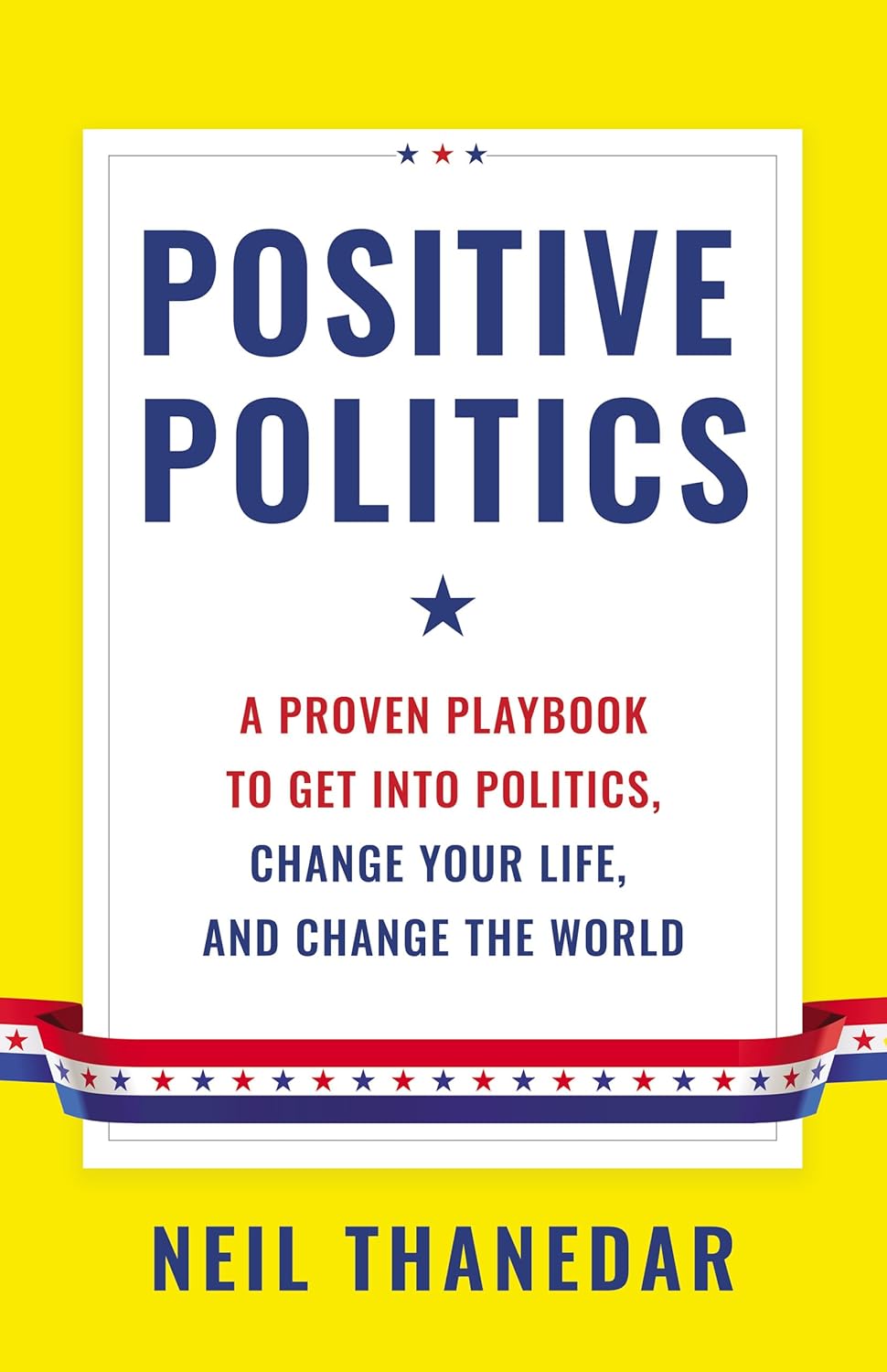
Positive Politics is a guidebook for anyone who wants to step into public life with clarity, courage, and a sense of purpose. Author Neil Thanedar lays out a practical playbook for how ordinary people can enter politics, build momentum through activism, and ultimately make a meaningful impact. The book mixes personal stories, political theory, and hands-on instruction. Thanedar opens with his father’s journey from poverty in India to serving in the US Congress, using that story as proof that political life is not reserved for elites. From there, the book moves through two arcs: why politics needs new voices and how to actually get started.
Thanedar’s writing has a direct and confident tone, and he keeps returning to one central belief: ambitious optimists can and should lead. His stories about watching political rooms from the inside, learning how negative incentives shape behavior, and seeing how ordinary activists turn ideas into bills all made the book feel grounded. He doesn’t pretend politics is pretty. He talks openly about corruption, cynicism, and personal attacks, but he frames them as challenges that can be met with transparency and action. The rhythm of the writing moves between clipped, punchy lines and longer reflections that read like someone thinking out loud about what they’ve seen and what they wish more people understood.
What surprised me most were the parts where he breaks down politics into simple, relatable pieces. His idea that politics is basically a long, iterative game reminded me of someone flipping on the lights in a dim room. Suddenly the noise makes more sense. Being nice, taking action, getting quick wins, thinking long term, going direct, and staying independent. These principles sound simple, but the examples he uses give them weight. Seeing his father win some races, lose others, and still find deeper purpose in the work made the ideas feel lived in rather than theoretical. And when Thanedar writes about ambitious optimists, it genuinely feels like an invitation, not a slogan.
By the end, I felt both clearer and more cautious, in the best way. Clearer about how change actually happens and cautious in the sense that the work is harder, slower, and more personal than it looks from the outside. If you’re someone who already cares about civic life but feels overwhelmed or unsure where to begin, this book will likely speak to you. It’s part memoir, part instruction manual, and part motivational nudge. People who enjoy political nonfiction that blends practical strategy with accessible storytelling will get the most out of it.
Pages: 222 | ASIN: B0FWF8XDX3
The Spiral Can Be Reversed

The Path from Hell to Heaven is a philosophical and psychological map of the ego, tracing how people spiral downward into “Hell” through fear, shame, and denial, and upward toward “Heaven” through trust, openness, and renewal. Why was this an important book for you to write?
Because ego explains nearly every human collapse and ascent, yet most people never receive a practical map for it. I wanted to translate psychological chaos—fear, shame, denial—into a recognizable model anyone could use, the same way we map complex systems in software or business architecture. This book is that missing human blueprint: a self-debugging framework that moves readers forward instead of leaving them looping in abstraction.
How did you come up with the concept of the two-sided spiral of the ego and develop this into a process that readers can implement into their own lives to find clarity and understanding of themselves?
I analyzed patterns before individuals. Ego contracts or expands; there’s no true neutral. Avoiding truth descends, openness creates lift. The spiral metaphor stuck because it captures momentum and acceleration.
To make it implementable, I structured it as an RPM self-awareness loop:
- R – Recognize the ego state you’re operating in
- P – Pause the automatic reaction loop
- M – Move with intentional correction or openness
It’s diagnostic and reversible, giving readers a clear exit path whether they’re descending or rebuilding upward.
I found the ideas presented in your book relatable and appreciated the actionable steps that readers can take to find their own clarity. What were some ideas that were important for you to share in this book?
The concepts that mattered most to me were:
- Ego itself isn’t the problem → closed ego is
- Narcissism is often unprocessed fear wearing armor
- Pain isn’t identity, it’s a turning point
- Ambition without self-awareness becomes self-sabotage
- Recognition of the loop always comes before the escape
And above all—I wanted a book that doesn’t just sound smart, but gets applied and changes outcomes.
What is one thing that you hope readers take away from The Path from Hell to Heaven?
That their ego has directions, and so do they. If they feel stuck, defensive, ashamed, or overwhelmed—it’s a state, not a life sentence. The spiral can always be reversed, rebooted, and climbed. The only real trap is believing the descent is normal and permanent.
This book is a Map of the Ego’s Double Spiral — a journey every individual, family, and society travels between Hell (closed ego) and Heaven (open ego).
Through vivid metaphors and grounded psychological insight, LANOU unveils how pain becomes protection, how protection turns to illusion, and how awakening begins when trust cracks the shell.
You’ll see yourself, groups, and even nations in these patterns:
The wound that starts the descent.
The mask that hides pain through control.
The collapse that breaks illusion.
The trust that starts renewal.
The open ego that frees love and truth.
Structured as a fractal spiral, the book reveals six repeating steps across all scales — from individuals to groups to the world itself. It blends the clarity of psychology with the simplicity of spiritual truth: hell is repetition; heaven is renewal.
Once you see the map, you cannot unsee it.
The Path from Hell to Heaven: The 2 Sided Spiral of the Ego
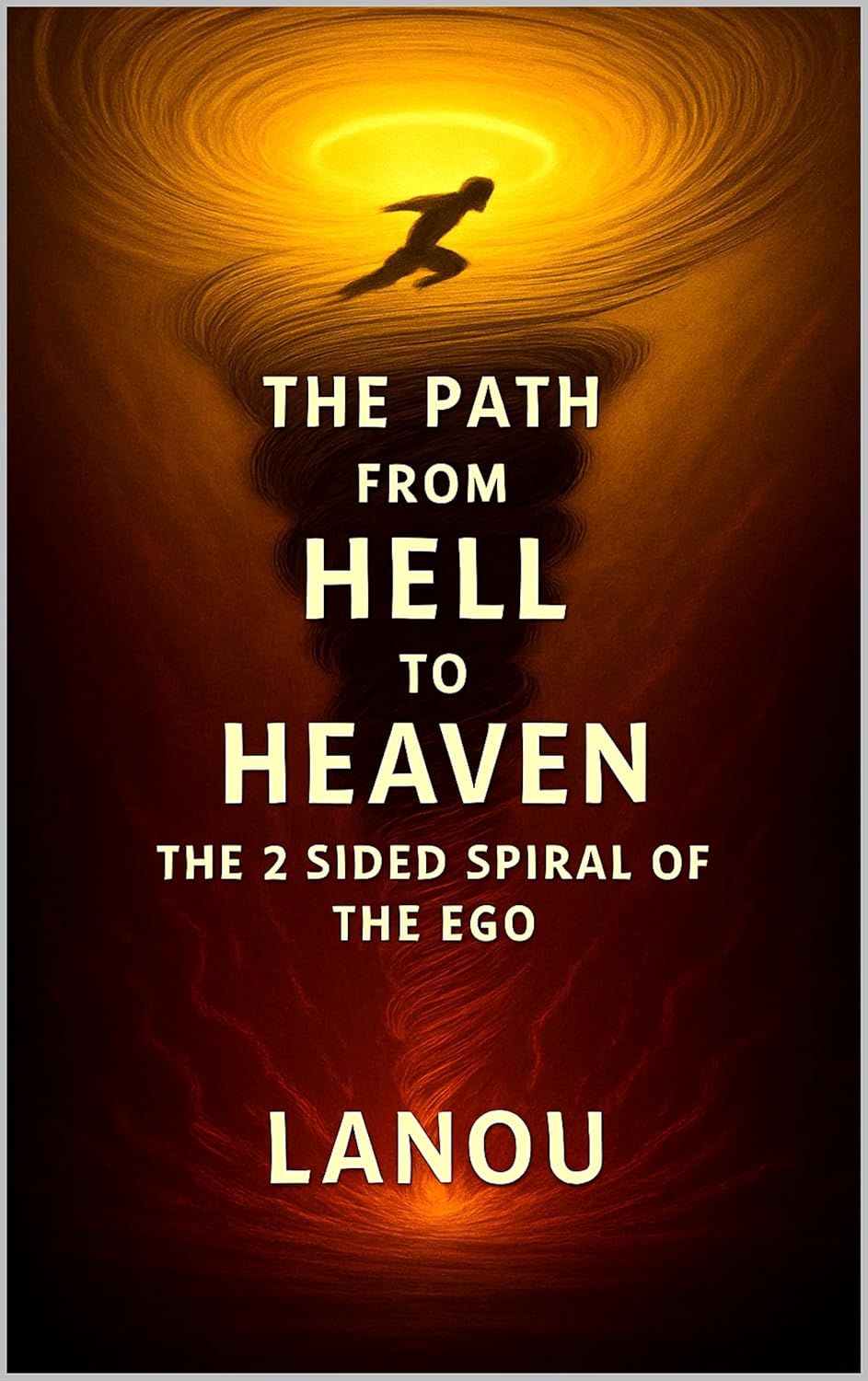
This book is a philosophical and psychological map of the ego, tracing how individuals, groups, and societies spiral downward into “Hell” through fear, shame, and denial, and how they rise toward “Heaven” through trust, openness, and renewal. It’s written like a guide for self-awareness, where the ego’s descent, wound, shell, mask, illusion, collapse, and denial are mirrored by its ascent through trust, openness, adulthood, mastery, and renewal. Each section builds on the last, connecting personal trauma to collective dysfunction and, finally, to global healing. The language is clear and rhythmic, sometimes poetic, and the structure moves like a spiral itself, repeating ideas but deepening them each time.
I liked how direct this book is and how it pointed to familiar pain without drowning in theory. The writing style blends psychology and spirituality without turning preachy. I could feel the author’s intention: to wake readers up, not to comfort them. Sometimes the simplicity of the prose makes it cut deeper than expected. It’s not a book that flatters, it exposes. At points, it felt like being called out and held at the same time. The “spiral” metaphor worked for me; it explained so much of what people repeat in life, from personal self-sabotage to entire societies collapsing under pride and denial.
The book’s tone is confident, almost absolute, which can feel heavy when you’re already raw. The ideas are strong, but their repetition across individual, group, and world scales sometimes blurs the freshness. Yet even then, I found myself underlining lines, rereading them, and thinking of people I know who live both spirals at once. The message that Heaven and Hell are not destinations but daily states of ego, sticks.
I’d recommend The Path from Hell to Heaven to people who crave clarity more than comfort. It’s for readers who think deeply about healing, leadership, and the way our inner wounds ripple into culture and politics. Therapists, activists, or anyone burned out on shallow self-help would probably find it bracing. It doesn’t tell you what to do; it shows you what you’re already doing. And if you’re willing to face that, it can be liberating.
Pages: 151 | ASIN : B0FT5HM9RS



The Redefining of Liberty and Democracy
Feb 22
Posted by Literary-Titan
American Insomniac is an insomniac citizen’s memoir-essay meditation on democracy, culture, and consciousness in a United States that feels like it’s slipping out of reach. Why was this an important book for you to write?
The politics in the United States are getting more and more out of sync with reality and the goals of democracy. I felt compelled to not remain silent in the face of watching our democracy and rights being dismembered by right-wing forces and the inability of both political parties to put a stop to this destruction.
Various pundits have called for certain actions to try to counter this rise of authoritarianism. My problem with this approach is that: (a) they still believe imperialist capitalism is not part of the problem;(b) that the elites are going to save America, when in fact they are a huge part of the problem across the political spectrum; (c) they will not shed the elitist privileged position they live in, and as such their “solutions” are always to regain some idealistic status quo that never really existed. They often call for a “mass movement” that is made up of “universities, law, business, nonprofits, and the scientific community, and civil servants,” which is bogus at face value. Lawyers and academics are never going to lead a revolution. And neither will they. They conveniently leave working people out of their movement, which is the vast majority of American citizens.
Did writing this book make you more hopeful or more worried about the future of American democracy, and why?
As I said in the book, we have ended up with a divided nation where civil discourse is nearly impossible to attain, where violence is considered a plausible option for personal expression, and where over forty percent of eligible voters do not engage in national elections. These are the problems that are on many people’s minds. Political parties have become increasingly inept and ossified in their effectiveness, presenting candidates so ideologically narrow within each party’s stated positions that the only difference seems to be the amount of money party leadership is willing to throw their way.
As such, I am as worried as ever, but the only solution is for the American people to become engaged citizens and to take back the power of “We the People.”
What were some ideas that were important for you to share in this book?
The main ones are these: If you are just the average citizen, it seems as if the Democrats want to “give it all away” and that the Republicans want to “take it all away.” The Dems have put a whole new meaning to the quip, “putting the fun back in dysfunctional.” They, apparently, couldn’t sell McDonald’s Happy Meals to hungry kids for a nickel a box if they gave them a coupon worth ten cents. The New GOP’s members, seemingly, hate almost everyone who’s not a white Christian nationalist, almost as much as they hate each other. It appears that their disdain for common decency and the rule of law is only surpassed by their hypocrisy on genuine Christian values.
Trump’s presidency is the logical outcome of decades of neoliberal political and economic policies and governance by both parties. While it appears that there is a difference between the Democratic Party of Clinton, Obama, and Biden compared with the Republicans and Reagan, and the Bushes, it is one of degree, not kind. Trump, on the other hand, is a unique kettle of fish. Like most bullies, it seems Trump’s personal insecurities stain everything in his presidency.
Democracy and freedom cannot be defined by those who actually hate such ideas. The redefining of liberty and democracy to be what we have today in the U.S. is part of the problem. That is one reason it is so important for people to become involved in the struggle today. Then they can shape what democracy is and what freedom entails.
For readers who feel politically exhausted, what forms of action or thinking still feel genuinely possible to you?
Engaging at the local level in some aspect of the various social movements and organizations that are fighting back against this destruction of democracy and the solidification of a government totally beholden to the oligarchy. “The U.S. has tipped the scales and is rapidly marching into fascism.” The militarization of local police forces and the use of ICE, DHS, and other federal law enforcement agencies to round up immigrants and anyone who gets in their way is the most overt sign that this statement is true.
Here are some of the key features of fascism:
So, does the shoe fit? Are we already there? Under the second rendition of Trump’s presidency, it appears that we have arrived. ICE and its fellow federal agents have become a lawless mob rather than any form of law enforcement. They regularly break the law in carrying out their agenda, creating situations of chaos, violence, and violation of basic rights that are guaranteed by the Constitution.
Congress has abdicated its power to a president who thinks he is not bound by any laws, rather the limits on his power are “My own morality, my own mind.” Where is Congress on all this? Their silence in the face of this reality is shameful. We must pressure our congressional representatives to get a backbone and stop this now. If they won’t, then we must vote them out and replace them with people who will. Engagement of citizens in the recovery of our democracy, in a nonviolent social movement, and organizations is the only alternative.
Trump is just the logical outcome of seventy years of neoliberalism. We have to quit focusing on him and change the system that gave him and his minions power to do what they are doing. It’s up to all of us. There will be no hero on a white horse with a white hat. We need a great refusal of everyone to say, “Enough is enough – no more!” Short of this, we are just going to slide further into the abyss.
Author Links: GoodReads | Facebook | Website | Amazon
The writings are about the great challenges facing the future of democracy, the struggle for equality and equity, and will, hopefully, add to a civil discourse on the solutions to the social, economic, and cultural problems that are interwoven within the times we live in. These issues and concerns have kept thinking people awake at night trying to figure out how we got here, how to reach a consensus for solutions for the common good, and how to protect the gains made in the prior century from the forces at work to deconstruct and destroy them currently. Hence the title, American Insomniac.
The problems and challenges are complex. The forces at work on all sides are equally complex, with intentions that are both noble and immoral. No perspective is purely evil or purely altruistic. But there is still truth, facts, and progress to oppose lies, fiction, and barbarism. This is one person’s attempt to add to this conversation.
Share this:
Like this:
Posted in Interviews
Leave a comment
Tags: American Insomniac, author, book, book recommendations, book review, book reviews, book shelf, bookblogger, books, books to read, ebook, goodreads, indie author, Jim Smith, kindle, kobo, literature, memoir, nonfiction, nook, novel, opinion, Political Commentary & Opinion, political opinion, politics, read, reader, reading, story, writer, writing