Blog Archives
Unchecked Abuses of Government Power

The Broken Whistle: A Deep State Run Amok is more than a memoir; it is a look at the corruption of the whistleblowing process within the Intelligence Community. Why was it important for you to tell your story?
Like so many others, I am just an ordinary American. I worked diligently to get an education and volunteered to serve our nation to defend and protect our beloved country from foreign and domestic enemies. Yes, it is my story, but I am not alone. It is a story that others could have also written. I am just one out of many who have witnessed the abuse of government power, but unlike others, I spoke up and had to tell it because the abuse of government power threatens the existence of our Constitutional Republic.
President Ronald Reagan said during his inauguration as the governor of California, “Freedom is a fragile thing, and it’s never more than one generation away from extinction. It is not ours by way of inheritance; it must be fought for and defended constantly by each generation, for it comes only once to a people. And those in world history who have known freedom and then lost it have never known it again.”
Therefore, it is crucial for the citizens of the United States to witness my firsthand story on the consequences of unchecked abuses of government power. My story shows the abuses I suffered for seeking to hold the CIA and Intelligence Community accountable for violating US laws. Just like it happened to me, it could happen to any and all ordinary Americans. If these abuses of power are left unchecked, tyranny will come knocking on their doors.
Your years working for the CIA gave you a front-seat look at the corruption of power and the way those in power twist policy to suit their needs. What were some ideas that were important for you to share in this book?
There is a well-known saying that, “Absolute power corrupts absolutely.” Attributed to 19th-century British politician Lord Acton. I witnessed firsthand the absolute perversion of power in the CIA and the Intelligence Community. The lust for power and influence drove senior leaders to betray the Constitution and the laws of the land. An attitude as if they were saying, “This is my CIA and my position. What I say and do is right, regardless of the law.” The truth is they trampled laws to cover up their abuses of power. That is the main storyline written in the book’s narrative. And I wrote as raw and real as possible with many examples to show the reader what I witnessed firsthand.
What is a common misconception you feel people have about Whistleblowers?
The revelations brought forth by most whistleblowers and the abuses they suffer cause many of these individuals to be mischaracterized as disgruntled and troubled individuals—troublemakers, snitches, rats, poor performers, vindictive, etc. It is nearly impossible to counter the coordinated assaults and attacks against a whistleblower’s character. Those who take reprisals literally have an army of attorneys and surrogates to defend them. Meanwhile, the whistleblower is like a lone Spartan in the Battle of Thermopylae on top of the hill, facing a massive onslaught of slander and defamation. It is a no-win scenario for the whistleblower. Almost all whistleblowers never recover from the reprisals.
What is one thing that you hope readers take away from The Broken Whistle?
My Epilogue ends with a poem by Martin Niemöller, a German theologian who lived before, during, and after the Nazi German regime. The title is “Who Will Speak For You When They Come Looking For You?” Unchecked abuses of government power have consequences. It is only a matter of time, not if it will, to affect many others outside of the DC establishment. We, the People of the United States of America, must demand that our government authorities obey the laws of the land and the Constitution and preserve our Constitutional Republic. As President Reagan said, failure to speak up and act to hold those in power accountable will lead us down a path of tyranny. Therefore, The Broken Whistle is a call to action for Americans to stand up and demand robust government oversight to defend and protect the laws of the land—to reign in abusive government institutions like the US National Security bureaucracy also known as the “Deep State.”
Author Links: GoodReads | Twitter | Facebook | Website | Amazon
The Broken Whistle is a searing exposé that unveils a chilling chapter in American history, a narrative meticulously recounted by Pedro Israel Orta. Plunged into the heart of power and deception, Orta emerges as a force to be reckoned with. On September 23, 2019, his single Twitter thread ignited a tempest, tearing through the sinister underbelly of the Intelligence Community Whistleblower Protection Act (ICWPA), which had been perverted for political ends. In this gripping account, Orta fearlessly shines a light on a corrupt system that brazenly weaponized the very process designed to uphold truth and accountability.
As the pages unfold, Orta unflinchingly reveals how the Intelligence Community (IC) whistleblowing process was perverted to target a sitting president, while genuine whistleblowers endured unimaginable torment and abandonment. With chilling detail and unyielding determination, Orta pulls back the curtain on the U.S. National Security Bureaucratic State, exposing the rampant abuse of power by the Deep State, shielded by Congress’s deafening silence.
Delving deep into the heart of darkness, Orta uncovers the unsettling saga triggered by the enigmatic “Ukraine whistleblower,” whose disclosures unleashed a political storm, despite falling outside the jurisdiction of ICIG and DNI, as confirmed by the Department of Justice. These allegations, detached from intelligence activities, were shamelessly exploited—an elaborate ruse orchestrated to manipulate public opinion and orchestrate the impeachment of a president.
Through the pages of The Broken Whistle, Orta lays bare his own harrowing journey, navigating the treacherous corridors of the Central Intelligence Agency. Within these walls, truth becomes an enemy, and those who dare to speak out face ruthless retribution and termination. As Orta’s unwavering voice rises above the cacophony of corruption, readers are led on an odyssey that unveils a bureaucratic machine bent on crushing dissent and preserving its shadowy secrets.
The Broken Whistle is an unapologetic chronicle of one man’s fight for justice—a clarion call that reverberates through the darkest corners of power. Prepare to be captivated by Orta’s unflinching courage as he peels back the layers of deception, exposing a broken system that has forsaken its sacred duty.
A Scent of John Ruskin in Tanzania


In A Scent of John Ruskin in Tanzania, author Ely Ould Sneiba brings to the forefront the legacy and impact of Victorian polymath John Ruskin—one of history’s most celebrated humanists. This insightful book scrutinizes Ruskin’s political ideology and its connection to African politics, with a specific focus on Tanzania under the stewardship of President Julius Nyerere. Further, Sneiba explores the intriguing diffusion of Ruskin’s principles into the philosophical fabric of some of Africa’s inaugural socialists, particularly those at the helm of nations, through the conduit of Mahatma Gandhi. This narrative compels the reader to consider the relevance of Ruskin’s ethos in today’s African context and the global sphere.
Sneiba’s writing is commendably lucid and devoid of unnecessary embellishments. His astute analysis illuminates the interplay between the focal figures and their surrounding milieu, offering a deep understanding of their influences and impacts. A significant highlight of the book is its examination of the economic and moral dynamics of the Victorian era, alongside the examination of Nyerere’s transformative role in Tanzania.
A Scent of John Ruskin in Tanzania is enriched with thoughtful quotations and citations, drawing from luminaries such as John D. Rosenberg, George Eliot, and of course, John Ruskin himself. Ruskin’s quotations provide intimacy, revealing his wisdom, creativity, and benevolence. The sentiment that a prosperous nation is one that “nourishes the greatest number of noble and happy men” is particularly resonant.
As a proponent of minimalism and social connectivity, I embrace the political perspectives espoused by both Ruskin and Sneiba. This book serves as a valuable resource for leaders, policymakers, human rights activists, and all those concerned about the unraveling state of global affairs. A Scent of John Ruskin in Tanzania delivers potent messages about natural living, freedom, equality, and happiness, offering transformative perspectives vital to our era. The book underscores the urgent need to shift from a culture of unsustainable resource exploitation to one that values life-centric practices—providing a roadmap for a more compassionate and sustainable world that our global society urgently needs.
Pages: 197 | ASIN : B0C7VRZ1ZY

I Am A Healer At Heart

Wisdom: A Very Valuable Virtue That Cannot Be Bought takes a secular approach to explain what wisdom is and how to obtain it. Why was this an important book for you to write?
Wisdom, values, ethics and so on are very important to me personally, and of major importance to what I consider to be an ailing America. Yes, I believe that America (and of course many other countries) are in serious trouble nowadays. If we do not begin to quickly value wisdom as a society, our institutions will continue to fail, Americans will become increasingly politically polarized and violent, and the promise of the American dream will slip further and further from the grasp of all but the wealthiest individuals. People who are wise have been advising us to listen to our better angels, or our gods, or our inherent potential as human beings, for millennia, and yet here we are…. As it stands, human beings will likely destroy ourselves through nuclear war or global warming in the foreseeable future. This is of great concern to me because I think of all the good and decent people who have come before me–they didn’t work so hard and reach for the stars simply to see the world implode.
But also, I am a healer at heart. I see the power of philosophy and the potential of philosophy to engender personal growth, critical thinking, and moral values in the hearts and minds of people. I did my very best with the book because my overarching goal was to be helpful to people.
What is a common misconception you feel people have about wisdom?
I personally think it is amazing that wisdom is this age-old virtue that every significant civilization has had some interest in, which can be of unparalleled use to us as individuals and as members of society, and yet most people never think about it. Wisdom is behind truth, justice, and love in regard to how highly it is regarded–and it is certainly behind money, power, beauty, popularity, and significance on the list of those things to which Americans aspire. This is tragically misguided, because wisdom is that which can most accurately guide us through all the trials and tribulations, all the mountains and valleys life throws at us all. It can even save your life, as anyone knows who has had an accident involving gasoline, hurt someone while drunk driving, or been faced with an agonizing decision to carry a child to full-term or end the pregnancy! I have also made some dumb decisions in my life, either as a person, as an investor, or in my relationships, and it is only through wisdom that I can hope to do better in the future!
Another element that seems interesting to me is that wisdom (to the degree that folks even really ever think about it, as I said…) tends to be associated with those who are excellent in some attribute or social status, or even simply more advanced in age. I live in a part of the country with more than a few Confederate flags flying on the porches and trucks of folks who are well over 50. So it is a bit of a paradox as to what engenders real wisdom, and what has merely a superficial appearance of wisdom.
What do you hope is one thing readers take away from this book?
We each have the capacity to make wisdom our greatest strength. And in a world some say has gone mad, character strengths and worthy virtues are of the highest value. These things, like love and peace, cannot be bought with money, but they can be worked toward, cultivated, prized, and loved. Indeed, the word philosophy comes from the Greek for “the love of wisdom.” So, to philosophize is to seek out, care about, and take seriously wisdom. That is amazing! To succeed in this high aspiration and worthy goal, we ought to make a habit out of taking a broad, deep look at large numbers of individuals throughout history (and from different cultures) who have lived wise, successful, impressive lives. What I call living “a life of value.” I have a free quote search engine on my website that has over 35,000 wonderful quotes about wisdom, values, virtues, ethics, personal growth, etc. Some are just plain truth (in my opinion) that I read in some magazine or heard someone say. In the present book, I bring in many philosophers, thinkers, artists, freethinkers, and spiritual exemplars to the fore. Even one quote about wisdom can make a difference in a person’s mindset, which is why I love quotes and have been thinking about these issues for almost twenty years. If we heed the lessons the wisest people have learned and then taught in many millennia of civilization, struggle, creation, cooperation, and thinking, we will surely benefit as a species.
What is the next book that you are working on and when will it be available?
I really left it all on the field with this book! It took me hundreds of hours of reading, thinking, and typing–dear God, THE TYPING!! I have issues with my eyes due to the side effects of glaucoma medications I take daily, so often to stare at a computer screen is hard to do. Further, I have to promote this book for the next year or so–and that is no easy task since I don’t have a publishing house behind me and I really don’t like book promotion. Frankly, I am not a full-time author and I don’t even think I am that great of a writer, so the thought of yoking myself to a computer for another 300 hours sounds frankly abhorrent to me at present. I also feel like I had a certain wind in my sails for this project because the Trump years were very hard on me, and the present moment causes me trepidation, and I am not sure I could replicate that “fire” for a subject such as meaning, compassion, or success. Wisdom is a thing of beauty, and I was transfixed by it, indeed!
Author Links: GoodReads | Facebook | Website
Why is America increasingly plagued by tribalism, elitism, materialism, and ME-ism?
What do philosophy, psychology, and personal growth have to say about wisdom?
Are the Bible and other religious texts legitimate and useful sources of human wisdom?
Wisdom is not able to be bought — no matter how much money a person has!
And philosophy has typically discouraged many who find it difficult, abstract, and boring.
Modern psychology and age-old personal growth principles are given a bad name by many social media personalities who oversimplify modern psychological science in an effort to make money.
What is wisdom, how can it help me, and is this book authentic, reliable and useful?
Four-time author Jason Merchey believes wisdom can be developed and acquired and improving your understanding of wisdom will certainly lead to living a better life! Wisdom is one of humankind’s oldest and most prized virtues, yet it is not much respected nowadays. . .
This new book has the potential to assist readers to live a life that harnesses the power of philosophy, critical thinking, and applied psychology. These secular sources of wisdom are not as complicated as they may seem, and indeed are road maps to a better life.
Greater wisdom leads to improved personal growth, happiness, and success.
Wisdom is not simple or plug-and-play, but it will yield its secrets to those who love it.
In fact, the word philosophy is Greek for “the love of wisdom.”
Wisdom is a comprehensive, transparent exploration of ancient and intriguing concepts combined with critical thinking, compassion, and other aspects of wisdom. Brimming with examples of psychological principles, careful analysis, and insightful quotes from many cultures and civilizations, it provides a basis for authentic intellectual, emotional, spiritual and moral growth.
The author deftly combines digestible psychological research findings, compelling personal stories, and useful quotations about wisdom.
Anyone aiming to build a life of value—one that yields purpose and happiness—should consider wisdom to be their basis. Wisdom has been one of humanity’s highest aspirations for millennia.
Jason Merchey has dealt with mental illness most of his life, but also earned a master’s degree in clinical psychology and trained as a psychotherapist. No stranger to “the big questions” and the difficulty of life, he has studied wisdom, values and virtues for twenty years.
In addition to personal benefits, this book sheds light on some of America’s significant social problems. The great philosopher Socrates himself knew that ancient Athens, Greece was in serious trouble. If we were all wiser and we had more enlightened and humane priorities, many of the problems that mark communities and nations would give way to more love, fellowship, and prosperity.
This deep and eclectic book is full of ideas and insights that will assist you to:
Discover and prioritize wisdom in your personal life and relationships
Achieve greater fulfillment, happiness and self-confidence
Bring about true success based on self-knowledge and values
Make a positive difference in your community—and the world as a whole
One cannot buy wisdom per se but investing in this affordable book provides a refreshing opportunity for self-improvement and intellectual growth. It has the potential to assist you to make wisdom your greatest strength!
Wisdom
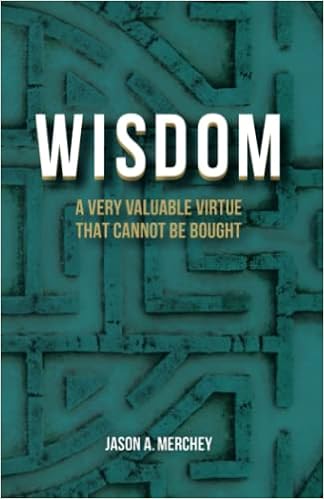

Wisdom is a virtue that many wish to live by. To be described as wise gives you an advantage over others, as people appreciate your persona and thinking capabilities. In his book Wisdom: A Very Valuable Virtue That Cannot Be Bought, author Jason A. Merchey digs deep into the topic, discussing insights from neuroscience and individual traits in detail. Jason Merchey combines notes about philosophy, astuteness, and human nature. The author is well-read and gives historical references when discussing various matters.
Wisdom: A Very Valuable Virtue That Cannot Be Bought is an excellent book for readers that yearn to improve their intelligence quotient. There are gems in the book that will benefit you as a reader to make better decisions and approach issues logically. I enjoyed how the author paired subjects in relation to wisdom in each chapter. The book has fifteen chapters, with each chapter having discussions from different perspectives. You get to read and understand interesting topics like loving wisdom, living a life of value, intellectual humility, self-awareness, and self-discipline, among others.
This well-written book will also teach you about modesty and open-mindedness. Jason A. Merchey tackles the aspect of human behavior in relation to the vastly different characteristics human beings possess. The historical tales and comparisons between modern man vs. ancient man and modern philosophy vs. ancient philosophy were enlightening. The lessons in the book are valuable and will have you view life in a different light. They will guide readers in finding a life of value.
Wisdom: A Very Valuable Virtue That Cannot Be Bought has the end goal of guiding people to be better humans and build a society where everyone is free and lives comfortably. With eye-opening discussions, readers of philosophy and social sciences will appreciate the perspective the author brings. As the author says, you can not buy wisdom, but you can invest in yourself to gain wisdom.
Pages: 399 | ASIN : B09RTR5F7D
Keys to Healthy Communication
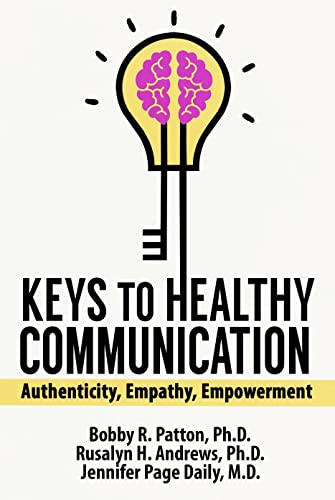
To sustain a fulfilling life, one must make a lifetime commitment to a healthy life. But what is the general definition of a “healthy life?” After witnessing the COVID-19 pandemic, the Keys to Healthy Communication was written. Authors Dr. Bobby Patton, Dr. Rusalyn Andrews, and Dr. Jennifer Daily developed this self-help guide to educate readers on improving interpersonal communication.
The first section, ‘Overview,’ outlines the many types of health and the necessity of the complementary relationship between personal and social health in achieving total well-being.
The first essential key to effective communication is ‘Authenticity,’ covered in section two. People are inundated with numerous erroneous beliefs and “alleged” facts, prompting them to question their own beliefs or those of others until they have properly analyzed and compared them to proof. The degree of sincerity exchanged between partners is also advantageous to the health of intimate relationships. Being unreal causes a skewed conscience, which leads to manipulation, dishonesty, and even abuse. Conversely, mutual trust in one another boosts productivity and decides the failure or success of society.
The importance of the second key to effective communication, ‘Empathy,’ is highlighted in the third section. Given people’s natural propensity to develop sympathy, empathy is seen as a key that may be taught through mindfulness or “moment-to-moment, non-judgmental awareness.” In addition, empathy is essential for a dynamic society because it allows people to empathize with people and cultures they do not necessarily identify with or agree with.
Section four is on ‘Empowerment,’ which depicts self-control and the ability to self-regulate, as well as comprehending the extent of one’s own choices and the repercussions of those actions, as well as detecting the power centers at play. Social variables that induce ill health are caused by a lack of self-authority.
The fifth section explains the activities, skills, and attitudes that should be practiced and a strategy for promoting good communication throughout one’s life. Finally, it breaks down all of the measures to improve one’s physical, mental, and relationship health into categories based on age and environment.
Keys to Healthy Communication: Authenticity, Empathy and Empowerment is an extensive self-help book filled with practical and actionable guidance. This well-researched book explains how individuals may adopt and learn certain practices and skills in daily lives to help them develop as a person.
Pages: 204 | ASIN : B09R4L4BRV



 LITERARY TITAN