Blog Archives
Friendship and Abandonment

High School Epic follows a teenage girl through her high school years in the early 1990s who struggles with issues of abandonment and with discovering who she is and who she wants to be. What was the inspiration for the setup of your story?
My own life is definitely the inspiration for High School Epic. I had a friendship and boyfriend breakup at the onset of high school that resulted in a type of heartbreak that only emphasized the feelings I had buried of abandonment from when my father left us (the first time) when I was six. Although he did return and remain with my mother for another 11 years, their relationship was shaky at best. Deep down, I was always anticipating when he would leave again for good.
In many contemporary coming-of-age novels, authors often draw on their own life experiences. Are there any bits of you in this story?
Yes! Every event is based on real events from my middle and high school years. Characters are derived from real friends and classmates. The main character has traits that are similar to me, but she really is her own person and not me.
What were some themes that were important for you to explore in this book?
Friendship and abandonment are the most important themes in the book, even within the context of the romance that happens.
What is the next book that you’re working on, and when can your fans expect it out?
I have a current project that is part memoir and part short story collection, all with the themes of relationships, love, loss, and heartbreak. I’m hoping it will come out sometime by the end of next year.
Author Links: GoodReads | X (Twitter) | Facebook | Website | Amazon
Left behind, Dani meets Kevin Martin, an outsider who seems to give her everything her world is missing. Until betrayal cuts deep, leaving her reeling once more. Dani’s circle keeps reshaping again and again: new friends like Ryan O’Leary offer comfort, while old wounds resurface.
Through each season of high school, Dani is tested through heartbreak, mistakes, and hilarious missteps, as she wrestles with who she is and who she wants to be.
Told in a unique blend of letters and chapters, Hannah R. Goodman’s HIGH SCHOOL EPIC captures the chaos of teenage life in the early 1990s with raw honesty, humor, and heart.
Beautiful Journey
Reigning Fire tells the story of a princess raised in a world built on Smokeveil magic, rigid hierarchy, and brutal expectations, whose Emberkin arrives too early and in a form that is forbidden. What was the inspiration for the setup of your story?
Reigning Fire grew out of two long-standing fascinations: mythical creatures inspired by East Asian folklore, and the question of what it costs a person to exist in a world that often values conformity over authenticity.
As a late-identified neurodivergent writer, I’ve spent much of my life feeling out of sync with the rhythm everyone else seemed to follow. When I was younger, a head teacher once described me as “a square in a world of circles.” It took years to realize she was right, but also that I wasn’t a square at all. I was a triangle. And ultimately, the problem wasn’t my shape, but the assumption that everyone should be the same.
That realization shaped the world of Reigning Fire more than anything. The Emberkin system—smoke creatures that take the form of real-world animals and bond with Weavers—became a way to explore identity, hierarchy, and the rules we’re told to accept without question. Characters in this world are taught that the timing of the bond and the “acceptable” Emberkin forms dictate their social status. Through that lens, I could examine the tension between who we’re expected to be and who we actually are.
As children, many of us inherit a set of rules about “how the world works.” But as we grow, we start looking closer and asking: Who created these rules? Why do they exist? Who benefits from them?
Xun’s Emberkin arriving too early and in a forbidden form allowed me to explore what happens when someone’s identity refuses to fit the timeline—or the template—that society sets for them. It’s a fantasy world, but the emotional truth beneath it is very real: the quiet, painful, and sometimes beautiful journey of learning to take up space as you are.
What were some themes that were important for you to explore in this book?
Beyond the question of identity, Reigning Fire explores three main themes that felt important for me to write about: historical erasure, loyalty, and the politics of perception.
First, I wanted to examine historical negationism—specifically, how societies can outlaw an aspect of human variation and then gradually erase all record of its existence. In the world of Reigning Fire, certain Emberkin forms are not only forbidden but deliberately removed from documented history and rewritten as “abnormal.” That dynamic mirrors the way real-world institutions sometimes control which narratives are preserved, which are buried, and which are reframed as taboo.
The second theme is loyalty, especially the form that exists between child and parent. I wanted to explore what happens when that bond is used as a tool—when a parent treats a child’s love and devotion not as something to nurture, but as a vessel for achieving their own agenda. It’s a painful tension: the longing to honor the people who raised you, and the slow, shattering realization that they may not always have acted in your best interests.
The third theme centers on power and perception. Throughout human history, the most enduring form of power hasn’t always come from weapons or armies—it has come from whoever controls the narrative. In Reigning Fire, characters constantly navigate a world where truth is malleable and obscure, and those in authority will go to extraordinary lengths to maintain their version of events. I wanted to explore the quiet, insidious ways people manipulate stories, memory, and even “facts” to protect their position.
All three themes—erasure, loyalty, and narrative control—shape the emotional core of the book. Even in a world of magic and mythical creatures, the human consequences of these forces are strikingly real.
What were some goals you set for yourself as a writer in this book?
One of my biggest goals with Reigning Fire was to write a story that felt deeply human, even inside a world full of magic, myth, and political danger. To do that, I challenged myself not only to explore the emotional territory I naturally gravitate toward, but also to sit with characters who unsettled me. I would ask them, “Who are you underneath your facade? What drives you? And how exactly did you become this version of yourself?”
Writing from perspectives that diverged sharply from my own was unnerving at times. There were chapters where stepping into another character’s inner world genuinely messed with my head for a while. But those were also the moments I’m proudest of because they made the story richer and more honest.
Another goal was to portray human choices in all their moral complexity. I wanted to move away from clean categories of “good or evil,” “loving or cruel,” and instead explore how intentions, fear, loyalty, and survival instincts collide. In real life, choices rarely fall into neat boxes—even the most well-meaning intentions can sometimes cause harm. One question that guided a lot of my writing was: At what point do good intentions stop being able to justify the consequences they create?
If readers walk away from the book holding more questions than answers, then I’ve achieved what I set out to do. Complex questions aren’t meant to have simple resolutions—but it doesn’t make them any less important to ask.
What is the next book you are working on, and when will it be available?
I’m currently working on the sequel to Reigning Fire, which will be released in late 2026. Without giving away any major spoilers, this next book explores how Xun—now going by Ling—ironically grows more in her years as a fugitive than she ever did as a princess. Stepping outside that gilded palace cage gives her the freedom to redefine who she is when no one is scrutinizing her every breath, even when her path is still fraught with danger.
Readers can expect to encounter more mythic Emberkin and new characters, as the world expands far beyond the political and cultural boundaries of the first book. Some familiar faces from Reigning Fire will return, while others may be absent… and I’ll leave it to readers to decide which disappearances should worry them.
One of the core themes of the sequel is reclamation—of identity, of history, and of personal power. That’s all I’ll say for now, but I’m excited for readers to see where the story leads next.
Author Links: GoodReads | Facebook | Instagram | Website | Amazon
In a realm where power is sealed through smoke and blood, Yan Xun was born to inherit a crown-or be destroyed by it.
When her Emberkin arrives far too early, and in a form the world has no place for, Xun becomes a danger to the very empire she was meant to serve. As she uncovers long-buried truths and navigates a court built on silence, loyalty, and control, her existence alone threatens to unravel everything.
Set in an ancient Chinese-inspired empire of myth and ash, Reigning Fire is a lyrical fantasy about forbidden power, political unrest, and the ghosts we carry. Through richly layered worldbuilding and emotional depth, this debut novel explores the complexities of trauma, neurodivergence, and what it means to survive when your truth has no place in the world.
Perfect for readers who love introspective characters, slow-burn rebellion, and myth-infused storytelling, Reigning Fire blends co
Ida Chatfield


The book follows the life of Ida Chatfield and tells her story from childhood on the Missouri River to her disappearance in Aspen in 1886. It mixes historical records with imagined moments that fill in the spaces between the facts. It feels like a full life unfolding, even though her real life ended at only eighteen. The book also weaves in real news articles that reported her missing and later confirmed her death. The mix of truth and imagination gives the whole thing a strange and lingering weight.
While reading, I often felt pulled into Ida’s voice. The writing felt warm at times and then cold in a way that mirrors frontier life. I found myself caring for Ida as if she were someone I’d once known. Her memories of Nebraska and Colorado felt vivid and earthy. The sadness around the deaths in her family hit me harder than I expected, especially the loss of her sister Jennie. The author sits close to Ida’s emotions and lets her tell the story in a plain and honest way. That plainness worked on me. It made the mystery of her final night feel personal.
The book pushes you to think about how people in the past were misunderstood, especially women. It shows how easily a person’s life can be shaped and misshaped by the stories others tell. The newspapers tried to fit Ida into neat explanations that never felt right. Reading those old clippings frustrated me. They felt careless and quick to judge, and it hurt to see how little room she had to define herself. At the same time, the fictional pieces brought her back to life with softness and patience. I loved that contrast because it made me think about how we all want to be remembered for who we were, not for the blur of a headline.
By the end, I felt a quiet ache for Ida and for every forgotten person whose life was cut short or brushed aside. The book works for readers who enjoy historical nonfiction but want more heart in the telling. It also works for readers who crave a mystery that will never be perfectly solved yet still offers something meaningful. I would recommend it to anyone who loves frontier history, family stories, and character-driven tales filled with emotion.
Pages: 280 | ASIN : B0FHJVCV7V

The Little Girl’s Mother

The Little Girl’s Mother drops us straight into a police station that turns into a battleground and then never really lets the tension slip. It follows a family whose daughter witnesses a murder and suddenly becomes the target of a powerful criminal syndicate. The parents, both former military with heavy pasts, step back into a world they hoped to leave behind. The story twists from procedural chaos into a dark rescue mission, something between a thriller and a raw look at what parents might do when no one else can keep their child alive. It moves fast. Sometimes brutally fast. And it carries a steady drumbeat of fear and determination.
Reading it, I felt myself leaning in, almost holding my breath. The writing hits with a kind of straight shot energy. There is no drifting around. The scenes move with hard edges and sharp turns. I liked that. It pulled me right into the panic, the cold choices, and the way the parents shift from frightened to focused. I cared more than I expected to and sometimes caught myself rooting for them in ways that surprised me. The emotional weight lands strongest when the parents talk to each other or when they steady their daughter. Those moments feel real. They cool the fire just enough to let the story breathe before it kicks off again.
Some scenes in the workshop are rough. Not because they are gory but because of the calm way they unfold. The tone made me uneasy in a way that felt intentional. I could sense the author pushing me to sit with the question of what desperation does to good people. I liked that the book did not try to pretend those choices are clean or noble. The pacing can feel intense. Yet the emotional through-line keeps things grounded and stops the story from tipping into pure action for its own sake.
I would recommend this book to readers who like high-tension thrillers and stories about families under extreme pressure. It fits readers who enjoy military backgrounds, tactical problem solving, and moral knots that do not come undone easily. If you want a story that grabs you by the collar and refuses to let go, then this will absolutely hit the mark.
Pages: 217 | ASIN : B0FHSHXY18
The Third Twin: Love, Lies, and Billionaire Secrets
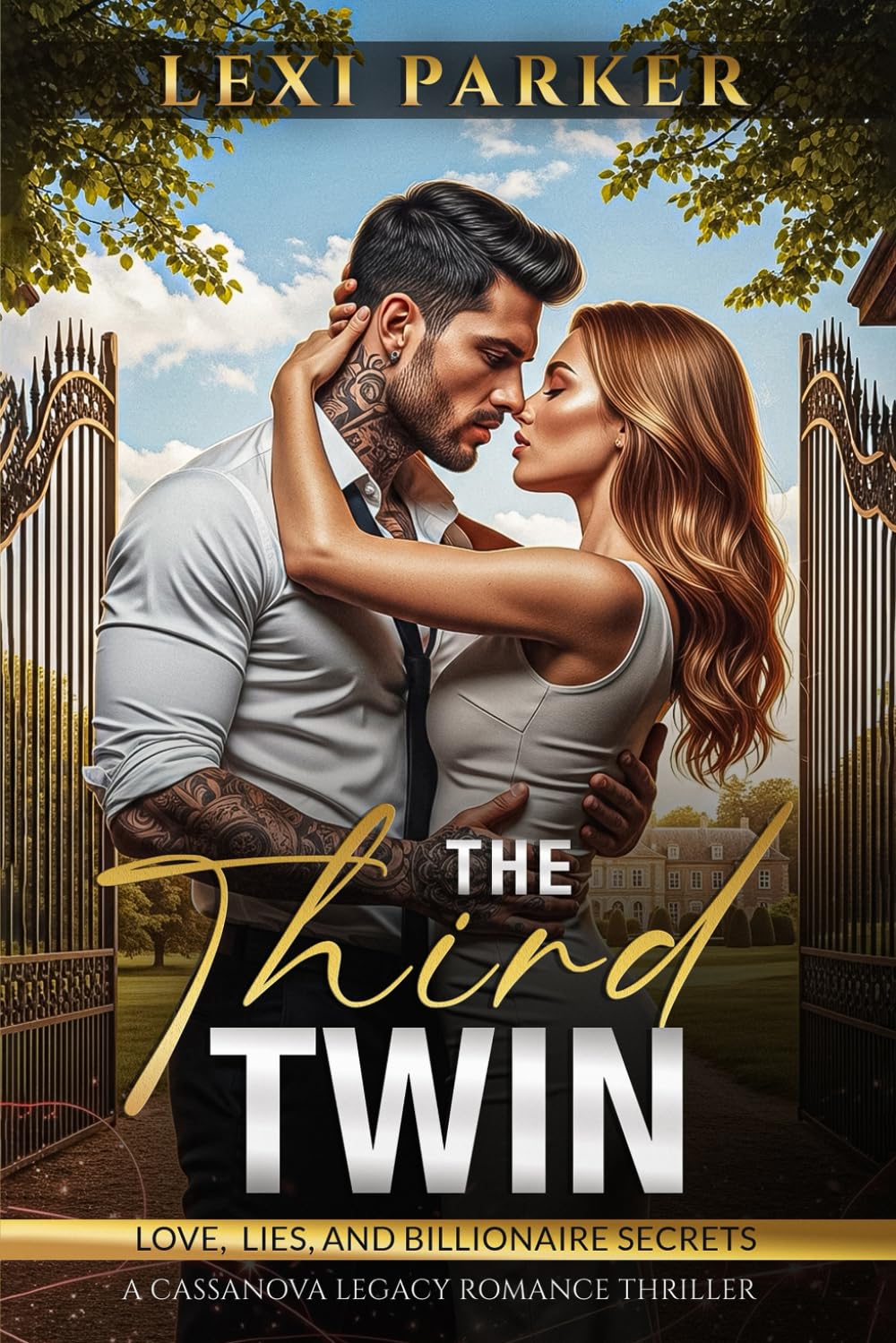
The Third Twin is a romance thriller that follows Sienna Casanova, an ER nurse whose world fractures the moment she feels her identical twin, Savannah, scream. Savannah, a famous investigative journalist, has gone dark, leaving behind only a bloodied necklace and a trail of danger. As Sienna races to find her, she’s pulled into a violent web involving black-market adoption rings, corrupt insiders, and Luca Stone, her sister’s brooding head of security. The story blends high-stakes suspense with an evolving, combustible romance. It’s very much a romance thriller at heart, stitched together with family secrets, danger, and the messy intensity of twinhood.
Reading it felt like riding in a car that never dips below fifty. The writing is fast and cinematic, with fight scenes that crack like glass and emotional beats that don’t waste time getting to the point. Parker leans fully into immediacy. Characters breathe hard, move fast, and react without overthinking. There were moments when I wanted the prose to linger or soften, but the clipped style fits the story’s heartbeat. Sienna’s voice oscillates between raw fear, jealousy, tenderness, and grit, and I found myself liking her more whenever she admitted something uncomfortable. Luca, meanwhile, carries that familiar romance-thriller energy: stoic, lethal, frustrating, and of course, irresistible. Their dynamic is chaotic in a way that feels intentional, like sparks thrown off metal.
What surprised me most was how the book knits an intimate relationship into the tension of a broader conspiracy. The author could have relied on the dangerous-man-protective-woman trope alone, but she gives the siblings’ bond real weight. The “twin sense” isn’t just a gimmick. It becomes the emotional spine of the story and gives the romance a stronger foundation than heat alone. Some emotional transitions happen fast. One chapter, you’re dodging gunmen, and the next, you’re collapsing into each other’s arms. But honestly, the abruptness works in a romance thriller. Bodies crash together under pressure. People cling to whatever feels solid. It all felt believable within the world that author Lexi Parker is building.
I’d recommend The Third Twin to readers who love romance thrillers packed with danger, devotion, and a relentless pace. If you enjoy bodyguard-romance energy, high stakes, and stories where fear and attraction tangle together until you can’t tell them apart, this one will hit the mark. And if you like your books to read like movies playing out in real time, you’ll have a good time here.
Pages: 190 | ASIN : B0FWC5VJFP
Eternal Search for Meaning

Flight of a Prodigy follows an eight-year-old street kid in ancient Rome who, after witnessing the death of his only friend, is captured and thrown into slavery, where he is trained to become an elite warrior. What was the inspiration for the setup of your story?
The inspiration came from my fascination with how traumatic events, particularly in our formative years, can affect the type of people we become, and how our perception of such events can either damage or expand our minds. I wanted to explore what happens when innocence refuses to yield to a predominant evil, and ancient Rome provided a platform where brutality and glory coexisted.
The death of the boy’s only friend symbolizes the loss of all he had, including his dreams and his childhood itself, while his capture into slavery reflects the harsh truth that fairness is rare. The exceptionally brutal training he is thrown into could be perceived as a punishment or a transformation, an allegory for resilience, identity, and strength through suffering. I wanted to reimagine them in a historical setting that feels both raw and epic.
What are some things that you find interesting about the human condition that you think make for great fiction?
What fascinates me most about the human condition is that, first of all, we are emotional creatures driven by hereditary traits in addition to our learned traits. And when we are forced into confrontation and must defeat the challenge or fall to it, emotions can be cast aside for incredible resolve or enhanced for a potential final stance. We all experience grief and hardship, but what makes great fiction is seeing how characters rise or fall when tested. I’m drawn to resilience because only in due time can we appreciate sadness for providing happiness, or weaknesses for providing strength, or hatred for providing love. For me, fiction thrives when it explores innocence colliding with a brutal reality, weakness evolves into power, and the eternal search for meaning in a chaotic world continues.
What were some themes that were important for you to explore in this book?
I enjoy a good coming-of-age story, so one of the most important themes to explore in this book was the loss of innocence, how a kid is forced to confront a brutal reality and reshape his identity in a world that never allowed him to be a child. How, after his escape from servitude, he teeters on a fulcrum between good and evil as he strives to learn more about himself and how to survive in civilization.
Another key theme was poking a little fun at humanity’s futile need to understand everything. What we cannot fully wrap our minds around must be magic, the will of the gods, preordained fate, or perhaps ancient aliens. I leave it for the readers to decide.
Ultimately, I am fascinated by how transformation from grief, through struggle and survival, can propel someone into an event larger than life. Those explorations felt essential to me because they create the kind of epic, emotionally charged fiction I love to read and write.
Will this novel be the start of a series, or are you working on a different story?
Although I would never say never to a sequel, Flight of a Prodigy was written as a stand-alone story. I try to write what I want to read, no endings left open or loose ends untied, no poor editing to save time, and no short stories disguised as a book.
I am currently working on a new Historical Fiction, and I’m starting to get excited for it. It has the potential to be my best work… if I don’t screw it up.
Author Links: GoodReads | Amazon
Remy’s journey begins as a homeless eight-year-old surviving on the unforgiving streets of ancient Rome. When his situation could not possibly become worse, it of course does. Thrown in to slavery, he must undertake what would become an eight-year training regimen devised by evil people for evil purposes. Only a few hundred survive, to form an elite group of warriors. Remy not only endures but thrives, becoming its prodigy.
Remy escapes with his life, only to find freedom is full of more challenges than expected. Though merely sixteen he is a volatile and dangerous weapon, at home in a fight but lost in civilization. He gains employment to scout for a traveling wagon party in hopes of remaining unnoticed by those that may be searching for him.
His new employer and coworkers consist of three beautiful young ladies, Annabelle, Divina and Gee, along with their surviving family members and household guards. It is a slow, difficult, and humorous process of growth for Remy. Will his newfound friendships, acceptance, trust and maybe even love, allow him to overcome the evil psychological affects that manipulate his childhood traumas?
Once-Mighty Civilization

Daughters of the Empire follows two women as they navigate through political intrigue, family secrets, and timeless battles as they search for truth and a way to save their world. What was the inspiration for the setup of your story?
There were several sources of inspiration, but two stand out: The Rise and Fall of the Great Powers, by Paul Kennedy, and The Legend of the Galactic Heroes, by Yoshiki Tanaka. I wanted to craft a story that blends Kennedy’s concept of the cyclical rise and decline of empires with a more human-centered narrative. While Tanaka’s work is brilliant in exploring the merits of autocracy versus democracy, it often lacks the intimate human dimension. I also felt that modern storytelling rarely gives us strong, complex female leads like Major Kira Nerys or Susan Ivanova. Too often, Hollywood substitutes depth for superficial “girl boss” tropes. My goal was to create flawed yet deeply relatable characters—Deanna, Valerica, Lucilla, and Miyu—whose choices you may not always agree with, but whose motivations you can understand.
I find the world you created in this novel brimming with possibilities. Where did the inspiration for the setting come from, and how did it change as you were writing?
The myth of Atlantis and Homer’s Iliad were my primary inspirations. I was fascinated by the idea of a once-mighty civilization—the Palladian Star Empire—suddenly collapsing, leaving the protagonists to pick up the pieces. The second half of the book draws heavily from the Iliad, exploring how war reshapes not only the world but the heroes themselves. One chapter of history closes, and a new one begins. Gaia emerges scarred yet transformed, and the four main characters realize that survival alone is not enough—the empire must evolve if it is to flourish.
What were some themes that were important for you to explore in this book?
Personal freedom is one of the core themes. I wanted to subvert the “chosen one” trope, but in a way different from Dune. Deanna, Valerica, Lucilla, and Miyu understand that their choices have consequences. They don’t blindly follow prophecies or orders—they seize leadership and make the best decisions they can in the moment, even when those choices haunt them later. Unlike Paul Atreides, Lucilla reforms the empire without invoking any divine mandate, and Deanna joins her not as a rebel but as a realist. Frank Herbert once said that all rebels are closeted aristocrats—a fair point—but Deanna is something else entirely: pragmatic and grounded.
The second major theme is transhumanism: what truly makes us human? Is it our memories, our personality, our capacity to love? Through genetic memory, cybernetic augmentation, and the tension between evolution and identity, the book asks whether humanity is defined by biology or by the choices we make.
I find a problem in well-written stories, in that I always want there to be another book to keep the story going. Is there a second book planned?
As you said, the story is intentionally left open-ended, which creates many possibilities for what comes next. So yes—a sequel is definitely a possibility. I already have ideas about where the characters and the empire could go from here, but I want to make sure any continuation feels as meaningful and ambitious as the first book.
Author Links: GoodReads | X (Twitter) | Facebook | Instagram | Amazon
Admiral Valerica Crassus, a veteran of countless battles, faces her greatest challenge yet—not from an enemy fleet, but from the haunting questions of right and wrong as she commands her forces in the final stage of the Draco Sector conquest.
On the verdant planet of Dorset II, Deanna Lancaster’s tranquil existence as a wine merchant is shattered by a sudden raid, thrusting her into a web of cosmic schemes. As she delves into her family’s enigmatic past, Deanna discovers truths that could alter the course of her life, and the galaxy, forever.
Daughters of the Empire is a tale of courage, camaraderie, and the unyielding quest for truth. Join Valerica and Deanna as they navigate through political intrigue, family secrets, and timeless battles over a galactic chessboard between light and darkness. This richly illustrated space opera—including 22 original artworks and two detailed maps—will take you on an epic journey where the legacy of the past will define the destiny of the future.
Devotion and Duty

Sick is a haunting psychological horror that follows a marriage unraveling into madness as devotion, illness, and manipulation, and blurs into a claustrophobic battle for control and belonging. What was the inspiration for the setup of your story?
This story was born from a nightmare. I dreamt I was a woman whose life was decaying around her as she cared for her sickly husband. By the end of the dream, she discovered the man she loved and trusted was far more ill than she could imagine. Her disorientation and fear pulled at me, and I knew I had to write the story.
How did you balance the ambiguity of John’s illness so the reader constantly questions what’s real and what’s manipulation?
I wanted to put people inside Susan’s mind, in the perspective of your typical person who feels the duty to care for their loved ones, no matter what is required. She has let her husband’s illness take over her life, so much so that she no longer has one. Of course, caregivers think, this person is sick, they need me. But what is the cost to yourself? When does devotion and duty become co-dependency? You can only be manipulated if you allow people to do so. How much of it is your own fault?
The book relies heavily on atmosphere and sensory detail rather than overt scares. How do you approach building tension through subtlety rather than shock?
I think the dark, quiet desires, motivations, and needs of our inner selves are more terrifying than your typical monsters, serial killers, or jump scares. It’s the realization that the frame you put around your life story to keep you safe could be a lie, and that you have been preyed upon by those you love and trust. It’s being slowly bled dry and not knowing until it’s too late. Worst of all is realizing you had a hand in your own demise.
What do you hope readers take away about love, neediness, and the moral gray zones that exist inside unhealthy relationships?
I hope readers will think more deeply about what they’re giving and taking in relationships, to be aware when someone is manipulating and using them, and where they themselves might be abusing a person in their life in a mental or emotional way.
Most victims can’t conceive that someone who claims to love them is silently exploiting them for their own gain. Likewise, abusers often don’t know that what they are doing is toxic. These are survival mechanisms they learned as children.
That is why I showed both Susan’s and John’s sides of the story. Neither of them is innocent.
Unfortunately, once confronted, not all abusers will acknowledge to themselves, much less to others, that they were damaging the people around them. It takes a brave person, a genuinely good-hearted and self-aware person, to be willing to admit their flaws and work to change them. Most narcissists and psychopaths do not have any empathy for others, nor true self-awareness that extends beyond their own self-importance.
I hope this story will wake up victims to possible abuse and tip off abusers that maybe they are the villain, and not the hero, of their own story.
Author Links: GoodReads | Facebook | Instagram | Website | Write Catalyst | Amazon
Charming and enigmatic, but very sick.
Born into wealth and prestige, John lost his family’s fortune to the mysterious illness that has now left him bedridden, and Susan’s life revolves around his care.
Years of devotion have left her exhausted and frustrated, yet she’s determined to scrape together whatever resources she can to keep John comfortable and happy—including stealing Demerol from the doctor’s office where she works to feed his growing dependence on painkillers.
As John’s condition continues to baffle doctors, Susan uncovers a secret from his childhood and the chilling cause of his illness.
Now that she knows the truth, can she put an end to the madness?
Christa Wojciechowski delivers a twisted psychological suspense novel for readers who like their fiction sick, sharp, and unforgettable.


 LITERARY TITAN