Blog Archives
Colloquialism and Exoticism

Damnatio Memoriae is the final, emotionally raw, and beautifully written chapter of the Nero and Sporus saga. How do you feel now that you have completed Sporus’s story, and were you able to achieve everything you wanted with the characters in the novel?
This is really one long novel, but now that I’ve reached an advanced age, I always worry about being able to finish things so I decide to do it as a trilogy so that even if I were to pass away, that would still be some parts of the book out as separate books. Because of this, I’ve lived with the characters for a very long time. One thing though is that we do know how the story ends, and we’ve always known it because it’s one of the few things that the historical record actually tells us. One problem with releasing the story in smaller chunks has been people getting the last chunk and complaining bitterly about the protagonist’s fate. Unfortunately, it’s one of the few things I couldn’t change without violating the whole idea of a historical novel.
What goals did you set for yourself as a writer in this book?
My largest aim was to truly inhabit the world of the first century and completely eschew any kind of moral or philosophical biases I might have as an inhabitant of our modern era. This is very difficult because so many things that were taken for granted are now shocking, and something that taken for granted today would’ve shocked the Romans. For example, the idea of people actually being equal would have been astonishing. Sex and violence, so much a cause of societal uproar today, were not only not that profound, they were even mostly entertainment. One reader complained bitterly that I didn’t use archaic language. But the Romans didn’t know they were ancient! I had to strike a balance between colloquialism and exoticism. Everyone doing what I do has to find their own happy medium. I hope that that which is exotic or horrific about the Roman world comes across most successfully when it is treated as completely commonplace.
What experience in your life has had the most significant impact on your writing?
Bringing up a child who was completely comfortable as either gender and had no qualms about switching whenever he felt like it. This book is actually dedicated to him. I use the word him because the language I usually speak to him in is Thai, a language in which most pronouns are gender-neutral. People who grow up in this culture simply don’t suffer any agony about pronouns.
What is the next book that you are working on, and when can your fans expect it to be out?
I’m returning to science fiction and fantasy at the moment with a new post-holocaust trilogy set among wolves. I’m also doing a sixth novel in a series that I’ve been working on for over 40 years. It was very popular in the 80s and I’m reviving it. It’s one of those vast Galactic Empire kind of things.
Author Links: GoodReads | Facebook | Website | Amazon
Captured by pirates as a boy and trafficked to the slave markets of Rome, Sporus rose from a poet’s plaything to one of the most powerful figures in the Roman Empire.
The historian Suetonius tells us that the Emperor Nero emasculated and married his slave Sporus, the spitting image of murdered Empress Poppaea. But history has more tidbits about Sporus, who went from “puer delicatus” to Empress to one Emperor and concubine to another, and ended up being sentenced to play the Earth-Goddess in the arena.
The decadence of Imperial Rome comes to life in S.P. Somtow’s Literary Titan Award-winning trilogy about one of ancient history’s wildest characters.
Damnatio Memoriae


Somtow’s Damnatio Memoriae is the final, emotionally raw, and beautifully written chapter of the Nero and Sporus saga. It’s a deeply personal journey told through the voice of Sporus, a former slave and imperial concubine, who relives his (and her) rise and fall at the edges of empire, identity, and power. This isn’t your average Roman epic—it’s visceral, surreal, darkly poetic, and hauntingly queer. With Nero’s collapse and Rome’s chaos as the backdrop, Sporus reflects on life, gender, betrayal, and the myth of love, all while waiting to be executed in a packed arena. It’s intense.
What hit me first was how lyrical the writing is. It reads like a fever dream soaked in garum and incense. Somtow doesn’t hold back—there’s real pain here, but also twisted humor and staggering beauty. The opening monologue, for example, where Sporus describes the reek of sand, blood, and beast dung in the arena, while cracking dry jokes about makeup and waiting for a death scene, felt like Oscar Wilde doing Gladiator cosplay. And yet, it’s achingly tragic. And then there’s the ring scene in the marketplace, where a carved image of Persephone triggers a spiritual collapse and sparks an impromptu imperial crucifixion crisis. Absolutely brilliant and brutal.
That said, this book isn’t an easy read. It expects a lot from you—emotionally, intellectually, even morally. Nero is magnetic and monstrous, sometimes at the same time, and the dynamics between him and Sporus swing from disturbing to tender. Somtow nails this complexity. But the heartbreak really comes from how aware Sporus is of their own powerlessness, even while being dressed up as a goddess or cherished as a boy. In “Clipped Wings,” the metaphor of the clipped doves—meant to be freed in a religious ritual but secretly recaptured—just gutted me.
If you like your historical fiction brutal and beautiful, if you’re into mythology reimagined through a queer lens, if you can handle morally messy characters and poetic trauma—this is for you. Fans of Mary Renault, Madeline Miller, or even Game of Thrones at its sharpest will probably find something to love here. But it’s also for people who want to feel something deep and uncomfortable. I’m not gonna lie, it’s sometimes hard to stomach—but I didn’t want to look away.
Pages: 232 | ASIN : B0F2YZ1HRH

I’m Dreaming of Moo Deng

S.P. Somtow’s I’m Dreaming of Moo Deng celebrates the limitless imagination of childhood with charm and originality. The story follows a suburban boy who stumbles upon Moo Deng, a newborn pygmy hippo, while browsing online. Instantly captivated, he becomes so enthralled that his mother plans a trip to Thailand to visit the zoo where Moo Deng resides. They stay with his Uncle Somtow, who helps coordinate the visit. When they finally arrive at the zoo, a long line threatens their plans. Uncle Somtow considers giving up, but the boy’s determination keeps them in place. While they wait, his imagination takes flight, spinning magical adventures where he and Moo Deng share whimsical moments together.
The book’s theme is a testament to the power of perseverance and creativity. The protagonist’s fascination with Moo Deng becomes a driving force, teaching children the value of pursuing their passions wholeheartedly. His family’s unwavering support creates a nurturing environment that further underscores the importance of encouragement. Somtow skillfully illustrates how creativity not only fuels joy but also builds resilience. Faced with frustration during the long wait, the boy channels his emotions into vivid daydreams, transforming a tiresome experience into a fantastical journey. Meanwhile, Uncle Somtow enriches the moment by sharing intriguing facts, turning the wait into an opportunity for discovery.
Visually, the book dazzles with its illustrations. They burst with fantasy elements and intricate details, enhanced by striking light and shadow effects. Somtow’s writing, on the other hand, is precise and engaging, seamlessly weaving together real-world events and the protagonist’s imagined escapades. Each scene flows effortlessly into the next, delivering a narrative brimming with wonder and excitement.
At its heart, I’m Dreaming of Moo Deng inspires children to chase even the wildest dreams. It’s a joyful reminder that imagination, perseverance, and the support of loved ones can transform the ordinary into the extraordinary. S.P. Somtow’s tale brims with warmth and creativity, making it an enchanting read for young dreamers and the families who encourage them to reach for the stars.
Pages: 67 | ISBN : 978-1940999388
A Warped Sensibility
In Terrestrial Passions, an unsuspecting widow finds her life transformed by the extraterrestrial who arrives in her orchard via starship. What was the inspiration for the setup of your story?
I think that I’ve learned an important lesson writing this book. You see, it’s a satire. If you look at the reader reviews, about half of the readers are laughing their pants off, get the offbeat literary humor, and understand that all the detailed historical background is being used in the service of its outrageous, surreal humor. The other half are trying to read it in romance genre terms, and therefore thinking that it’s off-key. The lesson: committed Regency romance fans take their genre rather seriously and don’t laugh at it; science fiction fans, on the other hand, are more likely to get a kick out of it. The result: a large number of 5-star reviews from the Hitchhiker’s Guide, Life of Brian, and Black Adder crowd, plus Lit Majors who have spent many a long night with Jane Austen and feel liberated by being able to laugh…and bewildered negatives from those expecting a serious romance with a tinge of spice. Even Literary Titan’s own reviewer, who did an admirable job analysing the book’s historical accuracies, never mentioned that it’s funny – while some other reviewers, the humor is ALL they talk about.
This is on me, not on the readers. On the way the book is marketed and packaged. I’ll have to tweak the presentation so it reaches its intended audience I think.
My inspiration…yes, indeed, it comes from having read all six Jane Austen novels in school, in England. Loved them. But her early novel Northanger Abbey is a bit different…you could see her going the way of the wild, satirical fantasy adventure rather than the way she ended up being best known for. It’s this playful version of Jane that inspires this book (with a bunch of Dickens tropes thrown in). Then…
I was at Cambridge the same years as Douglas Adams. This book, in a sense, comes from a similar mental place…a warped sensibility…highly intellectual yet sardonically detached. It’s what Americans call “British humor,” I think. An odd thing since according to the Library of Congress, my works are classified as “fiction, American.” This is what you get for growing up in too many countries.
What was your approach to writing the interactions between your characters?
No matter how outlandish, as far as the characters are concerned, it’s really happening. That’s really the only to make a story this weird be believable.
Within this book, you flawlessly blend historical fiction and science fiction. It takes exceptional talent to blend the two genres. How did you go about blending the two genres without disrupting the story?
They are the two genres that have most influenced me since childhood, and I have done several quite serious stories set in the past with fantasy elements, like my multiple award-winning werewolf novel Moon Dance. When it comes to science fiction, however, I can’t seem to escape “comedy.” My Hugo-nominated Aquila series is about the Roman conquest of America, but it’s essentially a laugh-a-minute romp.
What is the next book you are working on, and when will it be available?
I am finishing the third volume of my Delicatus trilogy — historical fiction which isn’t comedic at all (despite some arch dialogue at times), and starting another trilogy, the Yrth series, for new New York publisher Brazen House.
Author Links: GoodReads | Facebook | Website | Amazon
A rollicking satire that blends the world of Jane Austen with the sci-fi universes of E.T. and The Day the Earth Stood Still by World Fantasy Award-winning author S.P. Somtow, this story has been a top faved ongoing serial in Amazon Vella.
Terrestrial Passions: A Regency Romance, with Aliens
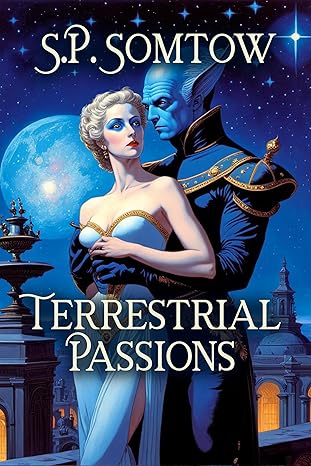

Terrestrial Passions, by S.P. Somtow, presents a unique fusion of Regency romance and science fiction, transporting readers to the quaint English village of Little Chiswick. In this unusual narrative, the life of Mrs. Emma Dorrit, a widow residing with her brother and twin daughters at the lower echelons of society, undergoes a startling transformation when an extraterrestrial visitor’s starship unexpectedly lands in her orchard.
The novel excels in its detailed characterizations, particularly in depicting the societal nuances and aspirations within 19th-century English society. The Dorrit family, along with the enigmatic alien, Monsieur Clatoux, navigate the intricacies of social conventions and class divisions. The story explores themes of ambition, intellectual exploration, and the intricacies of both terrestrial and interstellar relationships. The juxtaposition of Arabella’s intellectual pursuits against Anna’s more emotionally driven nature provides further depth to the narrative. The novel’s rich historical details and vivid portrayal of the era are a highlight, offering a textured backdrop to the story. Its melding of historical context with science-fiction elements showcases the author’s creative ambition, presenting a refreshing twist for those eager to explore beyond conventional boundaries.
The transition from the familiar setting of an English village to scenes involving extraterrestrial elements adds an element of surprise and innovation, appealing to readers who appreciate a blend of genres. The pacing of the novel, with its mix of reflective social scenes and dynamic sci-fi segments, provides a varied reading experience that keeps the narrative engaging and multifaceted.
Terrestrial Passions stands out for its imaginative approach, skillfully intertwining different genres to create an engaging and distinctive story. It’s a thought-provoking read for those who appreciate an inventive combination of historical fiction and science fiction, marked by well-crafted characters and an original plotline. The book is a testament to the author’s boldness in challenging genre conventions, making it a noteworthy addition to the realms of both historical and science fiction literature.
Pages: 281 | ASIN : B0CDQHNNJ9
Dinosaur Symphony: A Book of Poetry and Pictures about Dinosaurs and Classical Music

In A Dinosaur Symphony, author S.P. Somtow masterfully intertwines the realms of time travel, music, and paleontology, creating a unique and engaging experience for young readers. This imaginative tale follows a time-traveling conductor who ventures into the Jurassic Era only to find an orchestra of dinosaurs struggling with their musical tempo. Through this narrative, Somtow cleverly introduces children to the intricacies of a symphony orchestra, with each dinosaur character representing a different musical instrument and section of the orchestra.
The author’s background as a composer is evident, as he enriches the story with an original orchestral piece that reflects his dual passions for music and dinosaurs. This auditory element, along with the AI-assisted illustrations, provides a modern and interactive layer to the storytelling, making it an enjoyable and educational read. The author includes a note explaining the use of AI assistance in creating the illustrations. Although a few images might display minor imperfections, they do not detract from the story’s captivating narrative. This book is an educational tool, seamlessly blending fun facts about dinosaurs with insights into various musical instruments and their sounds. This approach captivates the young reader’s imagination and serves as a springboard for discussions about music and paleontology in classroom settings, particularly in music education.
A Dinosaur Symphony opens up opportunities for meaningful conversations between children and parents about diverse music genres, the role of different instruments, and, intriguingly, the prehistoric creatures that once roamed our planet. This inventive and informative book is an excellent resource for nurturing young minds to appreciate music and natural history.
Pages: 80 | ASIN : B0CPDJZ3RH
Strange and Often Quite Humorous Places
Club X: Vampire in the Closet follows four boys attending an elite all-boys Catholic school in Thailand who try to uncover the school’s dark secrets while figuring out their own sexual identities. What was the inspiration for the setup of your story?
Long story but here goes…I had a friend, a former executive of The Nation TV, a major media outlet in Thailand. He said to me, “Can you think of a Thai series I could sell to a Western platform?” I researched all the Thai TV series that were available on Netflix and other internationally available sites, and it was clear that the most popular subject matter, the one that Western felt to be “Thai” in feel, by far, were stories known as “BL”…tales of high school romances between boys. Generally rather innocent. In Asia, the main audience for these stories is actually young women. European and American TV are only just starting to toy with this genre (notably shows like the British Heartstopper for instance) but in Asia it is a huge genre, dominating the young adult market. I told my friend that this wasn’t a genre I was that familiar with. But, if I could combine the milieu with a storyline kind of like what I am more known for…that is horror or fantasy…perhaps, I could create a hybrid that might be quite fresh. So, I basically grafted the American “boys discover the dark secrets of their school” genre on top of the “BL” genre, and it led to very strange and often quite humorous places. And I started to create the pilot for this putative series.
Now, Amazon Vella was being born at that very time. So, I thought, as a serial format, it could be a way of testing out the story on people who like to read stories with cliffhangers. This is how the novel came about. At first, no one really noticed it, but after a few months, some of my regular book readers started to pick up on the series, and it was briefly one of the more highly-rated series on Vella, enough that I was able to use it to find people to invest in an independent production of the live-action version. So…it happened all at once, and we found ourselves shooting a series in various converted offices and people’s houses while I started writing Book II of Club X. Well, the series is in post-production and on the verge of appearing on some web TV platforms.
So, this is how this rather unusual setup came into being.
In a lot of contemporary coming-of-age fiction novels, authors often add their own life experiences to the story. Are there any bits of you in this story?
Yes and no. I did go to an elite boarding school but in England. I was also briefly in a Catholic school in Thailand but not a boarding school. As the director of a youth orchestra program, I’m often surrounded by people in this age bracket and able to observe how they talk and think at close hand. I’ve raised someone with Asperger’s, and my adopted son had many gender issues. All the characters are, in fact, inspired by real people.
What were some themes that were important for you to explore in this book?
The genre hands you a set of readymade characters — you can see this in everything from “IT” to “Stranger Things.” The coming-of-age trope says you must have four boys: a cute one, a tough one, a fat one, and a geek. You must have a girl that they all like because she plays their games, but will normally end up with the cute one. The tough one is usually also vulnerable. The cute one is often a writer, dreamer, a thinking man, and often a stand-in for the author himself. So, when I moved the milieu to a Thai-style BL milieu, the four compulsory boys underwent transformation. The main kid, the thinking one suffers from Asperger Syndrome. His best friend is a child prodigy. The kid who is usually presented as “fat” has a different social “issue” – he’s gender fluid, but he’s completely ok with it and so are all his friends. The “geek” becomes the kid with strange paranormal powers. So, there are many themes of identity and selfhood that are common to kids everywhere but are given a new twist because of the cultural setting. Interestingly, the original book and serial are written in English, but I had to write the screenplay in Thai (a first for me although I am bicultural.)
I hope the series continues in other books. If so, where will the story take readers?
The second book, Zombie in the Fridge is already out. I’m working on a third, the title unsure, but I might go with Banshee in the Bathtub.
Author Links: GoodReads | Twitter | Facebook | S.P. Somtow | Patreon | Website | Amazon
St. Cecilia’s boys’ school is an elite boys’ school in a remote part of Thailand, a hotbed of hormones, mystery, fantasy, and dark secrets! Five kids (binary and non-binary) uncover the dark secrets of their school amid mysteries of identity and sexual attraction.
Why does Dr. Leopold Strange only teach after sundown? Why is Sister Euphemia dancing in the forest without her habit? And why can’t Kim and Fluke talk about the awful thing that happened to them in Oldenburg? And what’s in the closet?
The Core of Innocence
Imperatrix: The Empress Who Was Once a Slave follows a young slave thrust into the decadence and danger of Nero’s court as he strives to survive and find his place in a world ruled by an insane emperor. What inspired you to choose Nero’s Rome as the backdrop for Imperatrix?
Growing up in England in the 1960s, I was one of the last generation to receive a “classical education” in which subjects like Latin were compulsory. So, the history of imperial Rome was almost as familiar to me as real life — and, compared to real life in a British boarding school, almost as weird, too. I was surrounded by fictional depictions of Nero’s Rome, in literature and film, yet they generally are as much about the mores and culture of the time they were written in as about Rome. I wanted to try to achieve the real alienness of this pagan culture while at the same time showing that these people are clearly recognizable to us in the modern world. One important difference is the entire societal treatment of sexuality and sexual morality which was in many ways more permissive than today, but also more restrictive in other ways. Relationships today are seen as two-way; in Roman times “maleness” was about doing, and “femaleness” was about being done to. Everything has to be interpreted in that light. “Of course” one could do anything to a slave, no matter what their gender or age — they were owned. Yet a modern, two-way gay relationship where the partners were equal might have been seen as eccentric, somehow un-Roman. When this one pillar of modern moral discourse — the idea of relationships being equal, going both ways — is altered, every little thing in society is seen through a different lens. That was the challenge — not to allow a modern sensibility to be interjected into characters’ attitudes — while at the same time showing characters that modern people share common humanity with.
Sporus is a complex and captivating character. Can you share the process of developing his personality and how you balanced his vulnerability and resilience throughout the story?
So many bad things happened to Sporus that he could not have survived without a great deal of native wit and real intelligence. To survive in Nero’s court was tough even for people who had been raised and bred for it. To develop his character, I imagined him talking to me, letting me share his innermost, often contradictory thoughts. It’s the core of innocence that people around Sporus love — the thing they themselves do not possess. But that innocence is constantly besieged by the realities of his world. I think that making this a first-person narrative makes you constantly strive to understand the realities of that world. It’s an imaginative exercise in chanelling if you will.
How did you approach crafting Nero’s character, and what were the challenges in depicting his divine madness and capricious nature?
Of course, we know a lot more about Nero than we do about Sporus. This means not only that it’s easier to create a character people would recognize as Nero, but also harder to bring out qualities that might be concealed behind the very well-known persona. Nero was not raised to be an Emperor, so on some level, he must have been able to understand how ordinary people felt. The evil madman image is to some extent anti-Julio-Claudian propaganda — followed by Christian propaganda. He was, almost to the end, rather popular, but the mob was fickle.
Can you give us any insights into what we can expect in the next installment of this enthralling trilogy?
In a way, the big events are all in the third part, a large part of which is set during a single year in which four emperors came to the throne, and Sporus’s fortunes ping pong rapidly. Nymphidius “took” Sporus for a while but his bid to become emperor did not work out. Otho, like Nero, married Sporus (and of course both were Poppaea’s ex-husbands.). The first part of Book III, the Grecian tour, is also an immense spectacle. So I hope the third volume will be suitably climactic.
I didn’t mean to do this in three volumes. It’s just that at my age, I worry about not finishing big fat books, so breaking them up is a way that least parts of them reach the audience. At about 180,000 – 200,000 words the three volumes together are a pretty fat work, but they are continuous, so it may also be necessary to do an omnibus edition.
Author Links: GoodReads | Amazon
Imperatrix, the second volume of the tale, takes us into the heart of the Imperial palace with all its intrigue, depravity, and splendor.



 LITERARY TITAN