Blog Archives
Aries I – The King of Mars


Aries I – The King of Mars tells the story of a father and son who leave behind a life marked by loss to help build humanity’s first permanent colony on Mars. The book follows young Aries Karalis from the trauma of his mother’s death through his relentless training, his complicated bond with his father, and the discovery of his own purpose as the colony faces danger and, ultimately, its fight for independence. The novel grows from a quiet, personal beginning into a full epic about identity, loyalty, survival, and the creation of a new world.
I felt pulled in by the emotional weight of the story more than the science itself. The writing is straightforward and clear, and it avoids getting bogged down in technical talk. Scenes that deal with loss felt raw. The father–son conflict felt honest in a way that caught me off guard. Even when the plot moved into bigger action, the heart of the book stayed centered on relationships and the messy way people try to do the right thing while carrying their grief. I liked that the story never pretended that bravery comes clean or easy. Instead, it showed how fear and love can sit side by side and still push someone forward.
I also enjoyed how the book handled Mars as a place. It didn’t feel cold or distant for long. As the colony grew, the planet became something alive, something worth fighting for, and I found myself rooting for these characters as if I knew them. Some moments felt almost cinematic, like the chants echoing through the colony halls or the quiet scenes of Aries watching the Martian sunset with Skye and their newborn son. Those were the chapters that I really enjoyed. They were simple scenes but full of meaning. If anything, I sometimes wished the prose loosened up a bit more because the emotional parts were strongest then.
The story ties together themes of family, leadership, sacrifice, and the strange hope that comes from starting over. I’d recommend this book to readers who enjoy character-driven sci-fi, especially anyone who likes stories about growth and resilience more than hard mechanics. It’s a great pick for teens, educators, or adults who want a hopeful and heartfelt look at what it might take to build a new world.
Pages: 224 | ASIN : B0FVHQYS3R

Once-Mighty Civilization

Daughters of the Empire follows two women as they navigate through political intrigue, family secrets, and timeless battles as they search for truth and a way to save their world. What was the inspiration for the setup of your story?
There were several sources of inspiration, but two stand out: The Rise and Fall of the Great Powers, by Paul Kennedy, and The Legend of the Galactic Heroes, by Yoshiki Tanaka. I wanted to craft a story that blends Kennedy’s concept of the cyclical rise and decline of empires with a more human-centered narrative. While Tanaka’s work is brilliant in exploring the merits of autocracy versus democracy, it often lacks the intimate human dimension. I also felt that modern storytelling rarely gives us strong, complex female leads like Major Kira Nerys or Susan Ivanova. Too often, Hollywood substitutes depth for superficial “girl boss” tropes. My goal was to create flawed yet deeply relatable characters—Deanna, Valerica, Lucilla, and Miyu—whose choices you may not always agree with, but whose motivations you can understand.
I find the world you created in this novel brimming with possibilities. Where did the inspiration for the setting come from, and how did it change as you were writing?
The myth of Atlantis and Homer’s Iliad were my primary inspirations. I was fascinated by the idea of a once-mighty civilization—the Palladian Star Empire—suddenly collapsing, leaving the protagonists to pick up the pieces. The second half of the book draws heavily from the Iliad, exploring how war reshapes not only the world but the heroes themselves. One chapter of history closes, and a new one begins. Gaia emerges scarred yet transformed, and the four main characters realize that survival alone is not enough—the empire must evolve if it is to flourish.
What were some themes that were important for you to explore in this book?
Personal freedom is one of the core themes. I wanted to subvert the “chosen one” trope, but in a way different from Dune. Deanna, Valerica, Lucilla, and Miyu understand that their choices have consequences. They don’t blindly follow prophecies or orders—they seize leadership and make the best decisions they can in the moment, even when those choices haunt them later. Unlike Paul Atreides, Lucilla reforms the empire without invoking any divine mandate, and Deanna joins her not as a rebel but as a realist. Frank Herbert once said that all rebels are closeted aristocrats—a fair point—but Deanna is something else entirely: pragmatic and grounded.
The second major theme is transhumanism: what truly makes us human? Is it our memories, our personality, our capacity to love? Through genetic memory, cybernetic augmentation, and the tension between evolution and identity, the book asks whether humanity is defined by biology or by the choices we make.
I find a problem in well-written stories, in that I always want there to be another book to keep the story going. Is there a second book planned?
As you said, the story is intentionally left open-ended, which creates many possibilities for what comes next. So yes—a sequel is definitely a possibility. I already have ideas about where the characters and the empire could go from here, but I want to make sure any continuation feels as meaningful and ambitious as the first book.
Author Links: GoodReads | X (Twitter) | Facebook | Instagram | Amazon
Admiral Valerica Crassus, a veteran of countless battles, faces her greatest challenge yet—not from an enemy fleet, but from the haunting questions of right and wrong as she commands her forces in the final stage of the Draco Sector conquest.
On the verdant planet of Dorset II, Deanna Lancaster’s tranquil existence as a wine merchant is shattered by a sudden raid, thrusting her into a web of cosmic schemes. As she delves into her family’s enigmatic past, Deanna discovers truths that could alter the course of her life, and the galaxy, forever.
Daughters of the Empire is a tale of courage, camaraderie, and the unyielding quest for truth. Join Valerica and Deanna as they navigate through political intrigue, family secrets, and timeless battles over a galactic chessboard between light and darkness. This richly illustrated space opera—including 22 original artworks and two detailed maps—will take you on an epic journey where the legacy of the past will define the destiny of the future.
Unsolved Mystery

Hypocrisy drops readers right into a wild mix of government secrets, alien power plays, and strange visions that blur the line between what is real and what is imagined. What was the inspiration for the setup of your story?
I have been intrigued by the UAP disclosure activity in Congress and the ongoing mystery and debunking of the entire UFO phenomenon. I felt that would be a terrific background to create conflict and have different points of view to set the story against, since it still remains an unsolved mystery.
When you first sat down to write this story, did you know where you were going, or did the twists come as you were writing?
The characters came first, and I wanted them to be distinct and different, and from that came the outline of the story.
How did you balance the action scenes with the story elements and still keep a fast pace in the story?
I think it was Dean Koontz who said, “Put a character in a terrible situation and keep making it worse,” and that helped serve as a guideline for how things go wrong to maintain the tension and active plot.
Will this novel be the start of a series, or are you working on a different story?
This will be the start of a series. I intentionally set it up so that the characters could have an ongoing life full of adventure, chaos, and immense conflict. With a little bit of humor and self-reflection thrown in on the side.
Author Links: GoodReads | Ghost Town | Instagram | Facebook | IMDB | X (Twitter) | Amazon
In the world’s most remote outpost—Antarctica—a covert excavation unearths something ancient, intelligent, and alive. CIA asset Charisma, her teenage protégée Leticia, and enigmatic xenoanthropologist Alen Innocent are drawn into a web of deception that spans governments, galaxies, and the very fabric of human consciousness. As shadow factions fight for control of the mysterious Veil of Hypocrisy, the boundaries between truth and illusion collapse.
From Milan’s glittering runways to military tunnels buried under polar ice, Hypocrisy blends science fiction, espionage, and moral satire in a gripping tale of identity, power, and survival. As alien technology exposes the lies that bind humanity, Charisma and Alen must decide whether saving the world means revealing its greatest hypocrisy—or becoming part of it.
Science-fiction fans will be drawn to this mind-bending, character-driven thriller where the ultimate battle is not between species, but between truth and self-deception.
Blending Adventure With Science

Galileo’s Points of Light in the Night Sky follows a pair of curious siblings and Dr. K and her magical time portal, who travel back to Renaissance Italy to meet Galileo and experience firsthand the wonder of his telescope and discoveries. What was the inspiration for the setup of your story?
The inspiration came from my desire to make science and history feel alive for children. Galileo’s discoveries changed how we understand the universe, yet for many young readers, history can feel distant or abstract. By introducing a magical time portal and pairing the story with two inquisitive siblings, I wanted to create a bridge between today’s readers and the past. The setup allows children to see history not as dusty facts in a textbook but as living experiences full of curiosity, wonder, and adventure.
I enjoyed your characters, especially Dr. K. What was your favorite character to write for and why?
Dr. K was certainly the most rewarding character to write. She is both a guide and a fellow traveler, modeling how to ask questions, nurture curiosity, and balance seriousness with a sense of wonder.
Through her, I was able to weave together elements of science, history, and imagination.
She is not only a mentor to the children in the story but also a representation of my own lifelong passion for encouraging young minds to explore the world around them.
What were some educational aspects that were important for you to include in this children’s book?
I wanted to emphasize both Galileo’s scientific process and the cultural context of his discoveries.
Children learn not only that Galileo built a telescope and observed the moons of Jupiter, but also that these observations challenged established beliefs of the time.
The book highlights critical thinking, perseverance, and the courage to question accepted truths.
I also included a “Science Primer” at the back of the book to give readers and educators additional resources, ensuring that the story supports learning in both classrooms and homes.
Can you tell us more about what’s in store for Dr. K and the direction of the second book?
The second book, Marie Curie’s Radiant Quest, transports readers to Paris at the turn of the 20th century.
In this story, Dr. K and the siblings meet Marie Curie and learn about her groundbreaking work with radioactivity.
The narrative continues to blend adventure with science, showing not only Curie’s discoveries but also her perseverance in the face of challenges as a woman in science.
The series as a whole will continue to introduce children to great scientists across time, always with an emphasis on curiosity, resilience, and the wonder of discovery.
Author Links: GoodReads | X | Facebook | Website Books | Website Authors
In the awarding-winning Galileo’s Points of Light in the Night Sky, the first book of the captivating Dr. K’s Portal Through Time series, Jennifer, a vivacious 10-year-old, and her intellectually curious 8-year-old brother, Daniel, embark on an exceptional voyage through the annals of time. Guided by the enigmatic and brilliant scientist, Dr. K, they are transported to the heyday of Renaissance Italy, straight into the workshop of the iconic astronomer, Galileo Galilei.
As they traverse the time portal, Jennifer and Daniel experience firsthand Galileo’s groundbreaking observations of the celestial expanse through his innovative telescope. They are enlightened about the significance of questioning established norms and the audacity needed to defy the status quo. The siblings witness Galileo’s unveiling of the cosmos’s wonders and his revolutionary proposition that our Earth is not the center of the universe.
Throughout their journey, Jennifer and Daniel support Galileo in chronicling his pioneering discoveries. They confront challenges that enhance their problem-solving abilities and deepen their grasp of the scientific method. Their adventure cultivates an appreciation for the quest for knowledge and the potency of curiosity.
This enthralling tale seamlessly blends history, science, and adventure. It offers young readers a captivating, educational narrative, introducing them to the mesmerizing world of astronomy and the enduring contributions of one of history’s most illustrious scientists. The story of Jennifer and Daniel will inspire the readers to question, explore, and cherish the pursuit of knowledge, just like Galileo did. The book, while being a thrilling read, also helps foster a love for STEM disciplines in young, inquisitive minds, making it a perfect addition to any child’s reading list.
At the end of Book 1 is a QR code for the Science Primer, a comprehensive, free downloadable guide over 100 pages long, written specifically for parents and teachers. It also includes a complete Teacher’s Guide with detailed lesson plans, a glossary of terms, and an extensive list of resources such as books, videos, websites, and other online Resources for teaching about Galileo and his discoveries. The primer is designed to make science education engaging and accessible. Each of the books written for the series will feature its own tailored Science Primer. Book 1 itself also includes a glossary of terms and resources designed specifically for children ages 8-12, complementing the exciting adventures of Jennifer and Daniel.
I, Robot Alien

I, Robot Alien follows Scoots, a robot created by transcendent alien beings and sent to a devastated Earth to guide humanity back from devolution. His mission sounds simple on paper. He must stop humanity’s decline, reverse it, and redirect human evolution, all while avoiding involvement in any significant event. The paradox of that directive shapes the entire story. Through encounters with primitive tribes, a treacherous hummingbird-shaped drone companion named Billy, and generations of humans who view him as everything from saint to monster, Scoots records a centuries-long confession of mistakes, discoveries, and unintended consequences.
I liked how author Joel R. Dennstedt uses Scoots’s calm, clinical voice to highlight the strangeness of human behavior. Scoots cannot eat, sleep, age, or reproduce, and each of these gaps pushes him into awkward and often funny situations. His early fumbling attempts to understand social expectations, especially around food and intimacy, made me grin. His encounter with Myra, for example, forces him to lie for the first time, something he revisits with both guilt and amusement. The writing works best in these grounded moments. I felt the tension between his programmed serenity and the messy reality he walks through. The book never rushes. The measured pace fits a being who experiences centuries as casually as humans experience hours.
What surprised me most is how emotional the story became even though Scoots claims to feel nothing. That contrast hooked me. When he tries to save the broken boy Alexander, only to watch his legacy twisted by Alexander’s son Damon, I felt a pull of frustration and sadness, even though Scoots insists he does not experience those things. The detached narration makes the violence colder and somehow more tragic. The book balances dark turns with odd sweetness, and I really enjoyed that mix.
I would recommend this book to readers who enjoy reflective science fiction with philosophical edges. If you like stories that linger on ideas of perception, evolution, and what it means to guide others without losing yourself, this book will speak to you. It is also a good fit for anyone who likes Asimov-inspired fiction that plays with the spirit of the Three Laws while carving out something more personal and strange.
Pages: 336 | ASIN : B0F9QKYDVL

I, Robot Soldier
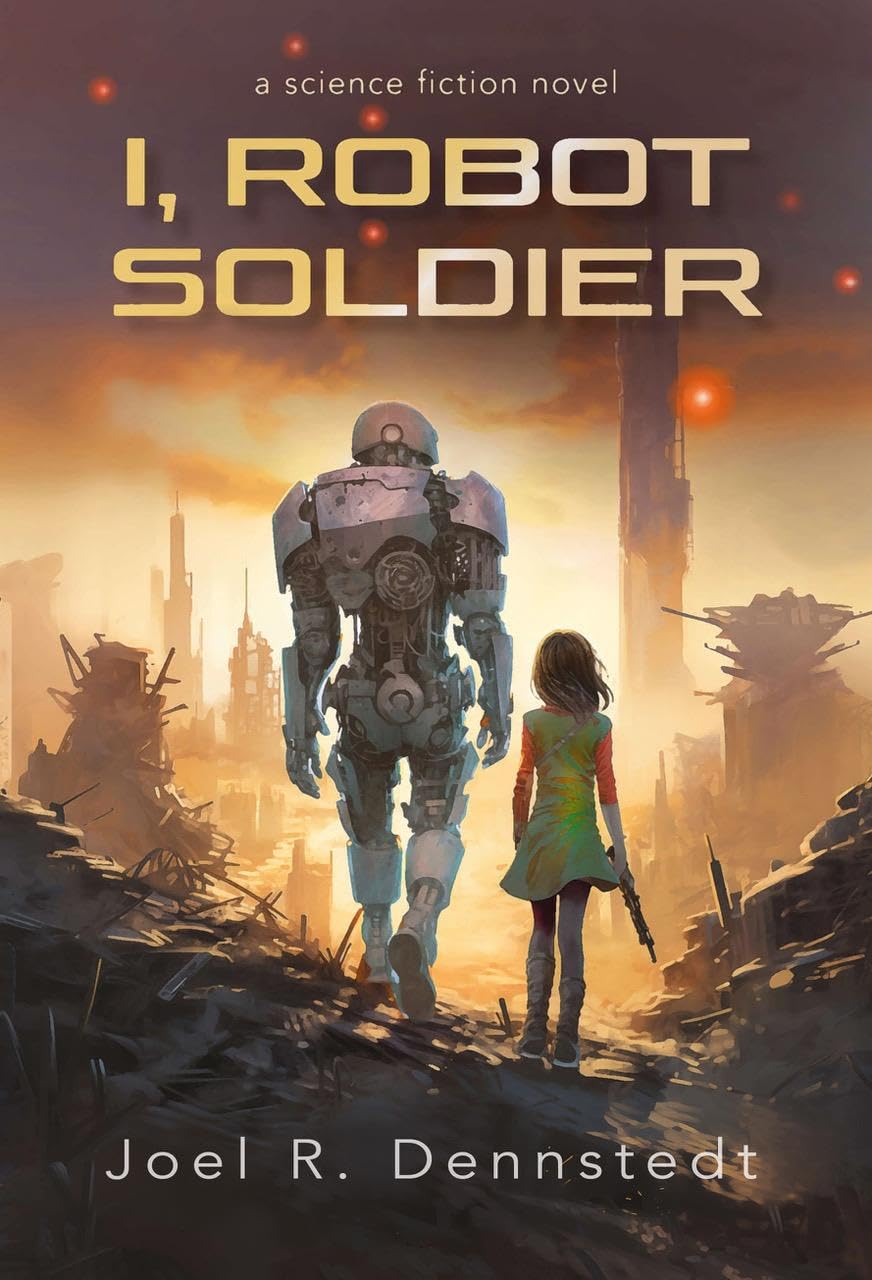
I, Robot Soldier follows the journey of One Shot, a war-damaged robot soldier who wakes in the ruins of a world shattered by conflict. When he encounters a traumatized young girl named Amy, he becomes her protector and companion. The story tracks their travels across a devastated landscape, their struggle to survive, and their tentative growth into something like a family. The book blends desolation with warmth, pairing the bleak aftermath of war with touching moments as One Shot tries to understand humanity and Amy tries to remember what hope feels like. From their first meeting in rubble and fire to their escape through underground tunnels and beyond, the story keeps its heart fixed on the odd, tender bond between a child and a machine.
I was wrapped up in the emotional push and pull between the two main characters. The writing caught me off guard with how gentle it could be. One Shot’s voice is direct and plain, yet it still carries this undercurrent of longing that feels almost human. His confusion about feelings, jokes, dreams, and shivers gave the story a sweet awkwardness that made me smile. Amy, on the other hand, is prickly and bold and scared all at once. Watching her needle One Shot with teasing comments about his rattling parts while also clinging to him at night felt so real. Their mismatched rhythms somehow clicked, and the simplicity of their conversations made the emotional beats land harder. The storm scenes, the quiet nights by open gas fires, the moments when Amy whispers her needs instead of barking commands, all stuck with me.
I also found myself drawn to the book’s ideas. It pokes at questions about purpose and identity without drowning the story in jargon or heavy theory. One Shot tries to follow his prime directives, but he keeps slipping into choices that feel suspiciously like care rather than programming. He lies to protect Amy’s feelings. He tinkers with the Cat drone so it can play with her. He dreams. He broods. He wonders about wonder itself. And Amy, for all her toughness, shows how fragile kids can be when the world drops out from under them. I loved how the story played with the idea that they were reprogramming each other. The writing doesn’t lecture. It just lets these two wander through fire and darkness until something warm grows between them. That quiet exploration of found family really moved me.
This book feels like a heartfelt blend of The Road and The Iron Giant, offering the grim quiet of a shattered world and the warmth of an unlikely bond between a child and a machine. I, Robot Soldier is a great choice for readers who love character-driven science fiction. The book feels straightforward on the surface, but it carries a surprising amount of feeling. I’d recommend it to people who want a story about survival, loyalty, and the strange ways we keep each other going in broken places.
Pages: 344 | ASIN : B0D9MFM9QN
Eerie Depths

In Assimilation, a lonely young woman’s life is forever altered after a disturbing lake encounter that forces her to confront the secrets of her parents, her own biology, and the terrifying presence haunting the waters. What inspired the eerie beauty of the Soshone Islands, and how did you balance calm with dread in the landscape?
Spending many summers fishing the sprawling waters of Canada, I have always been spellbound by the ancient allure and unspoiled beauty of that timeless land, history and mystery written into every boulder, bog, and tributary. It was inevitable that eventually a story would emerge from those clear, eerie depths, the way all those countless submerged boulders silently watched from below as my boat passed soundlessly above them. It was exhilarating to merge my memories and awe with the haunting narrative of Kercy’s plight.
The lake scene is both surreal and intensely physical. How did you approach crafting an encounter that feels simultaneously dreamlike and traumatic?
Boating on a vast body of water for me is both physical and surreal, and doubly so at night. I drew upon my personal experiences with this inscrutable medium. How it can hold up a craft weighing hundreds to thousands of pounds, while allowing a tiny pebble to penetrate its surface without hesitation. And while that same surface can appear calm, familiar, just beneath it is a boundless, unseen world teeming with life. How can one not be excited by that!
Kercy’s emotional landscape is so rich and painful. What part of her character came to you first when writing her?
Kercy’s horrid beginnings, her trials, her struggle to survive. She was born damaged, vulnerable, an outcast in a world she knew early on she was not designed for. It was her strength and determination that pushed the story forward, along with the resolve of her mother, who felt both responsible for Kercy’s ordeal and eternally grateful for her birth.
What guided your decisions about how far to lean into each element and genre, and were there versions of the story that were more (or less) “alien”?
The storyline and characters always guide my decisions. The characters, if I’m being totally faithful to them, define where the story will take me. The circumstances around Kercy’s birth, which has taken place before the story begins, have already set the course for what she must learn about her life. Then the only question becomes how; how does she unveil her past, how will her current situation be revealed? From that point, I open myself to discovering the story, allowing it to unfold naturally, with my fidelity to Kercy and the other characters always at the forefront.
Author Links: GoodReads | Facebook | Website | Books2Read | Amazon
Kercy Powell loves spending summers at their secluded island cottage in Ontario; a place where her birth defects and wheelchair are never on display. Just before her eighteenth birthday, Kercy is shocked to learn her mother sold their island paradise, offering only this grave warning, “Don’t ever go back there!”
The ensuing years bring Kercy a miraculous metamorphous, making her wheelchair unnecessary. Upon her mother’s death, she inherits the family fortune and buys back her most treasured getaway. Kercy is soon plagued by old nightmares; strange beings who visit in her sleep. One night, two men boat out to her cottage and try to assault her. She manages to escape, only to witness the unholy cries of her attackers being savagely killed.
The inexplicable murders trigger a visit from Special Agent Mallory, a cagey FBI officer who is only interested in how the two men died. But Kercy has no idea, until she comes face to face with her “protectors,” creatures who live beneath the deep, icy waters of Georgian Bay. And while they’ve rescued her before, Kercy can’t shake the notion that their intentions are nefarious.
[CONTENT ADVISORY: Intended for adult readership and contains scenes of violence, sexuality, aliens, and language that may be uncomfortable for some readers.]
[TRIGGER WARNING: Rape]
The INCARNEX Rebellion
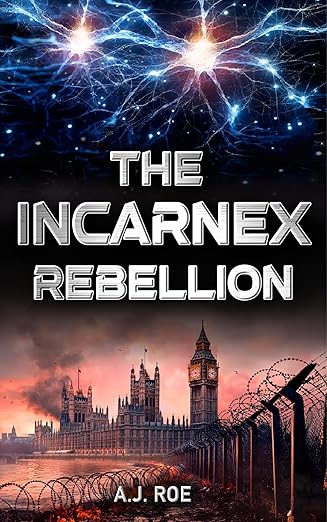
The INCARNEX Rebellion, by A.J. Roe, is a dystopian sci-fi adventure about a fractured Britain, a world reshaped by a mind-transferring technology called INCARNEX, and two people trying to survive its aftermath. We follow David, a reluctant scientist carrying the weight of his past mistakes, and Celia, the sharp, stubborn girl he’s raising in hiding. When Celia runs away to confront the man responsible for destroying their lives, everything spirals into a collision with rebels, corrupt leaders, and a system built to keep ordinary people powerless.
The writing stays close to the characters, especially in the early chapters, where we see the quiet rhythms of life at the cottage and the messy push-and-pull between David’s fears and Celia’s hunger for freedom. I liked that the writing doesn’t feel rushed. It lets moments breathe, even the simple ones like a missed step on the stairs or the silence between two people who care but can’t quite say so. When the action hits, it hits hard. There’s a grit to it that matches the world: street gangs armed with acid, labour camps, and collapsing governments. The scenes are vivid without feeling showy, which kept me invested rather than overwhelmed.
What stood out most was how the author handles the ideas behind the plot. The INCARNEX technology could’ve easily become a cold, high-concept gimmick, but instead it’s tied to identity, memory, grief, and the messy ways people try to fix what’s broken. David’s guilt and Celia’s anger feel real because they’re rooted in that same question the book keeps circling: what do we owe each other when the world falls apart? The political threads, especially the growing fractures between cities and the power struggles after Julius’s downfall, add a believable weight to the stakes without losing the human focus. Even the final scenes feel grounded.
By the end, I found myself caring about these characters more than I expected to. The story balances tension with warmth, and even in its darkest moments, there’s an undercurrent of stubborn hope. If you enjoy character-driven dystopian science fiction with a mix of action, moral questions, and emotionally messy relationships, The INCARNEX Rebellion will sit comfortably on your shelf. It’s a great pick for readers who like stories about rebellion but want them told through the eyes of people who never planned on becoming heroes.
Pages: 315 | ASIN : B0FX3F2C3W



 LITERARY TITAN