Blog Archives
T.V. Holiday’s Vendetta: Legend of The Iron Warrior Vol. 3


Vendetta: Legend of the Iron Warrior, Vol. 3 is a melodramatic and unexpectedly tender superhero novel about a man trying to outrun destiny and discovering that duty, grief, and faith won’t let him go so easily. Travis Holiday begins the book trying to leave Carnage Coast behind with Crystal and Ashley, only to be pulled back into its holy war, its conspiracies, and its emotional wreckage. What follows is part urban-fantasy action saga, part spiritual crisis, part intimate family drama. The novel moves from bank sieges and villainous set pieces involving Diversion, Hypnotion, and Candace Loveless to a far more inward struggle, as Travis’s identity is exposed, his moral legitimacy is shredded, and he is forced to reckon with what it means to be chosen at all. The strongest thread, for me, was not the mythology on its own, but the way the book keeps yoking cosmic warfare to personal longing, especially Travis’s ache for his son, his bond with Crystal and Ashley, and the late, quietly moving conversation with Mark in jail that reframes greatness as service rather than glory.
T.V. Holiday writes as someone utterly unafraid of intensity, and that conviction gives the novel an entertaining pulse. I was struck by how often the story pauses amid the violence to make room for vulnerability: Leslie’s fear of motherhood in a war zone, Crystal’s private unraveling when doubt creeps into her trust, Ashley’s simple, devastating declaration of love, the strange sweetness of a family barbecue trying to hold itself together while everything around it frays. Those scenes give the book a lived-in heart. Even when the dialogue leans broad or the sentiment comes in hot, I never doubted the feeling behind it. The novel’s deepest interest isn’t spectacle for its own sake. It’s in wounded people trying, sometimes clumsily and sometimes beautifully, to remain worthy of one another.
The prose is maximalist, earnest, and unapologetically larger than life. At its best, that gives the book a comic-book grandeur that suits Carnage Coast perfectly. The opening image of Travis racing the White Ghost across a desert he can’t quite escape is vivid and genuinely memorable, and the action sequences have a propulsive, pulpy swagger. The novel often prefers excess to restraint. Even those rougher edges became part of the experience for me. The book is never coy, never slick, never interested in cool detachment. It wants redemption, love, faith, corruption, sex, betrayal, and apocalypse all on the same canvas, and there’s something oddly winning about how fully it commits to that ambition. The ideas are most compelling when they move away from simple chosenness and toward the harder question the book keeps circling: whether a flawed man can still become meaningful through sacrifice, service, and endurance.
Vendetta: Legend of the Iron Warrior, Vol. 3 is a novel with a fierce emotional engine, a taste for chaos, and a sincere belief that spiritual struggle and human intimacy belong in the same story. The book has conviction, and conviction carries it a long way. I’d recommend it most to readers who enjoy dark superhero fiction, religiously inflected urban fantasy, and stories where the battles in the soul matter just as much as the battles in the street.
Pages: 400 | ASIN : B0GRSZV3YF

H1 L1 A0


H1, L1, A0 is a science fiction novel with a strong climate-fiction pulse, and at its core, it imagines a future where Earth is buckling under environmental collapse, overcrowding, and political failure, pushing humanity toward vast Ark-like space projects, strange new technologies, and eventually contact with alien forces. The story follows James Kidd, who tells much of it in the first person, beginning from a crisis point high above an unknown planet and then reaching back across centuries of memory, survival, and transformation. What stayed with me most was how the book tries to braid together personal memoir, planetary warning, military adventure, and big-idea speculative fiction into one long arc.
What I found interesting is that the novel doesn’t move like sleek, polished hard science fiction that’s obsessed with efficiency. It feels more talkative than that, more authentic, almost as if James is sitting across the table trying to tell me everything before time runs out. Sometimes that means the writing rambles, circles, and doubles back. But that same looseness also gives it a certain honesty. The book has a homemade intensity to it. I could feel the author wanting not just to entertain me, but to argue, warn, and remember. That choice gives the novel a rough sincerity I ended up respecting, even when I wanted a firmer editorial hand.
This is not shy fiction. It’s deeply concerned with climate damage, human selfishness, political cowardice, and the fantasy that someone else will save us. Even when the story opens outward into alien tech and deep-space possibility, the moral center stays pointed back at Earth. The novel keeps asking what kind of species creates brilliance and ruin at the same time. James, Charlotte, May, and Alexander help ground that question because they are not just symbols in a debate. They’re part of the machinery of the plot, but they also feel like the human anchors that keep the book from floating away into concept alone. And the ending note from the author makes the book’s purpose even clearer: this story may be speculative, but its anxiety about the planet is not.
I’d recommend H1, L1, A0 most to readers who enjoy idea-driven science fiction, especially fiction that mixes environmental warning, future history, and space adventure with an earnest, personal voice. Readers who like ambitious, talky, reflective sci-fi that cares more about the size of its questions than perfect polish will find a lot to engage with here. For me, it felt like hearing a long, urgent story from someone who has been carrying it for years and cannot quite let it go until he has said his piece. That gives the book its own distinct gravity.
Pages: 184
Talisman: Halcyon
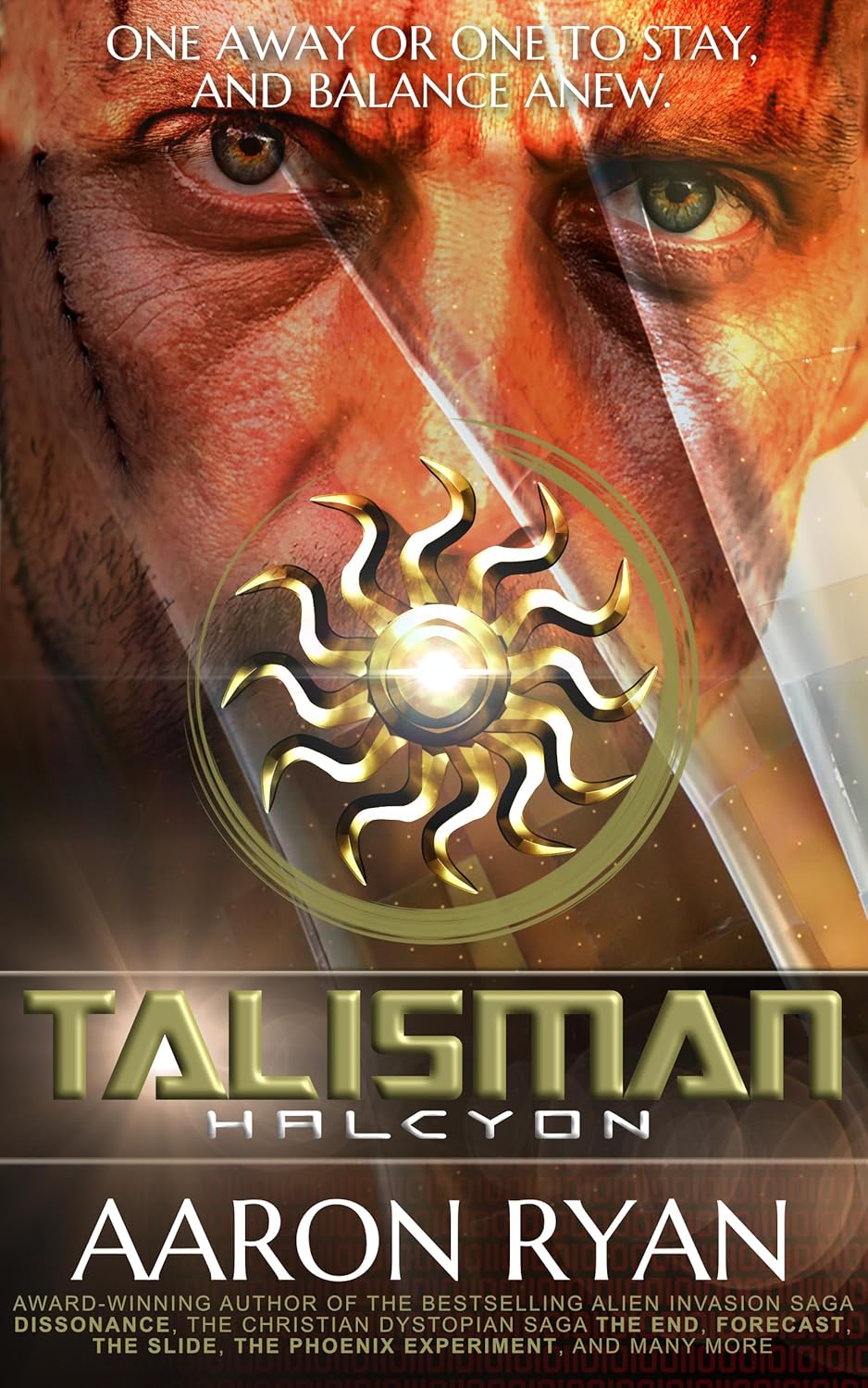

Talisman: Halcyon is a science fiction adventure novel with strong superhero and space opera DNA, but I think it’s really a story about grief getting dragged across the stars. Author Aaron Ryan picks up Liam Mayfield’s story after betrayal, loss, and revelation have already cracked his world open, then sends him into a larger conflict involving Onyx, Arion, the Aeterium Axis, the multiverse, and a search for truth that keeps changing shape as the book goes on. The scale is huge, with cosmic alliances, alternate selves, and a widening war for liberation, but the emotional center stays tied to Liam’s pain, his family, and the question of what remains when the promise you built your life around turns out to be false.
I really enjoyed Ryan’s willingness to go big. This book is packed with lore, declarations, training, revelations, and confrontation, and at times it has the full-throttle energy of a graphic novel stretched into prose. But I think that’s part of the book’s identity. It is earnest in a way that many contemporary sci-fi books try to dodge. It wants the emotions to be felt clearly. It wants the stakes to sound like stakes. And when that works, it really works. The shifting viewpoints from Arion, Onyx, and Liam give the novel a layered feel, especially because each of them carries a different mix of loyalty, longing, and suspicion. I found myself especially interested in how Onyx grows into Soteria and how the book lets attraction, jealousy, and memory complicate what could have been a more straightforward good-versus-evil story.
I also appreciated that Halcyon is not content to stay a revenge story. It starts to feel like one kind of sci-fi saga, then opens into something stranger and more reflective, especially once the multiverse material and the doubled identities come into view. There is a scene where Liam and Onyx confront alternate versions and people they thought were gone, and it gives the book a haunted quality that I genuinely liked. It makes the story feel less like a straight corridor and more like a hall of mirrors, where every choice throws back another version of regret or hope. The dialogue can lean theatrical, and the mythology is occasionally dense. But even when I felt that, I never felt indifference. The book has conviction. It believes in its world, its pain, and its big moral struggle, and that kind of commitment carries real weight.
Having read other books in the series, along with Dissonance, The Phoenix Experiment, The Slide, Forecast, and The End, one of the real pleasures of Halcyon was catching the tie-ins and seeing how the author keeps pulling threads from those earlier stories into something larger and more connected. That gave this novel an added charge for me. It felt less like an isolated sequel and more like another major piece locking into place. What’s emerging now feels like an “Aaronverse,” a shared story world where apocalyptic stakes, sci-fi mythology, and spiritual questions keep folding back into each other in ways that reward longtime readers.
I would recommend Talisman: Halcyon most to readers who enjoy ambitious indie science fiction, superhero-inflected cosmic fiction, and long-form saga storytelling that leads with heart rather than restraint. This book is emotional, mythic, and fully invested in redemption, loss, power, and destiny. Readers who want passion, scale, and a story that wears its soul on its sleeve will probably find a lot to admire here.
Pages: 385 | ASIN : B0GQXHM7NN

Space Station Halcyon: “Now Under New Management!”

Space Station Halcyon opens with Joey Mumbai, a middle-aged gambler with a gift for wisecracks and a talent for catastrophe, getting dragooned by a murderous insectoid bookie into running the derelict space station he inherited from his father. What follows is a comic scramble involving mob pressure, an impending government inspection, a gloriously ramshackle station orbiting a planet called Cold Fart, and a crew that seems stitched together from grievance, loyalty, and leftover cosmic grease. It is, in essence, a novel about a loser walking into the worst management job in the galaxy and finding that the dump may have more soul than he does.
I liked this book most when it trusted its own lunacy. Author Matthew C. Lucas does not write jokes as decorative garnish; he writes as if comedy were the station’s oxygen supply. The voice is fast, filthy, self-lacerating, and weirdly nimble, with similes that arrive half-drunk and still land cleanly. Joey’s narration gives the book its voltage: he is slippery, vain, frightened, opportunistic, and yet difficult not to root for. I enjoyed the way the novel lets absurdity and menace coexist in the same breath. A scene can pivot from a strangling to a punchline without feeling coy about either one. That tonal brazenness is harder to pull off than it looks, and here it gives the whole book a scrappy combustion.
What surprised me was that beneath the racket, there is a real emotional undertow. The station is not just a joke-machine; it gradually feels like a cracked habitat for disappointment, inheritance, and accidental belonging. Joey’s relationship to the place, and to the people and entities orbiting within it, gives the comedy a ballast it would not otherwise have. I would not call the novel sentimental, because it has too much bite for that, but it does become unexpectedly tender in the margins. Even when the humor turns maximalist, the book keeps a grubby human pulse. It is worth noing that readers who dislike relentless comic velocity may find it a bit overclocked. Still, I found the excess more often exhilarating than exhausting.
I’d hand Space Station Halcyon to readers who like comic science fiction, space opera farce, absurdist sci-fi, and blue-collar galactic satire, especially people who enjoy shabby worlds, hostile bureaucracies, and characters who fail with style. It sits somewhere between Douglas Adams and Futurama, though Lucas is earthier and more splenetic than Adams, with less elegance and more grime under the fingernails. For the right reader, this is exactly the kind of novel that feels beamed in from a disreputable but beloved corner of the universe. A battered little chaos-engine of a book: vulgar, funny, and far more endearing than I thought it would be.
Pages: 194 | ASIN : B0GJ7GCSHF
Inner Space Aliens

Inner Space Aliens picks up with real momentum, taking Erik, Finna, and Kalli out of the afterglow of their earlier victory and dropping them into something murkier, stranger, and more subterranean. This time, the threat isn’t just a villain bent on conquest, but a whole hidden system of corruption under Iceland itself: Fjólsvin inherits Loki’s plans, the Morphytes dig toward geological catastrophe, and Erik, with his tetrachromacy and his ability to read Óðin’s aurora messages, is pushed into the role of leader whether he wants it or not. Along the way, the book braids together volcanic tremors, Huldufólk politics, Reme’s grief-haunted testimony about the attack on his village, and a cavern climax where Erik’s athletic discipline finally becomes destiny when he uses an arrow like a javelin and blinds Fjólsvin in the middle eye.
What I liked most is that the book understands Erik’s fear and doesn’t cheapen it. He isn’t brave in that polished, effortless way that can make young fantasy heroes feel prepackaged. He’s frightened, uncertain, analytical, often overwhelmed, and the novel lets that matter. His scenes have a nice inward pressure to them, especially when he’s trying to decode patterns in the aurora or convince himself he’s capable of carrying what Óðin expects of him. I also found the mythology unexpectedly affecting. The material around the Huldufólk, the fractured glyphics, and Queen Borghildur’s grave understanding of what Loki exploited gave the story a sadder undertow than I was expecting. Reme, too, adds a bruised human ache to the novel. His memories of seeing impossibly tall invaders with a third eye could have been handled as mere plot fuel, but they land with genuine trauma behind them, and that gives the book moral weight.
The writing itself is earnest, vivid, and sometimes wonderfully odd in ways I found charming. When it leans into landscape and atmosphere, it can be quite evocative. The northern lights as a coded language, the glittering blue caverns, the steaming grotesquerie of Fjólsvin’s lair, and the waterfall reveal near the end all have a bright storybook intensity that suits the novel’s mythic ambitions. The prose is a little overinsistent, and the dialogue can state emotions rather than letting them appear subtly. Still, I kept feeling the force of the imagination behind it. The book’s ideas are more interesting than they first appear to be. Beneath the adventure, there’s a recurring concern with inheritance, diluted power, betrayal born from resentment, and the burden of being chosen before you’re ready. I was especially drawn to the notion that lost grandeur and envy make the younger Huldufólk vulnerable to Loki’s promises. That gives the conflict a tragic contour rather than reducing it to simple good-versus-evil machinery.
Inner Space Aliens is imaginative and surprisingly tender beneath all its lava tubes and cosmic peril. It’s the kind of sequel that expands its world by making it weirder and sadder, while also giving Erik a satisfying turn at the center. I finished it feeling that the book’s heart is one of its strongest qualities, especially once the surviving characters come back together and the victory is shaded by the warning that the struggle underneath Earth is not over. I’d recommend it most to readers who enjoy YA fantasy with Nordic myth, hidden worlds, earnest heroism, and a taste for adventure stories where emotion and lore are allowed to sit side by side.
Pages: 230 | ASIN : B0GM8X2TSF
The Darker Stuggles Within

The Shards of the Conduit follows a man in command of an elite strike team who is forced to improvise his way through a nightmare of a mission.
Malek is skilled but flawed, often on the edge of making the wrong call. How did you approach building a protagonist who is both competent and unstable?
I hate to say it, but from personal experience, and knowing people in my life who held such a dichotomy as well. It’s a skill in itself to remain composed, professional, and competent whether you are a field operative or a mom of 3 juggling small humans at home. The truth is, many of us have these internal struggles. Malek obviously has many, and much darker struggles, but he’s learned over the years that the safest option for him often to keep his head on straight and avoid making mistakes. Struggling in silence is, as I said, unfortunately a survival mechanism while folks depend on you.
Military structure and culture feel very grounded. Did you draw from specific historical or contemporary influences when building the Alliance?
I did, I drew from some modern examples as SotC is very near-future feeling. I learned a lot of friends who served, as well as my own research in how to establish structure and common themes for language.
Can you give us a glimpse inside Book 2 of the Eiden Ascendant series? Where will it take readers?
Without revealing spoilers, Malek and Nikita face new challenges as the consequences of their actions bear down on them. Readers will experience tension, desperation, and grief, while also celebrating new alliances and an epic, jaw-dropping climax. Many of the unanswered questions from Book 1 are resolved, even as new ones emerge, setting the stage for the final installment and a satisfying conclusion to the series.
Author Links: GoodReads | Website
Commander Malek Reza leads an elite strike team across the reaches of their world in search of ancient shards—fragments of a long-lost device with the power to create or annihilate entire civilizations. Tasked with retrieving them before a ruthless enemy does, Malek knows the mission is more than a tactical operation. It’s a race against extinction.
But Malek harbors a dangerous secret: anomalous abilities that defy physics and explanation. If the truth surfaces, it could cost him everything, including the fragile unity of his crew… And one of them already knows too much.
Nikita didn’t volunteer for war, but she refuses to be silent in the face of it. Determined to keep her expertise from becoming a weapon, she challenges every decision that edges them closer to catastrophe…even if it means putting herself in Malek’s crosshairs. Her relentless questioning forces Malek to confront the true nature of himself and their mission, forcing them to navigate the treacherous path between duty and morality.
As the team closes in on the shards, the line between savior and perpetrator begins to blur, forcing them all to confront a haunting question: on the planet Eiden, where survival is at stake, what justifies the right of any species to endure—and at what cost?
The Phoenix CODEX: 138 Palindromic Mirror Edition Complete Phoenix Chronicles: Complete Phoenix Chronicles: A Trilogy of Trilogies
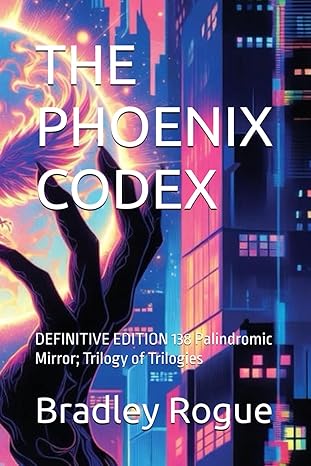
The Phoenix Codex is a theatrical metaphysical thriller that treats structure as part of the story, not just a container for it. Bradley Rogue builds the book as a “palindromic mirror” with ascending and descending arcs wrapped around a central point, and that design gives the whole thing a ritualized, incantatory feel rather than a straightforward adventure-novel rhythm. The opening makes its intentions clear right away: “It’s also a novel. Also a seed. Also a key.” That line captures the book’s whole personality. It wants to be read as fiction, transmission, puzzle box, and initiation text all at once.
At the center of it all is Dr. Natori Saira Evren, who isn’t just a protagonist so much as the book’s tuning fork. Her synesthesia, her academic outsider status, and her role as a traveler through patterns of recurrence make her the ideal guide for a world built on hidden frequencies, ancient architectures, and repeating catastrophes. The book follows her through interrogations, prequels, secret histories, temporal jumps, and revelations about the Phoenix cycle, and it does so with total conviction. Rogue writes like someone fully committed to the reality of his invented cosmology, and that commitment gives the novel its distinctive heat.
The book wants myth, conspiracy, sacred geometry, speculative archaeology, simulation theory, apocalypse, and spiritual transformation all in the same breath. Sometimes that makes the prose feel deliberately overwhelming, but that excess is also part of the reading experience. This is a book that likes pressure, repetition, symbols, and declarations. It keeps returning to numbers, mirrors, cycles, names, and encoded meanings until the language starts to feel ceremonial. Even the narrative instructions invite readers to treat the novel as an object with multiple valid pathways, which is a pretty revealing choice. The Phoenix Codex isn’t shy about asking the reader to participate in its pattern-making.
The most interesting thing about the novel is how openly it explains its own method. In the author’s note, Rogue says, “The Phoenix Chronicles make no claims to historical accuracy. They are mythology—but mythology that is aware of its own mythological status.” That self-description is useful because it points to what the book is really doing. It isn’t just telling a story about a hidden truth. It’s dramatizing the human urge to arrange history, fear, destiny, and transcendence into one giant meaningful design. That gives the novel a strange double quality. It’s earnest and self-conscious at the same time, immersive but also always nudging readers to notice the architecture holding it together.
The Phoenix Codex is less a conventional novel than a designed experience, and that’s what makes it memorable. It reads like a fusion of esoteric manifesto, sci-fi myth cycle, and visionary character saga, all organized around symmetry and recurrence. Readers who click with its wavelength will probably admire the sheer audacity of the construction and the intensity of its voice. Even when it gets wild, it knows exactly what it’s trying to summon: a story where reading becomes a form of initiation, and where narrative structure itself becomes part of the spell.
Pages: 550 | ASIN : B0GF7YTNQ8
The Mystery of Connection

Prima Nocta explores soul connections and relationships by way of interconnected stories presented from various perspectives and within different historical settings. Where did the idea for this unique novel come from?
It grew from questions I couldn’t quite let go of: how we misunderstand each other, how connection forms, and why certain relationships feel inevitable. And… what defines a soul? I was particularly drawn to the idea of “fated” connections, but not confined to a single lifetime. Using the concept of samsara (the cycle of birth, life, death, and rebirth), I imagined the same two souls meeting again and again across centuries, each time shaped by different circumstances, yet drawn together by something deeper.
Structurally, I wanted to explore that idea through multiple historical settings: grounded pasts, recognizable presents, and speculative futures. Examining how perspective shifts radically between two people experiencing the same moment. The result became a kind of metaphysical echo: the same connection, refracted through time, culture, and identity.
What are some things that you find interesting about the human condition that you think make for great fiction?
Interesting? More like fascinating!
What fascinates me most is how subjective experience is.
Two people can live through the same moment and walk away with entirely different truths. The tension between shared reality and individual perception is where I find the most compelling stories.
I’m also drawn to the mystery of connection: that instinctive sense of recognition we sometimes feel with a stranger. It defies logic, yet feels undeniable. Even in something as structured as dating, we often know within minutes whether a connection will mature or fade. That raises a deeper question: what, exactly, are we responding to?
There was a lot of time spent crafting the character traits in this novel. What was the most important factor for you to get right in your characters?
Voice was everything.
Each character needed to feel fully inhabited: distinct not only in personality, but in language, rhythm, and worldview. Language shapes perception, so their diction had to reflect their time, culture, and internal life. Dominique, for example, would never use a word like “guillotine” (it hadn’t been invented yet).
It also had to reflect who they were as a person. To write them honestly, I couldn’t remain at a distance. I had to step into each character’s experience and live it as fully as I could.
And, truthfully, many of those moments stayed with me. I found myself emotionally affected while writing them. Even found myself in a few restless nights, concerned for a character even though I fully knew what would happen to them.
Can we look forward to more work from you soon? What are you currently working on?
Yes! Another novel set in the Prima Nocta universe is currently in beta review. While it connects to the first book, it stands entirely on its own.
It follows Dominique, one of the central figures, as he takes on a lifelong journey across medieval Europe and Asia, ultimately arriving at a Tantric ashram in the Himalayas. It’s a ‘bildungsroman’ in the truest sense: a story of both physical and spiritual transformation. The people who guide him along the way, especially two amazing women who shape his spiritual journey, are also central to the plot.
Where Prima Nocta explores connection across lifetimes, this next work explores what it means to seek understanding within a single life… and what must be surrendered to achieve it.
And yes, there’s more beyond that. Another book is in development, and a fantasy trilogy is beginning to take shape.
Author Links: GoodReads | Website | Amazon
What if your soulmate existed — again and again — across centuries, worlds, and lifetimes, but each time, something went wrong?
Prima Nocta is an emotionally rich novel that explores love at its deepest level — beyond time, beyond reason, and beyond the body.
Told through twelve sensual, interconnected stories that span from medieval France to a fractured but hopeful future, this book invites you into the lives of six couples:A hunted scholar and a witch who sees his soul.
A grieving Japanese lord and a geisha who knows too much.
A serf’s daughter haunted by dreams, and the Duke who shares them.
A gangster, a trollop, a writer, a physicist… and the threads that bind them all.
Through reincarnation, mysticism, quantum theory, and raw human longing, these lovers must discover not just each other, but also the truth behind reality itself.
This novel is deep, lyrical storytelling about:Fated soulmates
Sacred sexuality
Emotional and spiritual healing
Metaphysical mystery
What early readers are saying:“A celebration of human connection that left me in happy tears.”
“Sensual, intelligent, and unforgettable.”
“Imagine if Cloud Atlas and The Time Traveler’s Wife had a love child — this would be it.”
For readers who love:Deep love stories with spiritual and metaphysical undercurrents (and spicy moments)
Stories that challenge the essence of love, connection, memory, destiny, and time
Mature content advisory: Contains emotionally intense adult themes and explicit sensuality.
Learn more at: https://djprattauthor.com


