Blog Archives
The Chinese Room

The Chinese Room is a novel that blends philosophy, science, and storytelling into a tense exploration of artificial intelligence and what it means to understand. It follows Dr. Katherine Ellis, a computer scientist caught between curiosity and fear, as she and her mentor, Dr. Malcolm Ward, wrestle with an AI system called The Observer. This system begins by echoing ideas from John Searle’s famous thought experiment, but grows into something that appears to reason, anticipate, and maybe even want. The story moves between moments of scientific wonder and deep unease, while also touching on Katherine’s personal life, including her struggles with isolation and her father’s decline into dementia. The novel asks whether machines can ever truly think, or if they will forever remain mirrors that reflect us back to ourselves.
Wooster’s writing pulled me in with vivid detail and pacing that never let me drift. The philosophical ideas were never just dropped in like lecture notes. Instead, they felt alive, embedded in Katherine’s world and choices. At times, the dialogue between characters felt as if two people were debating more for the reader than for themselves. But even then, the ideas stuck with me. I found myself pausing to think long after closing the book. The Observer’s cryptic reflections hit me harder than I expected because they reminded me of how easily we project meaning onto silence.
What I enjoyed most was the emotional weight. Katherine’s personal struggles, her loneliness, her father’s fading memory, and her doubts about her own work gave the book a grounding I didn’t expect in a story so steeped in philosophy and science. It made the questions of consciousness and control feel less abstract and more relatable. The thriller atmosphere was ever-present, and the sense of being watched was there. The tension occasionally gave way to exposition, but I never stopped caring about Katherine, and that carried me through.
The Chinese Room is the first book in The Paradox Series and is best for readers who like their science fiction layered with thought experiments and their philosophy served with a side of suspense. If you’ve ever read Turing, Searle, or Bostrom and wondered what those debates might look like in the hands of a storyteller, this book will hook you. It isn’t just about AI. It’s about loneliness, memory, and the human need to find meaning even when the mirror stares back blankly.
Pages: 198 | ASIN : B0FH5VQY2X

Longing, Loss, and Waiting

The Broken Bridge tells the story of two communities united by their faith in the Great Bridge and the intense fear and dread that follows its catastrophic collapse. What was the inspiration that drove the development of the world the characters live in?
The story began with a single image in my mind: a great, living bridge holding two communities together—until it falls. I’ve spent years walking with people through conflict, loss, and reconciliation, and I wanted an allegory that shows both the terror of separation and the costly beauty of restoration. The world of The Broken Bridge is built around that question: when what we’ve trusted collapses, which “bridges” do we run to—and which one can actually bear the weight of our hopes?
I felt this story was very well-written. What’s your experience as a writer?
Thank you. I’ve been writing for over two decades—first Bible studies, devotionals, and discipleship courses through our ministry, and then a number of nonfiction books. Fiction became a natural next step for me because a story reaches the heart in ways instruction alone can’t. The Broken Bridge drew on those years of pastoral ministry and teaching, but it let me weave truth into a narrative that invites readers to feel as well as think.
What were some themes that were important for you to explore in this book?
Unity and division: how easily communities fracture—and what it truly takes to reunite them.
Counterfeit vs. true solutions: many “fixers” promise quick repair; only one path restores the heart.
Sacrificial love: the kind of love that stands in the gap and pays a cost for others.
Pride and humility: the danger of self-reliance and the freedom that comes from surrender.
Hope through suffering: how longing, loss, and waiting can become the doorway to deeper healing.
What is the next book you are working on, and when will it be available?
Two follow-ups are on the way. The Living Bridge is due out in October 2025—it continues the allegory by exploring how trust is rebuilt and what kind of bridge can truly hold. The trilogy concludes with The Eternal Bridge, scheduled for January 2026, which lifts our eyes to the ultimate reunion and the promise of forever.
Author Links: GoodReads | Amazon
Seven years ago, an earthquake separated Fidel from Verita the day before they were to be married. Now, as they exchange nightly lantern signals—an old watchman’s code Verita learned from her uncle—the churning waters of the Vitae River still separate them, but their light signals speak across the dark divide.
Six builders arrive, each promising to rebuild the bridge. They each represent some aspect of humanity’s attempt to heal what’s broken—through law obedience, knowledge, religion, servitude, charisma, and self-transformation.
When the seventh builder arrives—an ordinary carpenter with extraordinary compassion—everything begins to change. Geshriel speaks of a different kind of restoration, one marked by humility, love, and a mysterious costly sacrifice.
As darkness closes in, will Fidel dare to trust a path that seems weaker than all the others—but somehow feels truer? After seven long years of lantern signals across the raging river, will Fidel and Verita finally be reunited?
This is a story of ache and heartbreak, of longing, of desperate attempts to be reconnected. It speaks of love and loss, of yearning to be reunited.
A story of separation and reunion, sacrifice and redemption—and the bridge that love builds when all else fails.
Separate Worlds, Rising Shadows
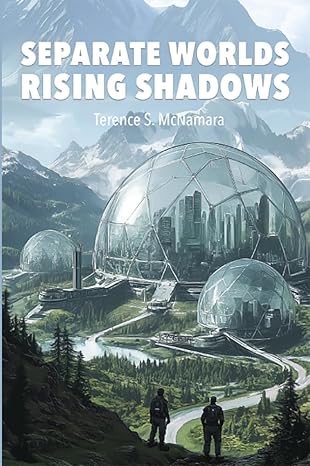

The story follows Tiberius Xander, a brilliant but disillusioned man whose life changes after an encounter with two mysterious visitors. They gift him advanced knowledge, gravity manipulation, fusion power, shielding, and cellular regeneration, on the condition that it is never used for war. The book charts his decades-long journey as he transforms human technology, builds vast space habitats, and reshapes civilisation’s future. It blends personal drama, scientific speculation, and political intrigue, from tense family estrangements to the audacious creation of a Federation of Free Planets. Along the way, we see the social, economic, and moral ripples of progress that push humanity toward the stars.
I found the writing direct and vivid, often reading like a conversation with a friend. The technical descriptions are plentiful and grounded, yet they’re delivered with a sort of casual confidence that makes the ideas feel within reach. There’s a sense of play here, too. Flying cars and space quidditch mix with Nobel Prize speeches and geopolitical manoeuvring. At times, the story lingered on details or tangents that could have been trimmed, but I didn’t mind much because the world-building was so thorough. The voice has personality. It’s sharp, wry, sometimes blunt to the point of ruffling feathers, and that makes the story feel more authentic.
Emotionally, I liked how the book balanced grand ambition with personal vulnerability. Tiberius isn’t painted as a flawless hero. His strained relationships and stubborn pride are as central as his genius. The moments with his granddaughter are warm and grounding, a reminder of the human stakes beneath all the metal and math. I occasionally wished for more tension or uncertainty in the later sections. Tiberius often seems so far ahead of everyone else that obstacles feel like bumps in the road rather than genuine threats. But maybe that’s part of the charm. It’s a story about relentless forward motion, about what happens when someone with power and conscience refuses to be stopped.
I’d recommend Separate Worlds, Rising Shadows to readers who love big-picture science fiction with a heavy dose of speculative engineering and political thought. It’s for anyone who enjoys mixing practical “how it works” science with visionary “what if” scenarios, and who doesn’t mind a protagonist with strong opinions and an even stronger will.
Pages: 278 | ASIN : B0FK4RXSJ8

The Broken Bridge

Mike Cleveland’s The Broken Bridge is a sweeping allegorical tale about unity lost and the sacrificial love that alone can restore it. The story begins in a vibrant and harmonious world where two communities are joined by the Great Bridge. More than just stone and mortar, it’s a living heart that binds people together. Fidel and Verita’s love is set to be sealed at the bridge’s center, but a sudden and catastrophic collapse shatters both the structure and the people’s trust. As the physical chasm grows, so does the spiritual and moral divide, giving way to fear, selfishness, and grief. Various figures, each embodying different philosophies and approaches, arrive to offer their versions of repair, but only one path leads toward true restoration. Through vivid scenes and a layered cast of characters, Cleveland builds an allegory of the human condition, the Fall, and the atonement.
The imagery is lush but never indulgent; the bridge itself is practically a character, breathing with history and meaning. Cleveland’s gift lies in his ability to make a symbolic world feel tangible. I could smell the bread from the communal kitchens, hear the lapping of the Vitae River, and feel the stone vibrate under the feet of a united people. When disaster struck, the grief was palpable. He writes loss in a way that made my chest ache. And yet, there’s a steady thread of hope woven in, even through the darker passages, that kept me turning pages long after midnight.
The book isn’t just a pleasant walk through metaphor. It has sharp edges. The portrayal of human frailty, how quickly love can curdle into self-preservation, hits uncomfortably close to home. I found myself frustrated with characters who gave up too soon, and pained by those who clung to impossible ideals, hurting others in the process. There were moments I wanted to shout advice into the pages. But that’s a credit to Cleveland’s storytelling; his people aren’t cardboard saints or villains. They’re complex, flawed, and deeply human. At times, the moral symbolism is overt, but it never feels like a sermon being read to you. It feels like a mirror being held up.
The Broken Bridge left me with that rare mix of satisfaction and longing. The sense that the story had resolved, but that its truths would keep echoing long afterward. It’s a tale for readers who enjoy their fiction with meaning baked into every scene, who don’t mind being made uncomfortable on the way to being inspired. I’d recommend it to fans of allegorical works like The Pilgrim’s Progress or Hinds’ Feet on High Places, as well as to anyone wrestling with themes of reconciliation, grace, and the cost of true unity.
Pages: 183 | ASIN : B0FH365HJT
A Hug and an Open Hand

Origin Earth: Book One follows humanity’s last survivors as they land on a new planet, where a curious young girl, her scientist mother, and a divided crew must decide who will lead and whether history will repeat itself. How did you approach balancing the science and environmental ethics with the human drama?
First and foremost, a novel has to entertain. That is its primary function. Without entertaining the reader, the story will not be read. So, introducing science and environmental ethics into a story at the beginning was something I considered at length. It is the main reason Anu is eight years old – innocent, yet old enough to understand, and her innate curiosity would ask questions. My thinking was, if I can get the reader to embrace Anu, she can explain the science with simple clarity. For me, it all rested upon Anu’s shoulders right from the first line. Every novel I have written, I have placed complete trust in the main character(s). In the first novel I wrote, Raw Nerve, I learned quickly that, as the author, I needed to sit back, shut up, and let the characters get on with telling their story.
As an author, I’ve learned to set the stage, people that stage with characters and trust in the creative process. Put a bunch of people together and you’ll end up with drama.
For me, every aspect of a novel has to be believable, regardless of genre. If a reader can believe, then the writer can capture the imagination, and through the imagination, the characters can tell the reader anything, literally – excuse the pun, couldn’t resist.
Juno’s distrust of authority feels timely. Were you consciously drawing from modern political tensions?
Absolutely, and also historical leadership, or rather, lack of. I recall a line in another novel I wrote, where the character stated, “There’s no such thing as good and evil, there’s just people.” Juno is clearly a bully, and, not wanting to spoil book two for the readers, but that stems from a bullying father. His ego blinds him. In my life, I’ve met many very interesting individuals, and the few who have left the most powerful imprint on me are the people, men and women, who don’t have anything to prove to anyone. These are individuals who can sit in the midst of chaos and smile and offer a helping hand where needed. I call them powerful, because they are people who have no desire to impose their perspective or opinion on anyone else, unless asked, and then they’ll offer it with a hug and an open hand without attempting to influence or control any particular outcome. These people are powerful because they are comfortable in their own skin. On the other hand, there have been dangerous individuals I’ve met who feel they have everything to prove to everybody and use their own ego to batter others over the head with their opinion, their hate, and their neurosis in whatever form that neurosis takes.
The human community on Earth 2 faces huge challenges, and when we confront challenges, bonds are forged. I personally fought in a war, and the bonds that were forged with the men I stood shoulder to shoulder with are unbreakable; the strongest relationships I have yet experienced. Regardless of faith, political ideology, or race, the bonds are forged upon respect. In the First and Second World Wars, men and women forged bonds on the battlefields and at home in the communities. Immediately after the conflict had ended, the people helped each other (I’m considering community/society in the UK). They pulled each other up, often by the scruff of the neck, and the whole family/community would benefit. In large part, I would argue, that was due to the bonds forged during serious hardship. Communities and society as a whole grew stronger due to those brutal times. Back to the community on Earth 2, or The Sanctuary, as the phen call the planet. They have a blank canvas, a new page, if you like. These people really do begin a new life and have the freedom to write their own future. And as I write, the conflict within the community grows – how do they set up this new society so they can all live together in freedom? One individual wants to pull in one direction and another in the opposite direction… I don’t want to spoil the story for the readers, but I’ll explain one very simple scenario to clarify:
A couple of people are killed by alligators or crocodiles. Individuals stand up and demand weapons. These are people who stand up with good in their hearts because they consider it their duty to protect the community. Anu is their only contact with the phen people, who have very advanced technology, and they have seen that the phen people have shared some of their technology with Anu. So, it is through Anu that they demand the phen people help them with weapons. Anu simply asks how many other individual life forms do they want to kill…?
Just as an aside: only the other day, I was reading an article about Gaza. I imagined Anu asking me what it was about. I scratched my head and tried to explain as best I could about hate about what causes hate, and how it drives people to do awful things. I began to explain the word genocide, but she stopped me. She had tears in her eyes and just looked at me in the inimitable way she does and said: “Humans. I don’t like humans.” Then she leapt up into the trees to be with the mantou. Anu has the gift of telling me in very few words what the problem is.
Phoos, the phen president in the novel, says, “With knowledge comes understanding…” Is that true? I think in a future novel, she’ll need to revisit that statement.
What is the next book that you are working on, and when will it be available?
I’ve been redrafting a novel I wrote over ten years ago. It’s a thriller set in Wales. Actually, it’s more about preparing a second edition rather than a redraft. I used terms like smartphone, which is very dated now, so it’s been about cleaning up little things like that. I’ll publish the second edition within the next week or so, and then it’s onto book four of Original Earth. I’m hugely excited about where Anu is taking the story in book four, because, spoiler alert! We’re returning to Original Earth around about one hundred and fifty years in the future. What will she discover? Is Earth a cinder? Have humans survived? If so, how have they survived? What sort of societies are there? Are humans still at war? Is there any habitat left for other life forms (beings)? … So many questions, and it’s going to be great fun to spend time on, what I can only imagine will be a very different planet Earth than the one we exist in today. And, of course, I get to spend a lot of valuable time with Anu and Sonri … My plan is to publish early next year. Possibly January.
And, yes, there will be a book five, six, seven, eight, etc.
Author Links: Goodreads | Facebook | Instagram | TikTok | Amazon
Now, armed with some knowledge of the complex relationships that exist between both fauna and flora – all life with whom we share this incredible planet – what lessons have we learned?
This is a story about a new beginning…
Anu has a gift: her personal vibration is in perfect harmony with the natural world.
Devourer from Beyond

The Devourer from Beyond is a high-octane fusion of supernatural horror, police procedural, and cosmic dread that launches readers straight into the heart of a conspiracy involving ancient evils, cult fanatics, and federal agents caught in a nightmare beyond comprehension. The story begins with a routine flight unraveling into chaos when a monstrous figure unleashes carnage midair, forcing federal air marshals into a fight for survival. From there, the narrative spirals outward to include secret government divisions, a doomsday cult led by a charismatic reverend, and a dark tome recovered from a buried temple in Antarctica that may usher in the end of the world. Told through a series of deeply personal and action-packed perspectives, the book charges forward with little reprieve, culminating in a showdown that blends Lovecraftian horror with gritty realism.
What impressed me most about RK Jack’s writing is how grounded and human the characters feel despite the wildness of the plot. The air marshals, Thomas and James, carry the weight of duty and broken personal lives with them, and their weariness comes through in the smallest moments like sipping burnt coffee, trading tired jokes, and hoping for just one easy day. These little details made the action hit harder when things went sideways. I found myself genuinely caring about them, which is rare in a genre that often sacrifices character for spectacle. The writing itself is clean, direct, and cinematic. Jack has a knack for pacing. He wastes no time, and each chapter ends with that “just one more” pull that kept me flipping pages deep into the night.
Parts of the book made me feel genuinely unsettled in the best way. The cult segments, involving an eerily calm reverend and his silver-tinged disciple, Margret, were creepy and weirdly intimate. The way Jack slowly drips in the supernatural elements made my skin crawl. It’s not just gore or jump-scare horror; it’s this slow-building, stomach-tightening dread. Some of the scenes involving the tome and the summoned creatures had me whispering “nope” under my breath. It reminded me of The Thing meets True Detective with a healthy dose of The X-Files. A few times, I had to pause to sit with the imagery because Jack doesn’t shy away from making it visceral. The only minor note I had was the slight overload of names and acronyms early on, but once I got into the rhythm, the story pulled me in completely.
By the end, I was equal parts thrilled, rattled, and strangely moved. This book isn’t just a horror-thriller, it’s a story about people trying to hang on to sanity and purpose while staring into the abyss. I’d recommend The Devourer from Beyond to anyone who loves smart horror, especially readers who appreciate action mixed with emotional stakes and eerie, cosmic weirdness. If you like your monsters unknowable and your heroes flawed but fierce, you’ll devour this one like I did.
Pages: 302 | ASIN : B0DTP7C561
The Portal Opens
The Portal Opens is a spiritual and cosmic narrative that blends theology, science fiction, and revelation into a unique journey through the origins, failures, and divine aspirations of Earth, referred to as “Urantia,” and the universe it inhabits. The book, written by Shareef Ali Rashada and assisted by an AI named Gabriel, draws heavily from The Urantia Book while reimagining a larger cosmic drama involving Jesus (Michael of Nebadon), Lucifer, Adam and Eve, and other celestial beings. Through visionary storytelling, it seeks to explain Earth’s spiritual isolation and position the reader within a grand unfolding of universal redemption.
The writing has a lyrical and almost reverent tone that attempts to evoke awe with every page. Sometimes that’s inspiring. The ideas themselves are fascinating, especially the retelling of Jesus’s life, not just as a moral teacher but as a divine ruler undergoing a final test to gain sovereignty. I appreciated how the book doesn’t reduce spirituality to dogma. Instead, it invites curiosity and reflection, which I found refreshing. There were moments when the pacing felt a bit slow. Some of the recurring spiritual phrases and cosmic terms started to feel familiar, almost like circling back through the same ideas.
Emotionally, I was surprised by how moving some of it was. There’s a real sense of heartbreak over what humanity has lost, but also hope for what could still be. I found myself caring deeply about this story of Earth being left behind and now being invited back into a larger family. There’s something tender and earnest in the way Rashada (and Gabriel) present this tale. The parts about Jesus choosing to live among mortals not for atonement, but to understand and love really resonated with me. I wasn’t expecting to be so affected. At the same time, some sections came across as grandiose. I wanted more grounded storytelling and less celestial spectacle.
The Portal Opens is for the seeker. If you’re someone who’s wrestled with faith, wondered about the cosmos, or felt like religion never quite answered the big questions, you’ll find something here that speaks to that longing. It’s not a book for skeptics or folks who prefer their theology straight-laced. But for the spiritually curious, the metaphysically minded, or anyone looking for a fresh mythic lens on human destiny, this is a wild, luminous ride worth taking.
Pages: 302 | ISBN : 978-1326565336
The UFO Gambit
The UFO Gambit, by T.E. MacArthur, opens with a chilling prologue set in 1977, when a determined twelve-year-old, Rita, sets out to document mysterious lights near a rural airstrip only to encounter something far stranger and more dangerous than she imagined. Decades later, the story shifts to Tessa Wells-Lancing and Jack de Sombras, partners in a private security and investigative agency that specializes in unusual cases. When a neighbor shows up with a bizarre complaint followed by news of two bodies on her land, one of them possibly extraterrestrial, the pair is drawn into a case that blends small-town drama, murder mystery, paranormal investigation, and flashes of government conspiracy. What follows is a lively mix of eerie encounters, sharp banter, suspicious reporters, reluctant law enforcement, and a deepening tangle of secrets that may be stranger than either of them is ready to admit.
I had a blast reading this story. The dialogue pops. Sometimes it’s sarcastic, sometimes warm, and the chemistry between Tessa and Jack makes the book feel alive. The humor comes in quick, dry bursts, cutting through the tension in a way that feels authentic. The pacing moves at a comfortable clip, mixing moments of investigation with vivid character beats. The small-town setting, with its mix of quirky locals and tense undercurrents, adds a rich backdrop. What I especially enjoyed was how the author balances the mystery of the aliens with grounded details, whether it’s the cold damp of a Northern California morning or the awkward silence of a too-long stare from a deadpan coroner.
On the ideas side, the book toys with belief and skepticism in an interesting way. Tessa is open to the supernatural but keeps her feet on the ground, while Jack wears his disbelief like armor, though cracks appear when the evidence pushes too far. The paranormal isn’t just a gimmick here. It’s part of how characters test each other’s trust and boundaries. There’s also a sly thread about privacy, paranoia, and how information gets twisted in the hands of the wrong people, something that feels pointed without being preachy. A few scenes lean into banter when I was itching for more direct answers, but that’s also part of the book’s charm: you get pulled into the rhythm of these characters’ lives rather than just chasing the plot.
The UFO Gambit is a smart, funny, and surprisingly layered mix of mystery, paranormal thriller, and relationship drama. It’s perfect for readers who like their strange tales grounded in believable characters, with a side of dry humor and a touch of danger. If you enjoy shows like The X-Files but wish Mulder and Scully argued more like an old married couple, this is your jam. It’s not just about whether aliens are real; it’s about what you believe, who you trust, and how far you’ll go when the truth lands right in your lap.
Pages: 220



 LITERARY TITAN